To avoid these ads, REGISTER NOW!

When Are Pigtails Required?

DC73

Well-known member
Joined
Dec 27, 2014
Messages
1,627
Location
Lubbock TX
I'm getting closer to finishing up my rough-in wiring. When are pigtails required in the installation of outlets, switches and fixtures?

I know I'll need pigtails for multiple switch locations, etc but got to wondering when they are required.

For example, are they required when connecting one outlet to one incoming and one outgoing feed?

Are they required when connecting a light fixture at a ceiling box with one incoming and one outgoing feed?

I do have GFCI outlets at the head of each circuit and I know I can't use pigtails there if I want to protect the rest of the circuit.

I used #12 everywhere if it matters.

Thanks,

DC
 
To avoid these ads, REGISTER NOW!

Gerald O

Well-known member
Joined
Mar 5, 2013
Messages
1,884
Location
NC
As far as I recall, they are only needed in multi-wire branch circuits (MWBC).
I always use them unless the device is the last outlet at the end of the circuit (or in the case of the GFCI protected circuit as you mentioned.)
 

Mustang51js

Well-known member
Joined
Jan 24, 2014
Messages
1,734
Location
Haskell nj
They aren't required anywhere but are used a lot to make connections better and if you have more wires than screws
 

toplessHO

Well-known member
Joined
Oct 20, 2014
Messages
14,009
Location
central florida
They aren't required anywhere but are used a lot to make connections better and if you have more wires than screws

yes they are!
multi wire branch circuits with shared neutrals require a pigtail at the device
instead of using device as a feed thru.
I make pigtails on everything that has more than one wire at terrmination
 

toplessHO

Well-known member
Joined
Oct 20, 2014
Messages
14,009
Location
central florida
In addition to the MWBC neutral's need to be pigtailed, all Equipment Grounding Conductors must be pigtailed.

not so if you strip out a portion(or use continuous bare) and loop around the ground screw on device and do same at box ground(if metallic box is used)

remember the greenies?
 
OP
D

DC73

Well-known member
Joined
Dec 27, 2014
Messages
1,627
Location
Lubbock TX
Are you truing to do it the good way or the fast and cheep way

I'm trying to do it the smart way while being code compliant. Not opposed to a bit of overkill but I don't necessarily want to create a lot of unnecessary work for myself either.

DC
 

p1ll1ng

Member
Joined
Apr 10, 2015
Messages
6
In residential i dont do it but we also never run mwbc because of afci's when i am doing comercial or industrial wiring i always do
 

94EG8

Well-known member
Joined
Apr 5, 2015
Messages
248
You can't put more than one wire under a single screw, any time you end up in a situation where there are more wires than screws you need a pigtail. As stated you also need a pigtail for ground wires on everything.
 

rsieracki

Well-known member
Joined
Mar 3, 2010
Messages
1,679
Location
Chicagoland Area
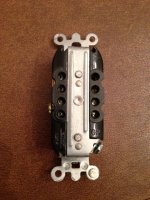
I know people say pigtails are better for daisy chaining receptacles but if one is using SPEC GRADE BACKCLAMP/WIRE not back-stab outlets that have provisions for 2 wires under each screw from the manufacturer i don't see the harm in wiring them that way.

attached is a photo...

anyone with a MENARDS close by they have them on sale tru tomorrow.. pass ans seymour for $14.99 for a 10 pack... virtually the same price of the bottom of the barrel for a top notch outlet
 

Attachments

  • backwire.jpg
    backwire.jpg
    74.1 KB · Views: 91
To avoid these ads, REGISTER NOW!
OP
D

DC73

Well-known member
Joined
Dec 27, 2014
Messages
1,627
Location
Lubbock TX
I have one location that has a 3 gang switch box with 3 standard switches (no 3-ways), power in and power out. That's a lot of ground wires. What's the best way to connect the grounds in this box?

Are grounds required to be wire nutted or crimped or can they simply be twisted together tightly? In my current 12 year old house, they are just twisted together but I'm thinking someone said codes had changed.

I purchased all pro grade outlets and switches that have the back-wire clamps.

Thanks for all the help and the good discussion.

DC
 

alfredeneuman

Well-known member
Joined
Mar 3, 2011
Messages
4,580
Location
Fullerton, CA
not so if you strip out a portion(or use continuous bare) and loop around the ground screw on device and do same at box ground(if metallic box is used)

remember the greenies?

That's a condition where just a single grounding conductor is coming into the box. The same is true for the hot and the neutral.
It doesn't apply in this case where you're talking about more than 1 ground.

....and Mustang, barrel crimps where you leave the tails intact past the crimp is just another method of pigtailing.
 

CGT80

Well-known member
Joined
Aug 29, 2014
Messages
862
Location
IE, SoCal, USA
I don't know the term for it, but I was taught to leave the wire long and strip it where you would normally cut it, but without cutting the wire. Make a loop and put the loop under a screw, then you have a pigtail without cutting the wire and using wire nuts, so you can connect the next switch or receptacle.

You could take a ground wire that comes into a metal box and loop it around the ground screw for the box, then loop around the first switch, the the second, and then the third, without cutting it. Even if a screw comes loose on a switch, the devices down the line are still connected. I do the same with the hot or neutral wires as well. You just have to strip the middle of the wire enough to go under a screw head. The wire can be looped on the end and may stop at a receptacle or switch, or it could be connected to another wire with a wire nut, to feed another box.

I have used the back wire receptacles that clamp the wire with a screw, and I like them, but the screw can still come loose and cause a device down the line to no longer have a connection. Push in connections are a joke and I will not use them. I also don't recall seeing any that accept 12 ga wire. The ones I have seen are made for 14 gauge. Most of the work I did was on 20 amp circuits, or for receptacles, so my boss and I decided to always use 12 gauge rather than stocking two different types of cable. Most of our work was also commercial and therefore required MC cable or conduit.

When you make pig tails, twist the wires with lineman's pliers and then wire nut them, it prevents bad connections. Lazy people will just hold the wires together and put the wire nut on. When they do that it makes it easier to take that connection apart later, but it is a common failure point in a circuit. A loose wire nut ( or screw connection on a receptacle or switch, for that matter) creates more resistance and sparking and heat. Burned or melted wire nuts can result from this.

Once you do connections with pigtails or looped connections, it isn't that hard or time consuming, but it reduces the chances of failure later on. Inspectors can have different preferences, even in the same city, so local code and the person doing the inspections can dictate which way you terminate wires.
 
Last edited:

toplessHO

Well-known member
Joined
Oct 20, 2014
Messages
14,009
Location
central florida
That's a condition where just a single grounding conductor is coming into the box. The same is true for the hot and the neutral.
It doesn't apply in this case where you're talking about more than 1 ground.

....and Mustang, barrel crimps where you leave the tails intact past the crimp is just another method of pigtailing.

not true
can do this with multiple devices in same box,saving all those pigtails
 

alfredeneuman

Well-known member
Joined
Mar 3, 2011
Messages
4,580
Location
Fullerton, CA
not true
can do this with multiple devices in same box,saving all those pigtails

Yes, Very true in this case!

The original question in the first post from DC73

For example, are they required when connecting one outlet to one incoming and one outgoing feed?

Are they required when connecting a light fixture at a ceiling box with one incoming and one outgoing feed?
 
OP
D

DC73

Well-known member
Joined
Dec 27, 2014
Messages
1,627
Location
Lubbock TX
. . . . Once you do connections with pigtails or looped connections, it isn't that hard or time consuming, but it reduces the chances of failure later on. . . .

Thank you for the help. I've decided that I will go ahead and use pigtails on all outlets where the circuit is continuing on (other than the GFCI outlets of course). For those locations with multiple switches, I picked up some crimp sleeves for the grounds although I do like your method of looping wire from switch to switch.

DC
 

Captain America

Well-known member
Joined
Mar 5, 2015
Messages
57
Location
TEXAS
I used the one wire loop method to tie together the hot and ground in a 4 switch box. It keeps the box more organized and takes less room.
 

Attachments

  • 20150328_094007.jpg
    20150328_094007.jpg
    130.2 KB · Views: 108

xyster101

Well-known member
Joined
Jul 3, 2013
Messages
640
Location
Upstate NY
Those look like the $0.89 switches. In the future splurge and get the $1.50 switches and outlets. They last longer and have nicer screws.
I don't like to daisy chain things. More expensive switches allow two wires on the same screw because they have a screw clamp.
 

Captain America

Well-known member
Joined
Mar 5, 2015
Messages
57
Location
TEXAS
True on removing all switches to work on one, but I can not remember the last time I had to work/remove one switch. It will only take an extra five minutes to remove all the switches. Not a big deal for me.
 

teamextreme

Well-known member
Joined
Aug 10, 2013
Messages
867
Location
Lakewood, CO
I guess we're somehow not thinking the same thing, because I don't see how all switches need to be removed to work on one. With one solid wire, starting at switch 1, wrapping around the screw, continuing on to switch 2, etc., you can unloop any one switch and work on just that one. :dunno:

Edit: Nevermind, I just figured out what you guys are talking about, removing the switches from the wall, not removing the wiring from the switches. Yes, you're right, it pretty much requires removing all of them to work on.
 
Last edited:
To avoid these ads, REGISTER NOW!
Top Bottom