To avoid these ads, REGISTER NOW!

When did bolt threads change?

Radio Ron w4ron

Well-known member
Joined
Jan 23, 2013
Messages
867
Location
Radio Heaven (near Charlotte NC)
I remember working with my dad many years ago using bolts
that were designated NF & NC for National Fine and National Coarse.
When were thread counts adapted for bolts designations?
Last year I was working on a 1920 era Edison phonograph, it had
bolts inside that were not the current standard, I checked every
size at our local hardware store and there were none that matched
the thread count.
Is there any cross reference for the old NF and NC bolts?


.
 
To avoid these ads, REGISTER NOW!

Provincial

Well-known member
Joined
Sep 21, 2011
Messages
6,855
Location
Near Salem, OR
Even after standardized threads were established, many manufacturers used special threads on their equipment. Guns often have very fine threads, as do tire valve stems. I can see a phonograph manufacturer using special threads to keep the repair parts business in-house.
 

Outlawmws

Well-known member
Joined
Aug 9, 2011
Messages
39,081
Location
The Badlands
Ron, I'd check Machinery's handbook. I still (I believe) references some of the Archaic threads as well as the "extra fine" std (but rarely seen) threads.

Also one fairly common thread "back in the day", is a 12-24. hard to find these anymore. Can you map to a thread pitch? (use another bolt and lay the threads to each other and when it meshes, regardless of diametrical size, you know the tread pitch) Once you know the TPI, use calipers to measure the major thread diameter.
 

Kevin54

MEMBER EMERITUS
Joined
Jan 12, 2005
Messages
29,341
Location
Urbana, Ohio
Even after standardized threads were established, many manufacturers used special threads on their equipment. Guns often have very fine threads, as do tire valve stems. I can see a phonograph manufacturer using special threads to keep the repair parts business in-house.

They are not "special" but they are not a common thread as threads are today. A valve stem is 5/16-32. Basically it's an uncommon, common thread:lol:

As outlaw stated, 12-24 used to be a common thread back in the day. I have a few taps and may even have a few dies for 12-24.

You can still get screws, but you'll have to do some serious internet searching for them.

I made some phillips head screws for a member on here that replicated the screws that were in his ratchets but pretty chewed up. IIRC, they were 5-32 thread. Uncommon by todays standards, but common years ago.

Every once in a while, I will run up against a screw that will throw me because it is neither a standard, nor a metric, but falls in between. Luckily I have some old dies and a few old taps to compare to, and it usually is one of the oddball old style.

When I get out to the garage today, I'll make a list up of the old style threads that I have the dies for, and post them on here.
 

Dave455

Well-known member
Joined
Mar 19, 2013
Messages
5,796
Location
Sussex, England
Well, there are a couple of areas here where there can be confusion!

Firstly, although folks in the U.S. tend to refer to threads as 'National Fine' or 'National Coarse' or even 'Sae' the threads are technically 'Unified Fine' or 'Unified Coarse'!

I don't know when the original 'National' threads wre introduced, but it was certainly the 19th Century! After World War 2, the U.S, The U.K, and Canada got together and decided to adopt the same threads! As the U.S. threads were of 60 degree form (easy angle to generate) it was decided to use the U.S. National threads as the basis for the new standard, which was 'Unified'

Unified threads are very similar to the old U.S. National threads, so although it was a big change in the U.K. many folks in the U.S. didn't really notice, and continued referring to the threads as 'National', when they were actually slightly different! in most cases the sizes and pitches are the same, but there are one or two differences, which can cause confusion!

There are also 'preferred sizes' within the standard, which are generally 1/16 inch increments! In the smaller sizes especially you sometimes find 1/32 increments, which as the guys above have said is still 'standard' but less common! 5/32 or 7/32 turn up quite often!

Finally, Unified Threads don't use 'numbered' threads greater than No.10, after which they switch to fractional! The old National threads certainly go up to No.14, giving a much greater overlap! Again, encountering a No.14 National Fine can cause confusion if you're not expecting it!

God knows what an Edison Phonograph would have used! My first guess would be National Fine from the numbered series, but in that era standardisation was a newer concept so it could have been anything!
 
Last edited:

Kevin54

MEMBER EMERITUS
Joined
Jan 12, 2005
Messages
29,341
Location
Urbana, Ohio
Here are some of the ******* size dies I have. For some things they may be a common size, but for everyday things that most are used to, these are uncommon
1-64
1-72
4-48
5-36
5-40
5-44
12-24
12-28
1/4-36
5/16-32

There may be an odd one or two above that size, but I'd have to look a little further for anything above 5/16
 

spike99250

Well-known member
Joined
Apr 27, 2013
Messages
451
Location
Pottsville, PA
Is it uncommon in the automotive industry? I just finished a hospital job where we installed all of the doors and hardware, almost 75% of the bolts and screws were 12-24.
 

big.jim

Well-known member
Joined
May 11, 2011
Messages
1,011
Location
derbyshire uk
we use a zeus book in the uk dont know if they available in the us but it lists all pitches and diameters from whit , ba , unf ,unc , metric coarse and fine and some more besides
 

scw1991

Well-known member
Joined
Mar 28, 2010
Messages
506
If I recall correctly, years ago I refurbished a 1940's Delta/Rockwell 6" jointer and the table raising assembly used some ******* size like 7/16"-16 thread spec or something similar.

Delta was very good about using non-standard motors, bearings, pulleys, etc.
 

Spudland_Dave

Well-known member
Joined
Mar 12, 2010
Messages
3,025
Location
Maine
Is it uncommon in the automotive industry? I just finished a hospital job where we installed all of the doors and hardware, almost 75% of the bolts and screws were 12-24.

I wouldnt call 12-24 "Uncommon" in terms of application either, as I come across them from time to eim, BUT they are near impossible to find locally in box stores or hardware stores. Just recently I came across yet another application for #12-24...the Lock Cylinder Assembly on a SnapOn lock...I retrofitted a couple onto some cabinets I had and came across it. Luckily 2 seconds at my local Fastenal and ****, I was in business.

3/16-24 is another oddity of the machine world...
 
Last edited:

WWIIjeep

Well-known member
Joined
May 30, 2012
Messages
1,240
Location
Arizona
Well, there are a couple of areas here where there can be confusion!

Firstly, although folks in the U.S. tend to refer to threads as 'National Fine' or 'National Coarse' or even 'Sae' the threads are technically 'Unified Fine' or 'Unified Coarse'!

You are correct; however, it's a very easy mistake to make, especially for those of us old enough to have been around when other names were common. I'm guilty of it myself, even though I (should) know better.

There are a couple of very good reasons for the confusion.

First, the "UN" abbreviation itself. It's rare in the US for two letters from one word to be used in an abbreviation like that, especially related to screw threads. All of the older designations used combinations of single letters from words in the full name; e.g., USS (United States Standard), SAE (Society of Automotive Engineers), NC/NF (National Coarse/National Fine), ASME (American Society of Mechanical Engineers), etc. So, when some of us see the modern "UNC" or "UNF" designation for coarse and fine series screw threads, we automatically relate it to the older NC and NF designations.

Secondly, even decades after the Unified thread system became the official standard, fastener manufacturers continued to use the older designations on their packaging. Even into the 1990s, it was common to find new packaging with NC, NF, USS or SAE designations instead of UNC or UNF.

Here's a box purchased in the early/mid 1990s, nearly a half-century after the "Unified" standard had been adopted (PFC = Porteous Fastner Co., originally a US fastener company, now a subsidiary of Brighton Best International). Note the "NC" in the description:

MVC-013F_zps7a60e133.jpg


I don't know when the original 'National' threads wre introduced, but it was certainly the 19th Century! After World War 2, the U.S, The U.K, and Canada got together and decided to adopt the same threads! As the U.S. threads were of 60 degree form (easy angle to generate) it was decided to use the U.S. National threads as the basis for the new standard, which was 'Unified'

Unified threads are very similar to the old U.S. National threads, so although it was a big change in the U.K. many folks in the U.S. didn't really notice, and continued referring to the threads as 'National', when they were actually slightly different! in most cases the sizes and pitches are the same, but there are one or two differences, which can cause confusion!

The original system which became the 60-degree thread form of modern times was introduced by William Sellers in 1864. It didn't become an officially adopted standard until 1907. At the time, it was called the Sellers thread, or American National Form. NC for the coarse thread series and NF for the fine thread series.

Later, it became known as United States Standard (USS) for the coarse thread series, and SAE for the fine thread series. The NC, NF, USS and SAE designations carried on long after the Unified thread system was adopted. In fact, I wouldn't be surprised if (new) packaging with the old names can still be found in some places.


Finally, Unified Threads don't use 'numbered' threads greater than No.10, after which they switch to fractional! The old National threads certainly go up to No.14, giving a much greater overlap! Again, encountering a No.14 National Fine can cause confusion if you're not expecting it!

Actually, the Unified thread form does go beyond No. 10 to No. 12; it's just not common anymore.

Page from Machinery's Handbook, 21st Edition (1979):

MVC-014F_zps8015930d.jpg


The asterisk means "secondary sizes."

Note even Machinery's Handbook still listed the old "NC" designation along with UNC at the top.

The original numbered bolt size system was adopted in the very early 20th Century as the ASME Standard for Machine Screws and included number sizes from 0 to 30. Sizes from 0 to 16 were the most commonly used. By the 1940s, the common size range had been reduced to 0 to 12.

A "good" hardware store will still carry No. 12 machine screws, and they're also easy to find from industrial suppliers like Grainger or McMaster.
 

WWIIjeep

Well-known member
Joined
May 30, 2012
Messages
1,240
Location
Arizona
If I recall correctly, years ago I refurbished a 1940's Delta/Rockwell 6" jointer and the table raising assembly used some ******* size like 7/16"-16 thread spec or something similar.

That was done so that one full turn of the crank equaled 1/16th of an inch.

Very common in many applications, particularly on table raising mechanisms for drill presses, jointers, planers, etc., and lathe tailstocks and drill press stop rods.

16 pitch thread was also part of the "constant pitch" thread series, wherein various diameters of screws all had the same thread pitch. It's still a standard in the modern Unified thread form as 4UN (4 TPI), 6UN (6 TPI), 8UN (8 TPI), 12UN (12 TPI), 16UN (16 TPI), 20UN and 28UN. For example, you can still get (or make) 16UN thread in sizes ranging from 3/8" diameter to 6" diameter, all with 16 threads per inch.
 

Dave455

Well-known member
Joined
Mar 19, 2013
Messages
5,796
Location
Sussex, England
The original system which became the 60-degree thread form of modern times was introduced by William Sellers in 1864. It didn't become an officially adopted standard until 1907. At the time, it was called the Sellers thread, or American National Form. NC for the coarse thread series and NF for the fine thread series.


Actually, the Unified thread form does go beyond No. 10 to No. 12; it's just not common anymore.
.

Thats all useful to know!

1860's is about the era I would have guessed, but I had no idea this didn't become 'official' till 1907!

Yes, I stand corrected! Looking at my reference book Unified threads do go up to 12, I was going by the chart above my bench which only lists up to 10!

Trouble is, while the U.K. adopted Unified threads for fractional sizes, we never adopted the numbered series, instead retaining B.A.! Consequently, not many folks over here are familiar with them! (unless of course you work in the aviation industry, which DID adopt them, to a degree!)
 
Last edited:

white91formula

Well-known member
Joined
Dec 11, 2012
Messages
424
Location
Boston, MA
Here are some of the ******* size dies I have. For some things they may be a common size, but for everyday things that most are used to, these are uncommon
1-64
1-72
4-48
5-36
5-40
5-44
12-24
12-28
1/4-36
5/16-32

There may be an odd one or two above that size, but I'd have to look a little further for anything above 5/16

i have worked with most of those working in medical devices. Especially the smaller ones. We also did a lot of work with 0-80 and 2-56.
 

Kevin54

MEMBER EMERITUS
Joined
Jan 12, 2005
Messages
29,341
Location
Urbana, Ohio
i have worked with most of those working in medical devices. Especially the smaller ones. We also did a lot of work with 0-80 and 2-56.

Where I worked (aerospace products) We used 0-80, 2-56, and 4-40, of the smaller thread sizes. I'm thinking 1-72 will fit eyeglasses. But beyond that, we mostly used the more common sizes that you can get practically anywhere.

Out of curiosity, I wonder why the medical field uses the uncommon sizes? I guess I don't want to call them uncommon, but instead, maybe I should say, not your everyday thread size. I can understand a fine thread for something that has to have a particular fine adjustment to it though.:dunno:

Has anyone tore into a watch, whether a pocket watch, or your everyday wristwatch, and know what size of threads are on the very small screws?
 

rlitman

Well-known member
Joined
Oct 18, 2010
Messages
24,576
Location
Long Island
Where I worked (aerospace products) We used 0-80, 2-56, and 4-40, of the smaller thread sizes. I'm thinking 1-72 will fit eyeglasses. But beyond that, we mostly used the more common sizes that you can get practically anywhere.

Out of curiosity, I wonder why the medical field uses the uncommon sizes? I guess I don't want to call them uncommon, but instead, maybe I should say, not your everyday thread size. I can understand a fine thread for something that has to have a particular fine adjustment to it though.:dunno:

Has anyone tore into a watch, whether a pocket watch, or your everyday wristwatch, and know what size of threads are on the very small screws?

Yes. Watches and eyeglasses are metric.
 
To avoid these ads, REGISTER NOW!

Kevin54

MEMBER EMERITUS
Joined
Jan 12, 2005
Messages
29,341
Location
Urbana, Ohio
Yes. Watches and eyeglasses are metric.

All eyeglasses and watches are Metric? :dunno:

I guess metric taps and dies are something I'm going to have to invest in sometime. I only had a couple of times at work I needed a metric tap, but today it seems like 75% of the stuff I have uses metric.
 

WWIIjeep

Well-known member
Joined
May 30, 2012
Messages
1,240
Location
Arizona
Here are some of the ******* size dies I have. For some things they may be a common size, but for everyday things that most are used to, these are uncommon
1-64 UNC
1-72 UNF
4-48 UNF
5-36 ASME Special
5-40 UNC
5-44 UNF
12-24 UNC
12-28 UNF
1/4-36 UNS
5/16-32 UNEF, also old USF

There may be an odd one or two above that size, but I'd have to look a little further for anything above 5/16

Added thread series designations in red.

Here's a few uncommon sizes in my tap drawer:

6-36 (ASME Special)
14-24 (ASME Standard)
16-18 (non-standard)
5/16"-32 (USF)
25/64"-27 (USF)
27/64"-32 (USF)
7/16"-24 (USSS)
1/2"-12 (pre-1907 standard--1/2"-12 and 1/2"-13 overlapped as standard for a few years)

And most of a set of fractional size taps in 1/64" and 1/32" oversize and undersize. Such were common before thread inserts became the norm for repairing worn or stripped threads.
 

Kevin54

MEMBER EMERITUS
Joined
Jan 12, 2005
Messages
29,341
Location
Urbana, Ohio
Added thread series designations in red.

Here's a few uncommon sizes in my tap drawer:

6-36 (ASME Special)
14-24 (ASME Standard)
16-18 (non-standard)
5/16"-32 (USF)
25/64"-27 (USF)
27/64"-32 (USF)
7/16"-24 (USSS)
1/2"-12 (pre-1907 standard--1/2"-12 and 1/2"-13 overlapped as standard for a few years)

And most of a set of fractional size taps in 1/64" and 1/32" oversize and undersize. Such were common before thread inserts became the norm for repairing worn or stripped threads.

:thumbup:
 

GrantCee

Well-known member
Joined
Aug 23, 2010
Messages
808
Location
Willamette Valley, Oregon
Yes. Watches and eyeglasses are metric.

Uhh, no. At least not for all watches (can't speak to eyeglasses.)

Most wristwatches, and just about anything designed postwar, are certainly metric. But prewar American pocket watches, in particular, are not. There are a lot of case screws, for instance, that use 110tpi (diameter varied a bit depending on the maker.)

Much of the time the actual thread pitch isn't necessarily known; balance wheel screws, for instance, were often referred to as "large" and "small" thread, and I used to have handwritten interchange notes from my mentors about which brands were compatible with others.

I also remember during my apprenticeship in the '70s being told to be careful about Swiss (metric) screws, as their threads were coarser than American threads even if the diameter was the same.

We didn't call them inch and metric; they were known as American or Swiss!
 

Kevin54

MEMBER EMERITUS
Joined
Jan 12, 2005
Messages
29,341
Location
Urbana, Ohio
Added thread series designations in red.

Here's a few uncommon sizes in my tap drawer:

6-36 (ASME Special)
14-24 (ASME Standard)
16-18 (non-standard)
5/16"-32 (USF)
25/64"-27 (USF)
27/64"-32 (USF)
7/16"-24 (USSS)
1/2"-12 (pre-1907 standard--1/2"-12 and 1/2"-13 overlapped as standard for a few years)

And most of a set of fractional size taps in 1/64" and 1/32" oversize and undersize. Such were common before thread inserts became the norm for repairing worn or stripped threads.

After reading through your list, I went back over my dies again, and found a few other oddballs

1/4-36
7/16-32
15/32-32
9/16-12
9/16-18
1/2-28
7/8-32

And I may be wrong on this and I might have to dig out my Machinist handbook, but isn't the 15/32-32 a size that is used for something like the thin nuts for electrical appliances, switches, or has something to do with electrical? I was thinking that I read somewhere that the extra fine threads were for electrical applications. :dunno:
 

Kevin54

MEMBER EMERITUS
Joined
Jan 12, 2005
Messages
29,341
Location
Urbana, Ohio
Uhh, no. At least not for all watches (can't speak to eyeglasses.)

Most wristwatches, and just about anything designed postwar, are certainly metric. But prewar American pocket watches, in particular, are not. There are a lot of case screws, for instance, that use 110tpi (diameter varied a bit depending on the maker.)

Much of the time the actual thread pitch isn't necessarily known; balance wheel screws, for instance, were often referred to as "large" and "small" thread, and I used to have handwritten interchange notes from my mentors about which brands were compatible with others.

I also remember during my apprenticeship in the '70s being told to be careful about Swiss (metric) screws, as their threads were coarser than American threads even if the diameter was the same.

We didn't call them inch and metric; they were known as American or Swiss!

Just out of curiosity, are you a watchmaker? Not meaning to be snobby sounding, just curious as you said that you went through "your apprenticeship". And if you are, what has been some of the most troublesome watch to work on, or the most expensive watch you worked on. And what one made you pucker up the most if something went wrong :lol:
 

mdbeck1

Well-known member
Joined
Mar 7, 2010
Messages
2,297
Location
Norman, OK
Just out of curiosity, are you a watchmaker? Not meaning to be snobby sounding, just curious as you said that you went through "your apprenticeship". And if you are, what has been some of the most troublesome watch to work on, or the most expensive watch you worked on. And what one made you pucker up the most if something went wrong :lol:

Good questions.

I have my wife's Great-grandfather's watch repair bench in my dining room. I'll look and see if there are any taps in there. I know that there are some real small screws in there. ...and some LITTLE BITTY drill bits (4/1,000" or is that 4/10,000"?). The drill index is about the size of a quarter.
 

WWIIjeep

Well-known member
Joined
May 30, 2012
Messages
1,240
Location
Arizona
After reading through your list, I went back over my dies again, and found a few other oddballs

1/4-36
7/16-32
15/32-32
9/16-12
9/16-18
1/2-28
7/8-32

And I may be wrong on this and I might have to dig out my Machinist handbook, but isn't the 15/32-32 a size that is used for something like the thin nuts for electrical appliances, switches, or has something to do with electrical? I was thinking that I read somewhere that the extra fine threads were for electrical applications. :dunno:

Yes, 15/32-32 is one of the common electronic nut sizes.

The 7/8-32 is probably electronic related too, like maybe for the barrel on the old large panel indicator lamps.

The 9/16-12 and 9/16-18 are standard UNC and UNF sizes respectively, except that 9/16" fasteners are very rarely seen anymore. The No. 9 B&S tool holders for the index head on my tool & cutter grinder use 9/16-12 set screws. That's the only place I've seen a 9/16" thread in a long time. As if No. 9 B&S taper tooling is seen much anymore either. :lol:

The 1/2-28 is UNEF (Unified extra fine).

Another odd thread was 5/8"-27. It was used for microphone stands, booms, and older microphone mounts, and that's one of the two reasons I have a special gear adapter to turn 27 TPI on my lathe. The other reason is that 27 TPI is standard 1/8" pipe thread.
 

Outlawmws

Well-known member
Joined
Aug 9, 2011
Messages
39,081
Location
The Badlands
I don't think Ron knew how big a can of worms he was opening when he asked his question! :lol:

Just to add my oddballs: :evil:

I've got all the "standard" sizes fro 0-80 to I think 1" in "Normally available" fine and coarse threads, including the 12 and 3/16-24, but then some oddities like these:

9/16 in 20 and 24 NS,

5/8-27 :dunno: Ha! just noticed WWII jeeps last post with the reason for this puppy's existence! :beer:


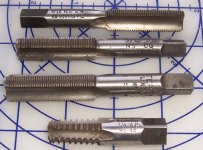
And then there is this Pipe tap, that I've never figured out what needed it, marked T-5, P&W Co.1/4 A.P., HS-46: :wtf:


attachment.php
 

Attachments

  • Taps.jpg
    Taps.jpg
    146.2 KB · Views: 120
Last edited:

WWIIjeep

Well-known member
Joined
May 30, 2012
Messages
1,240
Location
Arizona
5/8-27 :dunno: Ha! just noticed WWII jeeps last post with the reason for this puppy's existence! :beer:

:thumbup:


And then there is this Pipe tap, that I've never figured out what needed it, marked T-5, P&W Co.1/4 A.P., HS-46: :wtf:

Interrupted thread taper boiler tap. Used for tapping hardened boiler plate for pipe fittings. Note the fine thread right at the tip to start the tap, then the wider-spaced "interrupted" thread above that. Cuts cleaner for tighter fits and less chance of leaks at high pressure.
 

Dave455

Well-known member
Joined
Mar 19, 2013
Messages
5,796
Location
Sussex, England
Has anyone tore into a watch, whether a pocket watch, or your everyday wristwatch, and know what size of threads are on the very small screws?

Swiss watches use Metric threads, however there are as many different thread standards that use metric measurements as there are that use Imperial units!

The one they use in Swiss watches is not ISO Metric, but rather the Thury system, which was devised by I think the Swiss, specifically for small instruments and watches!

These sound obscure, but they are basically the same as the British BA threads, the biggest difference being that BA threads are described in a Imperial units!

British watches obviously use the BA system, provided they post date it's introduction!
 
Last edited:

Outlawmws

Well-known member
Joined
Aug 9, 2011
Messages
39,081
Location
The Badlands
:thumbup:
Interrupted thread taper boiler tap. Used for tapping hardened boiler plate for pipe fittings. Note the fine thread right at the tip to start the tap, then the wider-spaced "interrupted" thread above that. Cuts cleaner for tighter fits and less chance of leaks at high pressure.

Thanks again! I figured If anyone would spot that one it would be you! :pimpflash


:beer:
 

Outlawmws

Well-known member
Joined
Aug 9, 2011
Messages
39,081
Location
The Badlands
BTW, if anyone is desperate for a 12-24 tap, drop me a PM: I got a dozen of em in a box of taps this past weekend.
 

GrantCee

Well-known member
Joined
Aug 23, 2010
Messages
808
Location
Willamette Valley, Oregon
Just out of curiosity, are you a watchmaker? Not meaning to be snobby sounding, just curious as you said that you went through "your apprenticeship". And if you are, what has been some of the most troublesome watch to work on, or the most expensive watch you worked on. And what one made you pucker up the most if something went wrong :lol:

Yes, I once was a watchmaker. Specifically, I became a licensed watch & clockmaker when I was still in high school after serving the required apprenticeship. I never made it a profession, but it did help pay the bills and put me through college.

I gravitated primarily to clockmaking, because there was more money in it and (at the time) very few people specializing. Most of my work has been on clocks, ranging from marine chronometers to tower clocks (and everything in between.)

I did, however, do my share of watches. The worst, by far, were the tiny lady's (bracelet) watches. Nothing was as nerve-wracking as working on those, as everything was half the size (or less) of a man's wristwatch. Even as a kid, with great eyesight and very steady hands, they were a nightmare. Hated those things.

Most expensive? I worked on many platinum-cased, diamond-set watches of great value but with rather common movements. Pucker factor? Not sure how to quantify that, but hand-turning a balance staff for my license exam was probably the most anxiety-inducing thing I ever did.
 

Kevin54

MEMBER EMERITUS
Joined
Jan 12, 2005
Messages
29,341
Location
Urbana, Ohio
Speaking of small and tiny.......does anyone on here do any work that involves really, really small drill bits? Like .003, .005 in diameter? I have 5 or 6 different sizes and a few of each size, that someone would be welcome to if they can use them. For me, they are just a conversation piece. I have to leave here shortly, but when I get back, I'll post up the sizes.

ANd yes, they are way smaller the the #60-#80 wire sizes.
 

Kevin54

MEMBER EMERITUS
Joined
Jan 12, 2005
Messages
29,341
Location
Urbana, Ohio
When I posted the 9/16 tap r die sizes, I knew they would be common for the 9/16 threads, but in all my life, I don't think I ever ran across a 9/16 thread in either coarse or fine.

And again, when I get back home, I'll have to dig out my pipe taps. I either have 2 or 3 pipe taps. each one is marked the same size, but each tap is a different size. At least I think they are still in my tool box and have not been stolen. I know that at work, I was the only one that had the correct pipe tap that would match the pipe threads. And I don't know what the reasoning is behind the different sizes.
 
To avoid these ads, REGISTER NOW!
Top Bottom