To avoid these ads, REGISTER NOW!

Where to find a DC inrush clamp meter?

Hohn

Well-known member
Joined
Aug 25, 2016
Messages
2,835
Location
Diesel Central, Indiana
Much of the current I'd like to measure is inrush current to a DC motor. Think starter motors running off battery.
I've not had any luck find a current clamp meter that can measure that. Google is of course useless.
Any suggestions?
 
To avoid these ads, REGISTER NOW!

rattle_snake

Well-known member
Joined
Jun 25, 2015
Messages
5,303
Location
Chandler, AZ
Some clamps have a 'peak hold' ('min' or 'max') feature that will somewhat measure the inrush.

all handheld meters are going to average (RMS or other) so not going to report a fast transient/spike. Need a oscilloscope and a current probe or sense resistor.
 

BrandonV

Well-known member
Joined
Jun 9, 2023
Messages
4,030
Location
Arizona
I don't think you have any options.

I've worked with a lot of high-end clamp meters that have special inrush modes or fast response time modes, but they've always been for AC only.
 
OP
H

Hohn

Well-known member
Joined
Aug 25, 2016
Messages
2,835
Location
Diesel Central, Indiana
Some clamps have a 'peak hold' ('min' or 'max') feature that will somewhat measure the inrush.

all handheld meters are going to average (RMS or other) so not going to report a fast transient/spike. Need a oscilloscope and a current probe or sense resistor.
I was afraid of that.
Last project I did involving measuring inrush DC involved a rental scope worth $50k and the probes that were $2500 each.
 

rlitman

Well-known member
Joined
Oct 18, 2010
Messages
24,738
Location
Long Island
I don't think you have any options.

I've worked with a lot of high-end clamp meters that have special inrush modes or fast response time modes, but they've always been for AC only.
AC and DC clamp meters have different technology, but you can find max-reading DC handheld clamps. "Inrush" is a feature specific to AC, because it relates to measuring a "transient", which are features of AC RMS measurement (there is no analogy in DC). With DC, you don't use RMS measurement, so max-reading IS the inrush you care about.
 

BrandonV

Well-known member
Joined
Jun 9, 2023
Messages
4,030
Location
Arizona
AC and DC clamp meters have different technology, but you can find max-reading DC handheld clamps. "Inrush" is a feature specific to AC, because it relates to measuring a "transient", which are features of AC RMS measurement (there is no analogy in DC). With DC, you don't use RMS measurement, so max-reading IS the inrush you care about.

Good to know the fundamentals around that.

I'm guessing the hall effect sensors are the limitation here? Are they just slow to respond for DC in general unless you have specialized sensors?
 

rlitman

Well-known member
Joined
Oct 18, 2010
Messages
24,738
Location
Long Island
Good to know the fundamentals around that.

I'm guessing the hall effect sensors are the limitation here? Are they just slow to respond for DC in general unless you have specialized sensors?
The sampling rate of a hall effect sensor is easily faster than 60Hz, but the ADC in a DMM usually isn't anywhere near that fast, and the display may be the slowest element. Here, you get what you pay for. My Amprobe claims 3 measurements per second, but seems to sample a little bit faster when using min/max mode, so I think the 3Hz is the display refresh rate. You may get more in a Fluke (depending on the model), and you will get much less with a Chinese meter.

I regularly measure peak DC current when switching large series banks of batteries back onto charge after taking them out of service for maintenance/testing. The initial peak current can easily be 3x larger than the charging current just a second later, and my ACDC-52Nav usually does a good job of catching it. A contractor's Fluke generally does about the same, but his Klein never could read fast enough to see this happening.
 

dogdog

Well-known member
Joined
Nov 15, 2011
Messages
12,711
since you are measuring dc. And a motor. Maybe measure it with a shunt and calculate it manually. Or use that device that comes with the shunt. It calculate for you I think.

V/R=I

Shunts are about $10 eBay basically a really large and low known .value resistor that doesn’t change with current passing it and generate heat.

Peak Voltage drop across the shunt / known resistance value is the inrush current
 

rlitman

Well-known member
Joined
Oct 18, 2010
Messages
24,738
Location
Long Island
since you are measuring dc. And a motor. Maybe measure it with a shunt and calculate it manually. Or use that device that comes with the shunt. It calculate for you I think.

V/R=I

Shunts are about $10 eBay basically a really large and low known .value resistor that doesn’t change with current passing it and generate heat.

Peak Voltage drop across the shunt / known resistance value is the inrush current
That's an option. You could even use the fuse of the circuit as your shunt. But this still depends on the sampling rate of your meter.
 

Max

ALLIANCE MEMBER
Joined
Jun 16, 2018
Messages
3,384
Location
Georgia
since you are measuring dc. And a motor. Maybe measure it with a shunt and calculate it manually. Or use that device that comes with the shunt. It calculate for you I think.

V/R=I

Shunts are about $10 eBay basically a really large and low known .value resistor that doesn’t change with current passing it and generate heat.

Peak Voltage drop across the shunt / known resistance value is the inrush current
That is a good idea. Additionally, he can look at the “current waveform” across the shunt with just a standard oscilloscope. No $50K ‘scope and no $2.5K probes.
 
To avoid these ads, REGISTER NOW!

wyliesdiesels

Well-known member
Joined
Aug 14, 2012
Messages
20,179
Location
Modesto, CA
Some clamps have a 'peak hold' ('min' or 'max') feature that will somewhat measure the inrush.

all handheld meters are going to average (RMS or other) so not going to report a fast transient/spike. Need a oscilloscope and a current probe or sense resistor.
not true. Fluke has several clamp meters that have special circuitry and an activation button for measuring in-rush current... i have one such meter, the 381
 

dogdog

Well-known member
Joined
Nov 15, 2011
Messages
12,711
That's an option. You could even use the fuse of the circuit as your shunt. But this still depends on the sampling rate of your meter.
Yea @Max mentioned using a scope or just a min/max function will do. Measure it a few times and look for the numbers that make sense. Most meter do have min max on voltage
 

rattle_snake

Well-known member
Joined
Jun 25, 2015
Messages
5,303
Location
Chandler, AZ
not true. Fluke has several clamp meters that have special circuitry and an activation button for measuring in-rush current... i have one such meter, the 381
The 381 is a true RMS machine with special mode, which is fine for the indented use.

from381 manual:
'The Inrush function takes approximately 400 samples over a 100 ms period and calculates the starting current envelope.'

This is not the same as capturing the peak current on even the cheapest scope.

'current envelope' is an estimation (aka average) of the peak. Maybe an integration function.

So, handheld meters do some type of calculation and will not capture or properly report a fast transient/spike
 

dogdog

Well-known member
Joined
Nov 15, 2011
Messages
12,711
The 381 is a true RMS machine with special mode, which is fine for the indented use.

from381 manual:
'The Inrush function takes approximately 400 samples over a 100 ms period and calculates the starting current envelope.'

This is not the same as capturing the peak current on even the cheapest scope.

'current envelope' is an estimation (aka average) of the peak. Maybe an integration function.

So, handheld meters do some type of calculation and will not capture or properly report a fast transient/spike
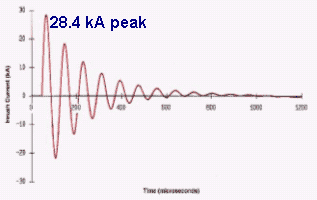
That statement from that manual mighty be referring to in-rush current of ac motors. Like that transient graph in the link. You can still manually calculate it. The op is asking for dc measurements not too sure if it is the same. Sampling rate of oscilloscope usually are higher. Might me a fluke marketing ****. Dunno


RPH

Well-known member
Joined
Dec 17, 2006
Messages
4,190
Location
Michigan Thumb
Dc shunt, reads in dc mv. I have a few throughout the range from 5 amps to 1000 amps.
Attach meter leads at specified spots and read the millivolt drop across the points.
On my 1000 amp shunt, 50 millivolts equals that 1000 amps.
10 mvdc = 100 amp dc.
Any decent meter can read dc millivolts quick enough.
Shunts are cheap and reliable for this measurement.
 

TractorJeff

Well-known member
Joined
Dec 8, 2013
Messages
3,309
Location
Elkhorn, WI
Dc shunt, reads in dc mv. I have a few throughout the range from 5 amps to 1000 amps.
Attach meter leads at specified spots and read the millivolt drop across the points.
On my 1000 amp shunt, 50 millivolts equals that 1000 amps.
10 mvdc = 100 amp dc.
Any decent meter can read dc millivolts quick enough.
Shunts are cheap and reliable for this measurement.
This is the way I was taught 40 years ago, when most lab instrumentation was still analog! We were testing variable AC Reactors controlled by DC. (big 5 and 7kva size, not a bench size)
 

Max

ALLIANCE MEMBER
Joined
Jun 16, 2018
Messages
3,384
Location
Georgia
If it was me I’d use a shunt and a relatively cheap oscilloscope. Once you get the waveform with the ‘scope, you can use your preferred DVM and see how well it captures the peak voltage across the shunt.

Since we are talking DC motors here I’d expect pretty much any modern ‘scope would work.
 

lund

Well-known member
Joined
Nov 2, 2019
Messages
869
Location
Michigan
Put a shunt resistor in line and use a triggered oscilloscope with waveform storage. It will catch all details of the transient. You will need a scope that will cost significant $ though or some (electrical engineer friend?) to borrow one and potentially help with the setup. With clamp on meters and meters with peak capture, you do not know the time response so it renders the measurements of limited worth.

Hope this helps.
 
To avoid these ads, REGISTER NOW!
Top Bottom