To avoid these ads, REGISTER NOW!

Which Insulated Tools for Basic Homeowner Use?

oldschoolcraft

Well-known member
Joined
Dec 31, 2017
Messages
1,829
Location
Bay Area, California
If you already had a reasonably comprehensive tool set with zero insulated tools, and wanted to put together a basic set as a homeowner, non-professional, no OSHA requirements, no liability insurance requirements, just whatever makes sense to keep yourself safe...

Which tools do you re-buy in an insulated format? I'm less interested in brand discussion and more interested in which tools (#2 philips screwdriver, needlenose pliers, etc). Also why those particular tools make the most sense to duplicate in your toolset in an insulated version.

I have a basic understanding of electricity, have no desire to be an electrician, but when I do become a homeowner, I want to have the right toolset to do whatever it is a non-professional can safely do in his own home. I don't know what that entails, at the very least, wiring an outlet, wiring external lights, installing a backup generator...

I suppose it makes sense before picking the tools to figure out what exactly can a non-electrician do in his own home, and then build the toolset around that need. If I'm never going to climb a pole and take apart a junction box, doesn't make sense for me to have specialized tools meant for that.

So let me know... what electrical-based tasks do you do as a homeowner, and which insulated tools do you need to perform those tasks safely?
 
To avoid these ads, REGISTER NOW!

Moe_Hushlin

Active member
Joined
Jan 21, 2018
Messages
36
Well, in my opinion the basic homeowner shouldn't be fooling with ANYTHING energized whatsoever. If you have a basic understanding of that zappy stuff then only working on circuits that aren't live should be an easy task. And if your attempt to de-energize said circuit is unsuccessful, call Mr. Sparky because you gots problems. And I'm not talking about the writing on the handles of your tools, lol.

I have rewired my entire garage before and never had to come anywhere close to working on a live wire. Be smart, use common sense, and if you don't know, call an expert.

A senior tech gave me a piece of advice back in my skilled trade days, "You have got to respect something you can't see, son!"

Sent from my SAMSUNG-SM-T377A using Tapatalk
 

jayrush13

Well-known member
Joined
Dec 30, 2006
Messages
340
Location
Lebanon Oregon
Very rarely do professional electricians even own insulated tools. If I have to work on something hot the company supplies everything. With the cost of the tools and ppe and how easily they get damaged to void their insulation rating it wouldn't make sense for me to invest in them.

Just turn it off or hire a professional
 

Mr. T

Well-known member
Joined
Sep 4, 2013
Messages
636
Location
Central PA
Insulated tools aren’t necessarily for tightening/breaking live connections. Mostly it protects you from an arc blast hazard that would arise from dropping your tool (or other inadvertent contact) in a cabinet or enclosure with other energized components.
 

Moe_Hushlin

Active member
Joined
Jan 21, 2018
Messages
36
If you use insulated tools how will you learn from your mistakes?
Savage, lol. Ironically, I had to learn my lesson the hard way as well. It involved 460 volts of the 3 phase variety and I just got a small sample of that *** blistering it had for me. It was the loudest silence I have ever heard. And the look on my helpers face was a glance I wish to never be on the other end of again.

Sent from my SAMSUNG-SM-T377A using Tapatalk
 
OP
O

oldschoolcraft

Well-known member
Joined
Dec 31, 2017
Messages
1,829
Location
Bay Area, California
So it sounds like the responses so far are that insulated tools aren't necessary if the wire isn't live and you shouldn't be working on live wires. That's what my common sense told me, but before I started this post, I read through old posts and it seemed like people really liked using insulated tools as a backup in case the line they thought wasn't hot, turned out to be hot.

I'd prefer not to have to buy insulated tools if they aren't needed, but I want to be smart and if they are recommended as a fail safe, I don't mind buying them.
 

bczygan

Well-known member
Joined
Nov 4, 2009
Messages
22,002
Location
DETROIT! Arsenal of Scrappers
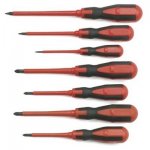
I got the HF screwdriver sets. They also have pliers.
https://www.harborfreight.com/catalogsearch/result/index/?dir=asc&order=EAScore%2Cf%2CEAFeatured+Weight%2Cf%2CSale+Rank%2Cf&q=insulated+tools

image_20756.jpg


image_20766.jpg


63783_I.jpg


image_13075.jpg


62840_zzz_500.jpg


May as well.

Bill
 
Last edited:

Fbmoose48

Well-known member
Joined
Sep 26, 2017
Messages
202
Location
GJ
I wouldn't play in an energized enclosure, but if I did I wouldn't trust anything from Harbor Freight to insulate me from the electricity
 

Ohmthis

Well-known member
Joined
Jan 20, 2013
Messages
3,009
Location
Outside of Louisville KY
The only time I use my insulated tools (a set of insulated screwdrivers) at home is when I'm wiring in the main or sub panel. You can't (I guess you could, but it isn't practical) kill the whole house to terminate a few wires. My advice is to get a good electrical meter and know when things are dead or hot.
 

mmason7764

Well-known member
Joined
Aug 7, 2017
Messages
199
Location
Wesson, Arkansas
Old School,

The main insulated tool you should have are the black and red probes on your multimeter. They are used in the following procedure (receptacles, switches, etc):

1. Turn off circuit breaker.

2. Test receptacle to make sure it is not energized.

3. Pull cover and gently pull said device a little way out of the junction box.

4. Test the wires connected to the switch/receptacle/other and make sure everything is at zero volts. Black to white, black to ground, white to ground. You don't know if the builder wired it per standards.

I have heard of guys that were able to change this stuff out hot. I am way, way below their league. My experience with house wiring, changing said devices (deenergised), is that the single conductor copper wire used is very stiff. It always ends up an awkward wrestling match to get the switch/receptacle out far enough to work on. Then after the replacement getting all that stiff wiring to go back into place.

All that being said, when KC tool offered their giveaway and sale at the end of last year, I could not resist getting an assortment of insulated screwdrivers. Going to try them out next time I work on a car's 12V DC electrical system in the hope that I blow fewer fuses.

Just 2 cents from a fumbling amateur.

Mark
 

Mohawk Dave

Well-known member
Joined
Oct 7, 2012
Messages
5,068
Location
SoCal

gregpack

Well-known member
Joined
Feb 1, 2015
Messages
245
I'm not an electrician but I play with some electrical in the machinery I service. I replaced a 100A three phase breaker today. I used an insulated flat blade and long nose pliers. I don't see much more need that that for most of my applications.
 

jd_1138

Well-known member
Joined
May 8, 2013
Messages
17,043
Location
NE Ohio
I just shut off the main breaker. I don't care if the wife can't watch her soaps for 20 minutes. ;)
 
To avoid these ads, REGISTER NOW!

jd_1138

Well-known member
Joined
May 8, 2013
Messages
17,043
Location
NE Ohio
I'm not an electrician but I play with some electrical in the machinery I service. I replaced a 100A three phase breaker today. I used an insulated flat blade and long nose pliers. I don't see much more need that that for most of my applications.

I hope it was shut off from the power?
 

dogdog

Well-known member
Joined
Nov 15, 2011
Messages
12,711
I don't own any special ones.

Same here.... when in doubt flip the breakers.... and confirm with a non-contact voltage tester or your best method of verifying live voltage.. Besides that, use a lot of common sense... nothing fixes stupidity.
 

CR888

Well-known member
Joined
Feb 19, 2017
Messages
1,198
Whenever I see those Knipex or Wiha insulated single ended but drivers in red coating, the tool fool within lights up and wants a set. The only thing that has stopped me is the hefty msrp they have....like $93 for one wrench or several hundred for a set. I have a few rated insulated pliers and set of screwdrivers.
 

Parrothead

Well-known member
Joined
Apr 27, 2014
Messages
5,346
Location
Earth
I have the Stanley insulated long nose, linesmen, and cutters with the Wiha insulated screwdriver set. A Fluke non contact voltage detector and a GB meter and you’re good to go.
 
Last edited:

gdpolk

Well-known member
Joined
May 16, 2016
Messages
238
For homeowner use, I would recommend NOT buying insulated tools. I would recommend having higher quality basic tools available and then turning the power off when working on something.

Insulated tools will be more bulky than standard tools and will be a very niche use item. In addition to this they are really only helpful for working on hot wires/equipment. I can't imagine a single situation where a DIY homeowner would require the hardware they are working on to remain live while working on it. Just turn the power off, stay safe, and use normal tools.

I would recommend a homeowner to own two tools related to electricity:
  1. quality mulitmeter with non-contact voltage detector - this will have a ton of uses for both your home and car and allow you to test parts and isolate issues/components that are broken as well as test for live/dead wires.
  2. studfinder with the ability to detect wiring and deeper pipes - I know you can just knock on walls to find studs but I like knowing if there is something in there that I can't see.
 
Last edited:

becker_atc

Well-known member
Joined
Jun 20, 2013
Messages
210
Location
Grady Co., OK
Average homeowner don't need them. I use them at work mainly in large junction boxes with rows of terminal strips likely 200+ terminations. 480,120, and 24v. What I'll be working on will be dead but everything around it live. If your working around live stuff like that you really need the right ppe not just few insulated tools. Hot gloves, face cover, ect


Sent via message in a bottle
 

PelicanPines

ALLIANCE MEMBER
Joined
Apr 30, 2014
Messages
38,106
Location
New Jersey, USA, Earth, My own reality
For homeowner use, I would recommend NOT buying insulated tools. I would recommend having higher quality basic tools available and then turning the power off when working on something.

Insulated tools will be more bulky than standard tools and will be a very niche use item. In addition to this they are really only helpful for working on hot wires/equipment. I can't imagine a single situation where a DIY homeowner would require the hardware they are working on to remain live while working on it. Just turn the power off, stay safe, and use normal tools.

I would recommend a homeowner to own two tools related to electricity:
  1. quality mulitmeter with non-contact voltage detector - this will have a ton of uses for both your home and car and allow you to test parts and isolate issues/components that are broken as well as test for live/dead wires.
  2. studfinder with the ability to detect wiring and deeper pipes - I know you can just knock on walls to find studs but I like knowing if there is something in there that I can't see.

Read them all... this advice mimics my advice. Anything on the hot side of a breaker is not something a homeowner should touch.

I've done complete room wire pulls, boxes, devices... then call in an electrician do the final make up at the box. My guy requires all boxes be open so he can inspect them... :thumbup:
 

Crazyjake8493

Well-known member
Joined
Sep 26, 2014
Messages
3,951
Location
Upstate NY
A homeowner/DIY'er doesn't need insulated tools. I only have one: a Wera flathead screwdriver that I had at work and hasn't been used since I brought it home.

There is never a reason why the power can't be turned off to work on something, especially in residential work. If your dishwasher is running, let it finish. If someone wants to watch a movie, tell them too bad. No reason you need to work on anything with the power on.
 

Mr. T

Well-known member
Joined
Sep 4, 2013
Messages
636
Location
Central PA
I'm not an electrician but I play with some electrical in the machinery I service. I replaced a 100A three phase breaker today. I used an insulated flat blade and long nose pliers. I don't see much more need that that for most of my applications.


Why did you use insulated tools for this?
 

Crazyjake8493

Well-known member
Joined
Sep 26, 2014
Messages
3,951
Location
Upstate NY
Some small insulated screwdrivers might be useful for working on small electronics, so you don't short out components, but really not needed for home electrical work.
 

CGT80

Well-known member
Joined
Aug 29, 2014
Messages
862
Location
IE, SoCal, USA
Dedicated insulated tools are not necessary to work on hot circuits without getting shocked. Knowing how the electricity works and being careful is required. I have touched hot wires bare handed and not felt anything. Yep, I shut off everything but the ac breaker in that suite. Where did the tenant hook up the light circuit they added to the ceiling? One of the legs of the AC unit, of course. Sometimes when doing lighting maintenance it is much faster to work hot than to deal with killing the power. Gloves give some extra protection, but by being careful and not purposely touching the conductors they aren't absolutely necessary. When possible, it is much preferred to kill the power.

I started out my construction experience by painting for my uncle. Often times we didn't have access to the switches for exterior lights and when we pulled them down, they could be hot but have photo cells and same for reinstalling. We weren't going to kill power to the whole building just to deal with lights.

Normal tools have some insulating property as well, but are not certified or designed for hot work. Use a meter or inductive tester and if in doubt you got the right breaker, rubber handled tools and some gloves while being careful about touching the conductor. Don't touch the conductor to the box and use a fiberglass ladder and make sure you are not grounded. When working inside a breaker panel, put one hand in your pocket or behind your back and pay attention rather than completing the circuit with your body.
 

Parrothead

Well-known member
Joined
Apr 27, 2014
Messages
5,346
Location
Earth
Dedicated insulated tools are not necessary to work on hot circuits without getting shocked. Knowing how the electricity works and being careful is required. I have touched hot wires bare handed and not felt anything. Yep, I shut off everything but the ac breaker in that suite. Where did the tenant hook up the light circuit they added to the ceiling? One of the legs of the AC unit, of course. Sometimes when doing lighting maintenance it is much faster to work hot than to deal with killing the power. Gloves give some extra protection, but by being careful and not purposely touching the conductors they aren't absolutely necessary. When possible, it is much preferred to kill the power.

I started out my construction experience by painting for my uncle. Often times we didn't have access to the switches for exterior lights and when we pulled them down, they could be hot but have photo cells and same for reinstalling. We weren't going to kill power to the whole building just to deal with lights.

Normal tools have some insulating property as well, but are not certified or designed for hot work. Use a meter or inductive tester and if in doubt you got the right breaker, rubber handled tools and some gloves while being careful about touching the conductor. Don't touch the conductor to the box and use a fiberglass ladder and make sure you are not grounded. When working inside a breaker panel, put one hand in your pocket or behind your back and pay attention rather than completing the circuit with your body.

This is great advice!!! :bowdown:

I've seen all sorts of weirdness in the different places I've worked, and in fact I have completed the circuit through no fault of my own as I wasn't even working on anything.

My Dad has wired 240 live, and I'm not going anywhere NEAR that!!! F that. Wasn't going to shut down part of the plant to install the repaired machine, he just did it. More power to him. (pun not intended)
 

gregpack

Well-known member
Joined
Feb 1, 2015
Messages
245
Why did you use insulated tools for this?

Once the breaker is flipped I am not working on anything energized but it still adds an element of safety if I get careless. I have ruined screwdrivers before.
 

Mike_662

New member
Joined
Nov 22, 2015
Messages
1
I watched an electrician friend of mine change a service at the weatherhead live, because it was a lot easier than having the power company disconnect it at the pole. IIRC, he didn't use insulated tools, but I do recall him standing on a rubber mat on the roof. No thanks!

IIRC, my Red Wing boots are supposed to isolate me from ground, but there's no way I'm trusting that.

Like others have posted, my method is to always turn the power off and double check everything is dead. The only time I get a little nervous is working in the breaker box, because there's always something live in there, even with the main off. I do the "one hand behind my back" deal too.

I'm still walking around, so it's worked out for me so far.

Sent from my SM-J700T using Tapatalk
 

NinnyCTSV

Well-known member
Joined
Apr 30, 2017
Messages
256
Location
Ontario California
I worked in the electrician field for a very short period of time, low voltage, but electrician nonetheless. In my brief time in the field, the only people I saw invest in the insulated tools were guys just coming into the trade. Myself included almost bought into the hype. However in that time, I dealt with multiple high voltage electricians and not a 1 had insulated tool in their bag.

zero contact voltage checker, multimeters, and some quality gloves were what I saw in all their bags. Some of which had electrical shock resistant boots, but that wasn’t even all that common
 

rick carpenter

Well-known member
Joined
Jan 20, 2011
Messages
3,771
Location
Huntsville, East Texas
I have the insulated Milwaukee 3 pc set of philips, straight, and combo for ~$19 at HD. These have replaced my Kleins for the most part. I don't work hot so I don't have them specifically for electrical insulation, I have them insulated for to provide a good grip when spinning them by the blade with my fingertips.
 
To avoid these ads, REGISTER NOW!
Top Bottom