To avoid these ads, REGISTER NOW!

Which Motor would be better? Air Compressor

Lenny B

Active member
Joined
Jul 19, 2020
Messages
26
Location
Detroit
I have a 1950's - 1960's era Kellogg Model 321 2HP 2 Stage 80 Gallon Air Compressor that I recently rebuilt. I want to replace the original motor with a new one. The pump can run at 400 to 800 RPM. It has a 14" Flywheel. My motor choices are either 1750 or 3600 RPM. Cost is about the same. If I use the 1750 unit with the biggest pulley I can find (5") the pump would turn at 625 RPM. If I use the 3600 RPM motor with a 3" pulley it will turn the pump at 771 RPM. I would like to get the most CFM but am concerned the 3600 RPM motor would be screaming.

My question is: Will the 3600 RPM motor be fine or should I sacrifice the CFM and go with the 1750 RPM motor. Which setup is more durable? What would you run?

The motors are Teco Westinghouse S0024 (1750 RMP 1 1/8" Shaft) and SPT0022 (3600 RPM 7/8" Shaft) models.

Thanks in advance for your advice and experience ~ Lenny B
 
Last edited:
To avoid these ads, REGISTER NOW!

Bigblockyeti

Banned
Joined
Feb 1, 2018
Messages
2,550
Location
Upstate, SC
The lower speed (four pole) motor would last longer and it would be slightly quieter when running. I would double check there isn't a sliding scale on max. pressure vs. max. pump speed. On some pumps max. speed might be limited to somewhere between 80-100psi. That being said, running the pump at 625rpm should be quiet, cool running and allow things to last a very long time.
 

Stuart in MN

Well-known member
Joined
Sep 8, 2005
Messages
23,042
Location
Minneapolis
I'd stick with whatever RPM the original motor runs at (for that matter, is there something wrong with the original motor that can't be fixed?)
 
OP
L

Lenny B

Active member
Joined
Jul 19, 2020
Messages
26
Location
Detroit
I'd stick with whatever RPM the original motor runs at (for that matter, is there something wrong with the original motor that can't be fixed?)

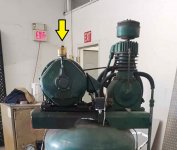
I'm not sure what the original motor is since there is no data plate on it and no witness marks showing it ever had one. I thought about tring to restore it but not sure if it would be worth it. Here are a couple pictures of it below. It has two clear oil containers on it (marked by the yellow arrows. I believe they are for lubrication. Just thought a new motor would be the way to go.
 

Attachments

  • 001.jpg
    001.jpg
    122.5 KB · Views: 81
  • 002.jpg
    002.jpg
    113.2 KB · Views: 67

matt_i

Well-known member
Joined
Mar 14, 2008
Messages
10,725
Location
SE Michigan
Don't be limited by a straight bore sheave. If you can find a Martin Sprocket & Gear catalog online they will have pages of taperlock sheaves in a multitude of sizes. The taperlock is better as it "grips" the shaft as the conical wedge tightens. I like QD/SDS sheaves because of the flange and easy hex head bolts but sometimes there's not room.

I usually lookup the size and then start shopping ebay for NOS. They are available new of course but higher pricing.

If the existing motor works, why spend the money? Personally I would just keep running it and instead build a belt guard.
 

TuxThePenguin

Well-known member
Joined
Jul 8, 2020
Messages
633
Location
MA
what RPM does the original motor turn the pump at? I see you gave an acceptable RPM range which is good, but you'd probably want to compare your choice to the original RPM to get an idea of how it might perform.

you can get a tool to measure it for probably < $20 if necessary.
 
Last edited:

larry_g

Well-known member
Joined
Apr 28, 2007
Messages
16,872
Location
oregon
http://www.aircompeq.com/ka.htm

Study the above chart. As the speed of the pump goes up the the cutout pressure goes down. So you get nothing for free. Instead of thinking in terms of CFM's think in terms of energy. You only get so much energy from a 2hp motor and the compressor head converts that into pressure and flow. You have the choice of more pressure or more flow, can't have both.

As far as which motor to select I'd go with the slower one. It has more torque.

lg
no neat sig line
 
OP
L

Lenny B

Active member
Joined
Jul 19, 2020
Messages
26
Location
Detroit
http://www.aircompeq.com/ka.htm

Study the above chart. As the speed of the pump goes up the the cutout pressure goes down. So you get nothing for free. Instead of thinking in terms of CFM's think in terms of energy. You only get so much energy from a 2hp motor and the compressor head converts that into pressure and flow. You have the choice of more pressure or more flow, can't have both.

As far as which motor to select I'd go with the slower one. It has more torque.

lg
no neat sig line

So based on that chart, does that mean if I have a 2 HP 60 hertz motor with the 6" pulley turning the pump at 783 RPM I will only be able to reach 125 PSI but if I run the pump at a slower RPM it will be able to build higher PSI? The CFM is more important to me. All of the tools I use require less than 90 PSI with the spray equipment only needing 40 PSI. Just want to know if my understanding of the above is correct and if so, I would need a pressure switch that cuts off below the 125 PSI or the pump would never shut off since it cannot pump higher than that at the faster RPM.

Does that sound right? - Thanks for your insight.
 

larry_g

Well-known member
Joined
Apr 28, 2007
Messages
16,872
Location
oregon
So based on that chart, does that mean if I have a 2 HP 60 hertz motor with the 6" pulley turning the pump at 783 RPM I will only be able to reach 125 PSI but if I run the pump at a slower RPM it will be able to build higher PSI? The CFM is more important to me. All of the tools I use require less than 90 PSI with the spray equipment only needing 40 PSI. Just want to know if my understanding of the above is correct and if so, I would need a pressure switch that cuts off below the 125 PSI or the pump would never shut off since it cannot pump higher than that at the faster RPM.

Does that sound right? - Thanks for your insight.

I believe what the chart is saying is that the motor would over current if you try to spin the pump at that speed and have a higher cutout. The speed/pressure is to keep the motor operating near its maximum load (current). You select what you want and monitor the motor current when you get it running. Once running then you can adjust the cutout point by monitoring the motor current. Push this old pump to the max and you are likely to experience failure.

lg
no neat sig line
 

Bert_

Well-known member
Joined
Dec 24, 2016
Messages
9,706
Location
NW Iowa
So based on that chart, does that mean if I have a 2 HP 60 hertz motor with the 6" pulley turning the pump at 783 RPM I will only be able to reach 125 PSI but if I run the pump at a slower RPM it will be able to build higher PSI? The CFM is more important to me. All of the tools I use require less than 90 PSI with the spray equipment only needing 40 PSI. Just want to know if my understanding of the above is correct and if so, I would need a pressure switch that cuts off below the 125 PSI or the pump would never shut off since it cannot pump higher than that at the faster RPM.

Does that sound right? - Thanks for your insight.

It takes more than 2hp to go higher pressure at that pump speed.
 
To avoid these ads, REGISTER NOW!

Bert_

Well-known member
Joined
Dec 24, 2016
Messages
9,706
Location
NW Iowa
IMHO, Newer design Motors are more efficient than the boat anchors they have replaced.

Yea they are but I don't think there is much savings to be had in a home shop air compressor.

The old motor has more cool factor.
 

marinusdees

Well-known member
Joined
Oct 30, 2012
Messages
1,325
Location
Edgewood, Washington
If the motor runs, why replace it?? Fill the oil cups with non-detergent oil and run it. Then you don't have to worry about pulley size, etc. If it doesn't, the 1 1/8" shaft motor is the way to go. I reckon the original motor was 1750 RPM, so you don't have to worry about a new pulley. Just my 2 cents worth.
 

Balvar24

Well-known member
Joined
May 18, 2016
Messages
870
If The old motor will run the pump, or did in the past, I'd take it to the local motor shop. They can probably rebuild it for the cost of a new one and it will last just as long or longer.

Those oilers are cool.
 

Dagny

Well-known member
Joined
Jul 25, 2014
Messages
2,980
Location
Northern Wi.
If it works use it keep it oiled and it will last longer than anything you could replace it with.
 

Burl

Well-known member
Joined
Sep 21, 2007
Messages
791
Location
Where Mountaineers are free
Your compressor is very similar to mine, along with the same model no., etc. I believe my motor is original, a GE 1 1/2HP at 1725RPM. I would post pics but don't know how.
 

Showkey

"MEMBER EMERITUS"
Joined
Aug 9, 2014
Messages
8,638
Location
Wausau WI
If The old motor will run the pump, or did in the past, I'd take it to the local motor shop. They can probably rebuild it for the cost of a new one and it will last just as long or longer.

Those oilers are cool.


If it’s not broken .......don’t fix it.:dunno:
 
OP
L

Lenny B

Active member
Joined
Jul 19, 2020
Messages
26
Location
Detroit
I'm going to take a closer look at the motor and possibly reuse it. I rung out the motor leads and have continuity between them with no short to ground. I plan to pull and inspect the brushes and replace if needed. I'll also pull the armiture and clean, inspect. I'll also check the bearings and replace if needed. Then I plan to power it up with the belts off and check the amp draw and then again with the belts on to see what Horse Power it is. If all looks good I'll then order a pair of new drip feed lubricators.

I paid $150 for this unit. The pump was stuck. The guy said the motor worked. When I got it home I pulled the drain plug and the tank had about 5 gallons of water in it. I looked inside the tank and it looked good, no pitting from rust. The wall thickness is about 1/4" thick. I pulled the pump apart and somehow he also had water in it. The oil was like milk and the low pressure piston ring was stuck due to rust. It tapped out fairly easily. I use a hone to clean up the cylinder and wire wheeled the piston to clean it up. I found the Timken 1 3/4" crank shaft bearings (New Old Stock) on EBay for $50. Pacific Compressor had a rebuild kit with new rings, valve discs and springs, and all the seals and gasket for $130. The drip oilers are available for about $15 each so as long as I don't need a new motor I'll be in this thing for about $400 and it should run like new, hopefully.
 
Last edited:

matt_i

Well-known member
Joined
Mar 14, 2008
Messages
10,725
Location
SE Michigan
http://www.aircompeq.com/ka.htm

Study the above chart. As the speed of the pump goes up the the cutout pressure goes down. So you get nothing for free. Instead of thinking in terms of CFM's think in terms of energy. You only get so much energy from a 2hp motor and the compressor head converts that into pressure and flow. You have the choice of more pressure or more flow, can't have both.

So just more on that subject in basic principles....Pressure * Flow = Mechanical Horsepower = Electrical Horsepower = Volts * Amps

So if you want to increase flow while keeping max pressure the same you need more HP.

Getting more flow involves running the pump's input shaft faster. Which means improving overdrive of the pump. Which means a larger sheave on the motor.

The 2-pole v 4 pole motor is not really a thing here because the max horsepower is the same.

Imo you should also consider the heat input to the pump by running it faster. The pump curves should give you some guidance but also in some generalities the cooler things run the longer their potential lifespan.
 

redmondjp

Well-known member
Joined
Nov 25, 2014
Messages
2,318
Location
Redmond, WA
As pointed out above, there is no free lunch. You have to do the math to figure out what HP is required for a given flow and pressure, including all losses (such as through the pulley belts - you lose 10% of your power right there).

I wanted to add that it is important to check motor current right before the pressure switch turns off the motor/pump, and ensure that it doesn't exceed your full-load amps for the motor. The motor doesn't magically limit its power output to the nameplate rating - it will output more power, but will draw more current and eventually overheat.

Many folks don't seem to understand this, and end up frying their motor because it is working too hard. Doing the full-load current check on the motor will tell you if you are getting the most power out of your motor that you can, without overheating it. That $75 you spend for the clamp-on AC ammeter may well save you from having to buy a new compressor motor that costs several times that much!
 
Last edited:

marinusdees

Well-known member
Joined
Oct 30, 2012
Messages
1,325
Location
Edgewood, Washington
If that motor has brushes and a wound armature, it's a repulsion-induction with hellacious starting torque. If it runs, use it. I suspect the bearings are sleeve bearings, likely not replaceable. Maybe some felt wicks to hold oil. If you want to test shorts to ground, the correct way is to use a megohmeter, uses higher voltage to detect smaller leaks.
 
To avoid these ads, REGISTER NOW!
Top Bottom