If you were building a table or bench. Using square or rectangle tubing. I have noticed a lot of tables seems to have rectangular for the longer length pieces. Is there a reason for this? The top rails could either be 4 x 1.5 (0.120 wall) or 3 x 2 (0.120 wall) or maybe I should just get some 3 x 2 (1/4 wall). I could just imagine the price on 4 x 2 (1/4 wall). I don't want to cut corners but we don't want to spend where we don't need to. We are using 3 x 3 (1/4 wall) corners.

You are using an out of date browser. It may not display this or other websites correctly.
You should upgrade or use an alternative browser.
You should upgrade or use an alternative browser.
Which one is stronger or ideal?
- Thread starter skipnay
- Start date
e36jon
Well-known member
Square is great for vertical / compression loads (legs) and rectangular, with the long dimension vertical, is great for horizontal spans / bending loads.
Bending loads are dominated by geometry as opposed to wall thickness, so if your horizontal span is very long (6'?) I would vote for 4"X whatever. The difference between 1.5" and 2", even with the wall thickness difference will be relatively minor.
Bending loads are dominated by geometry as opposed to wall thickness, so if your horizontal span is very long (6'?) I would vote for 4"X whatever. The difference between 1.5" and 2", even with the wall thickness difference will be relatively minor.
readhead
Well-known member
What is the top?
What is the top?
He hasn't decided but I would say probably around 1.25 to 1.5 plate steel...
e36jon
Well-known member
Here's 'the math' behind all those rectangular beams you see (below). The TLDR is that if you double the depth of the beam you get 8X the bending strength...

For that monster thick top the 2"X4"X0.25" wall material would seems like a good fit.
For that monster thick top the 2"X4"X0.25" wall material would seems like a good fit.
Attachments
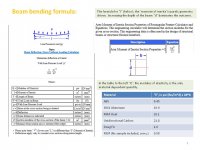
Moment of inertia. For a square or rectangle it is base times height cubed divided by 12. Its the formula you see to the right.
The bd^3/12 will not work for an I beam directly, it's only for square or rectangles. That formula can be used to calculate an I beam but can't be used for an I beam as is. You have to subtract out the material 'missing' from an I beam if it were a solid rectangle.
The bd^3/12 will not work for an I beam directly, it's only for square or rectangles. That formula can be used to calculate an I beam but can't be used for an I beam as is. You have to subtract out the material 'missing' from an I beam if it were a solid rectangle.
Now, I think of it a little differently. The Bending Stress in a beam depends on many things, the moment (from load applied), distance from the neutral axis to the outermost fiber, and moment of inertia.
So calculate moment of inertia using the bd^3/12 formula for a 2x8 laying flat and one on edge like a floor joist. When on edge you have more material further away from the neutral axis and the distance to the outermost fiber from the neutral axis is hugely different. So, mathematically, the 2x8 is stronger on edge than laying flat.
This is why you see floor joists in a house on edge, not laying flat.
Do this to illustrate: take a wooden yard stick and two kitchen chairs. Separate the chairs 34" and put the yard stick on them laying flat. Now push in the center of the yardstick, it will bend. Now, put the yardstick on edge and push in the center, it doesn't bend anywhere near as much! Same yard stick, same force from your hand, but a big difference in strength! Now, one thing to observe with the yard stick on edge is that the ends will tend to twist when you load it. The inherent twisting in a beam on edge is why those 'X' braces are installed on long span floor joists.
So calculate moment of inertia using the bd^3/12 formula for a 2x8 laying flat and one on edge like a floor joist. When on edge you have more material further away from the neutral axis and the distance to the outermost fiber from the neutral axis is hugely different. So, mathematically, the 2x8 is stronger on edge than laying flat.
This is why you see floor joists in a house on edge, not laying flat.
Do this to illustrate: take a wooden yard stick and two kitchen chairs. Separate the chairs 34" and put the yard stick on them laying flat. Now push in the center of the yardstick, it will bend. Now, put the yardstick on edge and push in the center, it doesn't bend anywhere near as much! Same yard stick, same force from your hand, but a big difference in strength! Now, one thing to observe with the yard stick on edge is that the ends will tend to twist when you load it. The inherent twisting in a beam on edge is why those 'X' braces are installed on long span floor joists.
The rectangular tubing on edge will be a stronger beam than the same thickness square tubing. However, due to loading, you may never need the extra strength. Unless you're putting engines or really heavy stuff, it is not needed. Stronger yes, not needed Unless you're putting a car on it, use what you have.
Do the calculations with each tubing geometry so you can calculate where you get your most strength for the money.
Do the calculations with each tubing geometry so you can calculate where you get your most strength for the money.
matt_i
Well-known member
Just to add some more for a 2x4 solid wooden piece (1.5" x 3.5" for illustration purposes)
Flat way Ixx = 1/12 (3.5) * (1.5)^3 = 0.984 in^4
Tall way Ixx = 1/12 (1.5) * (3.5)^3 = 5.36 in^4
So roughly 5x stiffer oriented the "tall way". The value which gets cubed is the biggest factor in making the section more rigid (more resistant to bending, other things being equal)
Flat way Ixx = 1/12 (3.5) * (1.5)^3 = 0.984 in^4
Tall way Ixx = 1/12 (1.5) * (3.5)^3 = 5.36 in^4
So roughly 5x stiffer oriented the "tall way". The value which gets cubed is the biggest factor in making the section more rigid (more resistant to bending, other things being equal)
sberry
Banned
plus the tube will be fastened to the plate. I built about 50 of them, used 2x2 angle. Most load isn't directly in the center. As was mentioned,,, sure you can keep making it stronger but why?
I don't recall seeing an under built bench on here. Most are a waste and multiples times stronger than they need to be. 10k# frame on 300# casters.
I don't recall seeing an under built bench on here. Most are a waste and multiples times stronger than they need to be. 10k# frame on 300# casters.
Last edited:
readhead
Well-known member
Unless something very heavy is going on this table at 1 1/2" thick you could just weld four legs on it and be done.
The Tool Tyrant
ALLIANCE MEMBER
Unless something very heavy is going on this table at 1 1/2" thick you could just weld four legs on it and be done.
^^ This...seriously.
What is the main purpose of your table as this should have some bearing as to how its constructed.
I have 3 fab/welding tables in our shop, two are 4X10 and one is 5X10. All three are built using 4X2X .188 wall rectangular tube, with the 4" dimension in the vertical plane and 1/2" plate on top. All three use three tubes running in the 10" direction, one in the center and the other two, in 3" from the edges. All three are also on casters and move without much effort. I've had my Yanmar tractor on the 5X10 without any issue.
sberry
Banned
Yes, 4 posts welded to it, the math here is being applied to a single piece of unbraced tube. None of that will be point loaded on a bench. Most of it will be shared over the legs and split by 4. With 3x3 legs would put a piece of place with 5 or 6 ft between them in the dozens of tons, The extra cost is already in a top and I don't like it that thick anyway, we do edge clamp and it takes clamp adjustments between that and other common pieces we work on and we just don't need it.
I worked a career on a **** bench with 1/4 top and 2 inch angle legs. Worked well enough we never bothered to make a new one.
I worked a career on a **** bench with 1/4 top and 2 inch angle legs. Worked well enough we never bothered to make a new one.
The heaviest of things on this will probably be stuff like skid loader buckets or even the back hoe bucket... I don't see the last one very much but I do see him putting some skid loader buckets on them and beating on it with a sledge hammer...
e36jon
Well-known member
Sorry, all, for tipping this off into engineering-ville. Gearhead1 made the point better than I with his examples, which was all I was trying to do. Rectangular is better than square for spreaders...
As Sberry sez, lots of tables seen here with that thickness top and just legs, no horizontal spreaders at all. Good enough for those plates the road crews put over ditches, right?
That said, in my shop, on my dime, I would use a 4X2X0.25" spreader... (And casters rated for enough weight that they can handle the table + loads + sledgehammer!)
As Sberry sez, lots of tables seen here with that thickness top and just legs, no horizontal spreaders at all. Good enough for those plates the road crews put over ditches, right?
That said, in my shop, on my dime, I would use a 4X2X0.25" spreader... (And casters rated for enough weight that they can handle the table + loads + sledgehammer!)
Sorry, all, for tipping this off into engineering-ville. Gearhead1 made the point better than I with his examples, which was all I was trying to do. Rectangular is better than square for spreaders...
As Sberry sez, lots of tables seen here with that thickness top and just legs, no horizontal spreaders at all. Good enough for those plates the road crews put over ditches, right?
That said, in my shop, on my dime, I would use a 4X2X0.25" spreader... (And casters rated for enough weight that they can handle the table + loads + sledgehammer!)
The 4x2 1/4 spreader is what I thought also for the spread...Yes the casters is what I'm trying to tell him isn't enough... He wanted to go with the 4 or maybe even 5". I think 6" should be his minimum....
I like trying to figure stuff out. So I figured if I could figure that out I could know more. You guys have taught me a lot!
sberry
Banned
If it gets too heavy you need steel wheels. Something heavy is great for a stationary deal but for portable this is way beyond what a guy needs unless he is in a dedicated heavy fab shop. I was at a power plant, all the shop benches were heavy plate set on steel sawhorses. They tossed some heavy plank across the leg braces for shelves.
Yes, they drive loaded cement trucks across simple plates. I used a couple a foot wide inch thick to go across about 18 inch groove, not very far but very heavy.
Yes, they drive loaded cement trucks across simple plates. I used a couple a foot wide inch thick to go across about 18 inch groove, not very far but very heavy.
So a 4x2 would be
2 times 4 cubed divided by 12
2 times 64 divided by 12
128 divided by 12
Equals 10.6 repeating. Does this mean it will take 10.6 pounds per square inch? Wait that isn't it. Now I'm lost...
In short, no.
Look at the formula for bending stress: Mc/I. Keep in mind, we're not looking for an exact number off stress to determine the trend of which is stronger.
Look back at what I posted, M relates to loading, c is distance from the neutral axis (usually the center of the beam in cross section) and I is the moment of inertia. Assume the loading on the top half of the equation doesn't change, the I on the bottom relates to beam geometry.
So let's do a simple case in two extremes to illustrate the point, and the trend can be seen easier. To make the math easier, we'll round matt_i's I calculation for a 2x4 flat and on edge to 1 and 5. Assume the moment is 50 in lbs.
50*.75/1=37.5psi of bending stress for a 2x4 flat
50*1.75/5=17.5psi of bending stress for a 2x4 on edge
The math shows there is less bending stress when the 2x4 is on edge given the same loading because the predominant factor that changed is I, moment of inertia, in the bottom of the equation. matt_i just jumped to it because he understands the concept.
Laying the 2x4 flat causes a little more than double the bending stress than if you put the 2x4 on edge.