I bled all of the air out of the tank by opening the drain and attaching my double-male. A while later I fired it up and timed it with a stop watch. It took 7:03/423 seconds to bring it from 0 to 175. That works out to an ACFM of 18.1. However, tonight is significantly colder than standard day, as you know, because we don't live that far apart. It is only 50 degrees, but 97% RH, and the psia is only 14.24. All that works out to 17.8 SCFM. Part of the increase might be attributable to another reason, which I will share later.
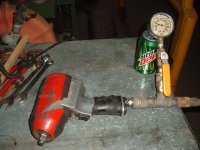
I plugged my air gun, CP734, made in USA, directly into the fitting and pressed the trigger. The regulator output psi dropped 30 psi. The CP734 air requirements are modest by today's standards. This behavior makes sense because it would always start out fast for a split second and then dog down, so the air hose was providing a brief high pressure reservoir. When I pulled the air gun, the quick disconnect wouldn't shut off so I turned it off at the ball valve. I went back into the house and read the reviews for the regulator. A lot of people liked it, and some didn't, and the ones who didn't, tended to be the ones who knew what they were doing, and had real air tools. The thought suddenly occurred to me that it is entirely possible that a guy with an 80 gallon compressor, professional shop tools, and knows how they are supposed to perform, might not be completely satisfied with a Harbor Freight $4.97 regulator with no published CFM rating, and which may have been designed for bicycle tires and aquariums. (tic)
> Part of the increase might be attributable to another reason, which I will share later...This is a pretty respectable unit. It will keep up with body work at least as hard as I would work<
I bought the compressor from guy who works as a hi-lo driver by night, and a gifted and highly productive chop shop operator by day. He said he bought it at Sam's club and had used the compressor for a few years in his shop. It ran his hoist, and being a chop shop, did a lot of body work and HVLP painting. He fired it up and said, hear that knock? That's a rod knock. I said, I don't hear a rod knock. Then he said, hear that popping? Without taking it apart, I'm pretty sure that's a bad head gasket. All I witnessed was it pumped up steadily to the shutoff pressure, so I thought I don't have to do anything to this thing because I use it only occasionally, and even as-is, it was more capable than anything I planned to buy new. The tank was worth more than $250. He was selling it because he needed the money to pick up the motor he just had rewound for a Quincy 7.5 HP he had there that he had gotten a deal on. He decided fixing that instead would give him more capacity for painting and sanding. After it was in my garage, I noticed the belt was very loose, I cleaned the air filter, which was caked full of paint residue, and changed the oil using the recommended compressor oil. It sounded different after that, and I'm guessing that what he determined to be an air leak was the noise generated by the bolts being loose on the belt guard cage. This is when I took the initial capacity measurements. I didn't have a lot of respect for the air filter, but figured they must know what they are doing. It's a well-known company and they sell a lot of these.
Fast forward a couple years. It was a very cold morning. I had just started the furnace and compressor. About the time it got to 100 psi I heard a pop followed by hissing and it stopped building pressure. I traced the hissing down to the inter-stage pressure relief valve. That usually indicates a blown head gasket or bad reed valves, which are expensive. I dreaded paying $450 for a compressor head of that size. When I pulled the head off, I discovered was it was loaded with carbon that fit the reeds so perfectly, it looked like black inserts that belonged there, except where it had broken off and jammed under a couple reed valves. The ports under the reed valves were down to about 1/2 their normal size, but the valves and seats looked good. After cleaning out the rest and determining there were no rod, piston, or any other issues, I carefully cleaned all of the paint buildup from the passages, and carbon around the reeds, seats, and exhaust, which was painstaking work. Nicking or kinking anything would have instantly added ~$275 for reconditioned reed valve plates, in addition to the $112 already required for a gasket set, which could change the whole equation. The final bath was done in the old, and now illegal, carburetor cleaner I had. However, I could not soak it for a long time like you can the old carburetors because it also eats aluminum. Tonight might be the first capacity test after cleaning it up. Carbon both helps and hinders, and I haven't spent the time to calculate if the cleanup was any part of the increase or not.
EDIT: Tonight must not have been the first capacity test after cleaning out the top end. I found an earlier measurement where it took 590 seconds, where it worked out to 13.76 SCFM. I don't need to calculate to realize that would be well outside any density altitude variations, meaning the top end work DID yield a capacity increase.
The heat of compression had been burning the over spray and paint sanding dust and depositing them as carbon on BOTH the high and low pressure sides. I never gave it a thought that compressor heads get hot enough to do that since they don't have compression like a Diesel. (As a side note, I remember the Army guys had V8 Cummins Diesel sand blasters where one bank provided power while the other had a special head to compress air.) I determined that compressors used in body-shop-type environments need paper filters for more reasons than vehicle engines. Before replacing the oil, I studied the recommended oil, and the seal composition, and determined that their recommendations were inferior to simply using Mobile 1 0W20, which would provide superior lubrication under both cold and hot conditions, and it is available more places and costs less. Since it sounds like you use your compressor for body work in what looks to be my dream of a man cave, I thought you might find this additional information useful. That's a pretty cool story on your home page about the history of your family farms.