To avoid these ads, REGISTER NOW!

Which Vertical Mill would you buy

ThomasT

Well-known member
Joined
Dec 1, 2013
Messages
58
Location
Etoile, Texas
A question to those fellows who either own or operate a Mill (vertical milling machine) and are familiar with their use and application. If you were going to buy a new Mill today for your own use in your personal work shop, which unit would it be and why? Keeping in mind cost as a major factor and it being a tool that is not used a lot. Power source will be 220 Volts Single Phase.

Second question, what would be a list of “tool / bits” that you would consider to be a must have based on the Mill having a R-8 Taper Spindle.
 
To avoid these ads, REGISTER NOW!

justanengineer

Well-known member
Joined
Apr 5, 2011
Messages
7,722
Location
Motor City
Assuming youre wanting a manual mill, I'd buy the best condition knee mill possible for the least amount possible on the used market, but admittedly I dont have $10k+ to spend on a mill and prefer to avoid the imported toys as much as possible. Please note I said imported toys, not imported mills as there is a huge difference between a full sized imported knee mill and something like an X2.
 

Slowboat

Well-known member
Joined
Nov 5, 2010
Messages
598
Location
Green Mountains
I found a Rockwell knee mill that was perfect. 110v, smaller than a Bridgeport, but still pretty big, with R-8 tooling. See if you can find one...
 

A_Pmech

Well-known member
Joined
May 8, 2007
Messages
8,002
Location
IL
If I was dead-set on a new machine and it had to be R-8 taper, I'd buy a Wells Index 847. I think it's the best new "Bridgeport-style" machine available today. IIRC, they're also a little less than a new Series 1 Bridgeport.

As far as spindle tooling, I'd buy a 14N Jacobs Super Chuck with an R-8 arbor, a collet set by 1/16", and a 3" Criterion boring head with R-8 arbor. That will handle most things anybody would want to do with a knee mill.

It will be three-phase though. :)
 

JoeFin

Well-known member
Joined
Sep 13, 2013
Messages
717
Location
NorCal - where the Rednecks Race
http://www.ebay.com/itm/INDEX-9-x-3...165?pt=US_Heavy_Equipment&hash=item20dc3587cd

Price is right

http://www.ebay.com/itm/Hurco-KM-3P...385?pt=US_Heavy_Equipment&hash=item3a812f0489

I have 1 of these but its been upgraded to the Dynapath 50 control system. Wouldn't touch any thing with a control system over 12yrs old

Nice pile of tooling though


http://www.ebay.com/itm/GORTON-MAST...317?pt=US_Heavy_Equipment&hash=item20d1a63d6d

This one is close to you and from my experience Gorton Mills are very stout

Looks clean too
 
OP
T

ThomasT

Well-known member
Joined
Dec 1, 2013
Messages
58
Location
Etoile, Texas
I found a Rockwell knee mill that was perfect. 110v, smaller than a Bridgeport, but still pretty big, with R-8 tooling. See if you can find one...

Thanks for this info. I like the Rockwell and it is the right size for my shop. It is one that is on my list to try and find.
 
OP
T

ThomasT

Well-known member
Joined
Dec 1, 2013
Messages
58
Location
Etoile, Texas
If I was dead-set on a new machine and it had to be R-8 taper, I'd buy a Wells Index 847. I think it's the best new "Bridgeport-style" machine available today. IIRC, they're also a little less than a new Series 1 Bridgeport.

As far as spindle tooling, I'd buy a 14N Jacobs Super Chuck with an R-8 arbor, a collet set by 1/16", and a 3" Criterion boring head with R-8 arbor. That will handle most things anybody would want to do with a knee mill.

It will be three-phase though. :)

Thanks for this information, the Wells is another great looking machine.
 

Adam.C

Banned
Joined
Jan 29, 2013
Messages
1,490
I don't think there is any way to beat an old Bridgeport. They have more parts available, more readily available, more tech support on web forums, and far more capability than anything new costing twice as much. They hold their value.

Only downside is moving one, which isn't as big a deal as one might think. Put out of your head any other mills and just get a Bridgeport and be done with it.

Whatever you spend on the mill,you may find you spend that much again on tooling, mods, accessories etc. You will have to find ways to not spend mo money.

In terms of tooling, everything depends on what sort of work you will be doing. To get a mill that is easily capable of sub .010" tolerances is fairly easy. You can buy chinese tooling, or worse, second hand chinese tooling. Chinese mill vises (from Enco) are decent quality vises. You can get Chinese collets and end mills inexpensively. If you are cutting easily workable materials, aluminum etc, to generous tolerances you will be fine. Enco is your friend.

Once you start thinking about sub .005" tolerances, you need to start considering the condition of the mill, it's quill, and yes, even the quality of the collets. If you are cutting steel, you would be making a mistake to buy foreign end mills. US end mills get pricey.

Bare minimum tooling would be a mill vise, hold down kit (or at least tee nuts), collets, a few end mills 1/2", 3/4", maybe a ball end or two, and a decent dial test indicator and something to hold it in. You will need wigglers, or a center finder of some sort. For manual operation you need pretty much all of the layout tools.

Next would be a fly cutter, slitting saw mandrel?, boring bars?, 1" travel dial indicator. I would invest in a surface plate to aid in layout and inspection, drill and tap kits, good quality dies?

Last would be all the other tools and a DRO. Three axis is particularly nice. Some guys have 4 axes (quill and knee). If you can get any of this at the time you purchase the mill, all the better.
 
OP
T

ThomasT

Well-known member
Joined
Dec 1, 2013
Messages
58
Location
Etoile, Texas
I don't think there is any way to beat an old Bridgeport. They have more parts available, more readily available, more tech support on web forums, and far more capability than anything new costing twice as much. They hold their value.

Only downside is moving one, which isn't as big a deal as one might think. Put out of your head any other mills and just get a Bridgeport and be done with it.

Whatever you spend on the mill,you may find you spend that much again on tooling, mods, accessories etc. You will have to find ways to not spend mo money.

In terms of tooling, everything depends on what sort of work you will be doing. To get a mill that is easily capable of sub .010" tolerances is fairly easy. You can buy chinese tooling, or worse, second hand chinese tooling. Chinese mill vises (from Enco) are decent quality vises. You can get Chinese collets and end mills inexpensively. If you are cutting easily workable materials, aluminum etc, to generous tolerances you will be fine. Enco is your friend.

Once you start thinking about sub .005" tolerances, you need to start considering the condition of the mill, it's quill, and yes, even the quality of the collets. If you are cutting steel, you would be making a mistake to buy foreign end mills. US end mills get pricey.

Bare minimum tooling would be a mill vise, hold down kit (or at least tee nuts), collets, a few end mills 1/2", 3/4", maybe a ball end or two, and a decent dial test indicator and something to hold it in. You will need wigglers, or a center finder of some sort. For manual operation you need pretty much all of the layout tools.

Next would be a fly cutter, slitting saw mandrel?, boring bars?, 1" travel dial indicator. I would invest in a surface plate to aid in layout and inspection, drill and tap kits, good quality dies?

Last would be all the other tools and a DRO. Three axis is particularly nice. Some guys have 4 axes (quill and knee). If you can get any of this at the time you purchase the mill, all the better.

Adam.C thank you so much for taking the time to really explain your thoughts. I work mostly with aluminum but do need some steel work done every once in a while. A .010" tolerances is as close as I need most of the time. Again, I thank you very much.
 

mtnwalton

Well-known member
Joined
Apr 25, 2010
Messages
210
I don't think there is any way to beat an old Bridgeport. They have more parts available, more readily available, more tech support on web forums, and far more capability than anything new costing twice as much. They hold their value.

Only downside is moving one, which isn't as big a deal as one might think. Put out of your head any other mills and just get a Bridgeport and be done with it.

Whatever you spend on the mill,you may find you spend that much again on tooling, mods, accessories etc. You will have to find ways to not spend mo money.

In terms of tooling, everything depends on what sort of work you will be doing. To get a mill that is easily capable of sub .010" tolerances is fairly easy. You can buy chinese tooling, or worse, second hand chinese tooling. Chinese mill vises (from Enco) are decent quality vises. You can get Chinese collets and end mills inexpensively. If you are cutting easily workable materials, aluminum etc, to generous tolerances you will be fine. Enco is your friend.

Once you start thinking about sub .005" tolerances, you need to start considering the condition of the mill, it's quill, and yes, even the quality of the collets. If you are cutting steel, you would be making a mistake to buy foreign end mills. US end mills get pricey.

Bare minimum tooling would be a mill vise, hold down kit (or at least tee nuts), collets, a few end mills 1/2", 3/4", maybe a ball end or two, and a decent dial test indicator and something to hold it in. You will need wigglers, or a center finder of some sort. For manual operation you need pretty much all of the layout tools.

Next would be a fly cutter, slitting saw mandrel?, boring bars?, 1" travel dial indicator. I would invest in a surface plate to aid in layout and inspection, drill and tap kits, good quality dies?

Last would be all the other tools and a DRO. Three axis is particularly nice. Some guys have 4 axes (quill and knee). If you can get any of this at the time you purchase the mill, all the better.

plus 1
 

Kevin54

MEMBER EMERITUS
Joined
Jan 12, 2005
Messages
29,341
Location
Urbana, Ohio
If you are looking for a vertical mill and shopping Fleabay and CL, you need to know what you are looking at. You can come across some great deals until it comes to possibly having to rebuild something. Then things could get rather costly.

Number one thing is that you need to hear it run. If the head is really noisy, then you are going to start getting in to the gears, possibly the variable speed, keyways wore out in the head, and maybe a total head rebuild.

After that, then you need to check and see how sloppy the table is. You need to run the table clear out to the left and see if there is play in it moving it back and forth. Then you need to do the same thing by moving the table all the way to the right. After that, you need to see how much backlash there is. It may need new nuts for the table screw.

You need to look at the overall condition of the mill itself. If it is totally filthy with caked on oil and grease, then that will tell you that the owner doesn't take care of the equipment. You want to steer away from one that ISN'T under power. You want to be able to hear it run. You want to look too as to whether the person selling it has a replacement machine or you want to know why he is selling it. If there is another mill setting there in better shape, then the owner has upgraded. If there is a room full of machines and that is the only mill, and he's telling you that he doesn't need it or never runs it, then you want to be a little leery.

Next you need to figure out how much you want to spend. If you are looking at a mill and it doesn't have a digital readout, plan on spending $1000 for one. Does the mill have power feed? If not, then you are looking at around $400+ for power feed for the "X" axis. Power feed for the "X" axis is sort of a necessity today unless you are just making little parts.

You need to ask where the mill came from when the seller bought it. If it came out of a factory, ask about the background of it. What sort of materials were ran on it. Look at the tag on back and see if there is a year as to when it was new. Look and see if the mill has an oiler on it. Ask if there is any other tooling that comes with it. You could run into a few hundred just getting a 6" vise to use on it.

Then you have to consider the additional cost of a Phase Converter if the mill is a three phase. A PC can be picked up relatively cheap, but you will also need to consider how much you are going to invest in wiring. It may cost between $100 to wire it up, to $1000 if you need a Phase Converter, hire an electrician, buy your supplies, and so on.

And finally, the tooling. You most definitely need a mill vise. Then you will need collets. After that, you need to shop around for endmills....both standard endmills, then ballnose endmills. You will need to buy a clamping setup which consist of T-nuts, clamps, studs, nuts, step blocks. A clamping kit will run you around $50 and up.

Good luck in finding what you need, and what you intend to do with it, but shop wisely. If you've went this long without a mill, don't think that the first one you come across will be the right one. And the ones you look at, make sure you check it out thoroughly, especially for any slop in things. For everything that may be wrong, is just some more money and time that comes out of your pocket.

And finally......Post up some pics of what you decide on. And again....good luck!!!!!
 
OP
T

ThomasT

Well-known member
Joined
Dec 1, 2013
Messages
58
Location
Etoile, Texas
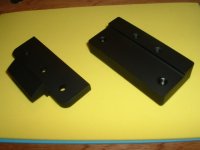
Adam.C here are 3 photos of some steel parts that I had a shop make for my Field Truck Cab. Two Striker Plates for the door latches and six Hinge Blocks for the inside for all 6 door hinges. Cost me almost $300.00 and took almost 2 months. It's not just the cost but I would much rather do all my own work. As soon as I sell this Truck, I plan to build a Speedster from scratch with all aluminum body and there will be a lot of custom parts to be built and the Mill will come in very handy. again thank you for your help
 

Attachments

  • 6-010.JPG
    6-010.JPG
    118.5 KB · Views: 49
  • 6-013.JPG
    6-013.JPG
    115.4 KB · Views: 41
  • 6-015.JPG
    6-015.JPG
    121.7 KB · Views: 41
OP
T

ThomasT

Well-known member
Joined
Dec 1, 2013
Messages
58
Location
Etoile, Texas
If you are looking for a vertical mill and shopping Fleabay and CL, you need to know what you are looking at. You can come across some great deals until it comes to possibly having to rebuild something. Then things could get rather costly.

Number one thing is that you need to hear it run. If the head is really noisy, then you are going to start getting in to the gears, possibly the variable speed, keyways wore out in the head, and maybe a total head rebuild.

After that, then you need to check and see how sloppy the table is. You need to run the table clear out to the left and see if there is play in it moving it back and forth. Then you need to do the same thing by moving the table all the way to the right. After that, you need to see how much backlash there is. It may need new nuts for the table screw.

You need to look at the overall condition of the mill itself. If it is totally filthy with caked on oil and grease, then that will tell you that the owner doesn't take care of the equipment. You want to steer away from one that ISN'T under power. You want to be able to hear it run. You want to look too as to whether the person selling it has a replacement machine or you want to know why he is selling it. If there is another mill setting there in better shape, then the owner has upgraded. If there is a room full of machines and that is the only mill, and he's telling you that he doesn't need it or never runs it, then you want to be a little leery.

Next you need to figure out how much you want to spend. If you are looking at a mill and it doesn't have a digital readout, plan on spending $1000 for one. Does the mill have power feed? If not, then you are looking at around $400+ for power feed for the "X" axis. Power feed for the "X" axis is sort of a necessity today unless you are just making little parts.

You need to ask where the mill came from when the seller bought it. If it came out of a factory, ask about the background of it. What sort of materials were ran on it. Look at the tag on back and see if there is a year as to when it was new. Look and see if the mill has an oiler on it. Ask if there is any other tooling that comes with it. You could run into a few hundred just getting a 6" vise to use on it.

Then you have to consider the additional cost of a Phase Converter if the mill is a three phase. A PC can be picked up relatively cheap, but you will also need to consider how much you are going to invest in wiring. It may cost between $100 to wire it up, to $1000 if you need a Phase Converter, hire an electrician, buy your supplies, and so on.

And finally, the tooling. You most definitely need a mill vise. Then you will need collets. After that, you need to shop around for endmills....both standard endmills, then ballnose endmills. You will need to buy a clamping setup which consist of T-nuts, clamps, studs, nuts, step blocks. A clamping kit will run you around $50 and up.

Good luck in finding what you need, and what you intend to do with it, but shop wisely. If you've went this long without a mill, don't think that the first one you come across will be the right one. And the ones you look at, make sure you check it out thoroughly, especially for any slop in things. For everything that may be wrong, is just some more money and time that comes out of your pocket.

And finally......Post up some pics of what you decide on. And again....good luck!!!!!

Kevin54 more greatly needed information that I appreciate. I am almost 73 and built my first Hot Rod when I was 15 and have never owned a Mill so I am in no hurry. This is why I am asking here to get this on hand and expert advise from fellows like you. I will be building a new shop and will plan out every major piece of equipment and where it will be located. I did this on my last shop and it sure made life better. Thanks for you help.
 

bkcorwin

Active member
Joined
Jul 10, 2013
Messages
32
your location may impact your options some as prices for mills fluctuates geographically as well as availability. Where I am the name bridgeport commands a price increase.

If you are looking new, then I would seriously think about the previously mentioned wells index 847. I understand they are very well built, and as a plus, still in business and doing repairs/selling parts.

It is not nearly as simple as buy an old bridgeport. Condition is king, and I have seen some completely clapped out bridgeports for sale. I'd take a good condition wells-index, tree, lagun, etc over a worn out 50s bridgeport.
 
OP
T

ThomasT

Well-known member
Joined
Dec 1, 2013
Messages
58
Location
Etoile, Texas
your location may impact your options some as prices for mills fluctuates geographically as well as availability. Where I am the name bridgeport commands a price increase.

If you are looking new, then I would seriously think about the previously mentioned wells index 847. I understand they are very well built, and as a plus, still in business and doing repairs/selling parts.

It is not nearly as simple as buy an old bridgeport. Condition is king, and I have seen some completely clapped out bridgeports for sale. I'd take a good condition wells-index, tree, lagun, etc over a worn out 50s bridgeport.

Yep, you are 100% correct and I do not have the time to "re-build" a Mill. I am not in a rush, which is good, so I can take my time and shop around. Thank you
 

Strouty

Well-known member
Joined
Mar 21, 2010
Messages
38,212
Location
Southern Maine
If I was dead-set on a new machine and it had to be R-8 taper, I'd buy a Wells Index 847. I think it's the best new "Bridgeport-style" machine available today. IIRC, they're also a little less than a new Series 1 Bridgeport.

As far as spindle tooling, I'd buy a 14N Jacobs Super Chuck with an R-8 arbor, a collet set by 1/16", and a 3" Criterion boring head with R-8 arbor. That will handle most things anybody would want to do with a knee mill.

It will be three-phase though. :)

What does the 14N designate? I have seen a lot of numbers, I am in the market for one too!

So I figured out that it designates the capacity of the chuck, what does the 3JT mount mean?

I am just a master of google today! I think it is the series of taper # 3 Jacobs Taper? Can you just get any R8 collet adapter that has the right taper or should you buy some super high end brand when using the drill chuck?
 
Last edited:

A_Pmech

Well-known member
Joined
May 8, 2007
Messages
8,002
Location
IL
What does the 14N designate? I have seen a lot of numbers, I am in the market for one too!

So I figured out that it designates the capacity of the chuck, what does the 3JT mount mean?

I am just a master of google today! I think it is the series of taper # 3 Jacobs Taper? Can you just get any R8 collet adapter that has the right taper or should you buy some super high end brand when using the drill chuck?

Google Fu is strong with this one! :D

A good quality arbor is always best. NOS Jacobs arbors are a good bet from Ebay.
 
To avoid these ads, REGISTER NOW!

zkling

Well-known member
Joined
Jan 23, 2007
Messages
16,939
:+1: On the wells mills. They are nice and USA, I don't know what the going rate today is though. What is the top end of the budget? Are you wanting DRO, power feed, power draw bar and all that jazz?

Heads up though, tooling up with all new good quality tooling is going to be $$$$


What does the 14N designate? I have seen a lot of numbers, I am in the market for one too!

So I figured out that it designates the capacity of the chuck, what does the 3JT mount mean?

Model number, taper size.
 
Last edited:

justanengineer

Well-known member
Joined
Apr 5, 2011
Messages
7,722
Location
Motor City
If youve got a decent budget, something to be aware of is that some mills like the Bridgeport Series I hasnt really changed in decades and there are still quite a few professional machine rebuilders in this country. JMHO, but before I'd spend $2500+ on a used mill in ok condition and appearance from a shop/private owner I'd seriously consider $3500-4500 on one thats had the ways reconditioned to like-new, been gone through completely mechanically, and also had a decent paint job by a rebuilder.

Regarding drill chuck and machine arbors, with R8 the arbor isnt hugely important IMHO as the machine isnt super stiff to begin with. Even a novice machinist should be able to turn a 1/2" or 3/4" straight shank arbor with the JT2 taper on one end and thats all thats really needed for most chucks and cutters.
 

bkcorwin

Active member
Joined
Jul 10, 2013
Messages
32
Not that I am an expert, but i'd guess that mill is a pretty early one early 60s late 50s. The powerfeed is the old style gear box one. People seem to like them, but I know that my friend's is pretty crappy. 3 phase motor on the power feed.

Bridgeport mill can be "dated" by the serial on the top of the knee at the front,
http://www.metalwebnews.com/howto/bridgeport/bridgeport.html
 
OP
T

ThomasT

Well-known member
Joined
Dec 1, 2013
Messages
58
Location
Etoile, Texas
:+1: On the wells mills. They are nice and USA, I don't know what the going rate today is though. What is the top end of the budget? Are you wanting DRO, power feed, power draw bar and all that jazz?

Heads up though, tooling up with all new good quality tooling is going to be $$$$


Model number, taper size.

zkling I haven't set a hard budget, but more based on what unit I decided on getting. I have priced "tools" from MSC so I am prepared to a degree for that expense.
 

bkcorwin

Active member
Joined
Jul 10, 2013
Messages
32
If youve got a decent budget, something to be aware of is that some mills like the Bridgeport Series I hasnt really changed in decades and there are still quite a few professional machine rebuilders in this country. JMHO, but before I'd spend $2500+ on a used mill in ok condition and appearance from a shop/private owner I'd seriously consider $3500-4500 on one thats had the ways reconditioned to like-new, been gone through completely mechanically, and also had a decent paint job by a rebuilder.

Regarding drill chuck and machine arbors, with R8 the arbor isnt hugely important IMHO as the machine isnt super stiff to begin with. Even a novice machinist should be able to turn a 1/2" or 3/4" straight shank arbor with the JT2 taper on one end and thats all thats really needed for most chucks and cutters.

This is a prime example of how location matters. In the NW there is no way you could find a rebuilt/refurbished bridgeport for 3500-4500 bucks. I know of a guy who does it in northern california but I heard he wants 8+ grand for one.
 
OP
T

ThomasT

Well-known member
Joined
Dec 1, 2013
Messages
58
Location
Etoile, Texas
Not that I am an expert, but i'd guess that mill is a pretty early one early 60s late 50s. The powerfeed is the old style gear box one. People seem to like them, but I know that my friend's is pretty crappy. 3 phase motor on the power feed.

Bridgeport mill can be "dated" by the serial on the top of the knee at the front,
http://www.metalwebnews.com/howto/bridgeport/bridgeport.html

bkcorwin thanks for this link, I will print out this serial number page.
 

oldtools

Well-known member
Joined
Sep 15, 2008
Messages
2,706
I will take a Deckel FP1 or FP2 over a Bridgeport, but I will gladly take a Bridgeport as well.
 

justanengineer

Well-known member
Joined
Apr 5, 2011
Messages
7,722
Location
Motor City
This is a prime example of how location matters. In the NW there is no way you could find a rebuilt/refurbished bridgeport for 3500-4500 bucks. I know of a guy who does it in northern california but I heard he wants 8+ grand for one.

How many and which rebuilders have you inquired with? Ive seen a few rebuilds on PM that suggest grinding/scraping prices out west are pretty comparable to those back east, but admittedly dont know of any that stock machines. I did however bring back a suitcase full of tooling my last trip out by Seattle, so theres definitely deals out there.

Worst case, freight costs are pretty cheap compared to getting ripped off if you cant find something better local. Dealing with a distant business is fairly easy most of the time. Get a few recommendations from the guys over on practicalmachinist as to a reputable rebuilder, and write a check. If youre a hands-on buyer, pack a suitcase and start driving. $1k and a weekend of time could save you thousands and get a far better machine.
 

rodm1

Well-known member
Joined
Feb 17, 2008
Messages
2,270
Really in a home shop I think any name brand knockoff of the Bridgeport will be fine if new. My first choice would be a Clausing Kondia mill second would be a Bridgeport. But you are going to have this machine for a very long time why go cheep on it?
 
Last edited:

Kevin54

MEMBER EMERITUS
Joined
Jan 12, 2005
Messages
29,341
Location
Urbana, Ohio
There are quite a bit of good mills that are similar to Bridgeports. Myself, I have a Lagun in the garage. At work we had Alliants and BP's. I ran an Alliant Mill since '85 and probably 15 years ago it was retrofitted with a ProtoTrak 2 axis CNC unit. I think the Alliants had less downtime on them than the BP's had.

A good used BP, Lagun, Alliant, should be able to be bought with a readout and possible powerfeed on the "X" axis for around $4000 tops. I paid $2800 for my Lagun and it is in excellent shape, has an older readout, but no power feed. One member on here just bought a BP CNC that had a ProtoTrak retrofit from a friend up near Cleveland, and I think he paid $8000 for it. Not a bad price.
 
OP
T

ThomasT

Well-known member
Joined
Dec 1, 2013
Messages
58
Location
Etoile, Texas
First off, I really do appreciate the time and effort and knowledge shared by everyone, but let me approach the Mill question in another way. Lets say a really good condition BP, Rockwell, etc. were not available to me at my location when my shop is completed, but I could buy (for an example only) a brand new Shop Fox M1001 at a really good price. What would be the “good” and “bad” points to consider (other than it is foreign made) or any other brand that would be a much better choice? This is a learning curve for me and again I appreciate your knowledge.
 

ruquik

Well-known member
Joined
Feb 7, 2012
Messages
62
Location
Greenwood, DE
Also, if you come across a box or square way mill don't think it is not as good as dove tail ways. A lot of people seem to get that impression.

-Brad
 

Kevin54

MEMBER EMERITUS
Joined
Jan 12, 2005
Messages
29,341
Location
Urbana, Ohio
First off, I really do appreciate the time and effort and knowledge shared by everyone, but let me approach the Mill question in another way. Lets say a really good condition BP, Rockwell, etc. were not available to me at my location when my shop is completed, but I could buy (for an example only) a brand new Shop Fox M1001 at a really good price. What would be the “good” and “bad” points to consider (other than it is foreign made) or any other brand that would be a much better choice? This is a learning curve for me and again I appreciate your knowledge.

I looked at the Shop Fox that you posted. That mill is basically a benchtop mill with an added base. If you look at the table size, it is only 6" x 26" which is not very big. For a little more money, you could step up to a true knee mill from JET. For $5700 (vs. $4889 for the Shop fox) You would get a better mill, and a larger mill. You would have to get a phase converter though or a VFD as the JET is a 3 phase mill. And JET has a pretty good reputation. II own a JET lathe and am very satisfied with it.

But don't give up looking online. I think you have more machinery out your way than we do our way. If you aren't in a big hurry, one should pop up. Even if it takes a day to drive there and back, there's nothing wrong with a road trip.

And in getting a mill, whether a new or a used mill, you want to get one that you can readily get parts for. Bridgeports, Alliants, Laguns, ExCello, and so on, parts are still available. The Shop Fox that you are looking at is sold through Northern tool, so it may make it harder to get parts. JET is sold by a few places, and those places carry parts or can readily get parts. I bought my JET through Tools-Plus www.tools-plus.com They are an excellent company to deal with. I negotiated free shipping from them when I bought my lathe.

And don't overlook Grizzly either. I've not heard any bad about them.

You want to look for a mill that parts are available, that has a good reputation, and also a mill that has a decent size to it. A large mill can make small parts way easier than a small mill can make large parts. A knee mill the size of a Bridgeport can almost handle anything you can imagine. It may take a few ingenious setups, but you can get it done.
 
OP
T

ThomasT

Well-known member
Joined
Dec 1, 2013
Messages
58
Location
Etoile, Texas
Kevin54, thanks just looked at the specs on the Jet and the Grizzly, both are more machines than the Fox. The Grizzly has a few more features and is the heaviest by weight than all the others.
 

Kevin54

MEMBER EMERITUS
Joined
Jan 12, 2005
Messages
29,341
Location
Urbana, Ohio
One thing to remember about tooling, you can spend a fortune, or you can spend very little and get the same results. When I say tooling, I am talking about perishable tooling. End mills. A person can get by with a $3 HSS end mill the same as a $30 HSS end mill. Enco, MSC, Travers, they always run sales on HSS tooling. That is where you have to know your material, your machine, and your tooling.

Every machine is different. Every machine has it's own personality or characteristics. I always told the ones that I trained to run machines that they "Have to become one with the machine". They'd laugh, but they would finally realize what I was saying. A person can tell what a machine is doing more by listening to it than by watching it. Two machines can be built on the same day, using the same exact parts, and built by the same person. But both machines will have slightly different characteristics from one another. One may have .005 more backlash in one axis than the other. And most people think that .005 is nothing. Cellophane from a cigarette pack is .002 thick. A piece of notebook paper is roughly .003 thick, and yes, there is a difference between a red hair and a brown hair, hence the saying...."just move it a red one".

If a person has a fixture to build, the fixture will have dowel pins to properly locate component parts. Take two mills, brand new, built on the same day, by the same person. Drill all of your dowel holes that will receive the dowels in one mill. Next drill all of the mating holes that you are pressing the dowels in with the other mill. 75% of the time, the parts will not slip fit together. So anytime that a person builds a fixture, and are using very close tolerance dimensions, you want to make all of the components off of one machine it possible.

So when a person "becomes one with the machine", you will find out what characteristics that machine has, and it WILL speak to you. You have to listen to what it says. When cutting a piece of material, does the motor change sound when you enter a cut. Does a gear make a little noise. Does the table seem to jump slightly when cutting the material. When you look at the cut you just made, can you read the cut to see why it looks the way it looks. When making cuts, and I mentioned to "become one with the machine", you also need to become "One with the tooling". You need to see in your mind what the endmill is doing when it is cutting material. Any endmill will flex. Even a 1.000 diameter carbide endmill, as rigid as they are, will flex some when in a collet. It may not be a lot of flex, but depending on the depth of the cut, and the type of mill, the direction of the cut, it all has a direct impact on how the part turns out. In using both a "climb cut" and a "conventional cut", one will pull the cutter into the part and the other will push the cutter away from the part.

Depending on how much one will be using a mill, and what sort of materials will most be likely to be ran on the mill, instead of a "Knee Mill" where the bed cranks up and down, one may want to look at a bed mill with boxed ways. The table height is stationary, and only moves in "X" & "Y" direction and not in the "Z" direction. The "Z" direction comes from the head moving up and down. A bed mill is a more rigid mill because of this. A knee mill has locks. Once you have your "Z" height set, you tighten up the locks that will pull the knee back to the dovetails. Depending on how loose the mill table ("Z" axis) was when tramming it in, things could change by quite a few thousandths after tightening the locks up.

Learning to run a mill is not a hard thing to do as long as you "become one" with the mill, the tooling, and learn to listen to what it tells you. For me, I had a couple jobs as a Tool Designer, but I absolutely HATED sitting behind a desk day after day. I love machining and never once got tired of it. Taking a piece of square or round metal, and making something from it is just a great feeling. Our main business was aircraft lighting. The person that started the company was Warren G. Grimes.

http://en.wikipedia.org/wiki/Warren_G._Grimes

http://nationalaviation.org/grimes-warren/

He was pretty much the main guy that started putting lights on aircraft. I've designed tooling for the manufacturing of the lights, I've built the tooling for the manufacturing of the lights, and I've built prototypes of the lights theirself that have went on the aircraft.

Anyways....I guess I really ventured off track. I love talking about our company and what it has done over the years. And it really makes me proud to see a plane fly overhear at night and knowing that we literally have a few hundred lights on that plane. It's a feeling like no other.

So I want to apologize for rambling on. We were talking about mills, and here I am flying around in the clouds. :lol:
 

Jim Johnstone

Well-known member
Joined
Apr 11, 2011
Messages
1,841
Location
Brantford, Ontario
When I am in the market for a mill at home I will be searching for a used prototrak in good condition.

Another really nice mill to add to the list is excello (xlo depending on the age). They are more stoutly built that Bridgeports and also are north American made (made in London Ontario)

Sent from my SGH-I727R using Tapatalk 2
 
OP
T

ThomasT

Well-known member
Joined
Dec 1, 2013
Messages
58
Location
Etoile, Texas
Hey Kevin54, I would be willing to say that more people than myself enjoyed and learned from your “ramblings”. I always appreciate anyone that will put a positive view on a subject. I hear and read too much of the condescending statements people make today. My daddy always told me that a bucket of honey will draw more flies than a bucket of bulls**t, he was a simple but honest man.
 

ezzzzzzz

Well-known member
Joined
Jan 25, 2012
Messages
359
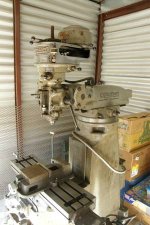
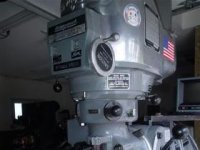
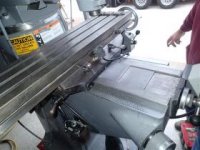
My first purchase was at an open air auction. I bought a very old BP (round ram style) without hearing it run. When I powered it up at home it was obvious that it was is horrible condition. I rebuilt the head and replaced the leadscrew nut. It was a nice machine after that and I learned a lot about the inner workings but at a high price. I second BP Series I (1994) was bought at auction (www.govdeals.com, but there's also www.publicsurplus.com) from the National Neutron Laboratory in Oak Ridge, Tenn. I never heard it run either but took my chances considering the ownership. I paid $6200 plus 1200 mile round trip from Va to retrieve it. A VFD was added at another $300 approximately. Despite the hour meter showing 30K it runs like a new machine. That said, I'd look long and hard and invest in the best you can get. It's the difference between buying a rusty piece of **** project car or one that is 90% and only needs a good polish.
 

Attachments

  • bp 8.jpg
    bp 8.jpg
    9.8 KB · Views: 25
  • bp 7.jpg
    bp 7.jpg
    12.1 KB · Views: 16
  • bp 6.jpg
    bp 6.jpg
    10 KB · Views: 23
  • bp 4.jpg
    bp 4.jpg
    13.4 KB · Views: 26
  • bp 3.jpg
    bp 3.jpg
    10.7 KB · Views: 23
  • bp 1.jpg
    bp 1.jpg
    12.5 KB · Views: 28
  • bp 2.jpg
    bp 2.jpg
    10.4 KB · Views: 18
To avoid these ads, REGISTER NOW!
Top Bottom