

chicagocat
New member
- Joined
- May 21, 2010
- Messages
- 4
Hello all,
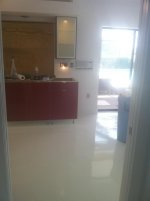
I’ve been lurking here for a few months trying to learn more about epoxy and polyurea floors. The project is not a garage, it’s a vacation house in Florida. My idea is to have very modern, high gloss white floors. I am doing the entire house (1800 sf) as essentially a single floor. After talking to several vendors and getting quotes and reading a bunch here, I decided to go with a local Florida floors guy who works with polyaspartics from Crown (located outside Chicago). He had excellent references.
The house previously was just padding and carpet (and some tile), over a concrete slab. The kitchen tile was pretty tough to get out and the mastic was pretty nasty. So the contractor decided to sand, then patch using one of Crown’s patching compounds, then use Crown’s #315 self leveling epoxy to get a flat surface. That worked pretty well, but not perfectly.
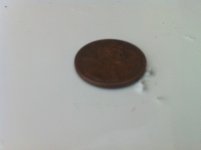
After that, they applied Crown’s #333 white polyaspartic polyurea. That seems to be where the problems began. The first time they did it, there were sharp bumps of either dust or dried epoxy everywhere (maybe 10 per sf). I’ve attached a picture for reference. In addition, there were parts where the polyurea didn’t seem to cover the self leveling underlayer (which is slightly gray). This resulted in quarter-sized gray spots (not too many, maybe 20 over the whole floor).
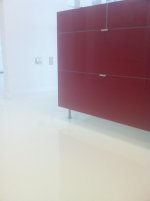
They then came back and sanded and recoated the floor with the #333 again. This time there were far fewer bumps (I suspect a bad roller and dust on the first coat). However, there were still some gray spots and indentations from bucket marks (semicircular marks, I’ve attached a pic). They then came back to patch the indentations and repaint them with the polyurea. After watching then try to do this, I got nervous. They use some kind of epoxy patch (from Crown), that’s light gray. For whatever reason, the white top coat (#333)simply wouldn’t cover the patch. The gray just kept showing through. Also, the places with new paint were very clearly distinguishable and stood out.
It’s now been decided that we should patch and resand and recoat the entire floor. My concern is that we’re just doing the same thing over again, and that we’ll get gray spots where the self leveler shows through and some bumps as well. In addition, there is a fair amount of orange peel effect (not terrible, but it’s there).
I realize that a glossy white floor like this is a very difficult job, and that I can’t expect perfection. That said, I chose the most expensive of the bids, and I’m paying quite a high rate ( higher than most stone tiles, for example). The contactor has been great about trying to fix the problems, but I feel like we’re going in circles.
Anyway, any thoughts would really great.
Thanks
I’ve been lurking here for a few months trying to learn more about epoxy and polyurea floors. The project is not a garage, it’s a vacation house in Florida. My idea is to have very modern, high gloss white floors. I am doing the entire house (1800 sf) as essentially a single floor. After talking to several vendors and getting quotes and reading a bunch here, I decided to go with a local Florida floors guy who works with polyaspartics from Crown (located outside Chicago). He had excellent references.
The house previously was just padding and carpet (and some tile), over a concrete slab. The kitchen tile was pretty tough to get out and the mastic was pretty nasty. So the contractor decided to sand, then patch using one of Crown’s patching compounds, then use Crown’s #315 self leveling epoxy to get a flat surface. That worked pretty well, but not perfectly.
After that, they applied Crown’s #333 white polyaspartic polyurea. That seems to be where the problems began. The first time they did it, there were sharp bumps of either dust or dried epoxy everywhere (maybe 10 per sf). I’ve attached a picture for reference. In addition, there were parts where the polyurea didn’t seem to cover the self leveling underlayer (which is slightly gray). This resulted in quarter-sized gray spots (not too many, maybe 20 over the whole floor).
They then came back and sanded and recoated the floor with the #333 again. This time there were far fewer bumps (I suspect a bad roller and dust on the first coat). However, there were still some gray spots and indentations from bucket marks (semicircular marks, I’ve attached a pic). They then came back to patch the indentations and repaint them with the polyurea. After watching then try to do this, I got nervous. They use some kind of epoxy patch (from Crown), that’s light gray. For whatever reason, the white top coat (#333)simply wouldn’t cover the patch. The gray just kept showing through. Also, the places with new paint were very clearly distinguishable and stood out.
It’s now been decided that we should patch and resand and recoat the entire floor. My concern is that we’re just doing the same thing over again, and that we’ll get gray spots where the self leveler shows through and some bumps as well. In addition, there is a fair amount of orange peel effect (not terrible, but it’s there).
I realize that a glossy white floor like this is a very difficult job, and that I can’t expect perfection. That said, I chose the most expensive of the bids, and I’m paying quite a high rate ( higher than most stone tiles, for example). The contactor has been great about trying to fix the problems, but I feel like we’re going in circles.
Anyway, any thoughts would really great.
Thanks
Attachments



Last edited:
