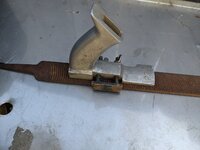
Reading the patent, inventor claims flat filing, and clamping the file on edge (which had not crossed my mind) for cleaning a slot which would have been 'milled' with a cape chisel. Both very applicable to metalwork although less Common with the rise of cheap machine tools.
Mine could have been made right from the parent drawing aside from having 2 guide rods instead of one. I have not tried to file all day but it seems to grip with total security. I don't think the front part is missing, there is nowhere to attach it, and it feels solidly functional as-is.
I'm thinking the cat aluminum grip puts production mod century or a little later. The dynamic jaw looks to be brazed to the guide rods . The company mentioned in the patent may have gone on to make compressors and air tools, but I have not established that continuity.
Great find! And useful too. It inspired just the kind of analytical distraction I needed this morning. Thanks for posting it.
I agree that the construction looks mid-century. It was probably seen as an accessory to a tool. many such accessories have no branding marks. I must have well over a dozen different vintage wood file handles in the shop, but none of them have any mfr markings, even on the ferrules. You might have to find a NIB example to ID the maker.
With regard to the thoughts of perhaps needing a second front 'knob' part, I think there may be a number of tool conventions that might be conceptually distracting. The patent drawing shows it mounted close to the file tang, but that may be primarily to show it's indeed a file while keeping with the scale of the drawing so the tang isn't located somewhere off the drawing area. We also expect a normal file handle to be at the tang end, which leads us to think about it in this way. The handle design is much like the tote on a wood plane, again causing us to anticipate a knob at the other end. Too, we use many tapered files where the only square or parallel section is near the tang. Many modern file holders often used for body work have handles at both ends, which further directs our expectations.
However, I get a different impression from this handle. I think about how a traditional woodworker uses a plane to flatten and level a large area of wood (a remarkable skill and art form that has always eluded me). The handle leads me to think that its primary use might be to similarly level a large metal surface, otherwise a standard file handle would be more practical. So I picture this singular handle being more practically mounted at the center of the file where the cutting angle and applied pressure could be most effectively kept level to the work surface. Of course, it could be mounted anywhere along the file length for a particular job, whereas a center mount might seem at first to be counter-intuitive. But for leveling a large area by hand, a center mounting would make the most of this handle's unique utility.