To avoid these ads, REGISTER NOW!

Whole-House Surge Protectors

FlyBy

Well-known member
Joined
Feb 26, 2008
Messages
407
Location
NE Ohio
So I'm getting ready to renovate my grandparents old house come spring time and I've been looking into a lot of things that I want to put in my own house someday. You'd figure with my grandfather being an electrical engineer, that his house would be perfect in the wiring world (too bad it isn't).

What I'm looking at are breaker panel mounted surge protectors that cover all the circuits in a panel. Anyone have any experience or have them in their own homes?

1. Are they worth it?
2. Does this eliminate the need for surge suppressors on major electronic devices (PC's, tv's, etc)
 
To avoid these ads, REGISTER NOW!

porcupine73

Well-known member
Joined
Jan 22, 2008
Messages
576
Location
Buffalo, NY USA
I've got that sort of device on a couple of my panels. They can help protect against surges coming in the power mains. But due to wave propagation / standing waves, they may not necessarily completely protect other circuits from surges coming in another circuit, such as a lightning strike coming in a TV antenna.

I've thrown out all my plastic surge protectors because they can be fire hazards. The MOV's start to conduct after they take enough surge hits and eventually can melt the plastic case and even start on fire.
 
Last edited:

Stuart in MN

Well-known member
Joined
Sep 8, 2005
Messages
23,439
Location
Minneapolis
They can be worth installing, but they don't necessarily eliminate the need for individual surge suppressors. They'll help diminish surges that come in on the service line, but if for instance lightning strikes the house directly it will bypass the whole house suppressor - that's where individual suppressors can come in handy.
 
OP
F

FlyBy

Well-known member
Joined
Feb 26, 2008
Messages
407
Location
NE Ohio
I've thrown out all my plastic surge protectors because they can be fire hazards. The MOV's start to conduct after they take enough surge hits and eventually can melt the plastic case and even start on fire.

I know house fires all too well. My grandfather's company was forensic electrical engineering dealing with loss analysis. I don't have any old strips laying around or connected to expensive equipment, too risky with age.
 

PRH44

Well-known member
Joined
Dec 25, 2009
Messages
563
Location
Indiana
Keep the leads as short as possible is the key best protection. be sure to put the devices on the exterior of the panel. The built in models are good but when they blow they do alot of damage to the panel. Any valued equipment should have its own protection. In this case more is better
 

rlitman

Well-known member
Joined
Oct 18, 2010
Messages
24,771
Location
Long Island
Keeping the leads as short as possible is less important than how you route the leads. You want them to not have any kinks, and to take widely radiused turns. These work best when they're farthest from the main breaker in the panel, and require a very good grounding system.

Oh, and for those saying they don't protect you if your house is directly struck by lightning: true, but neither do surge strips. If you take a direct lightning hit, you're making an insurance claim. Plain and simple.
 

Stuart in MN

Well-known member
Joined
Sep 8, 2005
Messages
23,439
Location
Minneapolis
Oh, and for those saying they don't protect you if your house is directly struck by lightning: true, but neither do surge strips. If you take a direct lightning hit, you're making an insurance claim. Plain and simple.

Yes, it's true you can't absolutely prevent damage, but you'll have a better chance with multiple levels of protection.
 

The Lazy Destroyer

Well-known member
Joined
Jun 1, 2011
Messages
181
Location
Woodstock GA
The newest issue of the Family Handyman has an article on this but I haven't yet read through it, but it talks about installation and benefits, etc.
 

toyotadriver

Well-known member
Joined
Dec 30, 2010
Messages
1,586
I have this installed in my shop and plan to install the same in the house when we build it.

P9070007.jpg
 

NLBUILDER

Member
Joined
Feb 24, 2011
Messages
14
Location
Newfoundland, Canada
Being and Electrical Technologist who does forensic investigations with our provincial utility, I can say they do work. As mentioned above, they do not eliminate the need for "layers" of protection. I would also recommend using a small UPS (uninterruptable power supply) on large items such as servers, LCD TV's and the like. Eaton makes a real nice compact unit that's available at Costco.

Merry Christmas Everyone!
 

malibu101

Well-known member
Joined
Jul 1, 2005
Messages
3,910
Location
Walnutport PA
Being and Electrical Technologist who does forensic investigations with our provincial utility, I can say they do work. As mentioned above, they do not eliminate the need for "layers" of protection. I would also recommend using a small UPS (uninterruptable power supply) on large items such as servers, LCD TV's and the like. Eaton makes a real nice compact unit that's available at Costco.

Merry Christmas Everyone!

May I ask why the UPS? I guess I understand a server but why a TV? Surge protection is fully understandable but why UPS?
If I'm watching TV and the power goes out-so what the TV goes off. I have an LED TV and if the breaker pops (it has happened with the wife plugging in a heater) it does not come back on until the power button is pushed.
Thanks for any info.
 

gatchel

Well-known member
Joined
Dec 12, 2009
Messages
672
Location
West of King of Prussia, PA
May I ask why the UPS? I guess I understand a server but why a TV? Surge protection is fully understandable but why UPS?
If I'm watching TV and the power goes out-so what the TV goes off. I have an LED TV and if the breaker pops (it has happened with the wife plugging in a heater) it does not come back on until the power button is pushed.
Thanks for any info.

The ups is a sacrificial piece of insurance. The idea is that the UPS also has surge protection built in, which is good. The better part is that the UPS monitors line voltage and will disconnect the incoming voltage when there are power issues and it won't reconnect it until the voltage is within safe range. It really depends on the cost of the TV , I guess. If you have a $400 walmart TV it doesn't make much sense using a $200 UPS. On a $2000 TV it might be worth having.


I Use Ditek whole house surge protectors with Ditek DTK-8FF surge strips in key locations. I use APC UPS' on my TV/Home Theater equipment, my alarm panel and accessories, and on my computers / servers. It's cheap insurance. Once again there is no guarantee, but something is better than nothing.

I have worked with surge protection in various forms in the security industry for 15 years. I can tell you that it does work.
 

NLBUILDER

Member
Joined
Feb 24, 2011
Messages
14
Location
Newfoundland, Canada
Yes, well said gatchel. The UPS will always provide constant "clean" power regardless of the input, and when the input becomes unuasble it will provide it's own power, and disconnect from the main supply.

The whole idea is to use the UPS to constantly filter and condition the power from the UPS, not to watch TV when the main power is out. My home theater has a 2K plasma, so $138.00 UPS is cheap insurance.
 

malibu101

Well-known member
Joined
Jul 1, 2005
Messages
3,910
Location
Walnutport PA
Thanks for the info on UPS's!!!!!
I guess over my holiday vaction I will be shopping for a UPS.
As was said by NLBUILDER losing a UPS is cheaper than losing my new $1K 60" LED TV.
 
To avoid these ads, REGISTER NOW!

malibu101

Well-known member
Joined
Jul 1, 2005
Messages
3,910
Location
Walnutport PA
I do NOT want to derail this post but may I ask.....
What is everyones thought on surge protection on the incoming cable from the cable company. It is grounded at the NID on the outside of the house but that's it.
Should there be (is there even such a thing) a surge suppressor on the incoming coax?
I'm now giving a bit more thought to my new bigscreen after reading a few things here.
 

rlitman

Well-known member
Joined
Oct 18, 2010
Messages
24,771
Location
Long Island
The UPS will always provide constant "clean" power regardless of the input, and when the input becomes unuasble it will provide it's own power, and disconnect from the main supply.

This UPS "clean" power myth isn't entirely true.
Just about all UPS's in the size range that plugs into a 110V outlet are of the "standby" type. Those pass line voltage directly through (with a couple of MOV's in the system for surge protection, but usually nothing more than can be found in a $10 surge strip). When the power goes out, they start up their inverter, and connect that to the output, usually in well less than one cycle, but it takes FAR longer for this switchover to occur (a few milliseconds), than the time it takes for a surge to strike (on the order of picoseconds). The "voltage correction" feature on the better models of this type uses a 1:1 transformer between the input and output, with two extra taps to bring it up or down a few percent during an overvoltage or brownout. If you didn't have that feature, it would just switch to battery during these conditions, so this is more important for staying online during a brownout, than actually protecting your electronics.

There is a UPS configuration called "online" which rectifies all of the input power to charge the batteries, and then uses the DC to run the inverter all the time, which does provide "clean" power all the time. I know Eaton makes UPS's of this variety, but I don't know if the models sold at Costco are of this type.

The downside to an online UPS, is that by running the inverter 24x7, it is wastes electricity. The inverter burns some power no matter what you're using, and depending on the electronics, they're somewhere between 80% and 90% efficient.
 
Last edited:

MBfreak

MEMBER EMERITUS
Joined
Dec 10, 2010
Messages
2,301
Location
Linkoping , Sweden
Hi.

What the surge arrestor does very well is to control the surge voltage across itself. The " arrestor " voltage is depending on the surge current and the rise time of same, typical values in low voltage at a lightning strike in the feeder line close to the house is 10kA with a rise time of a few µs´s.

The voltage at a downstream point away from the arrestor will depend on the connected load, the inductance and the capacitance. A value of twice the arrestor voltage 20 " wire" meters away from the arrestor is not unrealistic.
One good way to clamp this voltage increase is to install surge capacitors close to sensitive objects, they are less prone to start fires than a secondary surge arrestor.

And as pointed out in earlier posts, install the surge arestors so that they are well away from anything combustible. A roofed wire cage and polymeric insulation on the arrestors is the best way to guard against fires.

However, before doing anything of this I would contact the utility and :
Ask for their recommendations
Insist that they run a ground wire of adequate area at least 3´above the house feeder for at least a few hundred yards. The " umbrella " line is the best lightning protection.
Arrange open air spark gaps in the last two or three poles before your house. The utility will know how to do this.

Best regards

Ola
 

Tim Kennedy

Well-known member
Joined
Oct 16, 2011
Messages
368
Several years ago - during the summer - I came up the driveway - hit the garage opener & the door started up then went down - hit it again & same thing happened - then it started to cycle up & down on it's own. Went inside the house & microwave was flashing - but I still had lights. Went outside to check if anything was wrong with the incoming power lines - took awhile but found my neutral had seperated for whatever reason. Called the power company & tech comes out & fixes the neutral - he asked if I had lost the garage opener & anything else - he was right it fried my garage door opener fortunately I had disconnected the heat pump or it might have fried it also. When I asked him about a surge protector maybe preventing what happened - he said not in this case but if I wanted to purchase a whole house surge unit from the power co. it was available for a nominal fee, It installs either prior to the meter socket or is built into the meter socket itself - not sure.. I would contact your power co. & ask about such an item.
 

matt151617

Well-known member
Joined
Dec 17, 2011
Messages
488
Location
New Jersey
There are surge protectors available from the power company that hook up to the meter. They're usually around $5 month, with the advantage being free installation and free replacement if it goes bad/gets blown. But, after a little while, you end up paying more.

I put in a $100 whole panel surge protector from Amazon. I added 2 breakers so it was on its own circuit. Simple as adding a new circuit. I also bought a cable line surge protector for about $15 off Amazon. I don't have a phone line but that may be worth protecting also.
 

gatchel

Well-known member
Joined
Dec 12, 2009
Messages
672
Location
West of King of Prussia, PA
I do NOT want to derail this post but may I ask.....
What is everyones thought on surge protection on the incoming cable from the cable company. It is grounded at the NID on the outside of the house but that's it.
Should there be (is there even such a thing) a surge suppressor on the incoming coax?
I'm now giving a bit more thought to my new bigscreen after reading a few things here.

Any copper or other wire that comes from outside of the house is a point of "surge" entry to your house.

Ditek makes a kit. I believe the part number was WH-8. It covers the power, coax, and telephone. It's not a bad deal but it is a more expensive bunch of devices.

You could always get FIOS and alleviate the problem all together if it is available and they are still installing it in your are. Lightening can't travel through glass.
 

toyotadriver

Well-known member
Joined
Dec 30, 2010
Messages
1,586
I do NOT want to derail this post but may I ask.....
What is everyones thought on surge protection on the incoming cable from the cable company. It is grounded at the NID on the outside of the house but that's it.
Should there be (is there even such a thing) a surge suppressor on the incoming coax?
I'm now giving a bit more thought to my new bigscreen after reading a few things here.


In my pic above, it shows the Eaton surge protector. They also make one that looks like it that provides surge protection for cable lines.
 

Provincial

Well-known member
Joined
Sep 21, 2011
Messages
6,883
Location
Near Salem, OR
I had an open neutral situation in my house a couple of years ago. My wife called and said that the lights had gone very bright and smoke came out of the DVD player, so she was sitting in the car about 100 feet away from the house. It turned out that the neutral wire had frayed from damage about a month earlier that the electrician had not noticed, and it finally burned out the remaining strands.

I came home and plugged a VOM into a wall socket, getting 210 volts! I pulled the main breaker and called the electrician, who ran a new overhead wire. Then we checked out the damage.

It fried almost all the "wall wart" transformers for the cordless phones, etc. It also fried the TV, Stereo, and DVD player. All the UPS's were fried, but the batteries were OK. the good news was that all the equipment protected by the UPS's and surge protectors were undamaged!

We don't have much lightning in this area, and I live in the bottom of a canyon that doesn't get strikes here because there are too many tall trees higher to attract them. I have replaced all the UPS's and added some to protect the more expensive electronics.

I highly suggest some sort of surge protections for the more sensitive items in your house, but be sure that it includes some sort of overvoltage protection.
 
OP
F

FlyBy

Well-known member
Joined
Feb 26, 2008
Messages
407
Location
NE Ohio
You could always get FIOS and alleviate the problem all together if it is available and they are still installing it in your are. Lightening can't travel through glass.

Good to know on the FiOS end of things since we have that installed in our current house, and I'm sure as long as it's available in the area we might end up moving to, we'll have it installed there as well.
 

Milton Shaw

Well-known member
Joined
Feb 11, 2011
Messages
4,868
Most of the UPS's I have seen have phone line in and out and cable in and out. I would use them for sure on any home entertainment center. Also you can create surges in your own house, welder, a/c, compressor, all can create surges and that's why you have whole house and then individual surge protectors on comuters/TV's/alarm etc.
 

Teken

Well-known member
Joined
Jan 2, 2010
Messages
8,214
Location
The Bad Lands
As others have stated already layering is key. Here is a thread as to what happend to me late last year. :(

http://garagejournal.com/forum/showthread.php?t=71473&showall=1

After that whole episode quite a few things where installed and deployed throughout the home.

Increased diameter grounding cables from the meter socket, to the main panel. Had the POCO install a newer version of the primary surge protector at the service entrance.

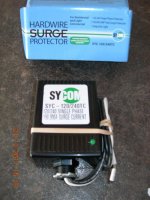
At the main service panel is the secondary surge arrestor from Sycom which protects both legs of the electrical system.

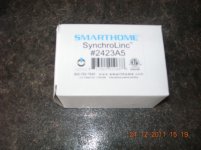
From there, secondary surge outlets for point of use devices: These protect the major appliances like cloths washer, microwave, fridge, dishwasher, and any other area requiring them. Such as audio / video, security, and sump pumps.

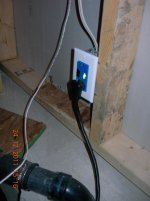
These Leviton surge outlets have both a LED to show that protection is active and 100% operational. Because many of the outlets where the devices were installed are heavy, or hard to see behind. These units also have a siren, to alert the user that the surge outlet has been damaged and is NOT protecting the device.

Depending upon how critical the system is: Some of the outlets are protected with a fail secure mode, so if the surge protection is lost, power will not be applied to the device until the outlet is replaced.

Whereas, others are wired with fail safe, so even if the surge protection is lost, the power will still be applied, such as for freezers, and refrigerators.

Other critical systems use various APC UPS devices spec'd for their respect load and run time. There are several APC BI units which run the server farm, alarm system, and the HA systems.

Critical systems such as the alarm system, fire control, home automation, emergency lighting all have optical SSR's in place for fail over protection.

I also have many home automation (HA) devices which react, and perform special functions based on the specific needs of the load, and what may have transpired.

I have a ACR power watch meter, along with a Brultech electrical monitor which monitor and report conditions. If anything is out of spec, or meets a specific threshold. There are several devices in the home which will disconnect and remove power, or engage a graceful shut down of secondary electrical systems.

Whether it be computers, A/V gear, network systems, appliances such as dishwashers, water tank, cloths washer.

Below are some of the related gear that are installed and deployed to protect the Teken home.

At the end of the day, layering, back up, and validation of systems is critical. :spit:

Teken
 

Attachments

  • DSCN6891.jpg
    DSCN6891.jpg
    35.4 KB · Views: 13
  • DSCN6901.jpg
    DSCN6901.jpg
    94.7 KB · Views: 7
  • DSCN6902.JPG
    DSCN6902.JPG
    51.9 KB · Views: 13
  • DSCN6898.jpg
    DSCN6898.jpg
    85.5 KB · Views: 13
  • DSCN6897.jpg
    DSCN6897.jpg
    135.7 KB · Views: 12
  • DSCN6893.jpg
    DSCN6893.jpg
    83.9 KB · Views: 9
  • DSCN6892.jpg
    DSCN6892.jpg
    44.6 KB · Views: 10
Last edited:

Teken

Well-known member
Joined
Jan 2, 2010
Messages
8,214
Location
The Bad Lands
Here are the other new additions to the fire control systems in the home. If anyone took the time to read the link provided in the first reply. You will note that one of the big problems I had was the false sense of security and protection against a fire. :eek:

The builders smoke / co detector died during the lightning storm. It also didn't have a battery back up in case of a power failure! :mad:

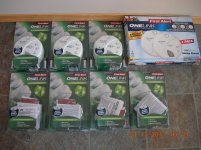
So, now the entire home is retro fitted with First Alert One Link combination smoke / CO detectors. Which all speak as to where the fire / CO is coming from. The best parts is that they are independent of the 120 smoke / CO detectors so they can't be sparked! :shocking:

To protect the 120 VAC wired smokes, SSR surge arrestors, along with EOL resistors were installed to ensure 24 hour monitoring of the devices. Should it fail on any of the three levels, zones, or area's I will know immediately via sms, e-mail, and phone call from the monitoring station.

Here are a few samples of the 12 units installed. I have eight more as back ups in the box ready for deployment just in case there is another lightning event. :(

Teken . . .
 

Attachments

  • DSCN6903.jpg
    DSCN6903.jpg
    127.2 KB · Views: 12
  • DSCN6904.jpg
    DSCN6904.jpg
    35.6 KB · Views: 6
  • DSCN6905.jpg
    DSCN6905.jpg
    43.7 KB · Views: 5

westom

Well-known member
Joined
Aug 16, 2009
Messages
221
the good news was that all the equipment protected by the UPS's and surge protectors were undamaged!
To make that claim, then the furnace, air conditioner, every cell phone charger, all digital clocks, the dishwasher, refrigerator, etc all were on a UPS or surge protector. If not, then every one was damaged. Junk science is a conclusion made by ignoring some facts. Numbers says something completely different.

Read numbers on each surge protector box. A let-through voltage of 330 volts means that protector completely ignores any lesser voltage - ie 210 volts. Each protector did nothing - remained inert. Each appliance protected itself. UPSes contained so little internal protection as to be damaged by a high voltage that could not damage other appliances.

In another home, a similar neutral wire failure occurred. They kept seeing lights change intensity when major appliances power cycled. Ignored an obvious defect. Intensity changed must not even occur on 1930 wired homes. Major appliances must not cause lights to change intensity. A failure that would only get worse.

They ignored changing light intensity. And also did not have the breaker box properly earthed. Eventually, a failing neutral caused electricity to use gas pipes as a conductor to earth. Until a meter gasket in the garage failed. Fortunately, nobody was home when it exploded.

1) Protectors do nothing for this type of failure. As even the manufacturer will admit in numbers. 2) Proper earthing is important so that this failure does become so bad as to even threaten an explosion. 3) Incandescent bulbs changing intensity means a wiring defect exists. Always fix what is probably a minor (but could be a major) problem.
 
Last edited:
To avoid these ads, REGISTER NOW!
Top Bottom