To avoid these ads, REGISTER NOW!

Why are larger screwdriver sizes longer?

garfunkle24

Well-known member
Joined
Mar 18, 2008
Messages
3,429
Location
Saskatoon, Canada
I think the marketing reason has the most application here. Very likely they make the sets to have the same proportions as the typical set of combination wrenches. With wrenches, the torque issue applies more, and so the brain comes to accept that the bigger fastener needs the longer tool, even if physics doesn't agree with it.

though has anybody seen a set of combination wrenches that is the same length for the entire set? would be interesting, though I don't think the public would accept it after it's ingrained to the standard angles of groth in wrenches

I have a set of double-open Mac tappet (thin) wrenches from 10 - 19mm that are all the same length. Even on these already non-typical wrenches, it really does seem kind of freaky.
 
To avoid these ads, REGISTER NOW!

Stuey

Well-known member
Joined
Jan 8, 2008
Messages
11,034
Location
28m above sea level
Because engineers design **** to be pleasing to the eye so you'll buy it.They usually don't know what you really need.Case in point,I've been trying to find a flat bladed screwdriver with a half inch wide tip and a short shank,like 2 inch max,and a regular handle.Everything I've seen has shanks 12 to 24".Totally useless to try and turn a brass screw with,cams out everytime.I know it exists,a guy in our other shop has a noname one he picked up at a yard sale,but try to find one in this day and age.
I know of one with an 8mm tip, but not 1/2". Sorry.

The last statement is false. The shear stress is not dependent upon shaft length. Only the angular deflection is.

The last statement is false. The shear stress, due to torsion, is not dependent upon the shaft length.
But isn't the magnitude of the angular deflection dependent on the shear stress?

Here is what I started to write but I decided to check some facts before posting:


As with most things, the more I looked into it, the more complex the problem became:).

My initial post and half-realised follow-up would have been 100% correct if I had started them with "given a set input rotation".

In looking into and thinking on this some more, I come to realise that once the shaft has reached it's limit of elastic torsional deformation, all of the input forces would be transferred to the load. But then of course, you haven't truely reached the limit of torsional deformation in the shaft. With increasing torque input it would spiral like an EZ out and eventually shear off...

I think my initial assertions may be correct in theory, but less so in practical terms.
Hmm. That makes sense. I remember seeing someone posting about a super spring steel allen wrench that could twist to an unbelievable extent before restoring to its original shape.
 

wyndycity

Well-known member
Joined
Dec 28, 2008
Messages
286
Location
Chicago
A larger driver handle enables more torque. A longer shaft doesn't increase the torque, it makes the transmission of torque easier. Just like cheater bars on ratchets.

Case in point: if using a stubby, in addition to applying turning torque you're more likely to exert extra energy also "pushing" the driver toward the screw head in order to maintain contact and prevent slipping whereas on a longer shaft, due to the increased angular freedom, you are less likely to exert as much force directly on the head and can exert more momentum for rotational force.
 
Last edited:

garfunkle24

Well-known member
Joined
Mar 18, 2008
Messages
3,429
Location
Saskatoon, Canada
A larger driver handle enables more torque. A longer shaft doesn't increase the torque, it makes the transmission of torque easier. Just like cheater bars on ratchets.

errmm....come again?

A cheater bar on a ratchet is a longer perpendicular lever, much like a bigger diameter handle on a screwdriver. Your three sentences seem contradictory.

Edit: Also, you can't "exert momentum".
 
Last edited:

krehmkej

Well-known member
Joined
Mar 20, 2009
Messages
197
Location
Oregon
I think the bigger ones are longer so they will "look" bigger making picking the correct one out of a cluttered box easier.
 

M5 LiTE

Well-known member
Joined
Aug 30, 2005
Messages
177
Location
Herndon, VA
OK - somebody write Snap-On, CM, MAC, Matco, etc. and ask them this question! Let's hear it from the horses mouth...
 

AdamMopar

Well-known member
Joined
Jul 18, 2005
Messages
182
Location
United States
But isn't the magnitude of the angular deflection dependent on the shear stress?

That statement is true. The angular deflection is dependent upon the shear stress. The longer the shaft the more (total length) angular deflection you will get.

That is a design consideration; however, as long as you apply your preferred failure theory to the stresses in the cross section and no yielding will occur, the deflection isn't going to cause a failure.

We of course have all ignored failure due to buckling caused by a compressive axial load.
 

JeepsAreBuilt

Well-known member
Joined
Nov 24, 2006
Messages
1,066
Location
The Beautiful NorthWest
Alright.. heres the real answer. The bigger the phillip screw head.. the more torque it'll require to break loose and remove. Say you got a stuck P2 vs a stuck P3. Whip out the P2, and you'll put pressure on the screwdriver, and lean your body on it for more pressure. Lets call this "leaning power" You dont wanna do this technique with a stubby do ya ? The longer shaft gives you better leaning power. So.. the P3 screws require more torque to break loose.. and more leaning power, longer shaft gives you better leaning power. How does it give better leaning power ? Well.. The longer P3 shaft will allow you to be more comfortable to lean at a greater angle and apply more weight on it. Keep in mind that too long of a shaft will not be ideal for the leaning power technique.
 

MAD

Well-known member
Joined
Jan 27, 2007
Messages
2,714
Location
Western MA
Because engineers design **** to be pleasing to the eye so you'll buy it.They usually don't know what you really need.Case in point,I've been trying to find a flat bladed screwdriver with a half inch wide tip and a short shank,like 2 inch max,and a regular handle.Everything I've seen has shanks 12 to 24".Totally useless to try and turn a brass screw with,cams out everytime.I know it exists,a guy in our other shop has a noname one he picked up at a yard sale,but try to find one in this day and age.

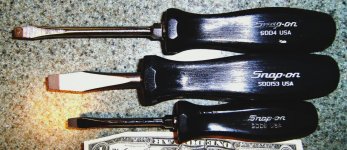
Not a 1/2" blade, but the SDD153 I recently picked up is a really nice 3/8" flat blade driver with a full size handle.
 

Attachments

  • SDD153.jpg
    SDD153.jpg
    165.9 KB · Views: 14
  • SDD153.2.jpg
    SDD153.2.jpg
    167.8 KB · Views: 11
  • SDD153.3.jpg
    SDD153.3.jpg
    155.5 KB · Views: 16
To avoid these ads, REGISTER NOW!

theWORLDSaNAIL

Well-known member
Joined
Apr 5, 2009
Messages
49
Location
Kentucky
Because engineers design **** to be pleasing to the eye so you'll buy it.They usually don't know what you really need.Case in point,I've been trying to find a flat bladed screwdriver with a half inch wide tip and a short shank,like 2 inch max,and a regular handle.Everything I've seen has shanks 12 to 24".Totally useless to try and turn a brass screw with,cams out everytime.I know it exists,a guy in our other shop has a noname one he picked up at a yard sale,but try to find one in this day and age.

Engineer dont design **** to be pleasing to the eye we design **** to meet performance and cost specs first while attaining the function of an object. Human pleasure reference to an object are usual a visual designer or "DESIGNERS" area unless the use of the object dictates the use of human input elements. By the way engineers usual do know what someone doing a task needs however cost constraints from upper managment are why **** gets painful I know im an engineer
 

theWORLDSaNAIL

Well-known member
Joined
Apr 5, 2009
Messages
49
Location
Kentucky
A larger driver handle enables more torque. A longer shaft doesn't increase the torque, it makes the transmission of torque easier. Just like cheater bars on ratchets.

Case in point: if using a stubby, in addition to applying turning torque you're more likely to exert extra energy also "pushing" the driver toward the screw head in order to maintain contact and prevent slipping whereas on a longer shaft, due to the increased angular freedom, you are less likely to exert as much force directly on the head and can exert more momentum for rotational force.

You have 90% off the answer for the longer lengths the other important part is the torsional force control it longer so you don't over apply torque placing more torsional force internal to the drive tool and screw keeping you from breaking the tool.
 

rinny_tin_tin

Well-known member
Joined
Dec 20, 2008
Messages
636
Location
Northern Virginia
Huh? You could have a a big azz screwdriver with a mile long shaft and it will not be able to impart more torque on a screw than with a screwdriver with an inch long shaft if the handle diameter were the same on both.

If used as a prybar, yes. But when used as a screwdriver, then a WIDER head, like a T-Handle, would allow you to apply more torque to rotate a screw.

To help visualize, imagine a stubby 1/2" ratchet vs a 24" long breaker bar - with which can you apply more torque to the fastener?

In order to apply torque, you need to apply the force PERPENDICULAR to the fastener.

Yes yes - force needs to be applied perp to the fastener - however, I said you need a longer handle (not shaft) so you can get more hand flesh (mebee two hands) around the handle - and also - the handle is best if made wider to provide more leverage about the fastener.....capish?
 

rinny_tin_tin

Well-known member
Joined
Dec 20, 2008
Messages
636
Location
Northern Virginia
A longer handle does nothing for torque. It's the radius about which force is being applied. In other words, the width of the handle is the dominant factor.


I think that longer shafts can handle greater amounts of torsion.

Consider that in tightening a screw or whatnot, high torque results in 20° of twist between the handle and the driver tip. Let's consider that the capacity to endure torsion before failure is 5° per linear inch. If you're using a 3" driver in these conditions, there may be a high probability of failure. If you're using a 6" driver, torsional stress will be distributed about a greater length, thus lowering the probability of failure.

Now, I may be wrong, but as far as I can tell my logic is relatively sound.


What's your reasoning behind this?

"A longer handle does nothing for torque. It's the radius about which force is being applied. In other words, the width of the handle is the dominant factor."

Sure- width is important --however, a longer handle permits better mechanical coupling between the driver and the hand...
 

volvo420coupe

Well-known member
Joined
Dec 6, 2008
Messages
598
Location
central Michigan
Its all about aesthetics, we spend way too much money on our snap on tools because they are good looking, and also perform well, the bigger screwdrivers need to stay in proper proportion to the "ideal" screwdriver which is as we all know a standard #2 phillips snap on black plastic handle. funny looking screwdrivers that are only functional can be found but not many of us need them.
 

caper

Well-known member
Joined
Feb 12, 2006
Messages
3,185
Location
cape breton
Not a 1/2" blade, but the SDD153 I recently picked up is a really nice 3/8" flat blade driver with a full size handle.

It's just what I'm looking for but the tip is to narrow.I need it for removing brass screws that hold slider pads on our extension booms.The screws are very soft so they tear up really easy if you use a screwdriver thats too narrow.I'd be happy to find one that had a shank anywhere close to reasonable,everything I've come across with a 1/2" tip is more like a prybar than a screwdriver.
 

farmall57

Well-known member
Joined
Mar 10, 2009
Messages
60
One of my most used screwdrivers is a Craftsman short slotted with a full handle. This thread got me wondering so I went to Sears web site looking for it. I was unable to find it so went to the shop and got the number off the handle and sure enough it comes up on Sears site, but is shown as a 5/16 x 1 3/4 and mine is a 3/8. Mine is probably 20 years old I suppose but I really like the full handle in the short length.

Click here for Sears page
 
Last edited:

Mickey O

Well-known member
Joined
Oct 25, 2009
Messages
6,153
Location
Chicago, IL
Same reason the sky is blue


Easier identification?

I'm not sure how a longer shank would give you any more torque, the larger handle on larger screwdrivers would give you more torque.

I have the same size screwdrivers in different shank lengths and some large tip screwdrivers that have a really short shank, here's a pic of a Craftsman one (not the best pic):

shortshank.jpg
 
To avoid these ads, REGISTER NOW!
Top Bottom