AI.I can never tell if the OP is a real person or not.
Martin


You are using an out of date browser. It may not display this or other websites correctly.
You should upgrade or use an alternative browser.
You should upgrade or use an alternative browser.
Why are spark plug tools 3/8 drive?
- Thread starter qqzj
- Start date
Ingnore button

bcradio
Well-known member
How much rust and corrosion would you like us to factor into this chart?Plug installation torque specs are easy to find.
But, I've been looking for a removal torque spec chart and have been unable to find one.
if you could post one it would help me select the proper tool.
I like to break them loose and crank 'em out with the same tool so that would help with that too.
I'd thought of that so it would probably best to include a correction factor by state, or salt/brine use.How much rust and corrosion would you like us to factor into this chart?
Seven.How much rust and corrosion would you like us to factor into this chart?
mrbill55
Well-known member
On part of of this episode of "Wrenching with Mr Bill", we see our hero with a recently acquired 66 289 2V Mustang convertible with plugs date coded from 1986 installed by a 800lb gorilla with no clue as to how to tighten a spark plug properly. 7 of the 8 came out by hand, each one in a death grip with the head they were installed in, each requiring a rather large prybar type extention to my 3/8, then 1/2, then back to 3/8 socket and extension sets. Number 8 (actually the #4 plug) awaits a new impact gun (3/8"I used a 1/2" drive air impact to remove a stuck spark plug. It was probably 25 years ago when my daughter got a 93 Ford ******, 4 cylinder, had around 150k on it. I'm going to change the spark plugs, but only see 3. It took some looking, and the 4th plug is hidden behind the alternator. Well, the easy 3 came out just fine, the hidden one was stuck. I tried with a breaker bar, but was afraid it would snap off.
I took my air impact, which has a knob on the bottom to control the air. Turn it all the way in, and the gun will not even spin. So, I put the socket on the plug, turned the knob all the way in, and squeezed the trigger. Very slowly, start turning the knob out till the gun just starts chugging a little. Every few minutes, turn the knob out a tiny bit more. It took about 10 minutes, and finally the socket starts turning. The plug came out without damaging any threads. The plug was a Motorcraft plug, and the outer electrode was completely burned away. It had to have been the original plug. I guess whoever change the plugs before either missed it, or couldn't get it out, and left it.
) as I pulled my old (20+ years) out and it was DOA...Nothing, and I do mean nothing I have in my tool chest, no combination of such, gave me the leverage and clearance to get this last, stubborn plug out......Was really hoping to not have to use the old 1/2" impact gun, but I really had no chance after 1.5 hours into a typical 20 minute job, over an hour trying to wrestle the #4 plug out from it's 37 year slumber. Worse comes to worse, I'll snap the plug, or the socket, or both......Best result is that I can at least break it loose, so I can then use a hand ratchet to wrestle it from it's place.Stay tuned for part 2 (tomorrow morning if not raining) where we see our intrepid owner go either from zero to hero, or hero to zero.
Bill S.
2ndGearRubber
Well-known member
How much rust and corrosion would you like us to factor into this chart?
That's impossible to produce. Too many variables. I've used an 18" 1/2 drive ratchet to break them free before.
whateg01
Well-known member
I mean, if you don't break the plug off in the head, are you really even trying?On part of of this episode of "Wrenching with Mr Bill", we see our hero with a recently acquired 66 289 2V Mustang convertible with plugs date coded from 1986 installed by a 800lb gorilla with no clue as to how to tighten a spark plug properly. 7 of the 8 came out by hand, each one in a death grip with the head they were installed in, each requiring a rather large prybar type extention to my 3/8, then 1/2, then back to 3/8 socket and extension sets. Number 8 (actually the #4 plug) awaits a new impact gun (3/8"
Stay tuned for part 2 (tomorrow morning if not raining) where we see our intrepid owner go either from zero to hero, or hero to zero.
Bill S.
Can't tell if you are being a smartass, but lets play around with this idea for a minute.But, I've been looking for a removal torque spec chart and have been unable to find one.
Based on widely discussed advice on how to torque your bolts, you should generaly go in stages stopping at 65-80% of max torque. This is to compensate for the co-efficient of frictino/sticktion, which you need to overcome from any single torque application.Since the co-efficient of sticktion is likely 20-35% of installation torque (sometimes, arguably up to 50%),
IE, if you torque to 20nm and STOP, it will take 20%∆ of 25nm = ∆5 = 25NM to move the bolt. So you cant apply any bolt stretch without moving the bolt, if you need to stop 25nm, first you need to stop at like 18NM then go to 25 on another single motion of the wrench.
Now, for a baseline. Lets assume it applies in reverse as well as forward, as a first approximation of "take off" torque for any applied fastener. Take off will always be 120 % to 150% (or higher...but thats another story).
For our typical 16mm sparkplug, installation is ±25nm this is going to be 30 to 40NM take off range, which is technically viable for 1/4 drive.
However, let us not that in particular, AFAIK you cannot remove a plug wiht 1/4 deep sockets (even if you own them in 16mm), so this is all specalty hardware at this point. Only people that need or benefit from buying special application sockets (really) need worry about this.
Everyone else can just use regular 3/8 sockets or plug sockets if they have issue with removal of plugs without them.
Can't tell if you are being a smartass, but lets play around with this idea for a minute.
Yes, I was. Heat cycles, corrosion, lack of anti-sieze, or wrong type, just so many things that effect the removal torque makes the use of short ratchets, no matter drive size, ineffective.
turnthewrench 2.0
Well-known member
You need to watch Scotty, dude. He's the master of torque vocalizations.So spark plug tools are right in the alley of 1/4 tools. So I am pretty puzzled why most spark plug specific tools use 3/8 drive? Given the increasingly crowded engine bay 1/4 makes a lot more sense, doesn't it?
mrbill55
Well-known member
I've been there before, with cheap hand tools no less, still, Amazon delivered the previously mentioned impact gun, I'm attempting to garner enough motivation to go out in the 82 degree, 70 percent humidity with the remaining light outside slowly waining to attempt to wrestle the offending sparkplug from it's current residence....However, short of installing a quick disconnect on the new tool, and a quick oiling of the same, I'm sticking with my early morning attack plan. Only time will tell whether this will be as effective as I am hoping. Stay tuned to this channel for the results, good or bad.I mean, if you don't break the plug off in the head, are you really even trying?
Bill S.
2ndGearRubber
Well-known member
Can't tell if you are being a smartass, but lets play around with this idea for a minute.
Based on widely discussed advice on how to torque your bolts, you should generaly go in stages stopping at 65-80% of max torque. This is to compensate for the co-efficient of frictino/sticktion, which you need to overcome from any single torque application.Since the co-efficient of sticktion is likely 20-35% of installation torque (sometimes, arguably up to 50%),
IE, if you torque to 20nm and STOP, it will take 20%∆ of 25nm = ∆5 = 25NM to move the bolt. So you cant apply any bolt stretch without moving the bolt, if you need to stop 25nm, first you need to stop at like 18NM then go to 25 on another single motion of the wrench.
Now, for a baseline. Lets assume it applies in reverse as well as forward, as a first approximation of "take off" torque for any applied fastener. Take off will always be 120 % to 150% (or higher...but thats another story).
For our typical 16mm sparkplug, installation is ±25nm this is going to be 30 to 40NM take off range, which is technically viable for 1/4 drive.
However, let us not that in particular, AFAIK you cannot remove a plug wiht 1/4 deep sockets (even if you own them in 16mm), so this is all specalty hardware at this point. Only people that need or benefit from buying special application sockets (really) need worry about this.
Everyone else can just use regular 3/8 sockets or plug sockets if they have issue with removal of plugs without them.
Don't tell people this, otherwise the "200ft/lb lug nut" stories won't make sense.
Lassen Forge
Well-known member
The First time I had to do one five of those freaking plugs on ONE of those damned Ford Triton motors, I bought the plug removal tool from Lisle. That blue box for a while was my little money maker... but what an all out CRAPPY design. I hope the engineer who put that out there has daily hemorrhoids from shitting spark plug parts...
BTW all my plug tools until recently were 3/8" drive. Access issues made me get 1/4" plug tools, but yeah, they've ALWAYS been 3/8".
BTW all my plug tools until recently were 3/8" drive. Access issues made me get 1/4" plug tools, but yeah, they've ALWAYS been 3/8".
Hohn
Well-known member
I moved my 1/4 drive stuff to another drawer to get it out of the way of the tools I actually use.I almost never use my 1/4" drive stuff. I mean, I do, but not on cars, really. My go-to stuff is all 3/8" drive. 1/4" drive is for 7/16 and below. 12mm and below, these days.
Spark plugs. They corrode in place. 1/4" drive won't work. You need a little more torque than you can get from some 6" long ratchet.
Garcky
Well-known member
Yup. Me, too.I moved my 1/4 drive stuff to another drawer to get it out of the way of the tools I actually use.
mrbill55
Well-known member
When we last left our intrepid Mustang owner, he had spent 1+ hours in an attempt to remove the #4 spark plug from a 289 powered, 1966 Mustang convertible. With the delivery of his new 300/ft/lbs, 3/8" impact driver, and a good nights sleep, he dove in to what could have been the fight of his life. Did he go from zero to hero, or hero to zero this morning. We will let the picture speak for itself.
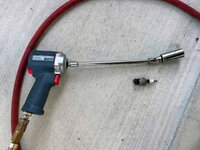
It fought the power of the impact gun from the lowest setting, to the highest before it started to budge, once broken loose from it's long slumber, it did not stand a chance, and was successfully removed, and in one piece no less. New spark plug installed in 90 seconds, and the car is now one step closer to being back on the road after being rescued from it's long hibernation.
Bill S.
PS: Back on track for the thread itself, the 1/2" drive would not fit in the tight confines of this area of the engine compartment, and I actually snapped a Craftsman 1/4" socket by hand, for the same, so the 3/8" drive set was the perfect "medium" solution, and thankfully, it worked.
It fought the power of the impact gun from the lowest setting, to the highest before it started to budge, once broken loose from it's long slumber, it did not stand a chance, and was successfully removed, and in one piece no less. New spark plug installed in 90 seconds, and the car is now one step closer to being back on the road after being rescued from it's long hibernation.
Bill S.
PS: Back on track for the thread itself, the 1/2" drive would not fit in the tight confines of this area of the engine compartment, and I actually snapped a Craftsman 1/4" socket by hand, for the same, so the 3/8" drive set was the perfect "medium" solution, and thankfully, it worked.
ChevyEFI
Well-known member
I started with 3/8"; it's what Dad had mostly.I am wondering where you guys have been when people from Europe claiming that they completely skipped 3/8 tools and only use 1/4 and 1/2.
Then I used it mostly for a few years.
Then I used 1/4" far, far more.
Now, I've avoided 3/8" for years.
When you have everything in 1/4" and 1/2", you really only need 3/8" because an available tool is that drive size.
I have seen way too many people complain about plugs on vehicles that require nothing more than extensions and wobble, or roto ratchet. Or with headers, a dedicated socket.Because, if spark plugs are that big of a PITA, it's definitely a van.
When Ko-Ken doesn't make a socket, you can find the thread to be troll bait.Does anyone know of a 1/4" drive 5/8 spark plug socket?
Or leaning over getting your gut pierced by a radiator. NBD.I started with 3/8"; it's what Dad had mostly.
Then I used it mostly for a few years.
Then I used 1/4" far, far more.
Now, I've avoided 3/8" for years.
When you have everything in 1/4" and 1/2", you really only need 3/8" because an available tool is that drive size.
I have seen way too many people complain about plugs on vehicles that require nothing more than extensions and wobble, or roto ratchet. Or with headers, a dedicated socket.
When Ko-Ken doesn't make a socket, you can find the thread to be troll bait.
whateg01
Well-known member
You need to work on more vehicles then.I have seen way too many people complain about plugs on vehicles that require nothing more than extensions and wobble, or roto ratchet. Or with headers, a dedicated socket.
Drunk posting be like.When Ko-Ken doesn't make a socket, you can find the thread to be troll bait.
He just drunk posting. His entire thread is contrary to life.You need to work on more vehicles then.
Ricky Joe
Well-known member
My guess is because if it was 3/7” drive then a whole range of drivers would have to be created to accommodate spark plugs. If you have to ask the question, you have to accept the answer.
When I decided to start upgrading my box from mostly USA Craftsman to higher end tools, I started with 1/4" because that's what I use and enjoy using the most. I love having good 1/4" drive tools, and a good selection of tools makes working on cars so much easier.I moved my 1/4 drive stuff to another drawer to get it out of the way of the tools I actually use.
Next on the list is 3/8", which I do use as much as 1/4", but its usually attached to a cordless ratchet. 1/2" is rarely ever used, even though I do have quality stuff.
I am also the weird guy who uses SAE ten times more often than metric, so take everything I say with a grain of sale.
Don't tell people this, otherwise the "200ft/lb lug nut" stories won't make sense.
Don't you mean oil pan bolt?
ChevyEFI
Well-known member
Stubby handle ratchet snugged by hand works.How many of you guys use a torque wrench to install plugs?
It's a shame the earlier 2v models were half-threaded.Been there, still have the tool in my "hope I don't ever need that again" drawer.

When Ko-Ken doesn't make a socket, you can find the thread to be troll bait.
Heard they make a special one for Ridgelines
ChevyEFI
Well-known member
I am holding my breath for the one they will undoubtedly make for the Hummer truck / Silverado EV.Heard they make a special one for Ridgelines
visionguru
Well-known member
Not torque, but socket size and extension sturdiness makes 3/8 the natural choice for spark plugs.... I am pretty puzzled why most spark plug specific tools use 3/8 drive? Given the increasingly crowded engine bay 1/4 makes a lot more sense, doesn't it?
One possible explanation is that 1/4 torque wrench often stops at 15 ft lbs or so. Then it is natural to ask why not make a 1/4 torque wrench going up to 30 ft lbs? As of now, using chunky 3/8 tools for spark plugs seems pretty dumb. Any opinions?
Most common spark plugs are of 14mm, 16mm, 18mm. Only 14mm is borderline appropriate 1/4 socket size.
Spark plugs are often way down the hole, thus extensions/U-joints are often needed. 1/4 extensions are too thin and will twist/flex easily.
Here is an example. When I was replacing the engine mount, the bolt was about 50 ft-lb. I thought my Snap On 3/8" extra long rachet (17" long) should take it out easily. BUT there was a huge amount of twisting on the 12" long 3/8 extension, which made me uncomfortable to pull the racket any further. 1/2" was more appropriate.
Last edited:
Most Denso or NGK plugs use about 13-15 ft pounds torque. I have seen good quality 1/4 ratchet fails at about 70 ft lbs. So spark plug tools are right in the alley of 1/4 tools. So I am pretty puzzled why most spark plug specific tools use 3/8 drive? Given the increasingly crowded engine bay 1/4 makes a lot more sense, doesn't it?
One possible explanation is that 1/4 torque wrench often stops at 15 ft lbs or so. Then it is natural to ask why not make a 1/4 torque wrench going up to 30 ft lbs? As of now, using chunky 3/8 tools for spark plugs seems pretty dumb. Any opinions?
This is why I like the Snap-on 1/4" ratchets with 3/8" mechanisms.
And why I use them on things like Spark Plugs.