Marvin Berry
Well-known member
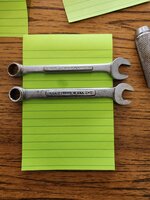
Same size, both =v= series, why is one noticeably 'sleeker' than the other?

That's what I assumed, but I wasn't sure. The thinner one reminds me of an SK wrench.Manufactured by different vendors or different design iterations.
...or different design iterations.
The metallurgy and/or the heat treatment changed, allowing the forging dies to be redone to use less metal and thereby creating the sleeker version.


Yeah, but here in the “VINTAGE” tool discussion, there’s a lot of collectors and that stuff matters. Hence all the type studies, old catalog searching, and research that takes place here. It’s not a contest about whose stuff is better, etc., but rather a discussion about the use and history of old tools.only thing i care about is "forged in USA" i dont have time for the petty stuff, my craftsman is pretter than yours BS
I would like to see the Craftsman logos on the opposite sides to take a look at the ”A”s.
-Don

The top one dates from prior to ~1966 and the bottom one is from after ~1966 thru ~1970. Earlier wrenches of the =V= series (which started in the late 40's) had a thin shank on them like the top onepictured. Starting in the mid to late 60's they went to a thicker shank and updated the font for the letter "A" in "CRAFTSMAN" from pointed at the top to being flat. Flip over your wrenches and you will see what I mean.Same size, both =v= series, why is one noticeably 'sleeker' than the other?
Looks like the F was also changed.The top one dates from prior to ~1966 and the bottom one is from after ~1966 thru ~1970. Earlier wrenches of the =V= series (which started in the late 40's) had a thin shank on them like the top onepictured. Starting in the mid to late 60's they went to a thicker shank and updated the font for the letter "A" in "CRAFTSMAN" from pointed at the top to being flat. Flip over your wrenches and you will see what I mean.
