There is a recent trend/fad in the increasing popularity of sockets with very little chamfer. The thesis is that that will allow sockets more chance to grab fasteners with shallow heads, or fasteners with normal heads, but the heads having a dimple in the middle. That is all fine. But then it begs the question why manufacturers bother to make chamfer in the first place. As a layman, my expectation is that it is a lot harder to make sockets with normal chamfer. So this whole thing remains a mystery to me. But if there is some forging expert here who can explain why making sockets with little chamfer is harder, then it will all make sense. Any help? TIA.


You are using an out of date browser. It may not display this or other websites correctly.
You should upgrade or use an alternative browser.
You should upgrade or use an alternative browser.
Why bother to make chamfer on sockets?
- Thread starter qqzj
- Start date
A few ideas as to why chamfer is so common:
- Easier fastener acquisition. A little bit of chamfer or radius helps guide the socket onto the fastener head.
- Many fasteners (ex: flange bolts/nuts or e-torx) include a radius that roughly corresponds to that of the tool.
- Particularly visible on older box wrenches, some chamfer can help disguise sloppy or off-center broaching.
- Eliminates sharp edges
The chamfer makes a socket a lot stronger. It has to do with something engineers call "notching effects".

It involves a lot of things, but to keep it simple - if you have a sharp notch, it weakens the material a lot. A smooth transition relieves stress a lot.
If you have a simple shaft with some transitions, the "radius" relief (marked "r") makes it considerably stronger than a sharp transition. The "u" groove further helps relieve the stress in the axle:

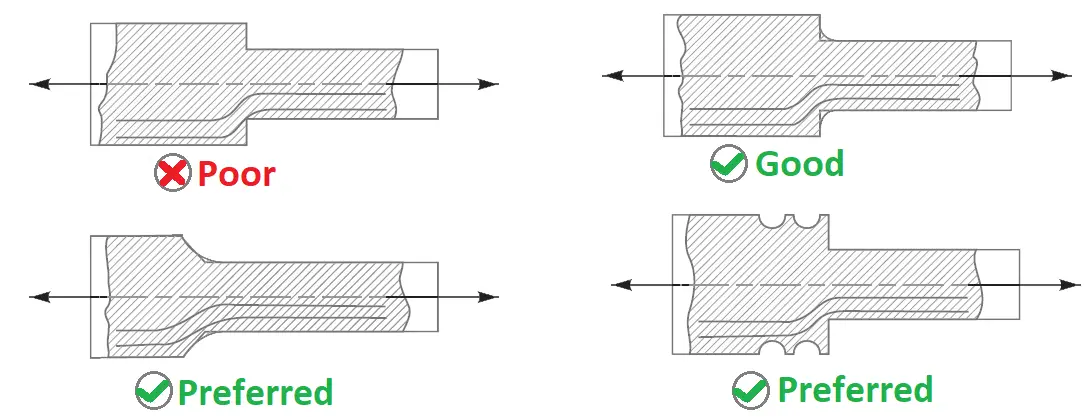

If you need a flat surface for e.g. a bearing, there are many techniques:

So to go back to your question. The chamfer helps spread the load a great deal.

Instead of the red area being concentrated, it goes further. Peak stress is smaller because it gets distributed over all of the material.
The smaller the chamfer the smaller the peak stress. A 12 point socket actually distributes stress nicer than a 6 point one (but at this point it is hard to say which is stronger, cause the extra material in a 6 point does play a certain role too, so it can go either way) because it is more circular.
If you use a very small chamfer on the end of a socket, I expect it wants to crack along one of the edges of the 6 point broaching inside of the socket. The end of the socket is where it wants to "spread" when it fails, and that's surely always the weakest point of it...
So just by using my logic, if you have a larger chamfer you can afford to make a thinner walled socket. If you have a small chamfer you need to compensate with a slightly thicker wall to withstand the same force. It's up to the socket manufacturers to find the most useful balance of those two factors and how safe they want to make their sockets...
That's how I see it. I think in theory that's how it is. In practice, maybe a smaller chamfer does not affect it a great deal. But IMO considering sockets are made for a century I'm sure the manufacturers made countless real tests to determine the optimal chamfers or radiuses on its shape.
It involves a lot of things, but to keep it simple - if you have a sharp notch, it weakens the material a lot. A smooth transition relieves stress a lot.
If you have a simple shaft with some transitions, the "radius" relief (marked "r") makes it considerably stronger than a sharp transition. The "u" groove further helps relieve the stress in the axle:
If you need a flat surface for e.g. a bearing, there are many techniques:
So to go back to your question. The chamfer helps spread the load a great deal.
Instead of the red area being concentrated, it goes further. Peak stress is smaller because it gets distributed over all of the material.
The smaller the chamfer the smaller the peak stress. A 12 point socket actually distributes stress nicer than a 6 point one (but at this point it is hard to say which is stronger, cause the extra material in a 6 point does play a certain role too, so it can go either way) because it is more circular.
If you use a very small chamfer on the end of a socket, I expect it wants to crack along one of the edges of the 6 point broaching inside of the socket. The end of the socket is where it wants to "spread" when it fails, and that's surely always the weakest point of it...
So just by using my logic, if you have a larger chamfer you can afford to make a thinner walled socket. If you have a small chamfer you need to compensate with a slightly thicker wall to withstand the same force. It's up to the socket manufacturers to find the most useful balance of those two factors and how safe they want to make their sockets...
That's how I see it. I think in theory that's how it is. In practice, maybe a smaller chamfer does not affect it a great deal. But IMO considering sockets are made for a century I'm sure the manufacturers made countless real tests to determine the optimal chamfers or radiuses on its shape.
Oh man, I think he’s talking about the internal chamfer at the end of the socket. Guessing: I think it probably helps center the broach that forms the inside of the socket and also helps locate the bolt head. Without any chamfer, it wouldn’t be easy to get a socket onto a bolt.
If the chamfer were too big, you’d lose contact area between the socket and fastener raising stress on both. Too small isn’t a stress issue. Would really lower the stress, but such sockets wouldn’t be easy to use, especially if they were tight fitting.
As I always say, sockets are complicated little devices. Kind of amazes me there are so many good ones out there. They really are more than a hunk of steel with a hex cut into them.
If the chamfer were too big, you’d lose contact area between the socket and fastener raising stress on both. Too small isn’t a stress issue. Would really lower the stress, but such sockets wouldn’t be easy to use, especially if they were tight fitting.
As I always say, sockets are complicated little devices. Kind of amazes me there are so many good ones out there. They really are more than a hunk of steel with a hex cut into them.
Your point is correct but a few of the details are wrong. Sockets don’t see tension. Primary loading is torsion. An abrupt diameter change is a stress concentration, not unlike a notch, but not as easy to analyze. Unlike tension torsion, like bending, seeks to load up outer most material, so the outside shape is more critical than the inside. Surface finish matters. This might be one reason why manufacturers don’t machine grooves in sockets anymore. Grooves (depending on where they are) are probably stress risers.The chamfer makes a socket a lot stronger. It has to do with something engineers call "notching effects".
It involves a lot of things, but to keep it simple - if you have a sharp notch, it weakens the material a lot. A smooth transition relieves stress a lot.
If you have a simple shaft with some transitions, the "radius" relief (marked "r") makes it considerably stronger than a sharp transition. The "u" groove further helps relieve the stress in the axle:
If you need a flat surface for e.g. a bearing, there are many techniques:
So to go back to your question. The chamfer helps spread the load a great deal.
Instead of the red area being concentrated, it goes further. Peak stress is smaller because it gets distributed over all of the material.
The smaller the chamfer the smaller the peak stress. A 12 point socket actually distributes stress nicer than a 6 point one (but at this point it is hard to say which is stronger, cause the extra material in a 6 point does play a certain role too, so it can go either way) because it is more circular.
If you use a very small chamfer on the end of a socket, I expect it wants to crack along one of the edges of the 6 point broaching inside of the socket. The end of the socket is where it wants to "spread" when it fails, and that's surely always the weakest point of it...
So just by using my logic, if you have a larger chamfer you can afford to make a thinner walled socket. If you have a small chamfer you need to compensate with a slightly thicker wall to withstand the same force. It's up to the socket manufacturers to find the most useful balance of those two factors and how safe they want to make their sockets...
That's how I see it. I think in theory that's how it is. In practice, maybe a smaller chamfer does not affect it a great deal. But IMO considering sockets are made for a century I'm sure the manufacturers made countless real tests to determine the optimal chamfers or radiuses on its shape.
By far the most common stress on a shaft with bearings is also torsion. E.g. a crankshaft transmitting power from the piston to the primary drive. It wants to shear off at its weakest point, which is typically at a sharp geometry transition.Your point is correct but a few of the details are wrong. Sockets don’t see tension. Primary loading is torsion. An abrupt diameter change is a stress concentration, not unlike a notch, but not as easy to analyze. Unlike tension torsion, like bending, seeks to load up outer most material, so the outside shape is more critical than the inside. Surface finish matters. This might be one reason why manufacturers don’t machine grooves in sockets anymore. Grooves (depending on where they are) are probably stress risers.
Shafts typically do not see tension either.
Or in case of a socket, the extension rod is a shaft. If it has sharp transitions, it is weaker than an extension with smooth transitions and same diameters (even if the one with sharp transitions uses more material).
rockettauto
Well-known member
- Joined
- May 12, 2023
- Messages
- 745
They do see plenty of tension. Particularly the corners at the tip. The nut imparts force in a way as to spread the socket end out during use. They're more likely to split along the axis from that tension than shear along the radius from torsion.Your point is correct but a few of the details are wrong. Sockets don’t see tension. Primary loading is torsion. An abrupt diameter change is a stress concentration, not unlike a notch, but not as easy to analyze. Unlike tension torsion, like bending, seeks to load up outer most material, so the outside shape is more critical than the inside. Surface finish matters. This might be one reason why manufacturers don’t machine grooves in sockets anymore. Grooves (depending on where they are) are probably stress risers.
To the OP. You can very easily demonstrate this to yourself.
Grind a socket flat across the tip and then tighten something until it breaks. It won't be long. Then put an unaltered one on there and start tightening more, it will take waaaaaay more force.
It's just plain much easier for a crack to start across the unchamfered rim vs one with chamfer.
Tension in a socket would be the force pulling the socket off the nut. Stresses in the walls running parallel to the end of the socket are like tension, or hoop stresses maybe. There's bending there too. I guess what we call it doesn't matter.They do see plenty of tension. Particularly the corners at the tip. The nut imparts force in a way as to spread the socket end out during use. They're more likely to split along the axis from that tension than shear along the radius from torsion.
To the OP. You can very easily demonstrate this to yourself.
Grind a socket flat across the tip and then tighten something until it breaks. It won't be long. Then put an unaltered one on there and start tightening more, it will take waaaaaay more force.
It's just plain much easier for a crack to start across the unchamfered rim vs one with chamfer.
I suspect if I made a fine meshed FEM of a socket, and correctly modelled the stiffness, we'd see the very end would yield a bit and the higher stress would be further inside. Then any change to the outer diameter would affect the stress. Any abrupt change would be a stress riser.
Keep in mind what I said earlier, which is super true: Sockets are complicated. Sockets don't only see torsion. Due to the offset between the ratchet handle and the base of the bolt head, there's an over turning moment as well. This is why 0 degree box wrenches kick so much ***. They have very little of this moment. Also why when something is stuck, we tend to reach for the shortest tool.
I think back to the original question, if I understood it, the chamfer provides "lead in" for the broach and the bolt heads. Box wrenches also have some amount of chamfer for the same reason. I don't think there's more to it than that. Grinding the chamfer off shouldn't negatively impact strength if the grind finish is as good as the rest of the socket. Anything ragged about that grind could be a crack initiation site as Rocketauto has described.
All of the socket is under stress, does not really matter much if it is torsion or tension or compression. Making a chamfer is a way to relieve stress.
Another point is also the "wear" on the edge. If you have a sharp edge, dinging it against bolt heads will eventually create bumps on it. Even if the material is very hardened. With a chamfer it practically does not happen, not even on the softer impact sockets.
Another point is also the "wear" on the edge. If you have a sharp edge, dinging it against bolt heads will eventually create bumps on it. Even if the material is very hardened. With a chamfer it practically does not happen, not even on the softer impact sockets.
A good explanation of this is found with a little demonstration.
- Find a very high quality 10.9 or 12.9 flange bolt, with ±13mm hexagon (like head bolt).
- Line up every single 13mm socket (or whatever) you have
- Do this with every singel socket you own in this size, in every drive size, make/model/price etc
- Put each socket on the bolt, and check for rotational grip horizontal deflection.
You will quickly notice the sockets have different levels of ease of use, different levels of slop, and different levels of horizontal deflection on the bolt.
The better sockets go on easy, but lock on tight and don't deflect. Good fitment sometimes makes for more usable sockets. This is true even with lower hardness or steel quality.
Not every socket needs to be bombproof at destructive torque values, but every socket ideally should go on/off easily, hold steady, and apply torque efficiently.
A good way to buy sockets is to take that high quality flange bolt to the place of purchase test-fitments from open stock.
Just my $0.02
- Find a very high quality 10.9 or 12.9 flange bolt, with ±13mm hexagon (like head bolt).
- Line up every single 13mm socket (or whatever) you have
- Do this with every singel socket you own in this size, in every drive size, make/model/price etc
- Put each socket on the bolt, and check for rotational grip horizontal deflection.
You will quickly notice the sockets have different levels of ease of use, different levels of slop, and different levels of horizontal deflection on the bolt.
The better sockets go on easy, but lock on tight and don't deflect. Good fitment sometimes makes for more usable sockets. This is true even with lower hardness or steel quality.
Not every socket needs to be bombproof at destructive torque values, but every socket ideally should go on/off easily, hold steady, and apply torque efficiently.
A good way to buy sockets is to take that high quality flange bolt to the place of purchase test-fitments from open stock.
Just my $0.02
This looks like the type of feature that would be not ideal. The groove this spring sits in is a stress riser for a section in torsion.

Hopefully, in use, the material from the ball to the end of the socket is not really loaded up. This may not be the socket to use on a seized thin nut. I think this ring is VERY close to the end of the socket.
But hopefully the point is clear. There may not be that much happening to end of the socket such that it much matters. I think F-22 was talking about about the fillet radius in the middle of the socket where it transitions down to the 3/8” sq drive. That’s got to be smooth.
Note: I think these Koken folks know what they are doing. I don't get the impression their features are at all gimmicky. I suspect they’ve done the math and tested these sorts of designs.
Hopefully, in use, the material from the ball to the end of the socket is not really loaded up. This may not be the socket to use on a seized thin nut. I think this ring is VERY close to the end of the socket.
But hopefully the point is clear. There may not be that much happening to end of the socket such that it much matters. I think F-22 was talking about about the fillet radius in the middle of the socket where it transitions down to the 3/8” sq drive. That’s got to be smooth.
Note: I think these Koken folks know what they are doing. I don't get the impression their features are at all gimmicky. I suspect they’ve done the math and tested these sorts of designs.
No, I did mean the end chamfer. Every part of a socket matters to some degree, andyou can see that Koken socket also has that chamfer.
As for the groove - it weakens the socket. There's no denying that... It's just a balancing act of whether it is strong enough and I am certain Koken did a lot of calculations and tests to determine whether or not it snaps off. Similarly, the Z series is surely a little bit thinner but does not have any grooves that would weaken it.
As for the groove - it weakens the socket. There's no denying that... It's just a balancing act of whether it is strong enough and I am certain Koken did a lot of calculations and tests to determine whether or not it snaps off. Similarly, the Z series is surely a little bit thinner but does not have any grooves that would weaken it.
I would rather have a socket or closed wrench with minimal chamfer as I prefer more contact area with the faster over ease of putting the socket on the fastener. The best I have used is a Nepros wrench. No chamfer. They are more spendy than Snap In though.

scooby074
Well-known member
jonesg
Well-known member
the curve avoids stress risers.All of the socket is under stress, does not really matter much if it is torsion or tension or compression. Making a chamfer is a way to relieve stress.
Another point is also the "wear" on the edge. If you have a sharp edge, dinging it against bolt heads will eventually create bumps on it. Even if the material is very hardened. With a chamfer it practically does not happen, not even on the softer impact sockets.
you can get wrenches and sockets with no real chamfer as the no chamfer design increases grip area contact to fastener .They do see plenty of tension. Particularly the corners at the tip. The nut imparts force in a way as to spread the socket end out during use. They're more likely to split along the axis from that tension than shear along the radius from torsion.
To the OP. You can very easily demonstrate this to yourself.
Grind a socket flat across the tip and then tighten something until it breaks. It won't be long. Then put an unaltered one on there and start tightening more, it will take waaaaaay more force.
It's just plain much easier for a crack to start across the unchamfered rim vs one with chamfer.
I've cut and ground deep sockets to required mid lengths with no major chamfer and broke none of them in years of daily use .
I have extra long aviation box wrench set with no chamfer design (taiwan made with quite thin ring walls) & they had some abuse at times and no failures yet ...
Wakefield
Well-known member
Just a tiny tiny bit of chamfer?I would rather have a socket or closed wrench with minimal chamfer as I prefer more contact area with the faster over ease of putting the socket on the fastener. The best I have used is a Nepros wrench. No chamfer. They are more spendy than Snap In though.
Wakefield
Well-known member
Depending on how you drive the socket (long extension,long ratchet/breaker bar as contrasted to centered sliding T bar) there might be quite a bit of sideways or "rocking" force on the socket?Your point is correct but a few of the details are wrong. Sockets don’t see tension. Primary loading is torsion. An abrupt diameter change is a stress concentration, not unlike a notch, but not as easy to analyze. Unlike tension torsion, like bending, seeks to load up outer most material, so the outside shape is more critical than the inside. Surface finish matters. This might be one reason why manufacturers don’t machine grooves in sockets anymore. Grooves (depending on where they are) are probably stress risers.
Maybe a skooch of chamfer. It fits tight. The drawback is getting it off, repositioning, and getting it back on. I need that end on a ratcheting reversible wrench. Perfection!Just a tiny tiny bit of chamfer?
Pictures or brands?you can get wrenches and sockets with no real chamfer as the no chamfer design increases grip area contact to fastener .
I've cut and ground deep sockets to required mid lengths with no major chamfer and broke none of them in years of daily use .
I have extra long aviation box wrench set with no chamfer design (taiwan made with quite thin ring walls) & they had some abuse at times and no failures yet ...

A few ideas as to why chamfer is so common:
- Easier fastener acquisition. A little bit of chamfer or radius helps guide the socket onto the fastener head
THIS has been my understanding all these years (doesn't mean I'm right though - it's just what I understood to be the reason).
The chamfer is so the tool will self-center onto the head, otherwise you would have to have it at least almost perfect to land it on the head (versus the chamfer getting/keeping the tool centered over the head so the only other activity necessary is rotating the tool to match the edges).
Still waiting for someone who knows about forging process to help. If chamfer is so in general undesirable, why not get rid of it? Unless it is cheaper to make a sophisticated-looking chamfer than simply making a flat surface which seems cheaper and easier to do.
Its not forging, its broaching that I think is the issue. I think the broach could self center a little if there was a little lead in. What works for the broach, also works for a bolt head.Still waiting for someone who knows about forging process to help. If chamfer is so in general undesirable, why not get rid of it? Unless it is cheaper to make a sophisticated-looking chamfer than simply making a flat surface which seems cheaper and easier to do.
I don't agree a chamfer is undesirable.
We are getting close to it now. When broaching, the die of socket, red hot and soft, is being punched by a hard and cool piece of metal. So it’s easier to see that it is harder to maintain a perfectly flat surface for the socket, than having some ‘natural’ chamfer. Is it a good explanation?Its not forging, its broaching that I think is the issue. I think the broach could self center a little if there was a little lead in. What works for the broach, also works for a bolt head.
I don't agree a chamfer is undesirable.
Pictures or brands?
Attachments


rockettauto
Well-known member
- Joined
- May 12, 2023
- Messages
- 745
Your line of questioning is absolutely correct.Still waiting for someone who knows about forging process to help. If chamfer is so in general undesirable, why not get rid of it? Unless it is cheaper to make a sophisticated-looking chamfer than simply making a flat surface which seems cheaper and easier to do.
Here;
You'll see that in fact they all start out as having been forged with a flat face. The chamfer is actually machined into it after the fact.
It seems like some people here have a running theory that the manufacturers are just adding this extra, "unnecessary" step with the goal of producing an inferior product for some inexplicable reason.
It's not hard to make a flat faced socket ( just skip a step ), it's hard to make one that is as strong as usual.
Try the experiment I suggested, ill estimate the flat face has maybe 70% of the ultimate strength the chamfered face does at best. Cracks form much more easily at those 90 edges when all the force is concentrated right on the rim rather than being directed back a few millimeters toward the body of the socket.
Last edited:
scooby074
Well-known member
Chamfir? My wife loves his mucic.
Not red hot. Broaching is capable of very tight tolerances. It’s often done cold to prevent the shrinkage of hot metal to blow the tolerance.We are getting close to it now. When broaching, the die of socket, red hot and soft, is being punched by a hard and cool piece of metal. So it’s easier to see that it is harder to maintain a perfectly flat surface for the socket, than having some ‘natural’ chamfer. Is it a good explanation?
You can see a dish, cold formed in at around :55 seconds in. This helps center the broach But Rocketauto is right that they do a subsequent machining operation to the business end. Wasn’t 100% clear that the inside was machined. The narrator said so, but I only saw the outside chamfer, not the inner. But I’ll take word for it.
Great. Thanks for the video! That answers a lot of questions. Low/no chamfer sockets are actually easier to make. There must be something else going on. Maybe you are correct. Lower shamfer sockets might get cracked easier. That makes a lot of sense actually. But why would all the force be concentrated on the edge if no chamfer?Your line of questioning is absolutely correct.
Here;
You'll see that in fact they all start out as having been forged with a flat face. The chamfer is actually machined into it after the fact.
It seems like some people here have a running theory that the manufacturers are just adding this extra, "unnecessary" step with the goal of producing an inferior product for some inexplicable reason.
It's not hard to make a flat faced socket ( just skip a step ), it's hard to make one that is as strong as usual.
Try the experiment I suggested, ill estimate the flat face has maybe 70% of the ultimate strength the chamfered face does at best. Cracks form much more easily at those 90 edges when all the force is concentrated right on the rim rather than being directed back a few millimeters toward the body of the socket.
If the area inside of the socket that actually turns the bolt is supported by the material around it, it will make sense the outer edge of the no chamfer socket to fail, it simply has less material to support it. With chamfer, it has a slope to provide support. In theory, someone can even calculate the optimal angle of the chamfer in terms of the tradeoff between less chamfer and the strength lost?Great. Thanks for the video! That answers a lot of questions. Low/no chamfer sockets are actually easier to make. There must be something else going on. Maybe you are correct. Lower shamfer sockets might get cracked easier. That makes a lot of sense actually. But why would all the force be concentrated on the edge if no chamfer?
rockettauto
Well-known member
- Joined
- May 12, 2023
- Messages
- 745
It's not all concentrated on the edge but there's a higher concentration on the edge.Great. Thanks for the video! That answers a lot of questions. Low/no chamfer sockets are actually easier to make. There must be something else going on. Maybe you are correct. Lower shamfer sockets might get cracked easier. That makes a lot of sense actually. But why would all the force be concentrated on the edge if no chamfer?
Imagine the socket in profile like in the post right after mine. The spreading force exerted by the nut is going to be dissipated away from the contact area both up and down. In sort of a gradient. Now if there's nowhere to dissipate it down the highest concentration of that force will be at that edge, no gradient , just full force, straight across the edge. Right where you also have a sharp angle which exacerbates the problem.
In an extreme example, imagine a deep well socket and a nut that is halfway into the socket on a bolt that has a weld bead stopping it.
I think you can see how it would be that much more difficult to split the socket open in that scenario. The force has to deform the socket both well above and well below the nut to reach the point it fractures.
rockettauto
Well-known member
- Joined
- May 12, 2023
- Messages
- 745
I mean that's one purpose but it doesn't explain why if a flat face is in demand it's difficult to deliver one. They could just skip a step.at 1:18 in the video,
"sculpts a bevel on the sockets inner rim" and then continues "so it will slide onto bolts more easily"
end of the discussion, it stops at 1:20
Seems to me though they need to employ a way to make the front edge stronger in order to deliver a flat face with acceptable durability.
Otherwise they'd all be scrambling to deliver zero chamfer sockets to fill the demand since theyd be cheaper and easier anyhow.
I dealt with alot of brass and aluminum fasteners on evap coolers. They were made thin to save cost, but with chamfered sockets they tended to round corners off. The chamfer just left too little meat to grab the nut, and the soft metals would rip off.
I took a half dozen cheapo sockets in the sizes I ran into (1/2. 9/16, and 5/8 inch. 13, 15, 16mm) and ground the working end flat, eliminating the chamfer. Not a high torque application so stress relief wasn't an issue.
Never stripped a thin nut again. Told it to a friend, he asked if I could do a set for him. He loved them, too.
Also found many hex head sheet metal screws had a beveled head profile to facilitate drive engagement. As such my Bonney sockets would slip, and grinding the end flat usually resolved the issue.
I took a half dozen cheapo sockets in the sizes I ran into (1/2. 9/16, and 5/8 inch. 13, 15, 16mm) and ground the working end flat, eliminating the chamfer. Not a high torque application so stress relief wasn't an issue.
Never stripped a thin nut again. Told it to a friend, he asked if I could do a set for him. He loved them, too.
Also found many hex head sheet metal screws had a beveled head profile to facilitate drive engagement. As such my Bonney sockets would slip, and grinding the end flat usually resolved the issue.
Last edited:
It all makes sense. I like the Astro Pneumatic nano sockets a lot and those don't have much of a chamfer. I also read from online reviews that they tend to break more often than normal. So I think the market is ready for some provider of such sockets. Tool vendors can profit in two ways. First online vendors without warranty can sell them at lower price and still make money. Or, traditional makers can sell them at higher price and large volume. They still make money after all the warranty expense given most people won't use the tools to their max.I mean that's one purpose but it doesn't explain why if a flat face is in demand it's difficult to deliver one. They could just skip a step.
Seems to me though they need to employ a way to make the front edge stronger in order to deliver a flat face with acceptable durability.
Otherwise they'd all be scrambling to deliver zero chamfer sockets to fill the demand since theyd be cheaper and easier anyhow.
I agree. I think that's the purpose.at 1:18 in the video,
"sculpts a bevel on the sockets inner rim" and then continues "so it will slide onto bolts more easily"
end of the discussion, it stops at 1:20
Keep in mind that almost all screws have a slight ledge underneath. Typically you don't want the hex to sit flush with whatever is underneath. That does not completely clear most of the chamfers, but it does make its impact on how well the socket grips the screw head even smaller:Pictures > 1000 words.
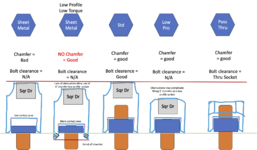

Also, if the screw has a standard washer underneath (not oversized), then I think all sockets fully come in contact with the head cause they can slide a bit further. That's why hex screws and hex nuts most commonly are used washers.