To avoid these ads, REGISTER NOW!

Why buy non impact sockets?

hoston23

Well-known member
Joined
Oct 30, 2013
Messages
437
Location
godley, texas
my impact sockets get soo much abuse that when i need to use a torque wrench i know my chrome sockets wont have play.
 
To avoid these ads, REGISTER NOW!

Stadger

Well-known member
Joined
Nov 19, 2016
Messages
483
It's all about safety. Impact sockets hurt more when you drop one on your toe.
 

franzdom

Well-known member
Joined
Sep 7, 2009
Messages
3,136
Location
NC
impact don't usually have the same indentations also, then you have to line up the hole with the ball which is not an issue with chrome.
 

thatguysb

Well-known member
Joined
Aug 5, 2015
Messages
178
impact sockets are decent but can use on a ratchet. HUGE sidewall.
i usually use chrome sockets for everything inside the engine bay, once suspension and steering well impacts.
 

visionguru

Well-known member
Joined
Jan 2, 2017
Messages
1,233
Location
Chicago
Usually true but it can make difference especially in cases where a large breaker bar is used. I work on some equipment with very large very tight fasteners. I have personally applied over 1000 ft-lbs to a bolt by hand. I have also dealt with some studs that had a torque spec of 1250 ft-lbs. We used a wrench welded into an 8 foot pipe to hold it.

Sent from my XT1635-01 using Tapatalk

There are many lower end impact sockets on the market that use the same CR-V steel, just thicker/bulkier.

I recently purchased a set of Snap-on Semi-deep impact socket set, intending to use for both impact and regular ratchets. I found that while they are useable, just not as easy to put on.
 
Last edited:

Finky198

Well-known member
Joined
Feb 25, 2014
Messages
2,120
Location
North East
Try the really THICK Cr-V impact sockets from Harbor Freight.

I have those and use them daily the older Pittsburghs in the steel cases. They are great sockets. I have Sunex ones as well. Our other box has Snap on, Sk impacts.

The HF and Snap on are much heavier and I think the extra mass works in your favor. Out of the four the Snap ons are the softest in my exp. all though it takes a long time to cause enough deformation to make it unusable...
 
Last edited:

Gila Monster

Well-known member
Joined
Jan 2, 2016
Messages
477
I have both, but I rarely use my chrome 1/2" sockets.

I definitely think if you're not a pro you can save some money and just own 1/2" impact sockets.
 

catron44

Well-known member
Joined
Feb 8, 2017
Messages
159
Location
CT
Impact sockets sometimes break if used with a long breaker bar. When you are torquing HD components you need 12-point sockets and the chrome sockets seem to work better with torque wrenches. Also impact sockets wear out and good chrome sockets last a long time

Can you elaborate on the need for 12-point sockets when HD torquing? I would have thought 6pt would be best in that situation?
 

Wamsutta

Well-known member
Joined
Jan 8, 2014
Messages
10,875
Location
Amarillo, Texas
There are many lower end impact sockets on the market that use the same CR-V steel, just thicker/bulkier.

I recently purchased a set of Snap-on Semi-deep impact socket set, intending to use for both impact and regular ratchets. I found that while they are useable, just not as easy to put on.

Not as easy to put on what? You got me curious.
 

T45

Well-known member
Joined
Nov 20, 2014
Messages
3,252
FYI -

Impact is also **** for torque instruments because of the flex (not to mention play) messes with the correlation of torque measured by the handle and force put on the bolt. You don't want that kind of energy storage and dissipation between the measurement tool and the target bolt. The reason is that the torque tool is itself a spring, so adding more springs to the mix is generally a bad idea and not in the engineering. :thumbup:

Messing around with demolition jobs or rusty bolts of course you can use a pipe wrench and a hammer and it won't matter either. Just horse for courses.
 

davethorik

Well-known member
Joined
Sep 14, 2013
Messages
4,992
Location
Norka, Ohio
Not as easy to put on what? You got me curious.

Guessing on the ratchet/extension etc

*non tech* I have a set of Wright 1/2 shallow 6pt metric impact sockets and I use them exclusively with hand tools. The 19mm in particular I often use on my Mac 24" breaker bar to remove lug nuts with no issues. I probably would have gotten chrome 6pt but I found a screaming deal on the Wright impact set.

I'm also guilty of using chrome sockets on my M18 impact. I've only broken one, a Husky 9/16 deep 6pt that cracked on one of the points where the wall is thinnest. I guess I'm just backwards.
 

donpauli2

Well-known member
Joined
Aug 6, 2013
Messages
91
Location
central Illinois
Side thought. Don't use chrome sockets on an impact gun. They may break and for sure the springiness reduces the force


Sent from my iPhone using Tapatalk
 

Spacey_G

Well-known member
Joined
Dec 31, 2015
Messages
492
FYI -

Impact is also **** for torque instruments because of the flex (not to mention play) messes with the correlation of torque measured by the handle and force put on the bolt. You don't want that kind of energy storage and dissipation between the measurement tool and the target bolt. The reason is that the torque tool is itself a spring, so adding more springs to the mix is generally a bad idea and not in the engineering.
I'm having trouble following the logic. The impact socket is a slightly less stiff spring than the chrome socket, but why should it matter? Draw a free-body diagram of the socket and you'll see that the torque applied to the bolt is the same as the torque applied to the socket regardless of deflection.

Yes, with a weaker spring the torque wrench anvil will twist more relative to the bolt head, but the wrench is still reading the torque being passed through to the fastener. Of course this is assuming the correct technique of gradually applying the load.
 

earlthegoat2

Well-known member
Joined
Jun 11, 2011
Messages
877
Location
SE GA
Myself, for 1/2 drive, I only use impact sockets. With ratchets and impacts. Saves space in the box and have never regretted not having chrome 1/2 drives. I use chrome 3/8 for hand tools and impacts as well. Never broken one yet (cheap Craftsmans and Gewarwrenches too)....but I think the day will eventually come.....then I may consider 3/8 impacts. Not today though.
 
Last edited:

M_George

Well-known member
Joined
Sep 25, 2016
Messages
966
Location
Eastern Pa.
Be realistic, How much torque are you planning on putting on 1/4 and 3/8 sockets anyway? That leaves them out of the argument. If I plan to put a lot of heavy torque on a bolt, I use 1/2 inch every time. The hits provided by an impact driver is between 200 and 1500 psi. That's why the steel has to be more elastic to receive the shock that will crack a CRV socket. Whereas the CRV will withstand the sustained torque a breaker bar with a cheater bar will create. The impact socket will stretch and loose hold of the bolt..
 

Al Borland

Well-known member
Joined
Jan 20, 2016
Messages
1,598
As far as this goes, I only have a couple chrome Metric 1/2" drive sockets. I usually use impact sockets, Never worried about it. Most of my "Daily use" SAE 1/2" sockets are old industrial finish sockets or impacts. I've used them with breaker bars and cheater pipes for 30+ years and never broken them. A few of the older industrial sockets have drive damage from impacts, but so do some of the impacts.
Most of them are painted fluorescent orange so I can find them when I drop them out of a manlift or off a catwalk and they bounce off into "Narnia". (Not sure what/where/who "Narnia" is, but I learned on this site that is where falling sockets end up)
 
Last edited:

T45

Well-known member
Joined
Nov 20, 2014
Messages
3,252
I'm having trouble following the logic.

Don't believe me or my example, it might be confusing in context. Instead, do this: look at an aerospace-style torque adapter. Then compare it to a combination wrench, and ask why its so overbuilt. Its overbuilt so it doesn't flex and is reliable when used with a calbrated device. The torque wrench is a calibrated spring, and introduced non-calibrated spring in between the other moving pieces is common sensically going to create some issues. :thumbup:
 

crf450x

Well-known member
Joined
Apr 20, 2017
Messages
176
Location
Fall Branch, TN
Flex is irrelevant concerning torque wrenches. It's like the common myth that you can't use an extension with a torque wrench. You can use a mile of extensions if you want and, while it will flex a lot, the torque applied/measured will be exactly the same.
 
To avoid these ads, REGISTER NOW!

Fender1325

Well-known member
Joined
Dec 30, 2014
Messages
1,309
Black oxide would get lost so quickly working under a car or in an engine bay
 

xjfish

Well-known member
Joined
Feb 22, 2014
Messages
1,293
I prefer the new Stap-On Kevlar reinforced fiberglass thin-wall sockets. Best of all worlds.
 

Mr.Nutcase

Well-known member
Joined
Apr 23, 2009
Messages
3,850
Location
USA
chrome sockets are thinner and gives more access to components.
 
Last edited:

WittHay

Well-known member
Joined
Jan 6, 2016
Messages
2,157
Location
Surrey, BC Canada
Head bolts on a lot of diesels are 12-point, also main cap bolts. There are 12-point impact sockets but i just prefer chrome sockets for the final torquing

My reasoning for chrome sockets when torquing is that chrome has a tighter fit on the fastener, so when your pulling on the torque wrench with 2 hands the socket stays level. The last machine i did had 120 bolts that had to be torqued to 150 ft.lbs.

Pictures of broken Proto impact sockets, using a breaker bar and cheater pipe.
 

Attachments

  • IMG_1071.jpg
    IMG_1071.jpg
    153.2 KB · Views: 81
Last edited:

Tonyuk

Well-known member
Joined
Jun 9, 2017
Messages
1,539
Location
Scotland
I've never broken any impact sockets using hand tools and use them on breakers often.

Only ever cracked 1 chrome socket and that was a cheap one with a pipe on the bar.
 

CR888

Well-known member
Joined
Feb 19, 2017
Messages
1,198
Using socket with a cheater bar is silly and dangerous and could scratch or leave a wear mark on your shiny polished artifacts. Just leave them in their expensive tool chest so there ready and looking their best for the next forum pic. If you need auto work done pay a pro to it properly.
 

Spacey_G

Well-known member
Joined
Dec 31, 2015
Messages
492
Don't believe me or my example, it might be confusing in context. Instead, do this: look at an aerospace-style torque adapter. Then compare it to a combination wrench, and ask why its so overbuilt. Its overbuilt so it doesn't flex and is reliable when used with a calbrated device. The torque wrench is a calibrated spring, and introduced non-calibrated spring in between the other moving pieces is common sensically going to create some issues. :thumbup:
The torque wrench is a calibrated spring between the handle and the drive anvil. I'm still failing to see why it matters if there's a spring between the anvil and the fastener. The wrench must read the torque that's applied to the fastener. There's no way the torque at the anvil can be different than the torque at the fastener with just a spring in between.

Think of a spring-style force gauge, with a spring between the housing and the hook and a scale to measure the deflection of the spring. If I loop a second unknown spring onto the hook and then apply the load, there will certainly be more deflection but the gauge will still read the correct force. It's a simple statics problem.

Your concerns about stored energy aren't relevant until the loading becomes dynamic, which would be improper technique. Maybe these aerospace adapters are designed to minimize the error due to operators improperly bouncing on their torque wrenches? Or maybe the folks who designed them are also misconstruing the problem.

If there's some technical explanation for what you're trying to explain, by all means, get technical.
 

T45

Well-known member
Joined
Nov 20, 2014
Messages
3,252
...The wrench must read the torque that's applied to the fastener.

...There's no way the torque at the anvil can be different than the torque at the fastener with just a spring in between.

...If there's some technical explanation for what you're trying to explain, by all means, get technical.

This is patently false by observation. I won't argue theory, just experience. But its common knowledge that torque is lost quite readily with extensions, adapters, wobble-sockets and the like. Its also common knowledge that the rotational mass/inertia of the impact socket itself can be modfied to deliver more 'torque' (impact force) to the fastener, despite the measured torque of the anvil not changing...

These are empirical datapoints which point to the same forces at play.

see for example...

It's worst when you put 'em on an impact. My FX24 [2ft x 3/8 extesnion]acts like a 50 ft lb torque stick

So they make 1/2 drive extensions with 3/8 drive squares....eg

They used to call the extra long extensons that were 1/2 female and 3/8 male Transmission extentions, I have a Wright and a Cornwell.

https://www.amazon.com/dp/B00061SNGQ/?tag=atomicindus08-20

https://store.snapon.com/Adaptors-E...l-drive-x-3-8-External-drive-36--P631537.aspx


Inertial delivery sockets for Honda crank bolts


http://www.coptool.com/ingersoll-rand-to-add-50-impact-torque-with-powersockets/

https://store.snapon.com/PARTS-Socket-Metric-Crank-Bolt-17mm-P857206.aspx


...read the reviews and they seem to be happy throwing money at the various vendors...
 
Last edited:

Spacey_G

Well-known member
Joined
Dec 31, 2015
Messages
492
T45 - You are still in the world of dynamic impact loading, which is entirely irrelevant to the manual torque wrenches we're talking about. I'm not arguing that extra springs and clearance fits reduce the peak torque that makes it to a fastener from an impact wrench. There's good supporting theory and empirical evidence there.

That has nothing to do with your original assertion that using an impact socket on a torque wrench causes some inaccuracy. As far as I can tell, there's no theory to support that idea.

Edit: on re-read I'm realizing that your original post only says "torque instruments" which could mean torque sticks meant for impact use. If that's the case we may have been talking past each other this whole time. Would you agree that in the case of a manual torque wrench, it does not matter at all whether the socket is chrome or impact?
 
Last edited:

finn

Well-known member
Joined
Mar 27, 2005
Messages
16,231
Location
The UP, God's country
This is patently false by observation. I won't argue theory, just experience. But its common knowledge that torque is lost quite readily with extensions, adapters, wobble-sockets and the like. Its also common knowledge that the rotational mass/inertia of the impact socket itself can be modfied to deliver more 'torque' (impact force) to the fastener, despite the measured torque of the anvil not changing...

These are empirical datapoints which point to the same forces at play.

see for example...


So they make 1/2 drive extensions with 3/8 drive squares....eg


https://www.amazon.com/dp/B00061SNGQ/?tag=atomicindus08-20

https://store.snapon.com/Adaptors-E...l-drive-x-3-8-External-drive-36--P631537.aspx


Inertial delivery sockets for Honda crank bolts


http://www.coptool.com/ingersoll-rand-to-add-50-impact-torque-with-powersockets/

https://store.snapon.com/PARTS-Socket-Metric-Crank-Bolt-17mm-P857206.aspx


...read the reviews and they seem to be happy throwing money at the various vendors...

Another case where you can have your own opinion, but you can't have your own facts.

Generate a free body diagram that supports your "theory "

Hint: You can't.
 

dwasifar

Well-known member
Joined
May 28, 2017
Messages
2,091
The torque wrench is a calibrated spring between the handle and the drive anvil. I'm still failing to see why it matters if there's a spring between the anvil and the fastener. The wrench must read the torque that's applied to the fastener. There's no way the torque at the anvil can be different than the torque at the fastener with just a spring in between.

Think of a spring-style force gauge, with a spring between the housing and the hook and a scale to measure the deflection of the spring. If I loop a second unknown spring onto the hook and then apply the load, there will certainly be more deflection but the gauge will still read the correct force. It's a simple statics problem.

I was about to reply and argue with you, citing the energy it takes to load the spring, and then I thought about it a little more and realized you are right.

Here's a different way to think about it. Imagine a spring hung from the hook of a scale, with the scale zeroed, and we hang a 1lb weight from the spring. The spring will deflect, but nobody would think that the scale would read anything other than 1lb.

In this example it's gravity applying the force, rather than your arm, but the principle is the same; the spring makes no difference in the amount of force transmitted to the scale.
 

franzdom

Well-known member
Joined
Sep 7, 2009
Messages
3,136
Location
NC
I was about to reply and argue with you, citing the energy it takes to load the spring, and then I thought about it a little more and realized you are right.

Here's a different way to think about it. Imagine a spring hung from the hook of a scale, with the scale zeroed, and we hang a 1lb weight from the spring. The spring will deflect, but nobody would think that the scale would read anything other than 1lb.

In this example it's gravity applying the force, rather than your arm, but the principle is the same; the spring makes no difference in the amount of force transmitted to the scale.

You guys are talking about this in an impact thread, it's fairly irrelevant.
 
Last edited:

Spacey_G

Well-known member
Joined
Dec 31, 2015
Messages
492
You guys are talking about this in an impact thread, it's fairly irrelevant.
The original assertion was that impact sockets should not be used on "torque instruments" because of some vague issue with spring constants and energy dissipation. I interpreted torque instruments to mean manual torque wrenches. With an impact socket on a properly-used manual torque wrench, there's no impact in sight except in the name of the socket. The discussion is very much relevant.
 

franzdom

Well-known member
Joined
Sep 7, 2009
Messages
3,136
Location
NC
Ok got it. I was fixated on the part that said no difference in torque no matter what extension you have and it took a minute to realize the topic had changed to static torque measurement rather than the use of an impact wrench.
 

Jazz1

Well-known member
Joined
Jan 3, 2016
Messages
4,184
Location
Thunder Bay On.
My understanding is that impact sockets are designed for brief, repetitive force, not sustained pressure, and can break when used as hand tools.
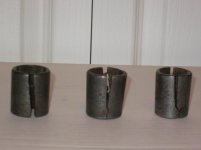
^ this here. I have split impact sockets with a cheater bar. I knew better but just had to see proof:dunno:
 
To avoid these ads, REGISTER NOW!
Top Bottom
