To avoid these ads, REGISTER NOW!

Why do Metric socket sets skip some sizes?

Mgdoug3

Well-known member
Joined
Mar 2, 2018
Messages
1,391
Location
KY
What I hate is when a piece of equipment mixes metric and standard. It's almost as if I have to check four to six sockets to find the best fit. My new Deere backhoe is the worst. Metric, standard, and fifty million bolt and nut sizes, sometimes on the same item.

I feel your pain. I'm overhauling a 4055 right now. I had to use 1/4, 3/8, 1/2, and 3/4" drive socket sets. Had to use 6 and 12 point sockets while looking at markings on the bolts to determine metric or SAE.
 
To avoid these ads, REGISTER NOW!

ToolPolisher

Well-known member
Joined
Jan 21, 2017
Messages
195
All the T-Bolt clamps I can remember have been 11mm from the factory. Given I have spare hardware on hand I change them to the more common 10mm size as they are both internally 6x1.0 threaded.
 

Lucid Moments

Well-known member
Joined
Aug 9, 2015
Messages
1,775
Location
Gainesville, Ga
My issue is that I never know what I am going to be working on. I am no kind of pro but because of that I end up with some oddball stuff sometimes. And while I can certainly go to the store to get what I need it annoys me to have to stop to go buy a tool. I would much rather buy the tool ahead of time and be ready to go.
 

M-EGT

Well-known member
Joined
Jun 2, 2013
Messages
417
Location
PHX
I was surprised to use an 11mm deep on my Ford Fusion (2010-2012), when removing the trunk taillight assembly.
 

Busted_Knuckles

Well-known member
Joined
Oct 9, 2009
Messages
2,613
Location
Northwest Illinois
I live rather rural, my main line is stand by generators, I also do industrial power tools, transmissions, powertrain, some general auto,... old enough that I no longer remember exactly what I used what size on, keeping in mind, I work on the same model of anything rarely twice.

That said, in the last year I replaced ALL my socket sets with Tekton, and maybe what put me over the top, was complete sets of sockets.

I about come out of my mind, when I dont have a socket to pull something apart. No store to drive too, to pick up a missing socket as well. Im OCD about socket management, out of necessity.

Thinking its a brilliant marketing strategy for Tekton, I do not even want to begin to try and figure out, what sockets I might NOT need in the future, just sell me the complete sets,... if I never use a socket, fantastic,..
 

Spider Curry

Well-known member
Joined
Feb 5, 2015
Messages
103
Location
Florida
Unless you have OCD in filling a socket tray, you'll very likely never see those sizes in fasteners. 9 and 11 also come to mind.

It was decades ago and my brain is probably rusty, but having torn apart my fair share of Pontiac Fieros, I recall nearly every bolt and nut in those cars were 9/11/13 mm. I started working on the Plastic Fantastic Fun Car after years in the F-body world. In those days when GM seemed to switch between SAE and metric every other bolt location, it was a real pleasure to have only 3 combination wrenches, 3 sockets, and a ratchet to keep track of.
 

hale1730

Member
Joined
Mar 29, 2022
Messages
9
I also hate this. Always end up needing one not in the kit and end up digging through the loose socket drawer for 10 minutes. I recently bought a made in USA Proto J72206 19 piece 3/8" drive impact set. Has 6 through 24mm with no skips. No skips was a requirement when I was shopping for this set. I would rather have it and not need it then to need it and not have it.
 

VolvoRyan

Well-known member
Joined
Dec 29, 2019
Messages
1,339
Location
Kentuckiana, USA
Depends on your jam. If you live in DIN or JIS, you may be happy with skipped sizes. Volvo's used AW (basically, Toyota) transmissions for 40 years. 6mm-24mm (except 23mm) will find a use.

Skips are nice above 24mm.... but I shop piecemeal anyway.

-Ryan
 

Kuma601

Well-known member
Joined
Dec 24, 2020
Messages
960
Location
Cali
This was why I bought as best a complete set in SAE and metric for some overlap in Craftsman. Has done well for me for the simple stuff.
 

jayemm

Well-known member
Joined
Dec 18, 2018
Messages
1,509
Location
up high down low
In an effort to eliminate surprises from skipped sizes, I got a 10-24mm inclusive set in deep impact sockets. My front strut to knuckle nuts are 23mm on a 21mm bolt head. Not concerned with anything bigger. Over the years, some odd/rarely used sizes I remember are:
GM dash lower covers --- 7mm screw head
GM fuel filter-- 20mm nut on one end of filter
GM - sintered fuel filter nut on side of carburetor -- 1"
Floor jack packing/seal nut on plunger --24 mm ( had to gently hammer a 15/16" open end wrench on that)
There have been others.
 

Debcrow

Well-known member
Joined
May 14, 2019
Messages
4,012
Location
New Mexico
When American manufacturers first started to finally be forced to use metric fasteners they seemed to resist using 'common' sizes. My Ford had several places they used 15 mm instead of 14 mm. Chevy van had 9 mm on AC compressor instead of 10 mm. ETC.
 

JradM

Well-known member
Joined
Sep 4, 2019
Messages
1,811
Location
Alberta
There are a bunch of situations where having no skips is great:

  1. Using a metric socket on an SAE fastener and vice-versa (saves a trip back to the toolbox on occasion).
  2. Going one-size up or down on a rusty or worn fastener.
  3. It gives you a sense of inner calm and completion.
  4. Especially with larger fasteners with loose tolerances, sometimes a smaller size provides a tighter fit.
  5. You don't need the oddball sizes until you work on something weird. 11mm fasteners exist, even if people can live their entire life without seeing one.
  6. When using your sockets for un-socket things, pressing in a seal for example, those skip sockets might be just the right size.
I think some company should come out with a "skip socket" set that's nothing but oddball sizes to fill the gaps in regular sets.
 

Dave455

Well-known member
Joined
Mar 19, 2013
Messages
5,796
Location
Sussex, England
In an effort to eliminate surprises from skipped sizes, I got a 10-24mm inclusive set in deep impact sockets. My front strut to knuckle nuts are 23mm on a 21mm bolt head. Not concerned with anything bigger. Over the years, some odd/rarely used sizes I remember are:
GM dash lower covers --- 7mm screw head
GM fuel filter-- 20mm nut on one end of filter
GM - sintered fuel filter nut on side of carburetor -- 1"
Floor jack packing/seal nut on plunger --24 mm ( had to gently hammer a 15/16" open end wrench on that)
There have been others.
7mm is fairly standard - ISO and DIN nut size for an M4 bolt.

Similar story with 24mm - ISO and DIN for an M16.

20mm is a right pain - think I might own one but don’t think I’ve ever used it.

I tend to view oil filters as a special case - one of my BMW’s needs a 36mm just to remove the oil filter! Some regular guy without 3/4” drive is going to need to invest in special tools just to do an oil change, but I suppose BMW want to make it as awkward as possible!
 
Last edited:

Dave455

Well-known member
Joined
Mar 19, 2013
Messages
5,796
Location
Sussex, England
When American manufacturers first started to finally be forced to use metric fasteners they seemed to resist using 'common' sizes. My Ford had several places they used 15 mm instead of 14 mm. Chevy van had 9 mm on AC compressor instead of 10 mm.
Yes, when the U.S. started adopting metric fasteners it evolved it’s own standard, ANSI Metric. Although some of the sizes are common to other standards, the 15mm is unique (as regards standard fasteners).

Personally, as a Brit, I hate the U.S. going metric. Historically, I can find any piece of American equipment, from a WW2 Jeep, through to a Caterpillar, and know which spanners I will need (same ones I use on most domestic classics).

If I need a bolt I can just grab one from the stores - could be one of my Grandfathers for the Diamond T, or one I bought last week, doesn’t matter.

Now, who knows, and it’s supposed to be in aid of standardisation. Or is all in aid of saving a few cents…!
 
Last edited:

dscheidt

Well-known member
Joined
Apr 26, 2017
Messages
2,880
Yes, when the U.S. started adopting metric fasteners it evolved it’s own standard, ANSI Metric. Although some of the sizes are common to other standards, the 15mm is unique (as regards standard fasteners).
15 mm has been the standard size for bike axle nuts for decades.
 

Dave455

Well-known member
Joined
Mar 19, 2013
Messages
5,796
Location
Sussex, England
15 mm has been the standard size for bike axle nuts for decades.
…as regards standard fasteners…!

When you get to axle nuts, oil filters, or pretty much anything other than a regular nut / bolt you can pretty much find any size. Think I can recall 15mm on a Citroen belt tensioner too.

This is the biggest argument for having a “non skip” set of wrenches / sockets.

I have some tools I leave on my vehicles, and I’m happy to just include the sizes they use, but in my “grab and go” road box, I have very few skips now - 20mm is one though!
 
Last edited:

dchawk81

Well-known member
Joined
Jul 31, 2014
Messages
14,343
I need all the sizes because I **** at identifying a size just by looking at it.

I gotta grab a fist full of metrics and standards that are close and see what fits.

My dad can look at a nut and be like "yeah that's a half" and I'm all "it might be a half or 9/16 or maybe 32mm." 😃
 

matthew

Well-known member
Joined
Dec 4, 2009
Messages
1,345
My best guess…

Old metric sets were built around VW, and DIN sizes. So 10, 13, 17, 19mm.

At the time, they also tended to skip sizes where there were ‘close enough’ inch sizes 11mm, 16mm, even basic sets sometimes didn’t have 19 because everyone was assumed to have 3/4”.

Over the years flange bolts have become more common, and so has JIS. And GM and Ford had their own take. So 12, 14, 15, 18mm are now relevant too.

Tool makers have put sets together with a blend of past practice, intended use, and target price. But the right answer for anyone here is no skips.

Inch sizes changed a bit over time too - 19/32 and 25/32 were supposedly common many years ago. 11/32 is often skipped. And often it is the large/small end of a SAE set that is skipped (like a 1/4” set ending at 7/16 instead of 1/2 or 9/16).

There’s bound to be specific applications where every size is needed. If not a bolt, a custom fastener. I know pro mechanics on here sometimes say they never use 9mm, but I’ve definitely used on brake bleeders.
 
To avoid these ads, REGISTER NOW!

msharley

Well-known member
Joined
Sep 20, 2021
Messages
13,950
Location
Central Pennsylvania
Seems like 23mm was used when changing 2.2L timing chain.

Isn't 20mm used for some lug nuts?

5.5mm was used for GM trim/dash screws.
18mm for some GM lug nuts (and other ****) :bounce:

5.5 for Ford ignition module.

4.5mm (special wrench) for FoMoCo headlight adjustment. (for Fords? you need one of every wrench ever made, two of most):bounce:
 

ATC

Well-known member
Joined
May 12, 2012
Messages
8,257
Location
VA
Drain plug on the oil pan of my F350 is 16mm.
Lots of 5.5mm on 80’s Fords I’ve had too
 

MBfreak

MEMBER EMERITUS
Joined
Dec 10, 2010
Messages
2,301
Location
Linkoping , Sweden
SAAB is fortunately now dead. And Buried. About the worst built cars in the world.
One example is the 4 cyl they made in the end of the sixties. Thermostat was placed between engine block and cylinder head for someobscure engineering decision. Replace thermostate: first remove the cylinder head.
Or, take the gearbox out of a SAAB 9000. Remove several parts of the suspension, drive shafts and subframe, ad then you need sockets from 10 to 19 mm to unbolt!
Anothe beauty is the lambda sond plug-in contact. Sond in front on the exhaust manifold. Wire snuck around the block to a contact that sits high up in the block, well hidden by various parts. Like the intake manifold with 8 short pieces of rubber hose and 16 hose clamps.
What´s not to like??

Good riddance.

ONE good fact. The swedish govt crash statistics show that the body is extremely well designed and manufactured. Injury statistics from real accidents very low

Ola
 

bonneyman

Well-known member
Joined
Apr 22, 2010
Messages
8,757
Location
Desert SW
Craftsman is great for only giving the popularly used sizes. I worked in aviation for many years. We pretty regularly used 11/32 inch wrench and socket. Outside of aviation, almost never! So I bought those less common sizes individually. They always had them on hand.

Sent from my SM-G970U using Tapatalk
I found that 11/32" is used on PSC motors alot. You change blower motors on residential - you'll need that 11/32". As it is often skipped I assembled a nice selection of various wrenches and sockets in that size just to deal with electric motors and brackets.
Can't say if recent motors out of China and Mexico have gone metric on those nuts, but I haven't seen it.
 

Ton ton

Well-known member
Joined
Oct 16, 2019
Messages
4,592
Location
Page County,VA
My New Holland is the same way: the tractor itself is metric, the FEL is all SAE.

I have friends in the heavy equipment repair business; their Miller welders have metric engines, but everything else on them is in inches.
I run into this phenomenon on a regular basis.
 

cannuck

Well-known member
Joined
Nov 30, 2021
Messages
4,592
Location
Rural SK
I have restored a few British cars from the immediate post-war period. It was common to find Metric SAE and BSW fasteners on the same vehicle, and some times mixed thread/head combinations. The way I understand it things were in such incredible short supply and UK so desperately needed export sales they would use ANYTHING they could lay their hands on.

You need a completely filled tool box to go anywhere near the full range of what is out there.
 

ronkz650

Well-known member
Joined
Oct 29, 2022
Messages
219
Location
Denver, CO
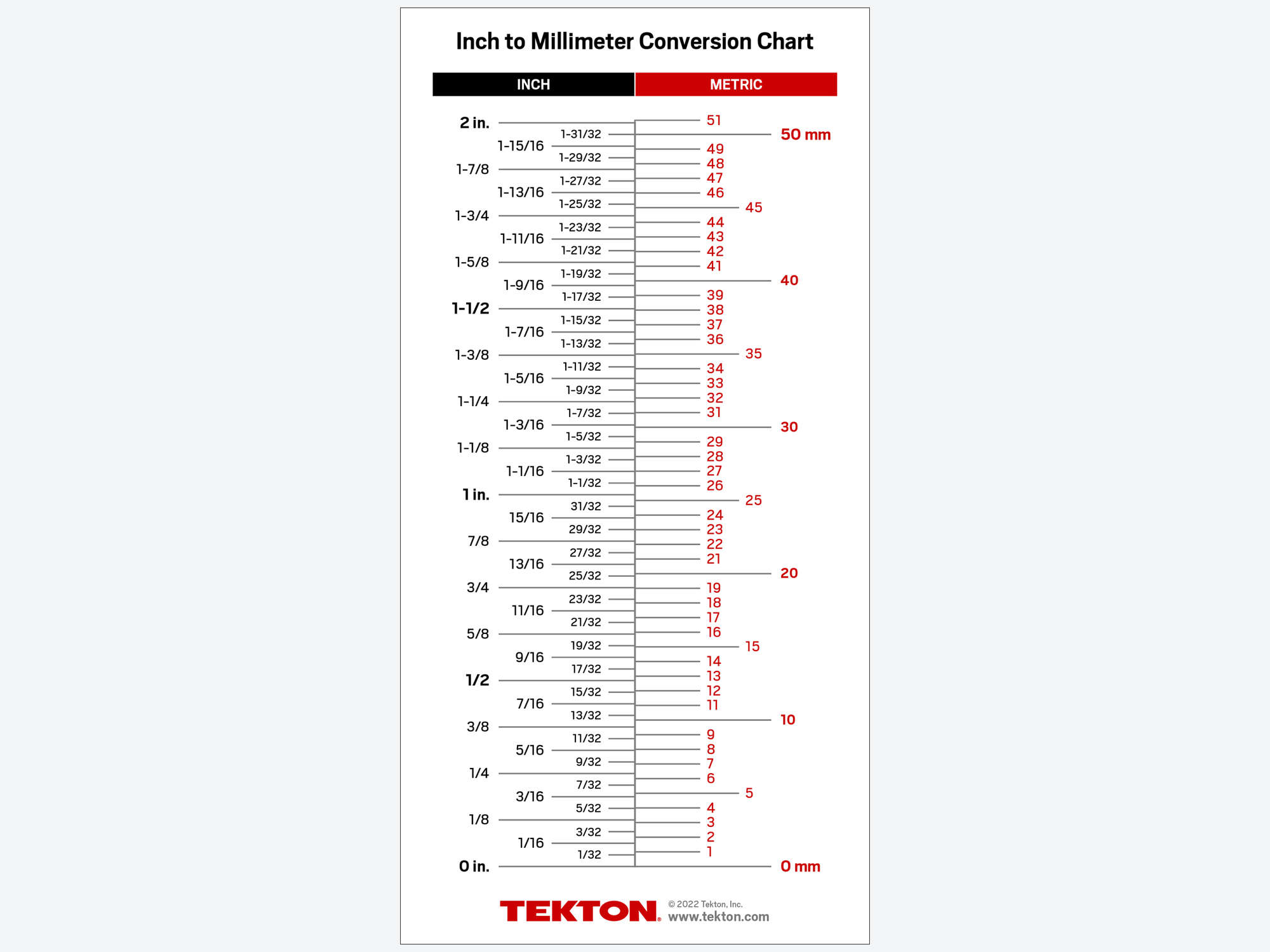
Handy metric and SAE comparison chart you can download and print free at Tekton. 5.5mm,8mm,16mm,19mm among others are all metric sizes already covered by a SAE set.
 

Bubba Fett

Well-known member
Joined
Jun 11, 2018
Messages
1,516
Location
Eastern NC
These days, I'd say you need a no-skip metric set, and then a set of common fractional sizes, unless you work on a lot of older stuff, or you have socket holder and must fill in the empties.
 
Last edited:

M6erfan

Well-known member
Joined
Dec 6, 2014
Messages
10,170
Location
'Merica!
I tend to view oil filters as a special case - one of my BMW’s needs a 36mm just to remove the oil filter! Some regular guy without 3/4” drive is going to need to invest in special tools just to do an oil change, but I suppose BMW want to make it as awkward as possible!

Meh. I own nothing in 3/4" drive and have had a 36mm BMW oil filter socket for decades. I mean you can find them for less than a tenner delivered to your door. Same as any oil filter strap wrench, plier, or cup, if you DIY, you're going to need something. Plus, one can torque the filter cap correctly with 3/8" drive.

:beer:
 

Dave455

Well-known member
Joined
Mar 19, 2013
Messages
5,796
Location
Sussex, England
I have restored a few British cars from the immediate post-war period. It was common to find Metric SAE and BSW fasteners on the same vehicle, and some times mixed thread/head combinations. The way I understand it things were in such incredible short supply and UK so desperately needed export sales they would use ANYTHING they could lay their hands on.

You need a completely filled tool box to go anywhere near the full range of what is out there.
In the immediate post war period (late 40’s early 50’s) while there was still food rationing, mechanical parts were not generally in short supply - the reason being that the country still pretty much had a war economy, and was turning out substantial quantities.

In fact, there was a degree of over production, as witnessed by the vast quantities of parts from this era that were subsequently sold as surplus!

Most of the items produced in this period were of the highest quality - everything from hand tools and machine tools, through to railway locomotives and aircraft.

What did happen, was a switch from British Standard fasteners to Unified. In theory, anything first produced after 1958 should be Unified, but there are many things first produced before that date that continued to be produced using BS fasteners, but incorporating components using Unified.

If in doubt, look for the “Unified” symbol of three interlocking rings - as shown on this aircraft vertical speed indicator.B84CC5AD-14EB-4806-904B-14E2E1752D18.jpeg

Metric back then was totally unheard of. Unless you were working on “foreign” vehicles, most mechanics wouldn’t even have owned metric tools till at least the 70’s.

Generally, if I find a metric fastener on a vehicle that old it’s a more recent modification - UNLESS it’s a BA screw, which are of course basically metric, even though their dimensions are specified in inches.

Prior to ‘58 you will generally find BA/BSF/BSW. Post ‘58 BA/UNF/UNC. You will not find the Unified “numbered series” on any British road vehicle, but you will find them on aircraft!
 

Dave455

Well-known member
Joined
Mar 19, 2013
Messages
5,796
Location
Sussex, England
Meh. I own nothing in 3/4" drive and have had a 36mm BMW oil filter socket for decades. I mean you can find them for less than a tenner delivered to your door. Same as any oil filter strap wrench, plier, or cup, if you DIY, you're going to need something. Plus, one can torque the filter cap correctly with 3/8" drive.

:beer:
Yes, you can, but you still need to buy a special tool just to do an oil change!
 

richfinn

Well-known member
Joined
Jan 29, 2011
Messages
4,809
Location
Leeds, Yorkshire, England
I suspect socket manufacturers make sets with sizes that people will actually use and aim them at a particular market region to keep pricing competitive (be it DIN/JIS/SAE or whatever)

I know this doesn't help the guys who want to be equipped for every eventuality but you can always upgrade and buy Snap-On/Ko-ken or other more specialist brands who sell every size.

I think a better question is "why do the socket organiser manufacturers insist on producing racks with sizes nobody actually uses?" (The ones marked with sizes seem to be more popular in the USA)

Of course you could just assemble your own custom rack just for the sockets you really need and not worry about "filler".

I have a mixture of complete (back up sets) and bespoke sets (which I find work better for me, as I decided which sizes to include, I mark the sizes myself with the little stickers from the ernst kits)
 

M6erfan

Well-known member
Joined
Dec 6, 2014
Messages
10,170
Location
'Merica!
Yes, you can, but you still need to buy a special tool just to do an oil change!

Every car I've ever owned or worked on needs a "special tool" to do an oil filter change. Honda, Nissan, Toyota, Jeep, Ford, Chevy, Volvo, Subaru. You make it seem like BMW is a special case :dunno:
 

Dave455

Well-known member
Joined
Mar 19, 2013
Messages
5,796
Location
Sussex, England
Every car I've ever owned or worked on needs a "special tool" to do an oil filter change. Honda, Nissan, Toyota, Jeep, Ford, Chevy, Volvo, Subaru. You make it seem like BMW is a special case :dunno:
Yes, fair comment!

But I grew up with British cars, almost all of which just needed standard tools. Still work on a lot.

With the switch to cartridge oil filters, I acquired a Facom oil filter wrench, (below - superb tool) with a stainless strap that’s able to handle every cartridge filter I’ve ever encountered, which is most British or Euro cars since.564688F9-95AD-4598-8105-95424AE9E168.jpeg

I know that many makers have switched back to separate housings, and special tools, but I don’t see many Chevy’s and Jeeps in my part of the world (and I’m pretty sure the last Suburu I saw had a cartridge filter), so it’s only really BMW’s (and Mini’s) that I find myself needing these big sockets for.
 
Last edited:
To avoid these ads, REGISTER NOW!
Top Bottom