-I don't think that's true, the class of cast iron would depend upon the application. This has been true since the 19th century. I've asked for source(s) of the above info and still waiting but I'll try to keep this reply as brief as possible with references included from my library.
-Well apparently some vise makers felt it was worthwhile to use a better material than just bog standard gray cast iron. I'm not attempting to declare what type/class of material vises are made from. What I'm suggesting is that cast iron can be a rather complex, batch made material that depends upon a lot of factors that can greatly affect the finished product.
"The degree and type of heterogenity and the characteristics of the several components of the solid metal are controlled by the composition, melting practice, rate of cooling and the subsequent heat treatment. Practically speaking, the properties of cast iron are determined by the type of dispersion (distribution) and the relative proportions and characteristics of the various phases of the solid metal." -Alloy Cast Irons pg. 2 published by American Foundrymen's Association 1930/1944
-Not so sure I'd rely upon advertised information either. Sometimes the marketing dept. is woefully underinformed and sometimes technical information isn't prominently displayed. The class/type of cast iron is/has been defined by chemical composition rather than marketing jargon. I only found one reference to material used by Prentiss in a catalog shown below, there may be more:

-Some do/did but I wouldn't use the presence/absence of advertising info as a definitive qualification for material used.
-True but the phrase "semi-steel" often was regarded by many as a catch-phrase from the marketing dept. like Meehanite cast iron was/is. Semi-steel could be no more than a piece of steel re-enforcement instead of an alloy addition to the ladle/cupola melt. That doesn't mean it's not a valid method/process it just isn't well defined like other cast iron compositions.
-Your dateline is off but I agree that ductile iron wasn't used prior to 1943.
Perhaps but there are plenty of other ways a vise design feature could be stressed to the point of breaking. Even what appears to be gray cast iron may not indicate graphite in flakes.
"(2) Additions of steel to the melt. Steel additions reduce the total carbon and dilute the graphitic carbon present in the melt. This reduces the opportunity for the carbon to graphitize and develop many and large flakes of graphite." -Metallurgy pg. 347 by Johnson/Weeks published by American Technical Society 1957
Furthermore, internal stresses can be from the foundry processes or even induced/released from machining/clamping the casting.
-I can partly agree with this but woodworking vises are not subject to the pressures/stress that most other types of bench vises are subject to. The different brands from the same company may indicate varying classes of quality, finish, or material used. The bench vise examples already seen, even without hammer marks, raise the original question in this thread. I find it difficult to imagine any major commercial venture using ordinary gray cast iron, known for being relatively brittle/rigid, as suitable material for a product subjected to compression/deflecting/impact stress like a bench/machinist vise is. This might be especially true when a malleable iron was commonly used for things as ordinary as plumbing fittings. In cheap, imported vises we see these breaking under relatively normal use. For companies hoping to offer better quality products this would seem to be foolish to use regular gray cast iron in an application that would be failure prone. The longevity of old vises vs. the brevity of cheaply made vises is evidence of the difference in material construction.
I'm not attempting to refute statements made in any post prior to this one. What I'm suggesting is that without a metallurgical analysis of the material I don't know how anything other than a vague assumption could be made. Without examining the mold, the process used in time/temperature/speed/cooling, and the defect itself it's just speculation about the fracture. Nothing wrong with speculating either, that's part of the fun in discussion on a board like this. But to make flat declarative statements about an uninspected item that may be over 75 years old seems like painting with a broad brush and while blindfolded as well. JMO, you're entitled to yours too.
You are presuming vises were made by manufacturers trying to use the “absolute best possible materials”, rather than what usually happened, which is that the vises were made by companies trying to make a vise using the “best economical manufacturing technique”.
If a vise company wanted, or needed, to manufacturer a vise that was incredibly strong, were cost of manufacturing was not an issue, then a brass or bronze alloy would have been used, rather than practically any cast iron alloy, since the Brass/Bronze alloys would be stronger than the iron alloys, as well as have the advantage of not rusting.
I would presume Brass and Bronze vises were made, but few survive, because they were melted down as scrap.
I know some vises were and are still made for non-sparking purposes, and marine use on ships, for both the non-sparking, and non rusting attributes, and possible because the Brass/Bronze will not affect magnets.
As for adding steel to iron, that was a cheap way to improve the qualities of iron, at least once affordable methods were developed for manufacturing steel, and vise manufacturers tended to advertise “semi-steel” when they did this, although maybe not always.
You also seem to be presuming that “virgin iron” was used, instead of a mix of virgin iron and scrap, which even nowadays is likely what is used for cheap iron castings, unless the iron is made with specified alloys, or for particular engineering applications.
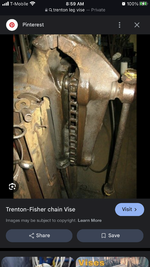
Vises made for blacksmiths, which are meant for hammering on, were made from wrought iron forgings, and later steel forgings, and there were variations made such as the Fisher & Norris vises that had a chain and sprocket design for parallel opening.
Parker, had a patent for casting a wrought iron bar into the jaw slide to strengthen the area subject to the most tensile stress, with a material more able to withstand tensile forces.
Incidentally, one theory about why some vises are cracked parallel within the center top of the vise slide, is stresses related to this strengthening bar that was cast into the vise part.
As for heat treating the cast iron, the time required is usually based on the item thickness, so a large vise would require extensive and long heat treatment to change a large industrial vise from grey iron to malleable iron, which is likely the reason it usually wasn’t done.
Armstrong of Bridgeport CT, the company that was using the malleable iron for their vises, was a manufacturer of pipe tools, including taps and dies, and also literally manufactured the world’s first hybrid car, although to someone else’s design.
A lot of other vise manufacturers probably just ran iron foundries casting a variety of products, many of which were likely cheap consumer goods, like cast iron pots.
A number of vise patents and designs replaced certain cast iron parts with rolled, and possibly machined steel” were it seemed necessary, to strengthen the vise designs.
Rolled and/or machined wrought iron bar was used on a number of vises for the dynamic bar, as well as the vise screws, while most of the other parts were still cast.
This became common fir woodworking vises were the vises faces were still brittle cast iron, but the bars were drawn round bar, a design and material choice that is still commonly used, although with the “wrought iron” bar, replaced with steel.
Rectangular bar was also used, and was the precursor to the Wilton and Columbian vises that are still manufactured, that have a U-channel steel slide, attached to a cast dynamic jaw head.
Sometimes a pair of rolled “wrought iron” and later steel plates, was used for the slide, and then riveted or fastened into the cast iron vise head, a design that is also still used and manufactured.
Even though ductile iron is currently readily available for manufacturing, vises are still routinely made from more brittle, and weaker iron alloys, even by manufacturers like Wilton, because the better alloys usually cost more in materials, or in casting production, due to a more complex process, or in heat treating afterward, or due to higher waste, since castings can warp during heat treating, an issue that sometimes turns up with the Austempered Ductile Iron vises Yost manufactures, at least judging by some reviews mentioning warped out of flat parts.
It is possible some foundries experimented with trying to make better iron alloys, or to make the iron more durable using other techniques such as heat treating, however, they would likely be doing so considering other costs.
Meehanite was a higher strength cast iron developed at the Ross Meehan foundry in Chattanooga, Tennessee and then patented a decade before Ductile Iron was.
In case you are unaware, basic brittle, cast grey iron, was used for all sorts of high stress applications, including bridges, made from cast parts, and subject to both compression and tensile stresses.
The same goes for building structures, and even “structural beams” in the form of inverted cast T-Beams, were the bottom of the beams, subject to higher tensile stresses, were cast wider and thicker than the upper section, which was thinner, due to being subject to compression forces.
This is the same reason older vises have a very thick section of cast iron on the upper part of the vise slide.
The Whitworth thread form was developed specifically for cast iron, since it produced less stress on the brittle material.
Once the rolling of large iron plate became a possibility, riveted beams in the form of I-beams, and Box beams became the standard, and these riveted beams were eclipsed by single piece rolled I-beams when that became a possibility.
If you want to find out if any other methods were used to change the iron alloys to a “better material”, you would have to test the iron from a wide variety of different vintage vise manufacturers, including multiple vises from the different lines those manufacturers made, both the economical ones, and the top of the line models, and check the iron alloy and molecular structure.
It’s possible some iron foundries left the cast parts to age for a while for degassing and stress relief, but I don’t know whether this would be easy to tell even with high level material testing, since the buses in many cases have had decades to stress relieve on their own, and a vise that lived in a hot area like Nevada or Texas would be subject to presumably months of hotter temperatures, which might leave an affect after decades.