To avoid these ads, REGISTER NOW!

Why use a T handle?

JamesMay

New member
Joined
Jan 23, 2019
Messages
4
Location
Laughlin,Nevada
I'm sorry if this has been asked before but I was tool shopping at the junkstore today and was wondering what are the advantages of a T handle vs Ratchet/ breaker bar? Also why were lots of old breaker bars so short?
 
To avoid these ads, REGISTER NOW!

four.cycle

Well-known member
Joined
Oct 19, 2015
Messages
28,602
Location
Tacoma, Washington
The "T-handle" socket wrench was introduced contemporaneously with the earliest breakers and ratchets, and kind of fell out of favor with the later introduction of interchangeable sockets and drive accessories.
Earliest versions were made by Walden and Mossberg and in many cases were intended to perform one unique task on one vehicle (i.e., connecting rod nuts on early Ford engines.)

Mossberg 2500 Salesman wocket wrench display 1924 Buhl sons catalog pp 260.jpg
 

neilreeveszz

Well-known member
Joined
Mar 9, 2011
Messages
57
A T handle is very valuable when you want to apply pressure and even, symmetrical torque to taps and extractors or to worn bolt heads that you cannot afford to cam off of.

Short breaker bars don't have as much use in my view but they can be handy in some cramped spaces where a long one or ratchet won't work. I wish I could go back in time and ask the original owner of my New Britain NS-58 how he managed to just about wear out a 1/2" breaker bar that is 11" long. He might have been one of those old timers that did not own a ratchet.
 

neilreeveszz

Well-known member
Joined
Mar 9, 2011
Messages
57
I had assumed that the OP was referring to a sliding T handle for use with interchangeable sockets.
 

rebelram

Well-known member
Joined
Sep 5, 2008
Messages
142
Location
AL
A sliding T handle is a tool that I did not own until just a few weeks ago. Never needed one or saw the use for one. A speed wrench is another one I do not own, but have used ones my dad owns.

The sliding T handle I did not think I needed, until I realized you can put the drive anvil in the center position and then spin the handle like a propeller to run bolts in or out. Seems just as fast as a speed wrench, but requires a little more clearance.

I would say these two tools were high tech years ago, before we got more modern ratchet designs or air tools. Definitely highly valued by their owners back then. Do they still have a use today? Depends on how you like to work.
 

jd_1138

Well-known member
Joined
May 8, 2013
Messages
17,043
Location
NE Ohio
A T handle is very valuable when you want to apply pressure and even, symmetrical torque to taps and extractors or to worn bolt heads that you cannot afford to cam off of.

Short breaker bars don't have as much use in my view but they can be handy in some cramped spaces where a long one or ratchet won't work. I wish I could go back in time and ask the original owner of my New Britain NS-58 how he managed to just about wear out a 1/2" breaker bar that is 11" long. He might have been one of those old timers that did not own a ratchet.

This.

After seeing many people put cheater pipes on ratchets, do we even need to ask why breaker bars are needed? lol. They are great, and the smaller ones are good for tight spots. Though of course the longer ones have more torque.

A breaker bar has a flexible head so you get it into some awkward spots whereas most ratchets are fixed. The flex and roto ratchets are nice to have though.

This SK 1/4 breaker bar has a hole in the end, so you can put a bar in there to add torque for stubborn fasteners.

Vintage-2-Pc-S-K-S-K-1-4-Drive.jpg
 
Last edited:

Private Lugnutz

Well-known member
Joined
Mar 30, 2012
Messages
30,505
Location
The Authentic Jersey Shore
The fact that they were initially known as hinge handles or flex-head handles, not "breaker bars", in vintage catalogs and ads is exactly why some guys can't understand now why they weren't all 21" long back then! They were originally intended to be used for more than just breaking frozen nuts and bolts loose with leverage. Essentially, they evolved from what were called offset handles, which had a short handle and a fixed (forged or welded) head with a male drive stud oriented at 90*. Somebody had the bright idea to hinge them so they could be used at 90*, 45*, or 0* (with the use of a cross bar through the hole drilled in the end of the handle for that purpose). Their current terminology and limited purpose is a modern phenomenon.

As for Sliding Tees, in addition to two-handed equal torque (as neil alluded to), quick propeller-like nut spinning (as rebelram alluded to), you can also slide the drive head all the way out to the stop on the end and use them like a traditional "L" or offset handle. Note also that because the whole head itself swivels 360* on the bar, you don't have to move or reorient the bar in a tight spot.
 

DFB

Well-known member
Joined
Sep 7, 2016
Messages
5,765
Location
Southern VT/Western Mass
By sliding the bar through you can rotate your swing leverage a lot easier than you can with a swivel head breaker bar especially if you don't have any room to flip one over (and that's where a short one may be handy :D )

The sliding T handle in lieu of a ratchet can actually be worked pretty fast sliding it back and forth in competent hands.

Cant say if its generally any stronger but breaker bars (though getting better quality all the time) often could break :dunno: especially at the pin point or the clevis depending on the design.

An as mentioned earlier you can get a more balanced grip to turn something like a socket over a thread die. I do own 2 Sliding T- handles both Craftsman a 1/2" -V- and nice 3/8" Circle H I found at the flea mkt.

I have more breaker bars than I care to count in in several brands and different lengths. HF both the old black rubber grips and new black and red handle one, nicely chromed round handle Tekton and the old flat handle Craftsmans all in 3/8" and 1/2" sizes and a nice little SK in 1/4" drive another flea mkt find.

My buddy at the motorcycle shop just recently snapped a Craftsman 1/2" breaker bar, he didn't even bother trying to warranty it.
 

four.cycle

Well-known member
Joined
Oct 19, 2015
Messages
28,602
Location
Tacoma, Washington
neilreeveszz said:
I had assumed that the OP was referring to a sliding T handle for use with interchangeable sockets.

That didn't even occur to me when I posted above (post #2).

Private Lugnutz does raise a salient point regarding the origins and original name of what is today commonly known as a "breaker" - it was originally a "flex handle" or "hinge handle".

Perhaps this is just a crazy assumption on my part, but as I recall nuts and bolts on earlier automobiles didn't require the kind of torque values seen on modern day vehicles. Ergo: the need for super-long handles on drive tools wasn't a requirement.
 

larry_g

Well-known member
Joined
Apr 28, 2007
Messages
16,872
Location
oregon
Back in the day Ratchets didn't hit the market till later and I can assume that they were much more expensive than a sliding T handle or a flex head handle. These days I relegate T and swivel head handles to a dedicated socket for use on machine tools. A lot of times on a machine tool it's loosen, adjust, and tighten. No need for a bulky ratchet.

lg
no neat sig line
 

rsanter

Well-known member
Joined
Dec 22, 2007
Messages
18,494
Location
visalia ca
The T handle vice ypu speed by being able to spin the thing.
Ratchets are more expensive due to the moving pieces.
t handles are largely old tech now, the only people who really use them are the folks that do the engine building competition as they are not allowed power tools
 

Monza Harry

Well-known member
Joined
Dec 29, 2018
Messages
1,433
Location
Windsor ON
Hi Gang 1st post! It would help to go back to the vintage of the origin of the "Tee handle" and "Breaker" bars, early Ratchets were almost 2X the price of either of the above "weapons" and the first "Cheapy" ones [still more than a BB or Tee] would sometimes pop out of gear, newer designs seem to be self energizing and I haven't been able to make any of mine skip, but some of my Dads OLD ones sure would [usually with a donation of the "Red Stuff" to the Auto Gods]. Of course with history comes those of us who have "issues" with change and we keep on hangin' on, this is as well as the many XLNT points above. Harry
 

Old Man Roger

Well-known member
Joined
Apr 6, 2017
Messages
17,453
Location
Palm Coast Florida
T-Handles were great before everyone owned a battery operated everything. Their good for working on small stuff, like dirt bikes, in the pits, with no power or air compressor. I've seen guys change a clutch on a 125 2 stroke in just a couple minutes with T-Handles. They spin like a 4 way lug wrench, much better than a ratchet in some cases.
 
Last edited:

Cooter Brown

Well-known member
Joined
Feb 6, 2017
Messages
316
In addition to the things mentioned a specific use I've found for a sliding T is disassembling through bolt shotguns--there is a bolt or nut under the buttplate that holds the stock on.

These are not high torque fasteners and a sliding T allows you to apply nice, even pressure and to the fastener and the stock, which can be an expensive chunk of wood.
 
To avoid these ads, REGISTER NOW!

1982fxr

Well-known member
Joined
Jan 7, 2012
Messages
10,000
Location
Phoenix
The "T-handle" socket wrench was introduced contemporaneously with the earliest breakers and ratchets, and kind of fell out of favor with the later introduction of interchangeable sockets and drive accessories.
Earliest versions were made by Walden and Mossberg and in many cases were intended to perform one unique task on one vehicle (i.e., connecting rod nuts on early Ford engines.)

Mossberg 2500 Salesman wocket wrench display 1924 Buhl sons catalog pp 260.jpg

Contempora.......what?
 

Oldtuleguy

Well-known member
Joined
Nov 4, 2017
Messages
10,457
It's the adverb of contemporaneous (adj). Living or occurring in the same time period...
 

d42jeep

Well-known member
Joined
Oct 22, 2014
Messages
16,510
Location
Northern California
I use the sliding t with tap sockets to clean up threads

Me too. The sliding Tee makes using a tap much easier than using a typical tap wrench. If you get to a difficult spot during the tapping operation you can immediately slide the handle to one end and exert much more pressure.
-Don
 

F124C

Well-known member
Joined
Aug 19, 2013
Messages
1,829
Location
Ireland
T-Handles were great before everyone owned a battery operated everything. Their good for working on small stuff, like dirt bikes, in the pits, with no power or air compressor. I've seen guys change a clutch on a 125 2 stroke in just a couple minutes with T-Handles. They spin like a 4 way lug wrench, much better than a ratchet in some cases.

I worked in a motorcycle workshop back in the mid '70's. The Boss invested in a m/c rolling-road (1st one in Ireland :bounce: ) and for good measure also ordered all the Honda Motorcycle tools which came on shadow-boards (iirc?).
The official Honda tools included a set of non-sliding T bar wrenches with fixed sockets, one for every metric size used plus the special pin drive sizes for clutch nuts etc. I loved using them to spin nuts on or off, faster than a ratchet. I still see aftermarket sets for sale in motorcycle stores.

AL.
 

Private Lugnutz

Well-known member
Joined
Mar 30, 2012
Messages
30,505
Location
The Authentic Jersey Shore
The "T-handle" socket wrench was introduced contemporaneously with the earliest breakers and ratchets, and kind of fell out of favor with the later introduction of interchangeable sockets and drive accessories.
All the vocabulary comments re-quoting this made me realize I really didn't read your original comment closely, 4.c. Going to have to politely respectfully disagree with you about this. The looping T-handle with a "fixed" (welded or hand-forged) socket on the end of it in various service opening sizes was contemporaneous to all the other handles (L, offset, speeder, etc) with a "fixed" socket on the end of it, well before "breaker bars" and other handles with drive studs for detachable interchangeable sockets. And, while I agree that the looping T-handle eventually disappeared from socket sets, several Mfgrs continued to make them with drive studs on the end for detachable sockets, just like all the other early fixed type handles (speeders, offset, etc) were converted.
 

four.cycle

Well-known member
Joined
Oct 19, 2015
Messages
28,602
Location
Tacoma, Washington
four.cycle said:
"...the earliest breakers..."

^ and there is where I failed to make the distinction between "breaker" and "ell handle".

Private Lugnutz said:
The looping T-handle with a "fixed" (welded or hand-forged) socket on the end of it in various service opening sizes was contemporaneous to all the other handles (L, offset, speeder, etc) with a "fixed" socket on the end of it, well before "breaker bars" and other handles with drive studs for detachable

(* emphasis added *)

^ Do a quick flip-through of all those early Mossberg catalog pages I sent to you.
I re-did that post twice after cruising through those old catalog ads, because I had originally assumed the same as what you're saying in your post.
The breaker as we know it today seems to have come later, as well as the concept of interchangeable sockets and drive tools, but Mossberg was producing their "wire" ratchet (as well as the 350 and 355) prior to WWI, right along with the fixed socket "T-handle" type wrenches.

We may well be splitting fine hairs here, but after cruising through several dozen of those early catalog images it looks like there was some degree of overlap - although (again) as you note, the modern-day "breaker" came on the scene later.

1914 Automobile Trade Journal Mossberg ad pp 223.jpg 1916 H. Channon Co. catalog Mossberg ad pp 178.jpg
 
Last edited:

Private Lugnutz

Well-known member
Joined
Mar 30, 2012
Messages
30,505
Location
The Authentic Jersey Shore
If you're saying by "breaker" you meant the early L or offset handles with welded or hand-forged sockets on the ends, then yes, that was the disconnect.

My other point, though, was to clarify that the early Tee-handle did not disappear with the advent of detachable sockets. When sockets became detachable, the handles to turn them (i.e., L/offset, brace, speeder, etc) looked pretty much the same, except for terminating in male drive studs. That included the Tee-handle. Snap-on had a Tee-handle in its 9/32-inch drive set well into the late 1930's.

EDIT: It would be a strictly esoteric exercise to track it down, but my hunch is the Sliding Tee may have evolved from the early fixed L/offset handles, not the early fixed Tee-handles. Picture a Sliding Tee with its drive head slid all the way out to the end. That's exactly what the early L or offset handles looked like with the head welded or hand-forged on the end permanently. Pure speculation, but I seems to me it's possible somebody may have looked at that and thought, "Hmm, if we could slide this to the middle we'd have a very short Tee handle!"
 
Last edited:

four.cycle

Well-known member
Joined
Oct 19, 2015
Messages
28,602
Location
Tacoma, Washington
Private Lugnutz said:
"...yes, that was the disconnect..."
^ yes.

best wild-*** guess on this is 1920s but without any catalog or other documentation, wild-*** guess is as close as I can get.
this illustrates exactly your last statement above:

Walden Worcester 39120-20 12-pc 9.32 SAE socket set (Ebay 112743731353 09).jpg

(* we're working on clearing out enough space in the living room to be able to break into these piles and get this stuff sorted out here, otherwise this would already be back there in the Lugzonian. *)
 

pi_guy

Well-known member
Joined
Jul 27, 2014
Messages
2,814
Location
N/A
One use I have for the tee handle is adjustments. On many race shocks the adjustment screw is x number of rotations. Or you count your rotations so you know where you are. Also if you counting clicks ratchets can confuse the issue.
 

Oldtuleguy

Well-known member
Joined
Nov 4, 2017
Messages
10,457
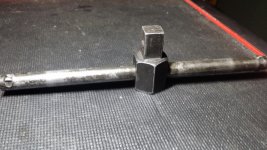
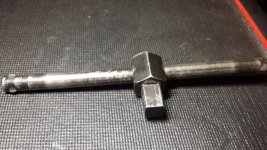
Earliest one I have came in a blackhawk set circa 1919. Somewhat crudely made with hex bar stock, pinched on the ends to retain the slider.....
 

Attachments

  • 20190126_191535.jpg
    20190126_191535.jpg
    150.1 KB · Views: 33
  • 20190126_191526.jpg
    20190126_191526.jpg
    155 KB · Views: 34
To avoid these ads, REGISTER NOW!
Top Bottom