Posted elsewhere but that thread coughed up a catalog page that in my beginner ignorance has attracted my curiosity.
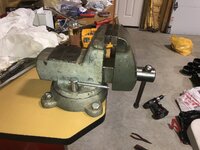
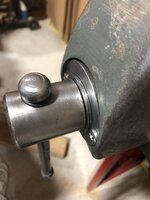
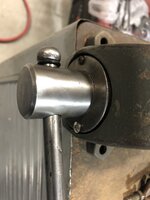
The vise in question is a Wilton, but not exactly like any regular 744. The jaws are narrower at 3" with 2" jaw-screw spacing, pipe jaws are not provided, and the swivel lockdowns were plain nuts in the two examples that are otherwise similar. The casting numbers match the first iteration of the 744 4" Mechanics Vise. One notable difference is the thrust collar for the lead screw, which is a steel thrust plate against which the handle boss bears. The lead screw is retained in this thrust plate using a snap ring. More on that later.



Here is the catalog page that aroused my curiosity:

Note the use of steel for the guide bar around the lead screw. Also notice the "semi-steel" description of the main casting.
I watched some YouTube of a guy destroying a collection of vises by testing them to destruction, which I'm sure has been discussed here before. In all cases, the most common and earliest overtightening failure was when the steel guide bar yielded. You could tell this because the stress increased (more tightening) but the clamping force did not (because the steel was yielding). So, I count the use of a square steel tube guide bar on the above vise as a weakness--that's what will fail first--but also a feature--it will fail gently rather than projecting a piece of shattered iron across the room and dropping the workpiece on your toe.
The long threaded lead-screw nut on the Mechanics Vise is a feature--those did not see any thread failure in the testing. The other major failure point for lead screws was any hole therein for a lock pin or collar set screw or whatever. The Mechanic's Vise does not have that--on mine, the lead screw is retained to the thrust plate (which is screwed to the moveable jaw) by a snap ring that runs in a groove in the wider section. So, there is nothing in the lead screw than presents less cross-sectional area than the thread root. I don't know the strength of the steel used in Wilton lead screws, but if equivalent to a Grade 5 bolt (meaning: middle of the range), the lead screw strength should be 15-20 kips. The vise is only demonstrated to 8000 pounds (8 kips, and described on the next page of that catalog whence the above page came), but I think the guide bar will fail through yielding long before the lead screw breaks.
So, what's the opinion on "semi-steel", used to describe the main casting? It seems that it could mean anything within the general description of iron with scrap steel mixed in during the melt. This has the effect of reducing the carbon content, reducing the flake graphite/carbon but not too much, increasing the compressive and tensile strength, reducing the damping properties, and possibly improving ductility and toughness. Read: It's somewhere between plain gray iron and ductile iron. In terms of strength, it could mean anything, but then we generalize that gray iron has a strength of 30 KSI and ductile iron is twice that, when there are gray iron formulations with 60 KSI strength and a few ductile irons that are less. My guess is that "semi-steel" is mostly marketing-speak for "the good-stuff gray iron compared to the run-of-the-mill gray iron **** used by those compromisers over at Columbian." I note that "semi-steel" does not seem to appear in later catalogs, and certainly not in catalogs published since the departure of Mechanic's Vise production from these shores. Lately, they describe these vises as being made from gray iron, which is not necessarily a bad thing if appropriately designed.
What does this all mean? Beats me--mostly just a new guy who didn't see this discussion in a search about these vises and perhaps naively thought it was interesting. I think the bottom line is that the earlier Mechanic's Vises were intended to be thoroughly competent vises that would be more affordable than ductile-iron bullet models. They should not fail in spectacular ways, and should allow fearless tightening using the supplied handle and perhaps judicious use of a cheater for those not as capable of cranking down on the handle as some are.
Rick "much ado about nothing" Denney
The vise in question is a Wilton, but not exactly like any regular 744. The jaws are narrower at 3" with 2" jaw-screw spacing, pipe jaws are not provided, and the swivel lockdowns were plain nuts in the two examples that are otherwise similar. The casting numbers match the first iteration of the 744 4" Mechanics Vise. One notable difference is the thrust collar for the lead screw, which is a steel thrust plate against which the handle boss bears. The lead screw is retained in this thrust plate using a snap ring. More on that later.
Here is the catalog page that aroused my curiosity:
Note the use of steel for the guide bar around the lead screw. Also notice the "semi-steel" description of the main casting.
I watched some YouTube of a guy destroying a collection of vises by testing them to destruction, which I'm sure has been discussed here before. In all cases, the most common and earliest overtightening failure was when the steel guide bar yielded. You could tell this because the stress increased (more tightening) but the clamping force did not (because the steel was yielding). So, I count the use of a square steel tube guide bar on the above vise as a weakness--that's what will fail first--but also a feature--it will fail gently rather than projecting a piece of shattered iron across the room and dropping the workpiece on your toe.
The long threaded lead-screw nut on the Mechanics Vise is a feature--those did not see any thread failure in the testing. The other major failure point for lead screws was any hole therein for a lock pin or collar set screw or whatever. The Mechanic's Vise does not have that--on mine, the lead screw is retained to the thrust plate (which is screwed to the moveable jaw) by a snap ring that runs in a groove in the wider section. So, there is nothing in the lead screw than presents less cross-sectional area than the thread root. I don't know the strength of the steel used in Wilton lead screws, but if equivalent to a Grade 5 bolt (meaning: middle of the range), the lead screw strength should be 15-20 kips. The vise is only demonstrated to 8000 pounds (8 kips, and described on the next page of that catalog whence the above page came), but I think the guide bar will fail through yielding long before the lead screw breaks.
So, what's the opinion on "semi-steel", used to describe the main casting? It seems that it could mean anything within the general description of iron with scrap steel mixed in during the melt. This has the effect of reducing the carbon content, reducing the flake graphite/carbon but not too much, increasing the compressive and tensile strength, reducing the damping properties, and possibly improving ductility and toughness. Read: It's somewhere between plain gray iron and ductile iron. In terms of strength, it could mean anything, but then we generalize that gray iron has a strength of 30 KSI and ductile iron is twice that, when there are gray iron formulations with 60 KSI strength and a few ductile irons that are less. My guess is that "semi-steel" is mostly marketing-speak for "the good-stuff gray iron compared to the run-of-the-mill gray iron **** used by those compromisers over at Columbian." I note that "semi-steel" does not seem to appear in later catalogs, and certainly not in catalogs published since the departure of Mechanic's Vise production from these shores. Lately, they describe these vises as being made from gray iron, which is not necessarily a bad thing if appropriately designed.
What does this all mean? Beats me--mostly just a new guy who didn't see this discussion in a search about these vises and perhaps naively thought it was interesting. I think the bottom line is that the earlier Mechanic's Vises were intended to be thoroughly competent vises that would be more affordable than ductile-iron bullet models. They should not fail in spectacular ways, and should allow fearless tightening using the supplied handle and perhaps judicious use of a cheater for those not as capable of cranking down on the handle as some are.
Rick "much ado about nothing" Denney