To avoid these ads, REGISTER NOW!

Wire as a Main Panel or Sub-panel?

budhabaier

Member
Joined
May 29, 2013
Messages
22
Location
Granbury, TX
Hello to all,

I am planning the replacement of two load centers in my new (to me) home. The house was built in 1951 and is feeling the effects of 66 years of updates (neglect). I have a couple of questions that have come up prior to starting and I hope that you all can help with them. I plan on adding an attached garage in the next two years and will add a subpanel for that.

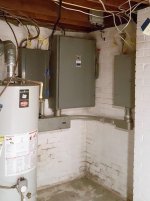
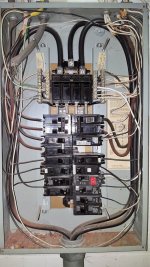
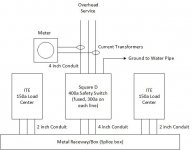
My electrical service comes in from the overhead, the meter uses current transformers on the incoming lines. The service enters the home through a Square D 400a Safety Switch (with 300a fuses on each leg); I assume this would be considered the main disconnect. The output from the Safety Switch is split and feeds into two ITE 150a Load Centers (vintage and decrepit).
There are two ground connections in the Safety Switch, one to a water pipe and the other I’m not sure, maybe to the meter base. These components are all connected by metal conduit and arranged next to each other. The neutrals and grounds are bonded in each load center. I will attach a diagram and pictures.

My questions are:
- These appear to be wired as main panels, vice sub-panels. Is this correct, one out of two electricians has mentioned it?
- Should I add a couple of ground rods? The piping the ground is hooked to is to be replaced with pex.
My new panels are Square D QO 200a PON 30 space panels. Thanks for any help.

Jeff
 

Attachments

  • Elec_Diagram.jpg
    Elec_Diagram.jpg
    29.1 KB · Views: 125
  • Elec_Panels.jpg
    Elec_Panels.jpg
    93.1 KB · Views: 156
  • Elec_Switch.jpg
    Elec_Switch.jpg
    99.7 KB · Views: 161
  • Elec_Left.jpg
    Elec_Left.jpg
    123 KB · Views: 156
  • Elec_Right.jpg
    Elec_Right.jpg
    134.6 KB · Views: 151
To avoid these ads, REGISTER NOW!

reader2580

Well-known member
Joined
Dec 31, 2014
Messages
14,516
Location
Minneapolis, MN
That is quite the install if is residential. The metal conduit and raceway looks really nice. The NM not so much. If that was inspected I am surprised an inspector wouldn't have required securing the NM.
 

sberry

Banned
Joined
Jun 18, 2005
Messages
35,747
Location
Brethren, Michigan
Ok, I will take a go as no one jumped on this. This is all metal piping and boxes so,,,,, by the letter of the current code it would need 4 wire feeds to the second panels,,, but in a practical sense and due to the grouping,,,, and I have seen this, they allowed it to be treated as one entity which is the way it is wired now.
The second panels should really be unbonded though due to the fact that the piping can become a conductor for neutral currents. Its not likely that it makes much difference in the current scenario but would need to be fixed under a new inspection.
As for the rods, yes it should have some anyway but especially if the water pipe is to be replaced, in fact rods are required even if the water is the primary electrode just due to that reason, should that become interrupted they become secondary and in this case are actually called secondary rods.
Now before someone gets their ******* in a wad this is somewhat a generalization, I am sure we will get some more elaboration shortly.
Yes, as for the cable there should be a means to staple it to above the panels, I would say most of that is replacement and may have been changed out later from old 2 wire to 3 which is far superior stapled or not.
Hard to tell from here but those panels look to be in good shape and have available spaces. Not all that sure I would fug wit it if I didn't have to.
 
Last edited:
OP
B

budhabaier

Member
Joined
May 29, 2013
Messages
22
Location
Granbury, TX
It is residential. Some, not all, of the wiring was hidden behind a partition. As an aside, the inspector was pretty bad and I didn't push back as hard as should have. As a result, we now have gutted about 80% of the basement due to old termite damage, wiring, asbestos, and water damage. But, we got a house with "character"!


Sent from my iPhone using Tapatalk
 
OP
B

budhabaier

Member
Joined
May 29, 2013
Messages
22
Location
Granbury, TX
Ok, I will take a go as no one jumped on this. This is all metal piping and boxes so,,,,, by the letter of the current code it would need 4 wire feeds to the second panels,,, but in a practical sense and due to the grouping,,,, and I have seen this, they allowed it to be treated as one entity which is the way it is wired now.
The second panels should really be unbonded though due to the fact that the piping can become a conductor for neutral currents. Its not likely that it makes much difference in the current scenario but would need to be fixed under a new inspection.
As for the rods, yes it should have some anyway but especially if the water pipe is to be replaced, in fact rods are required even if the water is the primary electrode just due to that reason, should that become interrupted they become secondary and in this case are actually called secondary rods.
Now before someone gets their ******* in a wad this is somewhat a generalization, I am sure we will get some more elaboration shortly.
Yes, as for the cable there should be a means to staple it to above the panels, I would say most of that is replacement and may have been changed out later from old 2 wire to 3 which is far superior stapled or not.
Hard to tell from here but those panels look to be in good shape and have available spaces. Not all that sure I would fug wit it if I didn't have to.
@sberry,
As some more background, the upstairs of the house is actually served by a sub-panel (which I believe to be the original, as built panel(more like breakers stuck in a wall)) that is fed from left side panel. All the upstairs wiring is cloth covered 2-wire, the NM serves the downstairs and some things added over the years. So the goal was to eliminate the mess upstairs and relocate those circuits to the panels in the basement. The electricians I contacted said the panels in basement should be replaced due their vintage, at the very least, fix the random mixture of breakers. I will need the extra spaces to support the upstairs circuits, new basement kitchen, and a garage.

Since I can not afford a whole house rewire they both quoted, I'm upgrading into stages to support future needs/wants. They suggested I start at the panels and work my way out from there.

The new Square D QO panels have the separate grounds bars installed and the bond screw is NOT installed.

- Will the panels and conduit be sufficient for the ground path pack to the disconnect switch or should I install a wire between the ground bars in the subpanels and the neutral/grounding lug in the disconnect switch?
- On adding the ground electrodes, do I just connect them with one continuous cable to the same lug in the disconnect switch?

Thanks,
Jeff
 

wyliesdiesels

Well-known member
Joined
Aug 14, 2012
Messages
19,994
Location
Modesto, CA
Someone messed up on those.

The main disconnect, which is the first means of disconnect, by code is the main. Anything after it would be a subpanel.

You DO NOT want neutral bonded in more than one location. This creates a shock potential.

All electrode and piping bonding would go to neutral in disconnect.

Thats gonna be real fun to fix.

If there are no rods, and water line is switching to PEX, definitely add them.

But i would verify where the unknown bond wire goes to. Gaa line?

I would definitely do load calcs.

What are your loads?
 
Last edited:
OP
B

budhabaier

Member
Joined
May 29, 2013
Messages
22
Location
Granbury, TX
The other looks like it goes back up the conduit from the weather head. Since the meter uses current transformers and is not directly connected, could it be for the meter and it's head?


Sent from my iPhone using Tapatalk
 

Bert_

Well-known member
Joined
Dec 24, 2016
Messages
9,701
Location
NW Iowa
That is quite the service for a house, especially in those years!

The current panels do sound like they are only fed with 3 wires. Even in those years a sub panel in the same structure should have had 4 wires. But it was extremely common to see only 3 wires and seemed to be accepted most of the time back then. Your new panels should have a separate neutral and ground, all ground rods and water lines grounds /ect. should go to that knife switch. Throw some plywood behind your new panels, that will make it easy to fix the stapling issue.

I'm going to guess that extra wire in the top of the disconnect is going to a bond bushing?
 
Last edited:
OP
B

budhabaier

Member
Joined
May 29, 2013
Messages
22
Location
Granbury, TX
746d5f1751d8a5a60d973fe915a7805a.jpg


This is the panel upstairs that is being eliminated. The breakers on this one have a tendency to close on there own after being opened. Even after moving the cover around.


Sent from my iPhone using Tapatalk
 

ChevyRust

Member
Joined
Dec 11, 2017
Messages
9
If I was doing this job I would start all over. I would demo all that out and get the power company involved to get a new meter socket installed outside then run new wire into a new MAIN panel. If it's just a "typical" house - 200 amp panel would be fine. You can always add a subpanel later. This would clean up that big mess of wire and all that metal pipe with that gutter. You will gain some wall space.

You mentioned a 200 amp 30 space panel. Not sure what your plan is for it, but in our state if it's being used as a main it can't be less than 42 space. I would check local codes depending on what your plan is with it. The plug on neutral is a good idea like you have which will make for a cleaner look when you start running new circuits you will have to provide AFCI/GFCI protection preferably at the panel.

That other wire in your safety switch that runs outside more than likely goes to ground rods outside. I would go outside and look under the meter socket and see if you see a bare copper wire sticking out the bottom running to the ground.

This is just what I would do. It will make it look cleaner and it will make future work a lot easier.
 
OP
B

budhabaier

Member
Joined
May 29, 2013
Messages
22
Location
Granbury, TX
That is quite the service for a house, especially in those years!

The current panels do sound like they are only fed with 3 wires. Even in those years a sub panel in the same structure should have had 4 wires. But it was extremely common to see only 3 wires and seemed to be accepted most of the time back then. Your new panels should have a separate neutral and ground, all ground rods and water lines grounds /ect. should go to that knife switch. Throw some plywood behind your new panels, that will make it easy to fix the stapling issue.

I'm going to guess that extra wire in the top of the disconnect is going to a bond bushing?


I think you are correct. It is hard to see, but in another picture it looks like a lug peeking around the edge of the cable.


Sent from my iPhone using Tapatalk
 
OP
B

budhabaier

Member
Joined
May 29, 2013
Messages
22
Location
Granbury, TX
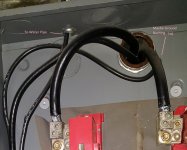
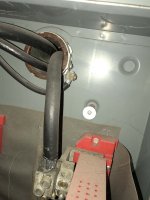
Looking through some other pictures I think I see a ground bushing lug for the second ground conductor. I attached as close-up.

Based on what has been said here and what I've read elsewhere, it would be proper to use a 4 ga solid bare copper wire from the neutral/ground lug in the disconnect switch outside to two 5/8"x8' ground rods at least 6 feet apart with no breaks.

For bonding, I need a 1/0 stranded copper run from the same lug connecting to both incoming gas lines and copper water inlet. This is about 60 feet under the house.

While getting rid of everything and starting over is appealing, I'm not sure my wife would be up to it. Will Georgia Power actually come out and change the meter base and supply. What would I have to do to be ready for them. I can't go without power that long.

As for the 30 space panel, I will be using two if that makes a difference. I will check local codes though.

Thanks for all the input,
Jeff
 

Attachments

  • Ground Close-ups.jpg
    Ground Close-ups.jpg
    138.9 KB · Views: 32
Last edited:

Bert_

Well-known member
Joined
Dec 24, 2016
Messages
9,701
Location
NW Iowa
Wow, how big of a house is this? I think that upstairs panel is a SQ D "MO", common in the 1940's. Most that I have seen were only 4-6 breakers, Yours, with 12 breakers and 100A rating, would have been pretty big for most houses in that era.

I really enjoy poking around in cool old installs like this, even though they usually have some issues. Nothing about is was "run of the mill" and someone clearly put some time into it.
 
Last edited:
OP
B

budhabaier

Member
Joined
May 29, 2013
Messages
22
Location
Granbury, TX
House was built in 1951 and is about 2000 ft2 upstairs and about 700 ft2 in a walk-out basement. The house was built as a builder's personal home; he built a lot of homes in this neighborhood during that time period.
 
To avoid these ads, REGISTER NOW!

Moto

Well-known member
Joined
Dec 9, 2007
Messages
153
The metal conduit is the ground conductor between the disconnect and the two basement panels, so the three-wire feeds are correct. The grounds should be separated in the panels, though, as previously mentioned. If the bus bars and lugs are not corroded, then I would not see a need to replace the basement panels.
 

ChevyRust

Member
Joined
Dec 11, 2017
Messages
9
Only need a 6 bare to the rods.

You would have to do all the work for the power company. They would pull the meter and you would change everything and have them come install meter once inspection is done. It would be a days work. It would just be to update everything and bring it up to today's standards. If money doesn't allow I would just leave the safety switch and install just one panel which as you know would be a sub so neutrals and grounds would have to be separate.

One more thing you might want to check is the size of wire you have coming from your meter to the satefy switch. I believe you said you have 400 amp rated fuses? Or is that just what the cabinet is rated at? Just to be sure your wire can handle that much load. If not you should downsize your fuse rating.
 

matt_i

Well-known member
Joined
Mar 14, 2008
Messages
10,724
Location
SE Michigan
The can of worms I think is when you start changing panels will be these:

a) the wire's too short.

b) the old cloth insulation which was already compromised from just sitting there is now really compromised from bending, pulling, etc. Becoming now a greater danger to cross the streams inadvertently.

Imo changing panels is a part of the solution. But to do a thorough job all that cloth covered stuff needs to be replaced with NM-B.

The main disconnect is impressive and would let you do a lot of changes without pulling the meter. But, as above, imo there's more to it than that...
 
OP
B

budhabaier

Member
Joined
May 29, 2013
Messages
22
Location
Granbury, TX
The can of worms I think is when you start changing panels will be these:

a) the wire's too short.

b) the old cloth insulation which was already compromised from just sitting there is now really compromised from bending, pulling, etc. Becoming now a greater danger to cross the streams inadvertently.

Imo changing panels is a part of the solution. But to do a thorough job all that cloth covered stuff needs to be replaced with NM-B.

The main disconnect is impressive and would let you do a lot of changes without pulling the meter. But, as above, imo there's more to it than that...

a) That is a big fear, but because of the disconnect I could replace those cables without significant issue.

b) All cloth covered wiring to the panels will be eliminated. The remaining cloth covered wiring is in the attic and upper floor walls. This will be replaced in about 2 years when the garage is built. The way the house is wired currently (mostly) is power comes from the panel to some junction in the attic, usually a ceiling light box or junction box, and at that point it kind of spiders out to the various loads to that room. This is convenient for replacing the wire supply, but also means no neutrals in switch boxes. Also, sometimes it is a challenge trying to trace circuits.

The disconnect is a blessing and a curse. Because the meter uses current transformers it is not inline with service coming in. So, the supply to the disconnect is always live unless the power company disconnects at the pole or weatherhead. If I could kill the power to the service entrance wires, I would just replace everything with one panel.
 

wyliesdiesels

Well-known member
Joined
Aug 14, 2012
Messages
19,994
Location
Modesto, CA
Only need a 6 bare to the rods.

You would have to do all the work for the power company. They would pull the meter and you would change everything and have them come install meter once inspection is done. It would be a days work. It would just be to update everything and bring it up to today's standards. If money doesn't allow I would just leave the safety switch and install just one panel which as you know would be a sub so neutrals and grounds would have to be separate.

One more thing you might want to check is the size of wire you have coming from your meter to the satefy switch. I believe you said you have 400 amp rated fuses? Or is that just what the cabinet is rated at? Just to be sure your wire can handle that much load. If not you should downsize your fuse rating.

Service is 400a, fuses are 300a.

So its like a 400a max/320a continuous service.

Lots of power for a house that size.
 

Bert_

Well-known member
Joined
Dec 24, 2016
Messages
9,701
Location
NW Iowa
Service is 400a, fuses are 300a.

So its like a 400a max/320a continuous service.

Lots of power for a house that size.

I doubt it, OP stated the service is CT metered.

I am going to wager a guess that the service wires are 500mcm aluminum, please note that this is nothing more than a guess. That would be good for 310 amps thus the 300a fuses.

It would be interesting to see a load calc, I would also guess that a single 200a panel would be plenty of power.
 
Last edited:
OP
B

budhabaier

Member
Joined
May 29, 2013
Messages
22
Location
Granbury, TX
I doubt it, OP stated the service is CT metered.

I am going to wager a guess that the service wires are 500mcm aluminum, please note that this is nothing more than a guess. That would be good for 310 amps thus the 300a fuses.

It would be interesting to see a load calc, I would also guess that a single 200a panel would be plenty of power.


I killed power and opened the disconnect after work. All the wiring is aluminum. Lines are 500 mcm, neutral is 4/0, and the ground and bond cables are both 1/0. In the teough/raceway the 500 mcm from the disconnect splits into a 250 mcm to each panel, I didn't note what the neutral does.

I am considering a plan 'B' of just replacing both panels with one QO 54 space panel and eliminating the trough/raceway. This gains me a lot of wall space and stops crowding the water heater.

Jeff


Sent from my iPhone using Tapatalk
 
OP
B

budhabaier

Member
Joined
May 29, 2013
Messages
22
Location
Granbury, TX
Okay, I have new questions now. If I replace the two panels with one large panel, then I will have to replace the existing conductors between the disconnect and the new panel. For a 200a panel, Aluminum SER 4/0-4/0-4/0-2/0 appears to be appropriate. The existing wire out of the disconnect is 500 kcmil split into two 250kcmil and the disconnect has a 300a fuse on each leg.

My questions are:
- Do I need to install 200a fuses to protect the smaller conductors downstream the fuses?
- If I understand the NEC tables correctly, my largest conductor (service entry) is Aluminum 500 kcmil so I need a bonding conductor of Aluminum 1/0 connected to iron gas pipe and copper water supply?
- I plan on making my ground, neutral, and bonding connections per the attached picture. Does it appear to be correct?

Thanks,
Jeff
 

Attachments

  • Disconnect ground neutral bond.jpg
    Disconnect ground neutral bond.jpg
    118.6 KB · Views: 31

ChevyRust

Member
Joined
Dec 11, 2017
Messages
9
Yes you would have to install 200 amp fuses to protect that size of wire. I'm pretty sure you just had a typo on the wire - I'm assuming you are doing a single phase panel so you only need a 4/0-4/0-2/0. BUT since this panel that you would be installing is still a subpanel you will also have to bring a ground over to it from your disconnect. Since the panel would be pretty close to the disconnect, you could just run some pipe to make it look a little bit nicer and even use copper to make the terminations a little bit easier as well.

As far as running new grounds from your disconnect, if it was me I would just run to the water main and pound two ground rods outside. Since your house is that old, the water main is more than likely copper coming through the slab.

Like I said before changing to a single panel would be pretty smart. I would make sure to get the plug on neutral like you stated before. When you replace the old rag wire you will have to bring the new wire up to code in which you will have to provide afci/gfci protection which is done at the panel. With the plug on neutral bar they make breakers that snap in to that bar which eliminates the neutral pigtail coming out of the breaker. This makes for a nice clean install!
 

ChevyRust

Member
Joined
Dec 11, 2017
Messages
9
Just checked out your pic. I don't see where the neutrals are bonded to the can. If they aren't they should be. The easiest way I always do this in the field is to take the neutral lug off and remove the red insulator. Then reinstall the neutral lug directly to the can.
 
OP
B

budhabaier

Member
Joined
May 29, 2013
Messages
22
Location
Granbury, TX
Just checked out your pic. I don't see where the neutrals are bonded to the can. If they aren't they should be. The easiest way I always do this in the field is to take the neutral lug off and remove the red insulator. Then reinstall the neutral lug directly to the can.


IMG_1208.JPGIMG_1209.JPG

I attached a couple of extra pictures showing the bonding ******** the neutral block and the bonding bushing.


Sent from my iPhone using Tapatalk
 
OP
B

budhabaier

Member
Joined
May 29, 2013
Messages
22
Location
Granbury, TX
I hate resurrecting old threads, but, it's mine and I have had a slight change in plans.

I have to add a 100a sub-panel for an apartment in the basement. My new questions are:
Can I feed this panel off of the small lugs in the disconnect?
Also, could I feed this with SER Al 2-2-2-4 or 1-1-1-3?

Thanks,
Jeff
 
Last edited:

Bert_

Well-known member
Joined
Dec 24, 2016
Messages
9,701
Location
NW Iowa
I hate resurrecting old threads, but, it's mine and I have had a slight change in plans.

I have to add a 100a sub-panel for an apartment in the basement. My new questions are:
Can I feed this panel off of the small lugs in the disconnect?
Also, could I feed this with SER Al 2-2-2-4 or 1-1-1-3?

Thanks,
Jeff

The answer depends on where you want to put the sub panel. You can use the tap rules in this situation (100A wire connected to a 300A fuse) but there are some rules you have to follow.

The main two rules that would apply to a house are,

#1-your sub panel must have a single main breaker that matches the wire. 100A if you use 1-1-1-3 or 90A for 2-2-2-4

#2-your tap conductors can be 25 feet long if they are 1/3 the size of the fuse. 1 aluminum fit's this rule. Wire must be protected from physical damage.

If you use 2 aluminum then you can only go 10 feet since they are less than 1/3 of the fuse but more than 1/10 of the fuse. The wires would also have to be in conduit, SER would not be allowed.
 
OP
B

budhabaier

Member
Joined
May 29, 2013
Messages
22
Location
Granbury, TX
The answer depends on where you want to put the sub panel. You can use the tap rules in this situation (100A wire connected to a 300A fuse) but there are some rules you have to follow.

The main two rules that would apply to a house are,

#1-your sub panel must have a single main breaker that matches the wire. 100A if you use 1-1-1-3 or 90A for 2-2-2-4

#2-your tap conductors can be 25 feet long if they are 1/3 the size of the fuse. 1 aluminum fit's this rule. Wire must be protected from physical damage.

If you use 2 aluminum then you can only go 10 feet since they are less than 1/3 of the fuse but more than 1/10 of the fuse. The wires would also have to be in conduit, SER would not be allowed.
Bert,

Thanks for the detailed reply; I think you answered a most of my questions.

I do have a pair of 200a fuses I could use. If I did, would this allow me to extend the distance to the sub-panel? I need to make it about 45 ft.

If not, I will just go back to feeding from the 200a panel.

Thanks,
Jeff
 
Last edited:

Bert_

Well-known member
Joined
Dec 24, 2016
Messages
9,701
Location
NW Iowa
Bert,

Thanks for the detailed reply; I think you answered a most of my questions.

I do have a pair of 200a fuses I could use. If I did, would this allow me to extend the distance to the sub-panel? I need to make it about 45 ft.

If not, I will just go back to feeding from the 200a panel.

Thanks,
Jeff

25 feet from the tap to the overcurrent device is the longest tap allowed inside a building. You need a breaker or fuse that matches the wire at the beginning of the run. That way your wire is not a tap and you can run it as far as you want.

I think seimans breakers can be used in those ITE panels, not 100% sure though.
 
To avoid these ads, REGISTER NOW!
Top Bottom