To avoid these ads, REGISTER NOW!

Wire flexing

george4

Well-known member
Joined
Feb 18, 2006
Messages
773
Location
N California
What type of electrical wire is best for an application where the wire breaks occasionally because of flexing/bending? I cannot change the design. I only need a few feet about 18 gauge. The application is for a kitchen refer/frig side by side where the wires service the through the door ice/water controls – opening/closing the freezer door flexes the wires at the bottom of the door. The wires are outside of the freezer box.
 
To avoid these ads, REGISTER NOW!

theoldwizard1

Well-known member
Joined
Feb 22, 2011
Messages
43,516
Location
SE MI
You need stranded wire with very fine strands. Next to impossible to find in a local hardware store or even electrical supply house.

Check hobby stores that sell electric RC cars. Ask for battery wire. You will have to go up in gauge (probably 16 or 14) and it will make a hole in your wallet.

The other solution is good quality electrical test lead wire like Pomona 6734-0.
 

rlitman

Well-known member
Joined
Oct 18, 2010
Messages
24,744
Location
Long Island
You want to minimize the bending, and maximize the bend radius.

Using fine stranded wire helps, but SO cord and any extension type cord already has that.
Using a thicker cord insulation increases the bend radius. That helps. If you look at extension cords, they include all sorts of non-copper **** in there like string, that keeps everything tight in the jacket so it all bends smoothly.

You could help that with a strain relief too. Or wrap the wire in heat shrink tubing.
Or if you want something stiffer, stick a piece of aircraft cable next to the wire, and heatshrink it all together.

You want to prevent the bending from happening all in one place, and spread it out a little.

For a larger range of motion, you can get coiled wire (something like a phone handset cord).
 
Last edited:

nanofrog

Well-known member
Joined
Mar 1, 2012
Messages
1,323
theoldwizard1 is spot on (high strand count using small diameter strands = more flexible).

Look for Silicone Test Lead wire, such as the Pomona P/N listed (xxxx-2 give you the other color, and it comes in 50' lengths for ~$23 per roll), or R/C car battery wire from a hobby shop or online (i.e. Dean's Wet Noodle). The latter can be had in shorter lengths, additional colors, and additional gauges than Pomona (18AWG in red and black only).
 

BFBOB

Well-known member
Joined
Sep 20, 2011
Messages
5,073
Speaker wire. Usually it's finer-stranded than stranded wire for other purposes. Way less expensive than meter-lead wire and probably fine for an application where it's only going to flex a maximum of 180 degrees.
 
OP
G

george4

Well-known member
Joined
Feb 18, 2006
Messages
773
Location
N California
Any considerations I should be aware off regarding crimping or soldering fine strand wire vs. regular strand? I usually use a ratcheting crimper but solder is good too.
 

theoldwizard1

Well-known member
Joined
Feb 22, 2011
Messages
43,516
Location
SE MI
Any considerations I should be aware off regarding crimping or soldering fine strand wire vs. regular strand? I usually use a ratcheting crimper but solder is good too.

The biggest issue is stripping the wire. The extra fine strands are easy cut/break. Loose too many and you need to start over.

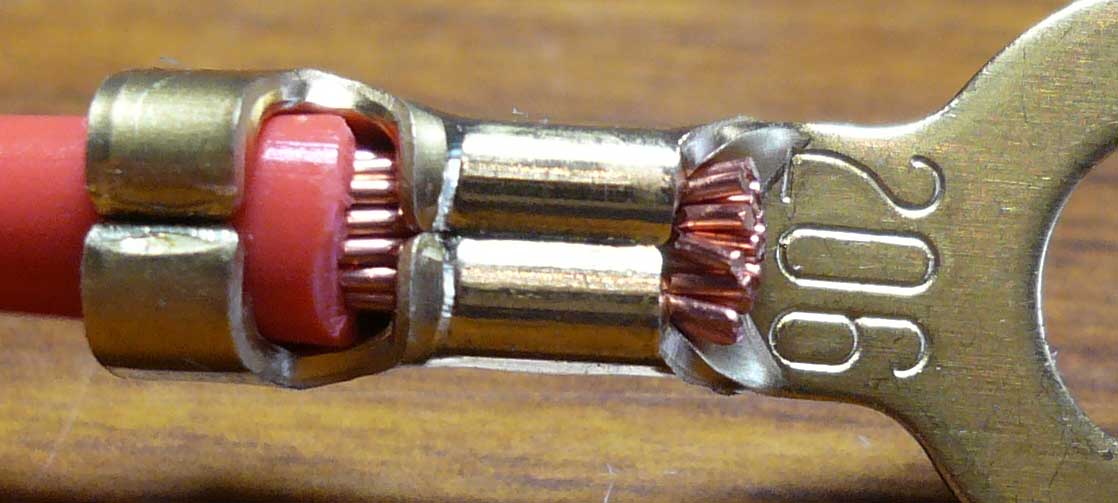
If you are crimping make certain the connector has 2 set to "flags" (or whatever they are called). The front, typically larger ones, crimp on to the conductor. The rear, typically smaller ones, crimp onto the insulation if the proper amount of insulation has been stripped !
 

theoldwizard1

Well-known member
Joined
Feb 22, 2011
Messages
43,516
Location
SE MI
theoldwizard1 is spot on (high strand count using small diameter strands = more flexible).
Thanks !

Look for Silicone Test Lead wire, such as the Pomona P/N listed (xxxx-2 give you the other color, and it comes in 50' lengths for ~$23 per roll), or R/C car battery wire from a hobby shop or online (i.e. Dean's Wet Noodle). The latter can be had in shorter lengths, additional colors, and additional gauges than Pomona (18AWG in red and black only).

Silicone insulator is great if you are soldering. Almost impossible to melt.

Dean's Ultra Wire (12 gauge only) has 660 strands an is pre-tinned for easier soldering

Deans Wet Noodle (12 gauge only) has 1660 strands !

Normal extension cord wire of the same gauge is less than 100 strands.
 

Dustball

Well-known member
Joined
Jun 25, 2011
Messages
2,081
Location
Hudson, WI
How many conductors?

I may have a length of hi-flex multi-conductor cable used for automation equipment laying around depending on exactly what you need. PM me if you're interested.
 

rlitman

Well-known member
Joined
Oct 18, 2010
Messages
24,744
Location
Long Island
SO cord strands are no where near as fine as RC car power wire or test lead wire.

Agreed. That silicone test lead wire would be ideal.

The biggest issue is stripping the wire. The extra fine strands are easy cut/break. Loose too many and you need to start over.

Yes. It takes a little more care. But it is important that the crimps are not what sees the repeated flexing. They should be covered in heat shrink after crimping, at a minimum.
 
OP
G

george4

Well-known member
Joined
Feb 18, 2006
Messages
773
Location
N California
The biggest issue is stripping the wire. The extra fine strands are easy cut/break. Loose too many and you need to start over.

If you are crimping make certain the connector has 2 set to "flags" (or whatever they are called). The front, typically larger ones, crimp on to the conductor. The rear, typically smaller ones, crimp onto the insulation if the proper amount of insulation has been stripped !

Good to know. I will practice stripping the fine strand wire. Usually I use un-insulted terminals or solder and cover with adhesive lined shrink tubing.
 
To avoid these ads, REGISTER NOW!
OP
G

george4

Well-known member
Joined
Feb 18, 2006
Messages
773
Location
N California
How many conductors?

I may have a length of hi-flex multi-conductor cable used for automation equipment laying around depending on exactly what you need. PM me if you're interested.

Thank you for your offer; I may take you up on it. There are 6 separate wires, 4 are about 16 gauge and the other 2 a bit larger. The 4 smaller have been the problem. I have fixed them once before but they broke again adjacent to the repair, I assume the repair exacerbated the problem because it was done in the area that is subject to the flex. My plan the next time is to splice in a longer section of fine strand wire such that the splices will be in a location that does not flex. It would be a major pain to replace the wires from end to end.
 
OP
G

george4

Well-known member
Joined
Feb 18, 2006
Messages
773
Location
N California
Yes. It takes a little more care. But it is important that the crimps are not what sees the repeated flexing. They should be covered in heat shrink after crimping, at a minimum.[/QUOTE]

I assume I would just heat shrink just the splice area. I am going to try to keep the splice as far away from the flex area as possible by replacing the whole flex area.
 

nanofrog

Well-known member
Joined
Mar 1, 2012
Messages
1,323
...the connector has 2 set to "flags"...The front, typically larger ones, crimp on to the conductor. The rear, typically smaller ones, crimp onto the insulation !
They're called Open Barrel connectors by manufacturers (sometimes referred to as B crimps by users due to the cross section profile).

I am going to try to keep the splice as far away from the flex area as possible by replacing the whole flex area.
This would be the right way to do it.
 

theoldwizard1

Well-known member
Joined
Feb 22, 2011
Messages
43,516
Location
SE MI
They're called Open Barrel connectors by manufacturers (sometimes referred to as B crimps by users due to the cross section profile).

Excellent example !

battery-ring-crimp.jpg
 

Milton Shaw

Well-known member
Joined
Feb 11, 2011
Messages
4,868
The wire should be flexing up inside the door instead of below the hinge, at least that is the way they are on GE refigs. Some of those wires were in a conduit up to the dispenser and could be pulled and replaced. It made a difference on the style as to if they could be replaced or not. If fiberglass insulated they could be replaced if foam they usually could not be replaced.
 
OP
G

george4

Well-known member
Joined
Feb 18, 2006
Messages
773
Location
N California
The wire should be flexing up inside the door instead of below the hinge, at least that is the way they are on GE refigs. Some of those wires were in a conduit up to the dispenser and could be pulled and replaced. It made a difference on the style as to if they could be replaced or not. If fiberglass insulated they could be replaced if foam they usually could not be replaced.

The wires flex at an area outside of the door at the lower freezer door hinge with tight but adequate access. It seems to be designed that way. The connection to the freezer box for the wires is a plug in that could disconnected easily. However, the wires then disappear into the freezer door and look like a real pain to remove, unknown what the insulation is and I would prefer not to find out. Hence my idea to splice in some short sections of find strand wire with the splices located at places that do not see any flexing. This one is a KitchenAid, nice reefer/freezer otherwise.
I am glad to have the wiring experts here.
 

nanofrog

Well-known member
Joined
Mar 1, 2012
Messages
1,323
It sure is. I was planning on using the tubular type double crimp **** connectors with shrink. Is there such a thing as a **** connector of the B type? Are they stronger because of the crimp around the insulation?
There is such a thing as an Open Barrel **** Splice, but it's not what you'd expect (wires do not enter from opposite sides, and crimp both the stripped wire and insulation), but rather come in from the same side (parallel = splice, but not actually a **** splice).

Pic of what I'm talking about.
61300-1.JPG


Here's a pic of an insulated version (no crimp on the insulation).
35653.JPG


There's another type that doesn't have an insulation crimp (stripped wire lay atop one another, typically used for large power conductors).

Here's a pic for this type.
 

Attachments

  • parallel splice connector.jpg
    parallel splice connector.jpg
    1.7 KB · Views: 58
OP
G

george4

Well-known member
Joined
Feb 18, 2006
Messages
773
Location
N California
There is such a thing as an Open Barrel **** Splice, but it's not what you'd expect (wires do not enter from opposite sides, and crimp both the stripped wire and insulation), but rather come in from the same side (parallel = splice, but not actually a **** splice).

Pic of what I'm talking about.
61300-1.JPG


Here's a pic of an insulated version (no crimp on the insulation).
35653.JPG


There's another type that doesn't have an insulation crimp (stripped wire lay atop one another, typically used for large power conductors).

Here's a pic for this type.
In your top pic, what part grips the wire and what part grips the insulation?
 

Rookie2

Well-known member
Joined
Feb 27, 2013
Messages
1,925
Location
Western Pa.
NO NO NO, call the manufacturer ! they probably have a repair kit . your probably not the only customer with this problem.
 
OP
G

george4

Well-known member
Joined
Feb 18, 2006
Messages
773
Location
N California
NO NO NO, call the manufacturer ! they probably have a repair kit . your probably not the only customer with this problem.

I appreciate your enthusiasm, why do you feel that way? The wiring harness may available but the end that disappears into the freezer door appears to be a real pain to install and I am not sure why that would be a better answer. Thanks for your insight.
 

nanofrog

Well-known member
Joined
Mar 1, 2012
Messages
1,323
In your top pic, what part grips the wire and what part grips the insulation?
The left-most strip is just a bit of retaining wire (some terminals come on a reel from the factory, meant for a partially automated machine), and is snipped off.

Only the two U portions make up the actual terminal itself.

The larger U shape (bit taller and wider than the other), is the insulation band, and the remaining U section is the stripped wire band.

Hope this clears things up. :)
 
To avoid these ads, REGISTER NOW!
Top Bottom