To avoid these ads, REGISTER NOW!

Wire ID

cmelville42

Member
Joined
Oct 1, 2017
Messages
16
Location
Santa Cruz, CA
I have a subpanel in my detached garage, fed by a 100a breaker in the main panel. I am trying to determine the actual wire gauge and I can't tell from the markings. I expected it to be #2 or #1 AL, but maybe someone with more experience can tell. If I have to shut if off and measure the wire diameter I guess I can do that.
 

Attachments

  • IMG_4649.jpg
    IMG_4649.jpg
    59 KB · Views: 61
  • IMG_4650.jpg
    IMG_4650.jpg
    67.3 KB · Views: 52
To avoid these ads, REGISTER NOW!

alfredeneuman

Well-known member
Joined
Mar 3, 2011
Messages
4,590
Location
Fullerton, CA
It's SER so it has 4 wires in it. Strip some of the jacket off and take a photo next to some common thing to scale off of.
 
Last edited:

PCustoms

Well-known member
Joined
Jul 23, 2011
Messages
23,293
Location
VT
Your first pic says with 4 AL ground.

Read a little bit in front of that and it should say.
 

wyliesdiesels

Well-known member
Joined
Aug 14, 2012
Messages
20,066
Location
Modesto, CA
I have a subpanel in my detached garage, fed by a 100a breaker in the main panel. I am trying to determine the actual wire gauge and I can't tell from the markings. I expected it to be #2 or #1 AL, but maybe someone with more experience can tell. If I have to shut if off and measure the wire diameter I guess I can do that.

Where is the main panel at?
 
OP
C

cmelville42

Member
Joined
Oct 1, 2017
Messages
16
Location
Santa Cruz, CA
The main panel is 60ft away at the service pole. I will open the panel and snap a few more pics for comparison. I have one below which shows some context but probably not enough. Unfortunately I am unable to get any more of the wire exposed to read more on the wire jacket.
 

Attachments

  • IMG_4331.jpg
    IMG_4331.jpg
    82 KB · Views: 42
Last edited:
OP
C

cmelville42

Member
Joined
Oct 1, 2017
Messages
16
Location
Santa Cruz, CA
Thanks everyone for your help. I was able to uncover another section of wire jacket and found the elusive marking "2-2-2 Triple-E".

I am planning to replace the subpanel with a larger one with more modern breakers. I am assuming I will be required to meet current code when I do so... my understanding is this wire is not rated for the 100a breaker currently in the main panel. This subpanel is 60ft from the main panel, in a detached garage. Running new wire is not an option. It seems the right thing to do is replace the current breaker with a 90a breaker. I am a little confused because according to Table 310.15(B)(16) if the wire is temp rated to 90degC it is suitable for 100a. Should I assume this wire is only rated at 75degC and change the breaker? I find this a very confusing part of the NEC.
 

wyliesdiesels

Well-known member
Joined
Aug 14, 2012
Messages
20,066
Location
Modesto, CA
Does the gray jacketed SER run underground?

If so, its the wrong cable since SER and SEU are not permitted underground.

Also, the 100a breaker is too large. #2 AL is limited to 90a in this application.
 
Last edited:
OP
C

cmelville42

Member
Joined
Oct 1, 2017
Messages
16
Location
Santa Cruz, CA
Yes, it is buried between the detached garage and the main panel.

The service was added by a prior owner sometime before 1990. What do inspectors do when faced with situations like this?

More importantly, what would you do in my situation?
 
Last edited:
To avoid these ads, REGISTER NOW!

alfredeneuman

Well-known member
Joined
Mar 3, 2011
Messages
4,590
Location
Fullerton, CA
It seems the right thing to do is replace the current breaker with a 90a breaker. I am a little confused because according to Table 310.15(B)(16) if the wire is temp rated to 90degC it is suitable for 100a. Should I assume this wire is only rated at 75degC and change the breaker? I find this a very confusing part of the NEC.

There is no breaker rated a 90 degrees. The most are 75 (and some even 60).
You figure amperage by the weakest point in the circuit, which in this case is the breaker.
EDIT: It's underground?? In that case it's completely wrong, and should be replaced.
Either the inspector didn't see it, or he's totally incompetent
 
Last edited:
OP
C

cmelville42

Member
Joined
Oct 1, 2017
Messages
16
Location
Santa Cruz, CA
hmm. Replacing that conduit-less, buried SER would be a major undertaking. Is it unsafe? Apart from potentially hitting it with a shovel (which is how I know it is not in conduit) what other bad things could happen?
 

pattenp

Well-known member
Joined
Jun 4, 2008
Messages
10,175
Location
Virginia - USA
The SER underground will fail. It's just a matter of time. I should say the ground of the SER will fail.
 
Last edited:
OP
C

cmelville42

Member
Joined
Oct 1, 2017
Messages
16
Location
Santa Cruz, CA
Ugh. So will failure look like the breaker continually tripping? Should I replace the 100a with a 90a breaker, which appears to be what should have been used in the first place?
 

wyliesdiesels

Well-known member
Joined
Aug 14, 2012
Messages
20,066
Location
Modesto, CA
Ugh. So will failure look like the breaker continually tripping? Should I replace the 100a with a 90a breaker, which appears to be what should have been used in the first place?

The ground wire is bare and will turn into mush and it may have already.

If you loose the ground wire you have no fault current pathway.

Not good.

But you may not notice anything...

Yes you should replace the whole thing.

I would be checking everything else electrical. No telling what other hack work may be lurching around.

Do you have an isolated neutral bar in the subpanel?

And at least 1 ground rod or other electrode at the detached garage?

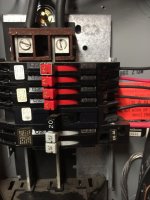
Is the pic above of the main or subpanel? Its a shitsco (Zinsco) panel and most definitely should be replaced.
 
Last edited:
OP
C

cmelville42

Member
Joined
Oct 1, 2017
Messages
16
Location
Santa Cruz, CA
The pic above is the subpanel I am replacing with a new Siemens panel. The main was replaced entirely last year when I had solar installed, so it is up to date.

The subpanel has an isolated neutral, but no grounding rod. I just poured a large concrete patio and had a 20' 1/2" bar added to serve as a ufer; I was planning to use this as an EGC when I upgrade the panel. I thought I had to add a rod too, but I have since been told a single UFER is sufficient. So, as of this moment, the ONLY EGC is the mushy aluminum ground in the buried SER.

It sounds like I really need to bite the bullet and install a new feeder line. Dang. I suppose I should use this as an opportunity to put in a bigger service. :)
 

wyliesdiesels

Well-known member
Joined
Aug 14, 2012
Messages
20,066
Location
Modesto, CA
The pic above is the subpanel I am replacing with a new Siemens panel. The main was replaced entirely last year when I had solar installed, so it is up to date.

The subpanel has an isolated neutral, but no grounding rod. I just poured a large concrete patio and had a 20' 1/2" bar added to serve as a ufer; I was planning to use this as an EGC when I upgrade the panel. I thought I had to add a rod too, but I have since been told a single UFER is sufficient. So, as of this moment, the ONLY EGC is the mushy aluminum ground in the buried SER.

It sounds like I really need to bite the bullet and install a new feeder line. Dang. I suppose I should use this as an opportunity to put in a bigger service. :)

A grounding electrode is not an EGC. 2 different animals and you need both for a detached structure with a branch feeder.

If you have a UFER, then you dont need any other electrodes.

If using rods, then you need 2.
 
To avoid these ads, REGISTER NOW!
Top Bottom