To avoid these ads, REGISTER NOW!

Wiring 15A 240V compressor question

haanzel

Active member
Joined
Dec 14, 2014
Messages
44
Location
Texas
I picked up a single phase Sanborn 5HP compressor. Motor specs on it are 230V at 15A. The compressor is wired and has a 15A plug on it and this outlet https://www.amazon.com/dp/B003AU30FE/?tag=atomicindus08-20

I had the shop wired for dedicated 50A outlet when it was built. I can do the wiring but unclear on the math. I know I need to put in a lower breaker, but I think it needs to be more than 15A since there is. What should the breaker be? TIA.
 
To avoid these ads, REGISTER NOW!

Firebrick43

Well-known member
Joined
May 12, 2015
Messages
13,989
Location
West central Indiana
I picked up a single phase Sanborn 5HP compressor. Motor specs on it are 230V at 15A. The compressor is wired and has a 15A plug on it and this outlet https://www.amazon.com/dp/B003AU30FE/?tag=atomicindus08-20

I had the shop wired for dedicated 50A outlet when it was built. I can do the wiring but unclear on the math. I know I need to put in a lower breaker, but I think it needs to be more than 15A since there is. What should the breaker be? TIA.
Breakers do not protect the load, they protect the wire in the walls. Its perfectly ok to have an oversize breaker in the panel.


Second, if its 15A it is not a 5 hp compressor. You need to look at the motor name plate and get the FLA or full load amps off of it.

If its 3 hp or more you can not use a NEMA plug on it. It has to be a pin and socket with disconnect upon unplugging and those are very expensive. Most just hardwire instead to a disconnect on the wall, and you can put a fused Disconnect there if you so desire.
 

nadogail

Well-known member
Joined
Jan 23, 2009
Messages
31,907
Location
Coronado, CA
How about a fused disconnect fed from the 50 Amp Circuit? that would allow you to have both a welder and the compressor, feed the fused disconnect with 10 AWG conductors, the 10' tap rule applies. 12 AWG should be big enough wires, 20 Amp fuses in the disconnect.
 
OP
H

haanzel

Active member
Joined
Dec 14, 2014
Messages
44
Location
Texas
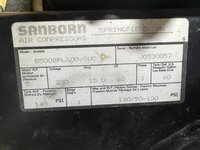
Thanks for the replies. It is 5HP/15A, here is what I am working with. Not pictured is the pressure switch that has 3 wires, a ground (green) and both legs (black and white). No idea on the history of it so it's possible this came from the factory as is or someone did something they should not have. All that said, would the plug work? I can hardwire it but the plug would be easier. Or open to suggestions now that you have seen what I am have.


IMG_1673.JPG

IMG_1674.JPG

IMG_1675.JPG
 

sparky 1971

Well-known member
Joined
Oct 9, 2018
Messages
7,966
Location
Central Iowa
I have the same compressor, it's newer and badged Menards, but it's the same thing. Mine is hardwired into #12 wire and connected to a 30 amp breaker. It's not 5HP, it's closer to three, probably a little less than that since 3HP is supposed to be 17 amps at 240 volts.

That cord is available as an option so it should be able to run on a 15 amp circuit. I just used what I had laying around when I installed mine.
 

wyliesdiesels

Well-known member
Joined
Aug 14, 2012
Messages
19,983
Location
Modesto, CA
I picked up a single phase Sanborn 5HP compressor. Motor specs on it are 230V at 15A. The compressor is wired and has a 15A plug on it and this outlet https://www.amazon.com/dp/B003AU30FE/?tag=atomicindus08-20

I had the shop wired for dedicated 50A outlet when it was built. I can do the wiring but unclear on the math. I know I need to put in a lower breaker, but I think it needs to be more than 15A since there is. What should the breaker be? TIA.
if the motor nameplate FLA is 15a then its definitely NOT 5HP. Does the motor nameplate list HP?
 

wyliesdiesels

Well-known member
Joined
Aug 14, 2012
Messages
19,983
Location
Modesto, CA
Thanks for the replies. It is 5HP/15A, here is what I am working with. Not pictured is the pressure switch that has 3 wires, a ground (green) and both legs (black and white). No idea on the history of it so it's possible this came from the factory as is or someone did something they should not have. All that said, would the plug work? I can hardwire it but the plug would be easier. Or open to suggestions now that you have seen what I am have.
its definitely NOT 5hp....

also the blades on that plug are really beat up. looks like pieces of the ends are missing too. Id probably replace the plug as who knows how loose the connections are..

Im surprised it came with a nema 6-15p as the motor load is 15a and a 15a breaker could nuisance trip...
 

pancho400cid

Well-known member
Joined
Sep 26, 2014
Messages
4,510
Location
Austin, TX
The Compressor Manufacturer's nameplate is stamped with 5 HP. That is a BS marketing rating that used to be common. It's been discussed on GJ many times, but equipment manufacturers used to put a big number for HP for marketing reasons. I think laws got passed to prevent the practice?

If the Jolly green Giant grabbed the shaft of that motor while it was running and stopped it, current would spike up to "locked rotor current". Now you have rated volts, and far more than normal full-load current on the motor. That condition is sometimes called "maximum developed HP". The motor is doing exactly zero useful work and is basically a big heater in that condition - buts it's making 5 HP electrically. It's an almost useless number, but it sounds good.

The motor NP is stamped "SPL" for HP - which is short for "special". That's because it's rated per the "special purpose" motor rating section of the NEMA regs - very common for compressors in the class you have. My current compressor is the same. As said, the motor will actually make around 3 HP continuously. The motor nameplate lists "peak KW" as 3.73 - which is equal to 5 HP, but that's "peak", not continuous.... probably the same as "max developed HP" I mentioned above - not a continuous rating for sure.
 
Last edited:

exranger06

Well-known member
Joined
Aug 9, 2015
Messages
1,686
Location
CT
Have the section of the NEC for that?

How does nearly every low power appliance plugged into a 20 amp circuit plugged into a 5-15p work with that?
Any appliance with a 5-15P plug is designed to be protected by a 15A or 20A breaker. That doesn't mean you can chop the plug off, install a 5-30P on the appliance, plug it into a 5-30 receptacle, and expect it to be fine and safe. Similarly, the OP cannot chop the plug off the compressor and install any other plug to match an existing receptacle.

The breaker protects the wiring in the wall AND receptacles (if any are installed). 210.21(B)(1) Single receptacle on an individual branch circuit: A single receptacle installed on an individual branch circuit shall have an ampere rating not less than that of the branch circuit.
So if he replaces the receptacle with a 30A receptacle (for example), the breaker cannot be greater than 30A. I didn't find anything specifically that prohibits installing a receptacle larger than the breaker though (ex. a 50A receptacle with a 30A breaker). Maybe there's language somewhere in the code that says it.

430.109(F) Cord and plug connected motors: For a cord and plug connected motor, a horsepower-rated attachment plug and receptacle...having ratings not less than the motor ratings shall be permitted to serve as the disconnecting means.

430.110(A): The disconnecting means for motor circuits rated 1000V nominal, or less shall have a current rating not less than 115% of the full-load current rating of the motor.

So, assuming this is a 3 HP motor, which has an FLA of 17A, means the receptacle has to be at least a 20A receptacle (rated for at least 3 HP) (17 * 1.15 = 19.55 A). But if he uses a 20A receptacle, he'd have to use a 20A breaker to comply with 210.21(B)(1).

The conductors need to have an ampacity of at least 21.25A (430.22): 17A * 1.25 = 21.25A. So that means at least #10 NM-b, or #12 THWN in conduit. That doesn't have much bearing on breaker size or receptacle size, though.

Table 430.52(C)(1) says he can use UP TO a 50A breaker, BUT 210.21(B)(1) again says he'd need a 50A receptacle in that case.

Theoretically, he could install #10 NM-b wire, a 50A breaker, and a 50A receptacle, even though #10 can't handle 50A. 240.4 says that "conductors...shall be protected against overcurrent in accordance with their ampacities specified in 310.14, unless otherwise permitted or required in 240.4(A) through (H)." And 240.4(G) refers you to Article 430 for motor circuits, which allows you to oversize overcurrent protection, and doesn't mention anything about overcurrent protection being different if you're using a cord and receptacle.

I think it becomes a gray area when it's a receptacle that someone can plug any appliance (with the corresponding plug) into. #10 on a 50A breaker is fine on a motor circuit, but if someone plugs something else into it, it's no longer a motor circuit and 240.4(G) no longer applies.

If this were my compressor, I'd install a 30A breaker, and either hardwire an A/C disconnect next to the compressor, or install a 6-30 receptacle and plug, run either #10 NM-b wire or #12 THWN (if hardwiring) or #10 THWN (if using a receptacle, just to be on the safe side), and call it a day.
 

Firebrick43

Well-known member
Joined
May 12, 2015
Messages
13,989
Location
West central Indiana
Any appliance with a 5-15P plug is designed to be protected by a 15A or 20A breaker.
No its not. A blender that draws 5 amps and has a 20 or 18 gauge cord in no way is protected by a 20 amp breaker.

ANY protection for the appliance has to be on the appliance. That can be in the form of a fuse, an on appliance circuit breaker, or thermal overload. In case of the OP in this thread there is a thermal overload on the motor.

That doesn't mean you can chop the plug off, install a 5-30P on the appliance, plug it into a 5-30 receptacle, and expect it to be fine and safe
Why not? Cite the code that says no. One sees in industry very commonly L5-20r receptacles many times exclusively on the shop floor. I have never had an inspector or Osha have issues with fans and other appliances having the 5-15P removed and a L5-20P installed. It was required both companies I worked for as an industrial mech/electrician to cut 5-15p off and install L5-20P on anything that wasn't temporary. All the fans mounted on the beams, flat screen tvs used as and on boards, even the computer terminals on the shop floor.

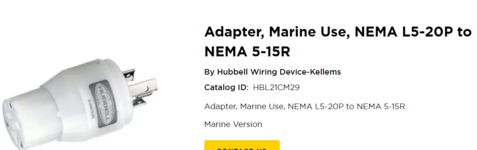
They even make UL approved adapters.
487888.jpgf
Similarly, the OP cannot chop the plug off the compressor and install any other plug to match an existing receptacle.
Where does it say in the code that you can not do this? This was the whole point of my question and its still is not cited in the code by anyone.

As long as the receptacle is the right voltage, has an equal or greater capacity than the load, is grounded, and matches the ampacity of the wires and circuit breaker, why not? Going by the OPs description his existing circuit and receptacle meets all these specs.
The breaker protects the wiring in the wall AND receptacles (if any are installed).
Yes, we have established this. That is all it protects.

All the other stuff was already covered, some multiple times in the thread.
 
Last edited:

Norcal

Well-known member
Joined
Mar 16, 2008
Messages
13,752
No its not. A blender that draws 5 amps and has a 20 or 18 gauge cord in no way is protected by a 20 amp breaker.

ANY protection for the appliance has to be on the appliance. That can be in the form of a fuse, an on appliance circuit breaker, or thermal overload. In case of the OP in this thread there is a thermal overload on the motor.


Why not? Cite the code that says no. One sees in industry very commonly L5-20r receptacles many times exclusively on the shop floor. I have never had an inspector or Osha have issues with fans and other appliances having the 5-15P removed and a L5-20P installed. It was required both companies I worked for as an industrial mech/electrician to cut 5-15p off and install L5-20P on anything that wasn't temporary. All the fans mounted on the beams, flat screen tvs used as and on boards, even the computer terminals on the shop floor.

They even make UL approved adapters.
487888.jpgf

Where does it say in the code that you can not do this? This was the whole point of my question and its still is not cited in the code by anyone.

As long as the receptacle is the right voltage, has an equal or greater capacity than the load, is grounded, and matches the ampacity of the wires and circuit breaker, why not? Going by the OPs description his existing circuit and receptacle meets all these specs.

Yes, we have established this. That is all it protects.

All the other stuff was already covered, some multiple times in the thread.
Those Hubbell adapters are not UL listed, any one I ever got had any UL, or CSA, marking obliterated, there is no way a adapter from 30A 125V, to 20A 125V will be listed, even the 20A 125V Twistlock®, to 20A 125V straight blade was not listed. BTW, UL "lists" they do not "approve" anything.

EDIT: Those Hubbell adapters are mind numbingly expensive, 25 years ago the supply house's cost was $55 or so & they need to make some money on the sale on top of that.
 
Last edited:

u2slow

Well-known member
Joined
Nov 20, 2011
Messages
3,583
Location
BC
I would use a 6-20R receptacle with the T-slot configuration. 20A breaker.

I have a 3HP compressor that is also 15A@240V and it came with a factory 6-20P cord.
 
OP
H

haanzel

Active member
Joined
Dec 14, 2014
Messages
44
Location
Texas
Here is where I am on this- got the Leviton plug above as well as a cover. The plug has screw connections and my wiring is 8 gauge, needless to say it won't fit. Do they make a push connector 6-15 plug that accepts 8 gauge?

If not, any concerns if I get a different wire, something larger that will accept the 8 gauge?
 

sparky 1971

Well-known member
Joined
Oct 9, 2018
Messages
7,966
Location
Central Iowa
Here is where I am on this- got the Leviton plug above as well as a cover. The plug has screw connections and my wiring is 8 gauge, needless to say it won't fit. Do they make a push connector 6-15 plug that accepts 8 gauge?

If not, any concerns if I get a different wire, something larger that will accept the 8 gauge?
Splice some #12 on to the #8. You will probably have to do the same at the panel in order to connect the breaker.
 

Firebrick43

Well-known member
Joined
May 12, 2015
Messages
13,989
Location
West central Indiana
anyone can make a website that says something is UL listed. doesnt mean it actually is. what is the actual listing #? without that hard to prove it is listed
I provided the link in post #14 (click on the Red "L5-20"?), its Hubble's own website. Are you saying Hubble is lying about their products?
Even if you did have the number one has to pay for access to the database. Your just attempting to send people on a farcical goose chase.

Did you ever find a NEC citation for what you posted on post #7? The NEC is pretty easy for anyone to search for free.
 
Last edited:
To avoid these ads, REGISTER NOW!

dscheidt

Well-known member
Joined
Apr 26, 2017
Messages
2,882
anyone can make a website that says something is UL listed. doesnt mean it actually is. what is the actual listing #? without that hard to prove it is listed
there are ul listings for lots of adapaters, the use of which is violation of the nec. UL recognizes there exists demand for them, and that people will buy (or make) and use them. Listing at least insures they don't have any unnecessary risks. There are versions of those adapters which are fused, which is superior.
 

mm08822

Well-known member
Joined
Jan 13, 2012
Messages
5,856
Location
NJ
Breakers do not protect the load, they protect the wire in the walls. Its perfectly ok to have an oversize breaker in the panel.
Bunk! Read up on section 210.21. / 210.22. There is only 1 exception where the receptacle does not have to match the cb and conductor ampacity and that is for a welder. Even this exception has concerns b/c people can plug continuous load devices into the same receptacle.

CB's in motor branch circuits are also permitted above conductor ampacity (within limits). What makes a motor branch circuit? :unsure: A branch circuit that only supplies a motor - meaning not interchangable with other devices = hard-wired :headscrat
 

mm08822

Well-known member
Joined
Jan 13, 2012
Messages
5,856
Location
NJ
Have the section of the NEC for that?

How does nearly every low power appliance plugged into a 20 amp circuit plugged into a 5-15p work with that?
1 HP motors are considered protected on a 120V branch circuit @20A or less. NEC 430.32 (D) (2) exception.
 

mm08822

Well-known member
Joined
Jan 13, 2012
Messages
5,856
Location
NJ
there are ul listings for lots of adapaters, the use of which is violation of the nec. UL recognizes there exists demand for them, and that people will buy (or make) and use them. Listing at least insures they don't have any unnecessary risks. There are versions of those adapters which are fused, which is superior.
Being as these adapters are not part of permanent building wiring, NEC does not cover these.
 

Max

ALLIANCE MEMBER
Joined
Jun 16, 2018
Messages
3,321
Location
Georgia
1 HP motors are considered protected on a 120V branch circuit @20A or less. NEC 430.32 (D) (2) exception.
You missed his point. A quick look around my house shows me lights, stereos, and battery chargers that all have line cord wiring that is much smaller than 14 ga. Yet they plug into 15A receptacles. If nothing was done at the appliance level, any short in the appliance would burn those wires causing a fire.

The answer is that the appliance has internal protection (fuse, breaker, whatever) that in the case of an internal short it operates and stops the current flow. This is done all of the time for products that plug into 120V 15A circuits. Clearly it is within the NEC to do this.

So @Firebrick43 has asked what in the NEC prevents a similar approach on 240V?
 

wyliesdiesels

Well-known member
Joined
Aug 14, 2012
Messages
19,983
Location
Modesto, CA
Ummm when was the last time u saw a light with a fuse? Go ahead I’ll wait

As to the other stuff, a short circuit can be hundreds of amps which would cause the breaker to trip and is of such duration that wire/coradage etc heating up isnt even a factor.

Did you mean to say overload? Youre comparing apples to oranges..
 

Firebrick43

Well-known member
Joined
May 12, 2015
Messages
13,989
Location
West central Indiana
This is another cherry-pick....voltage, # poles, #wires and ampacity all the same. The only thing this adapter does is change from locking blades to straight blades. Easy to see why it is UL listed.

These aren't UL listed......
1693684418529.png

1693684486767.png
1693684702982.png
No cherry picking, L5-20R is what we had in the plant. I never listed any other type of NEMA locking plug. I posted what I know. @Norcal was adamant that they were not UL listed. He was wrong.


Also the ampacity is not the same. 5-15P is a 15 amp plug, L5-20R is well 20 amps.

Then the hypocrisy that the adapters you post are "Marine adapters" and say I am cherry picking?
 
Last edited:

Firebrick43

Well-known member
Joined
May 12, 2015
Messages
13,989
Location
West central Indiana
Bunk! Read up on section 210.21. / 210.22. There is only 1 exception where the receptacle does not have to match the cb and conductor ampacity and that is for a welder. Even this exception has concerns b/c people can plug continuous load devices into the same receptacle.

CB's in motor branch circuits are also permitted above conductor ampacity (within limits). What makes a motor branch circuit? :unsure: A branch circuit that only supplies a motor - meaning not interchangable with other devices = hard-wired :headscrat
You are not reading the context of the post. The receptacle is part of the wiring. I was talking about anything past the plug/receptacle. Specifically I was referring to the OPs 50 amp circuit with 50 amp breaker and a 50 amp receptacle.

I even further clarified in post 12.

"As long as the receptacle is the right voltage, has an equal or greater capacity than the load, is grounded, and matches the ampacity of the wires and circuit breaker, why not? Going by the OPs description his existing circuit and receptacle meets all these specs."

Please read.
 
Last edited:

Bert_

Well-known member
Joined
Dec 24, 2016
Messages
9,699
Location
NW Iowa
You are not reading the context of the post. The receptacle is part of the wiring. I was talking about anything past the plug/receptacle.

I even further clarified in post 12.

"As long as the receptacle is the right voltage, has an equal or greater capacity than the load, is grounded, and matches the ampacity of the wires and circuit breaker, why not? Going by the OPs description his existing circuit and receptacle meets all these specs."

Please read.
I'm going to start installing 14-50's in my house instead of normal receptacles. I'll just put a 14-50 on my TV, lamp, and whatever else. Would be able to run anything I want. Should be fine by your logic
 

BrandonV

Well-known member
Joined
Jun 9, 2023
Messages
4,030
Location
Arizona
I usually draw the line at making sure the breaker, wiring, and receptacle are all up to snuff.

As long as they sell 16/3 100ft extension cords people will plug space heaters into them.
 

Firebrick43

Well-known member
Joined
May 12, 2015
Messages
13,989
Location
West central Indiana
1 HP motors are considered protected on a 120V branch circuit @20A or less. NEC 430.32 (D) (2) exception.
No, they don't have to have protection if they are within sight of the controller, ie the Circuit breaker panel or a disconnect. They person operating is the circuit protection.

"A. Within Sight from Controller. Overload protection shall be permitted to be furnished by the branch-circuit short-circuit and ground-fault protective device; such device, however, shall not be larger than that specified in Part IV of Article 430."

If its not within sight of the controller it has to have overload protection.

"B. Not Within Sight from Controller. Overload protection shall be in accordance with 430.32(B)."

And again out of context. How is a 1hp motor on a 20 amp circuit a “low power? load on the circuit?
 
Last edited:

Firebrick43

Well-known member
Joined
May 12, 2015
Messages
13,989
Location
West central Indiana
Ummm when was the last time u saw a light with a fuse? Go ahead I’ll wait
Still waiting for a Citation from post 7
As to the other stuff, a short circuit can be hundreds of amps which would cause the breaker to trip and is of such duration that wire/coradage etc heating up isnt even a factor.

Did you mean to say overload? Youre comparing apples to oranges..
FH06DJA_464_05_004-1200x1200-1.jpg

These act as pretty good fuses as well.


light-bulb-incandescent.jpg


LED lights, at least listed ones, are fused. Here is an A19 lamp taken apart to show the circuitry and the 2 amp fuse is circled.

kmkpe1ao.png
 
Last edited:

Max

ALLIANCE MEMBER
Joined
Jun 16, 2018
Messages
3,321
Location
Georgia
Ummm when was the last time u saw a light with a fuse? Go ahead I’ll wait

As to the other stuff, a short circuit can be hundreds of amps which would cause the breaker to trip and is of such duration that wire/coradage etc heating up isnt even a factor.

Did you mean to say overload? Youre comparing apples to oranges..
@Firebrick43 beat me. For tungsten lamps I’m sure that the argument is that they are self limiting by design. For LEDs there most certainly is a current limit.


Firebrick43

Well-known member
Joined
May 12, 2015
Messages
13,989
Location
West central Indiana
I'm going to start installing 14-50's in my house instead of normal receptacles. I'll just put a 14-50 on my TV, lamp, and whatever else. Would be able to run anything I want. Should be fine by your logic
By my logic you have nothing so you are coming up with the most ridiculous scenario possible.

The context of my post (since you cant/wont read in post 2 and 12) has to do with an OPs 50 amp 240V circuit with a 50 amp receptacle and using a 50 amp plug to attach a 240V compressor drawing 15 amps with thermal overload protection.

How can you jump to the conclusion that by my logic a 120/240v 50 amp 4 conductor circuit is ok to plug a lamp or TV or USB wall wart into it?
 

Bert_

Well-known member
Joined
Dec 24, 2016
Messages
9,699
Location
NW Iowa
By my logic you have nothing so you are coming up with the most ridiculous scenario possible.

The context of my post (since you cant/wont read in post 2 and 12) has to do with an OPs 50 amp 240V circuit with a 50 amp receptacle and using a 50 amp plug to attach a 240V compressor drawing 15 amps with thermal overload protection.

How can you jump to the conclusion that by my logic a 120/240v 50 amp 4 conductor circuit is ok to plug a lamp or TV or USB wall wart into it?
You said the breaker is only to protect the wire in the wall...

Fact is the wiring on an appliance is designed based on the circuit it's intended to be plugged into. I believe a 50A circuit would require a minimum #12 cord.

For a common 15/20A circuit the minimum is #18. An appliance with smaller wiring that that will have a fuse in the plug
 

Max

ALLIANCE MEMBER
Joined
Jun 16, 2018
Messages
3,321
Location
Georgia
You said the breaker is only to protect the wire in the wall...

Fact is the wiring on an appliance is designed based on the circuit it's intended to be plugged into. I believe a 50A circuit would require a minimum #12 cord.

For a common 15/20A circuit the minimum is #18. An appliance with smaller wiring that that will have a fuse in the plug
18 ga. wire is only rated to 9.5A. Yet it’s plugged into a breaker/wire/receptacle rated for 15/20A…


Bert_

Well-known member
Joined
Dec 24, 2016
Messages
9,699
Location
NW Iowa
18 ga. wire is only rated to 9.5A. Yet it’s plugged into a breaker/wire/receptacle rated for 15/20A…


In this situation we aren't concerned with the current that the wire can carry constantly.

During a short circuit #18 can carry enough current to reliably trip a 20A breaker. Smaller sizes of wire may not carry enough current to trip the breaker.
 

Firebrick43

Well-known member
Joined
May 12, 2015
Messages
13,989
Location
West central Indiana
You said the breaker is only to protect the wire in the wall...

Fact is the wiring on an appliance is designed based on the circuit it's intended to be plugged into. I believe a 50A circuit would require a minimum #12 cord.

For a common 15/20A circuit the minimum is #18. An appliance with smaller wiring that that will have a fuse in the plug
Yes, that is true, only the wire in the wall and the receptacle its attached to.

Your confusing "Fixture wire" connected to branch circuits with flexible cords. Your absolutely correct if we were talking about fixtures but we are not. They have different rules.

The NEC covers the cord from plug to appliance.

"NEC 240.5(A) Ampacities. Flexible cord and flexible cable shall be protected by an overcurrent device in accordance with their ampacity as specified in Table 400.5(A)(1) and Table 400.5(A)(2). Fixture wire shall be protected against overcurrent in accordance with its ampacity as specified in Table 402.5. Supplementary overcurrent protection, as covered in 240.10, shall be permitted to be an acceptable means for providing this protection. "

Table 400.5(A)(1) allows only 7 amps for 18 gauge wire. Then you have to place an overcurrent protection on the appliance just as I have been saying. 240.6 thru 240.9 covers the types of overcurrent protection. It does not have to be a fuse in the plug.

240.9 is thermal devices which is what the OPs air compressor has, that is what protects the flexible cord not the main circuit breaker.
 
Last edited:
To avoid these ads, REGISTER NOW!
Top Bottom