To avoid these ads, REGISTER NOW!

Wiring a 20amp/240v outlet

Teikas Dad

Well-known member
Joined
Dec 13, 2009
Messages
132
Location
Connecticut
I'm wiring my new shop and had a brain fart...:wtf: trying to wire up outlets for my dust collector and table saw (both 20amp/240v).

I ran 12/3 wire from the load center to the outlet. The wire is connected in the load center to a double pole 20amp breaker:
8726ff27-df60-4fd4-96d7-cfd9245bf274_300.jpg


The black wire to one pole on the breaker, the red wire to the other pole on the breaker.

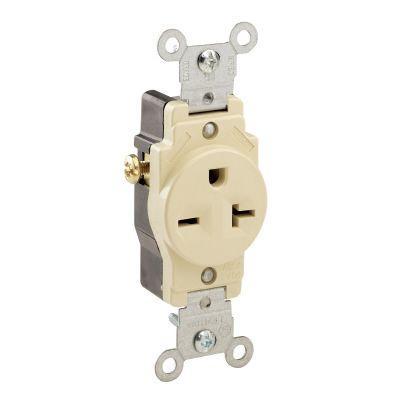
I'm using the following type of plug:
45c33b88-0e96-46f8-b9e9-78f5d0202e72_400.jpg


The issue I'm having...and can't remember how to do it,:headscrat is, the plug only has one lug for the black wire, one lug for the neutral and the green ground (according to the box instructions).

Where does the red wire go so I can get 240v to the plug?
1 - Do I not hook up the neutral (white) and attach the red wire to that lug on the plug or
2 - Do I hook up the neutral with the ground and red on the neutral lug...or
3 - Do I tie the red and black together on the black (brass) lug on the outlet?
 
To avoid these ads, REGISTER NOW!

DHS

Well-known member
Joined
Feb 9, 2009
Messages
1,054
Location
Central FL
I think that is just 2 hot and a ground, no neutral. But wait for experts, lol.:beer:
 

bdog

Well-known member
Joined
Oct 17, 2007
Messages
227
I agree. Not an expert but black and red go to the slotted plugs and the ground goes to the round one. Neutral is not used.
 

sberry

Banned
Joined
Jun 18, 2005
Messages
35,747
Location
Brethren, Michigan
A 12/3 with ground, 4 wires in all correct? You do not use the white, black to one, red to the other side and the ground (bare) to the ground as well as the ground bar in the panel (where other bare wires are) Yes, your number 1 option. Yes, above posts are correct.
 
OP
T

Teikas Dad

Well-known member
Joined
Dec 13, 2009
Messages
132
Location
Connecticut
OK, so I don't use the neutral (white) wire....I should have checked first, I could have saved some money on my wire by just using 12/2 and marking the white wire...:mad:

Appreciate the input all! Thanks:thumbup:
 

BioHazard

Banned
Joined
Feb 3, 2010
Messages
743
I always like to run an extra neutral wire even if I only want 240v, that way in the future I can change my mind and tap 120v out of it.
 
OP
T

Teikas Dad

Well-known member
Joined
Dec 13, 2009
Messages
132
Location
Connecticut
I always like to run an extra neutral wire even if I only want 240v, that way in the future I can change my mind and tap 120v out of it.

Good point. I put in an extra outlet box on another wall with 12/3 wired to a double pole 20amp breaker. I could always split an outlet and have 2 110v outlets off that one set of wires.
 

Norcal

Well-known member
Joined
Mar 16, 2008
Messages
13,769
Good point. I put in an extra outlet box on another wall with 12/3 wired to a double pole 20amp breaker. I could always split an outlet and have 2 110v outlets off that one set of wires.

120 volt circuits in a shop/garage/outbuilding require GFCI protection. NEC 210.8(A)(2) 2005 edition.
 

Falcon67

Well-known member
Joined
Jun 11, 2009
Messages
18,371
Location
Merkel, TX
OK, so I don't use the neutral (white) wire....I should have checked first, I could have saved some money on my wire by just using 12/2 and marking the white wire...:mad:

Appreciate the input all! Thanks:thumbup:

That's what I do - run 12-2 and mark the white on both ends with bright red touch up paint. I mark as much of the wire as I can at the ends. No mistake when opening up :thumbup: - hey, that might be a hot wire.
 
OP
T

Teikas Dad

Well-known member
Joined
Dec 13, 2009
Messages
132
Location
Connecticut
120 volt circuits in a shop/garage/outbuilding require GFCI protection. NEC 210.8(A)(2) 2005 edition.
Not exactly....I contacted my local Building Inspector this morning and asked him. He has already done my rough-in inspection so he knows my setup. My shop does not have a garage door, it has two separate entry doors. There is no plumbing/water lines in it. According to my Building Inspector GFIs are not required inside my shop area. The storage area behind my shop (separate entry, no direct entry from the shop) has an overhead garage door, so he said I would need a GFI to protect the two outlets I put in there. I bought one today and will wire it in series at the first outlet downstream from the load center.
 

Norcal

Well-known member
Joined
Mar 16, 2008
Messages
13,769
Not exactly....I contacted my local Building Inspector this morning and asked him. He has already done my rough-in inspection so he knows my setup. My shop does not have a garage door, it has two separate entry doors. There is no plumbing/water lines in it. According to my Building Inspector GFIs are not required inside my shop area. The storage area behind my shop (separate entry, no direct entry from the shop) has an overhead garage door, so he said I would need a GFI to protect the two outlets I put in there. I bought one today and will wire it in series at the first outlet downstream from the load center.

I say your inspector is flat wrong. Here is a copy & paste from the 2008 NEC.

210.8 Ground-Fault Circuit-Interrupter Protection for
Personnel.
FPN: See 215.9 for ground-fault circuit-interrupter protection
for personnel on feeders.
(A) Dwelling Units. All 125-volt, single-phase, 15- and
20-ampere receptacles installed in the locations specified in
(1) through (8) shall have ground-fault circuit-interrupter
protection for personnel.
(1) Bathrooms
(2) Garages, and also accessory buildings that have a floor
located at or below grade level not intended as habitable
rooms and limited to storage areas, work areas,
and areas of similar use

(3) Outdoors
Exception to (3): Receptacles that are not readily accessible
and are supplied by a dedicated branch circuit for
electric snow-melting or deicing equipment shall be permitted
to be installed in accordance with 426.28.
(4) Crawl spaces — at or below grade level
(5) Unfinished basements — for purposes of this section,
unfinished basements are defined as portions or areas of
the basement not intended as habitable rooms and limited
to storage areas, work areas, and the like
Exception to (5): A receptacle supplying only a permanently
installed fire alarm or burglar alarm system shall
not be required to have ground-fault circuit-interrupter
protection.
FPN: See 760.41(B) and 760.121(B) for power supply
requirements for fire alarm systems.
Receptacles installed under the exception to
210.8(A)(5) shall not be considered as meeting the
requirements of 210.52(G).
(6) Kitchens — where the receptacles are installed to serve
the countertop surfaces
(7) Laundry, utility, and wet bar sinks — where the receptacles
are installed within 1.8 m (6 ft) of the outside
edge of the sink
(8) Boathouses
(B) Other Than Dwelling Units. All 125-volt, singlephase,
15- and 20-ampere receptacles installed in the locations
specified in (1) through (5) shall have ground-fault
circuit-interrupter protection for personnel:
(1) Bathrooms
(2) Kitchens
(3) Rooftops
(4) Outdoors


Please note the bold type.
 

BC iron works

Well-known member
Joined
Jan 31, 2010
Messages
54
i just put in a 20 amp/240 the code here
says to mark the ends of the white lines
black with a sharpie
 

MrMark

Well-known member
Joined
Jan 25, 2010
Messages
4,626
Location
Southern Cal.
Why not put in the GFI? It's safer and not much more money, a couple bucks. Why fool with it. The inspector is probably wrong and it doesn't matter whether he's right or not really. He can't object to doing more than what he thinks is required.
 

johno

Well-known member
Joined
Oct 16, 2009
Messages
2,418
Location
Southern Ont.
The electrical inspector is never wrong. He signs the ok.


I say your inspector is flat wrong. Here is a copy & paste from the 2008 NEC.

210.8 Ground-Fault Circuit-Interrupter Protection for
Personnel.
FPN: See 215.9 for ground-fault circuit-interrupter protection
for personnel on feeders.
(A) Dwelling Units. All 125-volt, single-phase, 15- and
20-ampere receptacles installed in the locations specified in
(1) through (8) shall have ground-fault circuit-interrupter
protection for personnel.
(1) Bathrooms
(2) Garages, and also accessory buildings that have a floor
located at or below grade level not intended as habitable
rooms and limited to storage areas, work areas,
and areas of similar use

(3) Outdoors
Exception to (3): Receptacles that are not readily accessible
and are supplied by a dedicated branch circuit for
electric snow-melting or deicing equipment shall be permitted
to be installed in accordance with 426.28.
(4) Crawl spaces — at or below grade level
(5) Unfinished basements — for purposes of this section,
unfinished basements are defined as portions or areas of
the basement not intended as habitable rooms and limited
to storage areas, work areas, and the like
Exception to (5): A receptacle supplying only a permanently
installed fire alarm or burglar alarm system shall
not be required to have ground-fault circuit-interrupter
protection.
FPN: See 760.41(B) and 760.121(B) for power supply
requirements for fire alarm systems.
Receptacles installed under the exception to
210.8(A)(5) shall not be considered as meeting the
requirements of 210.52(G).
(6) Kitchens — where the receptacles are installed to serve
the countertop surfaces
(7) Laundry, utility, and wet bar sinks — where the receptacles
are installed within 1.8 m (6 ft) of the outside
edge of the sink
(8) Boathouses
(B) Other Than Dwelling Units. All 125-volt, singlephase,
15- and 20-ampere receptacles installed in the locations
specified in (1) through (5) shall have ground-fault
circuit-interrupter protection for personnel:
(1) Bathrooms
(2) Kitchens
(3) Rooftops
(4) Outdoors


Please note the bold type.
 

Norcal

Well-known member
Joined
Mar 16, 2008
Messages
13,769
The electrical inspector is never wrong. He signs the ok.

That is not true, some do not read the code or they make up their own rules .:shocking: Those I do believe are in the minority....
 

Stuart in MN

Well-known member
Joined
Sep 8, 2005
Messages
23,154
Location
Minneapolis
I say your inspector is flat wrong. Here is a copy & paste from the 2008 NEC.

Depending on local statutes they may or may not going by the 2008 NEC, many parts of the country are still using earlier versions. Also, some locales will make exceptions to specific parts of the NEC, such as the requirements for GFCIs.

I don't know if either of those apply in this case, but the point is the rules aren't always the same everywhere.
 
Last edited:
To avoid these ads, REGISTER NOW!

Norcal

Well-known member
Joined
Mar 16, 2008
Messages
13,769
Depending on local statutes they may or may not going by the 2008 NEC, many parts of the country are still using earlier versions. Also, some locales will make exceptions to specific parts of the NEC, such as the requirements for GFCIs.

I don't know if either of those apply in this case, but the point is the rules aren't always the same everywhere.

Most of the local exceptions are for AFCI requirements. (Smart move IMO).
 
OP
T

Teikas Dad

Well-known member
Joined
Dec 13, 2009
Messages
132
Location
Connecticut
OK....chill out everyone. To avoid any fistfights on the board I went out and bought GFCI outlets for my shop. The 20amp wall outlets anyway...I'm not worried about the 4 outlets I put in the ceiling for additional lights if needed.
 

SGKent

Banned
Joined
Feb 12, 2010
Messages
1,959
Location
Citrus Heights CA
I have seen cases where work was done to one inspector's instructions only to have another one force it to all be ripped out. Go with the most conservative solution. I would use a GFI - never know when that tool will short out or a cable will fray.
 

Charles (in GA)

Well-known member
Joined
Jan 11, 2006
Messages
12,489
Location
50 mi south of Atlanta
Wow, thread back from the dead. A concrete floor is quite conductive, being on "grade level" there is also more chance of moisture, condensation or flooding...... this is the general reasoning behind the GFCI requirement on the ground floor of garages, shops, etc.

That being said, I'm not a big believer in them. I do have some, positioned at doorways where cords may be run outside, but the majority of the outlets are not GFCI protected. Of course its been several code cycles since my shop was wired.

Charles
 

Norcal

Well-known member
Joined
Mar 16, 2008
Messages
13,769
When reading trade magazines at the time of the garage requirements for GFCI protection, one reason for adding GFCI protection in garages was that outdoor equipment would be plugged into garage receptacles, that being said GFCI receptacles are pretty cheap, work well & are a good safety feature. I will not say the same thing about AFCI's. All the 120 volt receptacles in my shop w/ the exception of the lighting is all GFCI protected.(All interior lighting is cord & plug connected.)
 

teamextreme

Well-known member
Joined
Aug 10, 2013
Messages
867
Location
Lakewood, CO
Depending on local statutes they may or may not going by the 2008 NEC, many parts of the country are still using earlier versions.

You'd have to go back pretty damn far to not have the GFI in garage requirement. I'm pretty sure my first 1984 copy required it. That inspector is way off base. I can see AHJ's making exceptions on some things, but not on GFI's in a garage.
 

sberry

Banned
Joined
Jun 18, 2005
Messages
35,747
Location
Brethren, Michigan
2 things,,, there are not as many local amendments as we hear about and on occasion in some areas some townships etc have their own electric inspection. I recall one that he was retired EE and the only thing he ever really looked at was the bond install. Her wouldn't have even known one code version for another or cared.
Now we have state, most of them are pretty good and the real deal.
 

Stuart in MN

Well-known member
Joined
Sep 8, 2005
Messages
23,154
Location
Minneapolis
I hadn't seen that the thread was started in 2010, sorry.

How about "No States are using pre 1978 Electrical Codes"

I don't think any states were still using 1978 or earlier codes in 2010 either, but as I mentioned back then sometimes local jurisdictions make exceptions to certain parts of the NEC so it was the responsibility of the original poster to find out what if any exceptions applied in their area. It's certainly possible that a state or city (or for that matter, the local inspector) would have been okay with not using GFCIs in a garage back then, but I'm not licensed in Connecticut so I'm not familiar with how they do things there.
 

Champanada

Member
Joined
Jun 21, 2014
Messages
8
Location
Beverly Hills, FL
I agree with Norcal.......... But, hey............ it's your life your dealing with; and, if the inspector has a garage, I'll bet that ALL of the circuits in HIS garage are GFCI protected (per NEC code).
 

Scouters

Member
Joined
May 11, 2014
Messages
12
Location
K-W Ontario
I will add to this question .... Is is alright to run 12/3 on a double pole for a 20amp 240v plug and then also continue on and use two 20amp120volt split plugs >>>> i will not be using both at the same time I just want to keep the garage wiring clean and just run 3 -12/3 circuts I only have 2 machines that run 240v at the moment but would like the ability to expand . and when not using the big machines would use the 110v plugs for hand tools
 

Norcal

Well-known member
Joined
Mar 16, 2008
Messages
13,769
The 120 volt receptacles will require GFCI protection, & a 2 pole breaker is required, I would not do it.
 

Mustang51js

Well-known member
Joined
Jan 24, 2014
Messages
1,734
Location
Haskell nj
I wouldn't run the wires like that either but if you do then you need two separate 12/2 off of the 220 volt outlet, the first 120 volt outlet coming off of it would need a gfi outlet for each circuit.
 

Scouters

Member
Joined
May 11, 2014
Messages
12
Location
K-W Ontario
In Ontario the code does state that GFCI are not needed in garages.
I would normally agree that it is a good idea, however this "garage" I am building is a shop, heated in winter and AC in summer, I am not putting in a typical garage door I am putting in 2 4ft swing doors that can open independently and 2 36in man doors. The shop is 18by 50. The floor will never get wet as I even have a large overhang area by the doors.

I was just thinking this would be an easier way to wire?
I would like to run all separate, but wire is not cheap these days, and I think this is a decent way to wire it, just never seen it done.
 
To avoid these ads, REGISTER NOW!
Top Bottom