OP's avatar appears to be some sort of dual-sport Husqvarna... no idea how the charging, electronics and lighting work on these, or if that's the bike in question. And of course no idea why the OP even wants to shut off the lights in the first place. Maybe the idea is to shut off the lighting off-road for some reason?
I do know on bikes with two headlights (older Suzuki V-Strom, for example) some owners install a switch to cut off one of the headlights to free up a few amps for heated clothing. (The charging system on these, and most motorcycles, is not designed to cope with much added load, so you scrounge amps where you can.) This is still an extremely bad idea for street riding where you need to emit every photon possible in order to improve your odds against somnolent steering wheel holders, but it is generally legal; the laws only require one headlight.
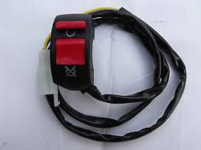
The headlight cutout circuit found on some bikes is a simple switch inside the starter switch (and this is failure-prone due to internal arcing), and on others there's a relay somewhere. And of course with many bikes, there's no headlight cutout at all while cranking. The cutout is mostly a way to spec a slightly lighter, cheaper battery.
But it can get even more complicated. My Yamaha FJ-09 has LED headlights, and the driver circuitry is part of the ECU (you can't just feed 12V to the headlight wires and turn it on). The tail and running lights turn on with the key, but the ECU does not turn on the headlight until the cam or crank (I forget which) position sensor reaches a certain speed, indicating the engine is actually running. Similarly, the front turn signals are single filament incandescent bulbs, and are fed reduced voltage by the ECU; when you use the signals, they blink with full voltage. So even though the headlights and tail lights are LED, you can't just swap in any old LED turn signal.
And BMWs use a CAN bus system that makes alterations far more difficult than just monkeying with the wires.