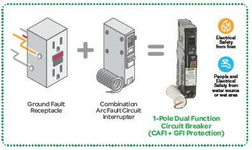
Should also note that modern GFCI breakers are actually combination circuit protection, meaning they include arc-fault protection.

www.jadelearning.com
Arc-fault is a big deal. Straight GFCI only detects current not returning via the neutral wire, which leaves a lot of potentially dangerous electrical fault conditions out.
The sentence in bold munges the 3 types of breaker protection together. Yet the article you quoted is designed to alleviate that confusion. Modern GFCI breakers only provide GFCI protection.
"A “COMBINATION” Arc-Fault Circuit Breaker is NOT equivalent to a “DUAL-FUNCTION” Circuit Breaker.
With ever changing electrical Code requirements, a circuit breaker with the ability to provide both Arc-Fault protection as well as Ground Fault (GFCI) protection was long overdue. But beware, the “combination” function that is identified on recently manufactured AFCI circuit breakers DOES NOT provide this AFCI/GFCI protection.
COMBINATION AFCI Circuit-Breaker: Provides protection against both parallel arcing conditions (which is a hot to ground arcing condition), and series arcing conditions (which is arcing that occurs along a single conductor where a portion of that conductor is broken, frayed, or otherwise partially disassembled, causing the current to leap an air-gap to continue on its path).
DUAL-FUNCTION AFCI/GFCI Circuit-Breaker: Combines both AFCI
and GFCI branch-circuit protection into one OCPD."
That is from the article.
I'd say it's better to say:
DUAL-FUNCTION AFCI/GFCI Circuit-Breaker:
INCLUDES both
COMBINATION AFCI
and GFCI branch-circuit protection into one OCPD.
My comments are only directed at explaining the terminology.
Some on GJ would argue AFCI is hogwash. I'm staying out of the fray on that topic. Just observing. YMMV