To avoid these ads, REGISTER NOW!

Wiring Begins.....

danho

Well-known member
Joined
Jan 23, 2011
Messages
124
Location
SW Oregon
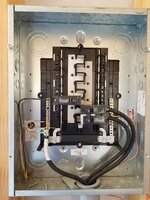
Morning everyone, I am starting to wire my newly built 30x42x14 shop and have a couple questions. First off, I had a 100 amp sub panel ran and in my research, it looks like the green bonding screw should be removed allowing the neutral bus (left side) and the ground bar (right side) to be separate? FYI, the 12-2 is a GFCI the electrician installed next to the panel for me. Second, I am running all 20 amp outlets and have limited them to 13 outlets per run max but can't find specs on this, just recommendations so please let me know if I am off on this one. Lastly (for now) I am planning to add the garage door opener outlets off one of the 20 amp GFCI runs, approximately 3' to 4' back from the door when open and about a foot off center if that sounds right.
Thanks for any help on these questions all, I have wired shops in the past but it has been a few years, so I am trying to do this right and pass the rough inspection without issue. I am also located in Oregon and this shop is detached from the house about 30'.Shop.jpgShop Sub Panel.jpg
 
To avoid these ads, REGISTER NOW!

u2slow

Well-known member
Joined
Nov 20, 2011
Messages
3,584
Location
BC
Unless you have a fully planned layout of how you'll use the shop, I suggest only putting in some minimal rough-in to get the walls done. Then add what you really need (with surface conduit later) when you get to using your shop and figure out places for things.

The most receptacles I put on a circuit in a shop is maybe 6 tops, unless it's for (plug-in) lighting.
 

pattenp

Well-known member
Joined
Jun 4, 2008
Messages
10,175
Location
Virginia - USA
Not sure what you have going on with the grounds. You need to add a ground bar and isolate the neutral. Also you need ground rods unless you have a ufer ground. There also needs to be an equipment ground from the subpanel back to the main panel. Is that bare copper wire the equipment ground or the earth electrode ground conductor?
 

u2slow

Well-known member
Joined
Nov 20, 2011
Messages
3,584
Location
BC
I second the grounding comments. You'll have straighten that out if being inspected.

The threes little holes on either side of the panel are for a ground bar... usually included in a parts baggie with the panel screw, etc.
 

Norcal

Well-known member
Joined
Mar 16, 2008
Messages
13,752
A 3-wire feed was used to supply the "Zinsco II" panel, a 4-wire feed has been required for many NEC editions, Oregon is on the 2020 NEC.
 

sparky 1971

Well-known member
Joined
Oct 9, 2018
Messages
7,967
Location
Central Iowa
I don't see a ground pulled with the feeder. Unless your on the 2005 or previous NEC, that's a no no. I wouldn't be concerned about the three wire feeder, but if you paid someone to do it right, you were probably robbed.

The panel is set up correctly for a three wire feed with a bonded neutral, the bare ground wire should be going to two ground rods. Don't take the green screw out unless there is a separate ground wire going back to the main panel.
 
OP
D

danho

Well-known member
Joined
Jan 23, 2011
Messages
124
Location
SW Oregon
Thanks for the responses so far, I guess the inspector and I will have something to talk about after all.
 

wyliesdiesels

Well-known member
Joined
Aug 14, 2012
Messages
19,994
Location
Modesto, CA
Morning everyone, I am starting to wire my newly built 30x42x14 shop and have a couple questions. First off, I had a 100 amp sub panel ran and in my research, it looks like the green bonding screw should be removed allowing the neutral bus (left side) and the ground bar (right side) to be separate? FYI, the 12-2 is a GFCI the electrician installed next to the panel for me. Second, I am running all 20 amp outlets and have limited them to 13 outlets per run max but can't find specs on this, just recommendations so please let me know if I am off on this one. Lastly (for now) I am planning to add the garage door opener outlets off one of the 20 amp GFCI runs, approximately 3' to 4' back from the door when open and about a foot off center if that sounds right.
Thanks for any help on these questions all, I have wired shops in the past but it has been a few years, so I am trying to do this right and pass the rough inspection without issue. I am also located in Oregon and this shop is detached from the house about 30'.Shop.jpgShop Sub Panel.jpg
If you paid an electrician to do this, make them come back and pull a green wire for the required EGC, from the main panel to this sub-panel, ON THEIR DIME. then bid them well and don't ever use them again as they dont know what theyre doing.
 

wyliesdiesels

Well-known member
Joined
Aug 14, 2012
Messages
19,994
Location
Modesto, CA
I don't see a ground pulled with the feeder. Unless your on the 2005 or previous NEC, that's a no no. I wouldn't be concerned about the three wire feeder, but if you paid someone to do it right, you were probably robbed.

The panel is set up correctly for a three wire feed with a bonded neutral, the bare ground wire should be going to two ground rods. Don't take the green screw out unless there is a separate ground wire going back to the main panel.
You wouldn't be concerned with a non-code compliant install?

If there are other metallic pathways between the buildings then the OP has a big issue...
 

SlappyWhite

Well-known member
Joined
Oct 3, 2012
Messages
1,819
Location
Upper Canada
Let others here confirm, don't take my word but....for this type of sub-panel install when straightening out the grounding I believe that green screw on the bottom left needs to be removed as it ties the neutral bus to the panel housing (ties neutral to ground). Only used if this is the service entrance panel AFAIK.
 

sparky 1971

Well-known member
Joined
Oct 9, 2018
Messages
7,967
Location
Central Iowa
You wouldn't be concerned with a non-code compliant install?

If there are other metallic pathways between the buildings then the OP has a big issue...
I left part of what I meant out. I wouldn't be concerned if it were existing from pre 2008, it would then be code compliant. Also, if I had just bought a place that had a three wire feed, new or old, I wouldn't lose any sleep over it as long as the neutral is bonded. There are more three wire feeders with a bonded neutral out there than there are four wire feeders with an isolated neutral. I would definitely be pissed if I recently paid someone to do that...
 

sparky 1971

Well-known member
Joined
Oct 9, 2018
Messages
7,967
Location
Central Iowa
Let others here confirm, don't take my word but....for this type of sub-panel install when straightening out the grounding I believe that green screw on the bottom left needs to be removed as it ties the neutral bus to the panel housing (ties neutral to ground). Only used if this is the service entrance panel AFAIK.
Absolutely do not take out the green screw until a grounding conductor is pulled back to the main.
 

TractorJeff

Well-known member
Joined
Dec 8, 2013
Messages
3,309
Location
Elkhorn, WI
Commenting on the outlets.
Outlets are placed 48 inches up the wall so **** can be leaned against the wall and not bury the Outlets.
I separated the 4 walls into separate circuits based on the Theory of one tripping the Breaker, not all would go dead.
Also the long wall, I split into 2 separate circuits.
The Refrigerator and Microwave are on their own circuit breakers on opposite Bus Bars.
Don't want the Drinks to get warm due to a nuisance trip!
 

wyliesdiesels

Well-known member
Joined
Aug 14, 2012
Messages
19,994
Location
Modesto, CA
I left part of what I meant out. I wouldn't be concerned if it were existing from pre 2008, it would then be code compliant. Also, if I had just bought a place that had a three wire feed, new or old, I wouldn't lose any sleep over it as long as the neutral is bonded. There are more three wire feeders with a bonded neutral out there than there are four wire feeders with an isolated neutral. I would definitely be pissed if I recently paid someone to do that...
only if there are no parallel metallic pathways... we dont know if there is any
 

sparky 1971

Well-known member
Joined
Oct 9, 2018
Messages
7,967
Location
Central Iowa
only if there are no parallel metallic pathways... we dont know if there is any
You'd have a heart attack, stroke, and an aneurism all at the same time if you saw what I have to occasionally deal with. It's not too bad anymore since I stopped doing farm work for new customers. I only do farm work if I've been there before. Usually, walking into a barn, the first thing you'll see is the panel cover laying on the floor, where it's been for at least 20 years. Then, 95+% of the time, it's a three wire feed. 25% of those weren't bonded until I did it. Sometimes, the bonding screw is laying on the bottom of the panel, but usually I am installing a ground bar or drilling and tapping a hole in the can for a mechanical lug so I can jump a piece of #6 or #4 from the neutral bar to the ground. Then, there are almost never ground rods, of course, I will put them in. My most favorite is the 25% of the time when URD is coming straight out of the ground with no pipe going right into a hole knocked out of the panel, sometimes it's 4/0 that's been given a haircut to fit under the lugs of a 100 amp panel. Fun stuff, that's why the state took over in 2007 and started inspecting everything that didn't have an inspection system in place already. But... a couple of years ago, they stopped requiring permits and inspections on anything considered agricultural, so here we go again.
 
OP
D

danho

Well-known member
Joined
Jan 23, 2011
Messages
124
Location
SW Oregon
If you paid an electrician to do this, make them come back and pull a green wire for the required EGC, from the main panel to this sub-panel, ON THEIR DIME. then bid them well and don't ever use them again as they dont know what theyre doing.
This is the plan, and after this is done, which bar will be the ground bar, or do I need to add one as mentioned earlier?
 
To avoid these ads, REGISTER NOW!
OP
D

danho

Well-known member
Joined
Jan 23, 2011
Messages
124
Location
SW Oregon
Commenting on the outlets.
Outlets are placed 48 inches up the wall so **** can be leaned against the wall and not bury the Outlets.
I separated the 4 walls into separate circuits based on the Theory of one tripping the Breaker, not all would go dead.
Also the long wall, I split into 2 separate circuits.
The Refrigerator and Microwave are on their own circuit breakers on opposite Bus Bars.
Don't want the Drinks to get warm due to a nuisance trip!
Yup, got them up 48" and on two circuits as of now with the max number of 13 in mind as previously mentioned. I don't plan on a heavy load at any given time, more along the lines of easy access to an outlet and not having extension cords come in to play as often. Thanks for the reminder on the refrigerator and micro as well.
 

wyliesdiesels

Well-known member
Joined
Aug 14, 2012
Messages
19,994
Location
Modesto, CA
This is the plan, and after this is done, which bar will be the ground bar, or do I need to add one as mentioned earlier?
You need to install a ground bar. As previously stated by U2Slow, the bar goes where the 3 factory made holes are.

I would install 2 bars, one on each side, to help keep the panel tidy.
 

wyliesdiesels

Well-known member
Joined
Aug 14, 2012
Messages
19,994
Location
Modesto, CA
You'd have a heart attack, stroke, and an aneurism all at the same time if you saw what I have to occasionally deal with. It's not too bad anymore since I stopped doing farm work for new customers. I only do farm work if I've been there before. Usually, walking into a barn, the first thing you'll see is the panel cover laying on the floor, where it's been for at least 20 years. Then, 95+% of the time, it's a three wire feed. 25% of those weren't bonded until I did it. Sometimes, the bonding screw is laying on the bottom of the panel, but usually I am installing a ground bar or drilling and tapping a hole in the can for a mechanical lug so I can jump a piece of #6 or #4 from the neutral bar to the ground. Then, there are almost never ground rods, of course, I will put them in. My most favorite is the 25% of the time when URD is coming straight out of the ground with no pipe going right into a hole knocked out of the panel, sometimes it's 4/0 that's been given a haircut to fit under the lugs of a 100 amp panel. Fun stuff, that's why the state took over in 2007 and started inspecting everything that didn't have an inspection system in place already. But... a couple of years ago, they stopped requiring permits and inspections on anything considered agricultural, so here we go again.
Naw Ive ran into all that **** before several times. Its a gold mine!!!
 

ddawg16

Well-known member
Joined
Jul 11, 2008
Messages
21,005
Location
S. California
Like Diesels said....2 ground bars....they are cheap. And makes landing wires easier.

Put your outlets at 50" or higher If the bottom of the outlet is at 48" (without the cover on) a sheet of plywood will be sitting on it.

Remember, there is no limit on how many outlets you have on a breaker....it's unlikely you're going to have that many loads going at one time.

In my garage I have 2 ckts for wall outlets. I alternate them as far as to which breaker they are on. That way I can have 2 high amp loads in close proximity each other powered up. I avoid extension cords when possible. True 12awg extension cords are expensive.
I have a good story about undersized cords.
 

nadogail

Well-known member
Joined
Jan 23, 2009
Messages
31,928
Location
Coronado, CA
A good wiring job begins with a plan. I suggesy you bring the power to the load, not move the equipment to where the power might happen to be.
 

89MustangGX

Well-known member
Joined
Feb 24, 2008
Messages
1,023
Location
Stanwood, WA
This is the plan, and after this is done, which bar will be the ground bar, or do I need to add one as mentioned earlier?

Already been answered, but in the interest of an explanation so you understand why and can see for yourself: If you look at the panel as it exists currently, the two existing (neutral) bars are connected together by the strap between them near the bottom. There is a black insulated cover in the middle but you can see where the strap is bolted to both bars and goes across. They will always be bonded together so you can land your neutrals on either side. You want to install separate (ground) bars on the case of the box, as mentioned earlier, and land your grounds there - as well as your equipment ground that still needs to be run from your main panel. The green screw bonds the neutral bars (existing) to the case of the box and the new ground bars, yet to be installed. In a main panel, you would leave this in and have them bonded together. In this sub-panel, you will want them separate. Once you have everything in place, removing the green screw will separate your neutrals and grounds.
 
OP
D

danho

Well-known member
Joined
Jan 23, 2011
Messages
124
Location
SW Oregon
A good wiring job begins with a plan. I suggesy you bring the power to the load, not move the equipment to where the power might happen to be.
Agreed, I have a layout plan and am pretty happy with it thus far. I have all the 20 amp outlets, 30 amp and 50 amp runs complete for the rough inspection. I still need to add a 30 amp RV plug however, then I can move on to the attic outlets and the lighting.
 

Knight511

Well-known member
Joined
Dec 28, 2020
Messages
91
Location
TX
If you have to drive the ground bar yourself, the "stupid" YouTube trick using just water and your hands is not, in fact, stupid at all and even works in North Texas's finest black expansion clay. :)

Edit: I say "stupid" because I thought "There is no way that actually works in this #$%^ clay," because the videos seems to show beautiful soil that just doesn't happen here.
 
OP
D

danho

Well-known member
Joined
Jan 23, 2011
Messages
124
Location
SW Oregon
If you have to drive the ground bar yourself, the "stupid" YouTube trick using just water and your hands is not, in fact, stupid at all and even works in North Texas's finest black expansion clay. :)

Edit: I say "stupid" because I thought "There is no way that actually works in this #$%^ clay," because the videos seems to show beautiful soil that just doesn't happen here.
Thanks, but the ground bars are already in.
 

mike93lx

ALLIANCE MEMBER
Joined
Dec 9, 2013
Messages
37,431
Location
Richmond, VA
Always surprises me how many folks are worried about tying up all their wall space with sheets of plywood. Here I am keeping sheet goods together and not scattered all over. Must be missing out on something... ;)

Having receptacles up high puts a lot of strain on them when using heavy extension cords. I'd much rather plug into a different one that is lower to the ground
 

TractorJeff

Well-known member
Joined
Dec 8, 2013
Messages
3,309
Location
Elkhorn, WI
Well?
My square boxes are actually 48 inches from to the bottom. This way they are at the seam of the bottom sheet (horizontal sheets).
I don't put a lot of **** up against the walls, but when I need to. Then there's not a problem!
 
OP
D

danho

Well-known member
Joined
Jan 23, 2011
Messages
124
Location
SW Oregon
Quick update: I called for the trench and feeder inspections last week and the feeder failed as I anticipated. Sent the correction notice to the electrician and he came out and ran an equipment ground to get me to a 4 wire, pulled the bonding screw and added an isolated ground bar to the sub-panel. I the mean time I have been running outlets, and have the main shop roughed in (minus a couple of outdoor outlets) and have moved to the attic. Overall I feel it is going well and I'm right on track and I continue to learn, thanks again for all the help folks.
 

wyliesdiesels

Well-known member
Joined
Aug 14, 2012
Messages
19,994
Location
Modesto, CA
Quick update: I called for the trench and feeder inspections last week and the feeder failed as I anticipated. Sent the correction notice to the electrician and he came out and ran an equipment ground to get me to a 4 wire, pulled the bonding screw and added an isolated ground bar to the sub-panel. I the mean time I have been running outlets, and have the main shop roughed in (minus a couple of outdoor outlets) and have moved to the attic. Overall I feel it is going well and I'm right on track and I continue to learn, thanks again for all the help folks.
I hope he didnt install an ISOLATED ground bar. you need a BONDED ground bar. The neutral bar is what needs to be isolated.
 

SlappyWhite

Well-known member
Joined
Oct 3, 2012
Messages
1,819
Location
Upper Canada
Quick update: I called for the trench and feeder inspections last week and the feeder failed as I anticipated. Sent the correction notice to the electrician and he came out and ran an equipment ground to get me to a 4 wire, pulled the bonding screw and added an isolated ground bar to the sub-panel. I the mean time I have been running outlets, and have the main shop roughed in (minus a couple of outdoor outlets) and have moved to the attic. Overall I feel it is going well and I'm right on track and I continue to learn, thanks again for all the help folks.
It is good that they came back out to fix it but the electrician should have known what they were doing and got it right in the first place. Not like these were minor code interpretation items or some minor thing the inspector found.
 
OP
D

danho

Well-known member
Joined
Jan 23, 2011
Messages
124
Location
SW Oregon
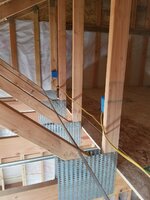
Afternoon all, just a quick question about wiring in my attic. I do not want to drill the trusses to feed wire for the outlets, etc. unless there is a code stating that this needs to happen. Am I ok with my current plan to staple to the backside of the vertical truss member knowing that the attic space will be covered in sheetrock later on and the lid of the shop will be as well? Attached is a pic of the attic living space and the current wiring.

Thanks.
 

Attachments

  • 20220510_114758.jpg
    20220510_114758.jpg
    439.9 KB · Views: 93
  • 20220510_114823.jpg
    20220510_114823.jpg
    304.8 KB · Views: 96

jmiller_2308

Well-known member
Joined
Nov 16, 2013
Messages
551
Location
Shakopee, MN
That looks to me to be a lot like stringing wire across the top of a joist which is what I did when wiring my shop and the inspector was happy with it; of course this was 6 years ago following the requirements my municipality required.

I'd send a quick question to your inspector as they will ultimately decide if they like it or not.
 

mike93lx

ALLIANCE MEMBER
Joined
Dec 9, 2013
Messages
37,431
Location
Richmond, VA
Afternoon all, just a quick question about wiring in my attic. I do not want to drill the trusses to feed wire for the outlets, etc. unless there is a code stating that this needs to happen. Am I ok with my current plan to staple to the backside of the vertical truss member knowing that the attic space will be covered in sheetrock later on and the lid of the shop will be as well? Attached is a pic of the attic living space and the current wiring.

Thanks.
I would never drill a hole in a truss.

Stapling is fine. I'd try to keep them as out of the way as possible
 
To avoid these ads, REGISTER NOW!
Top Bottom