To avoid these ads, REGISTER NOW!

Wiring for an RV...2-2-2-4 vs 2-2-4-6

juddspaintballs

Well-known member
Joined
Sep 1, 2011
Messages
324
Location
Hedgesville, WV
I'm setting up a 40' 5th wheel RV to live in for a bit while I build a house. It has two AC units and the typical power draw for a giant RV like that. With both AC's running, the whole thing will run on a single 50A plug by drawing two 120v circuits off of that big 4 prong 240v plug.


I bought a Siemens TL137US Temporary Power panel that has a 240v 4-prong 50A socket pre-wired, a 240v 3-prong 30A socket pre-wired, and a 120v GFI 20A outlet. 100A total in this box of pre-wired outlets. I will be using the 50A socket for the RV and probably also the full extent of the 20A plug for other things at the RV. I will probably not be using the 30A socket at all (and yes I realize I can't use it at all on the RV because it is 240v, not 120v like an RV 30A plug needs).


I wanted 2-2-2-4 MHF wire to power this. I have about 120' run from the house's empty sub panel with a 100A breaker in it already. I have a dual 50A breaker to put in to connect the MHF feed to. When I called Rexel to have them cut me 150' of it so I could just swing in and pick it up, the woman cut 2-2-4-6 for me and that's what I wound up paying for as well. I was in a hurry and took it with me anyways. I can probably still source and retrieve 2-2-2-4 somewhere if I need to, but I need to get this wire in the ground ASAP.


Will the 2-2-4-6 be adequate? I can't really "balance" my 120v loads from the RV on the temporary power panel. I assume the RV manufacturer was at least smart enough to put the AC units on separate sides of the plug so they sort of balance out. Without the AC units running, the whole RV takes maybe 20A to power. With the AC units running, I'll assume it requires nearly the full 50A it is specified for. And again, I'll probably find other things to plug into the 20A GFI on the panel, so I'm looking at an overall load of about 70A.
 
To avoid these ads, REGISTER NOW!

Bert_

Well-known member
Joined
Dec 24, 2016
Messages
9,875
Location
NW Iowa
You would have to try extremely hard to overload the neutral, even then you might not be able to do it.

Reducing the neutral one or two sizes is extremely common.
 
OP
J

juddspaintballs

Well-known member
Joined
Sep 1, 2011
Messages
324
Location
Hedgesville, WV
I'm tying into my parents' house with 200A service. It has brand new electric installed in it and the electrician put in a sub panel off of the main with a 100A breaker for future wiring. I can wire directly into that, or I suppose I could wire directly into the main panel since there's still space.


The temporary power panel I'll be using outside will technically be a sub panel by itself, wouldn't it?
 

Terry D

Well-known member
Joined
Mar 25, 2015
Messages
2,202
Location
St. Louis, MO.
I'm tying into my parents' house with 200A service. It has brand new electric installed in it and the electrician put in a sub panel off of the main with a 100A breaker for future wiring. I can wire directly into that, or I suppose I could wire directly into the main panel since there's still space.


The temporary power panel I'll be using outside will technically be a sub panel by itself, wouldn't it?
I dont know your local codes. We can not reduce a neutral for a branch circuit here where i live.
 
Last edited:

Bert_

Well-known member
Joined
Dec 24, 2016
Messages
9,875
Location
NW Iowa
Its still a branch circuit. It is a MWBC. Do you reduce neutrals when wiring a sub panel? He will be fine since he is feeding it with a 50 amp 2 pole. But now you have the issue with the EGC being to small since the ungrounded are oversized

Sent from my SM-G960U using The Garage Journal mobile app

It's feeding multiple overcurrent devices, it's a feeder.

Yes I often do reduce the neutral when feeding a sub panel. I've gone as far as using a #2 al neutral for a 200A sub with mostly L-L load. That was actually just above the code minimum.
 

Terry D

Well-known member
Joined
Mar 25, 2015
Messages
2,202
Location
St. Louis, MO.
It's feeding multiple overcurrent devices, it's a feeder.

Yes I often do reduce the neutral when feeding a sub panel. I've gone as far as using a #2 al neutral for a 200A sub with mostly L-L load. That was actually just above the code minimum.
Thats the difference between your area and mine

We dont reduce neutrals to sub panels. We dont even reduce neutrals to services in most areas anymore

Sent from my SM-G960U using The Garage Journal mobile app
 

Bert_

Well-known member
Joined
Dec 24, 2016
Messages
9,875
Location
NW Iowa
Thats the difference between your area and mine

We dont reduce neutrals to sub panels. We dont even reduce neutrals to services in most areas anymore

Sent from my SM-G960U using The Garage Journal mobile app

It's not that I don't run a full size neutral ever. I just think it's important to understand why and when you can reduce it. I don't see the point in putting a big wire in the ground when it will be lucky to ever see 30A on the neutral. Reduced one size for this is pretty accepted.
 

wyliesdiesels

Well-known member
Joined
Aug 14, 2012
Messages
20,236
Location
Modesto, CA
So this is a branch circuit off the main panel, or a sub off the main. I have never reduced a neutral on a branch circuit. On a main service yes, but not a branch circuit

Sent from my SM-G960U using The Garage Journal mobile app

Its not a branch circuit. Its a branch feeder for a subpanel

I dont know your local codes. We can not reduce a neutral for a branch circuit here where i live.

its a branch feeder. can you reduce the neutral on a branch feeder in your locale?

Sounds like I'm going to use it. Shall I pull off the main (200A) breaker panel or would I be OK pulling from the 100A sub panel?

depends on the load on that sub? we cant tell you which way to go since we dont know whats on it

also, that #2 AL needs to be protected with a 90a breaker max!!

Do you reduce neutrals when wiring a subpanel? He will be fine since he is feeding it with a 50 amp 2 pole. But now you have the issue with the EGC being to small since the ungrounded conductors are oversized

Sent from my SM-G960U using The Garage Journal mobile app

you are correct.

A 50a breaker requires a #8 AL EGC, which is 16,509 cir mil
A 50a breaker requires a #6 AL ungrounded conductor, which is 26,251 cir mils

#2 AL is 66,369 cir mils, which is a 253% increase over 26,251 (66,369/26,251)

16,509 x 253% = ~41,739 ci mils, which is a #4 conductor.
 
OP
J

juddspaintballs

Well-known member
Joined
Sep 1, 2011
Messages
324
Location
Hedgesville, WV
The sub panel is totally empty. When the electrician replaced the main in the house and upgraded it to 200A, he installed the sub panel for future wiring but it is totally empty. The sub panel has a 100A breaker protecting it. I have a 50A double pole breaker to use in either the main or sub panel to feed this temporary power panel.


Will the 2-2-4-6 be fine for what I'm doing or should I go back and see if I can get 2-2-2-4 locally?
 
OP
J

juddspaintballs

Well-known member
Joined
Sep 1, 2011
Messages
324
Location
Hedgesville, WV
Which breaker should I use then?


Edit: Ah, I see now that they make 45A double pole breakers. I've never seen them before.

The best course of action would be to get the cable I originally wanted, isn't it? 2-2-2-4 solves all of these issues.
 
Last edited:
OP
J

juddspaintballs

Well-known member
Joined
Sep 1, 2011
Messages
324
Location
Hedgesville, WV
Well dang. I called Rexel in Winchester, VA where I got the wire. They insisted that I was allowed to reduce the neutral and feed a 100A service with the 2-2-4-6 wire they sold me to the point that they wouldn't even consider selling me what I asked for. The exact phrase was "no, you have the right wire" before he hung up on me.


If it'll work, I'm just going to use it. No one else local has 2-2-2-4 in stock. I'm running out of time at this point. The RV is being delivered Saturday and it needs to be powered so things don't freeze. It will be our full-time home in a couple weeks so I can't winterize it.
 

sky jumper

Well-known member
Joined
Mar 13, 2018
Messages
127
It's feeding multiple overcurrent devices, it's a feeder.

Yes I often do reduce the neutral when feeding a sub panel. I've gone as far as using a #2 al neutral for a 200A sub with mostly L-L load. That was actually just above the code minimum.

what section in the NEC allows reduced neutral in a feeder for a mixed use load? I wanted to do this but was told in no uncertain terms that it was not allowed. I believe it was 220.61 that was quoted to me. so I ran a 1/1/1/6
 
To avoid these ads, REGISTER NOW!

alfredeneuman

Well-known member
Joined
Mar 3, 2011
Messages
4,596
Location
Fullerton, CA
what section in the NEC allows reduced neutral in a feeder for a mixed use load? I wanted to do this but was told in no uncertain terms that it was not allowed. I believe it was 220.61 that was quoted to me. so I ran a 1/1/1/6
220.61 only says it should be sized to the maximum of the imbalanced neutral load.
Read post #19:D It's only on a 50A breaker
 

wyliesdiesels

Well-known member
Joined
Aug 14, 2012
Messages
20,236
Location
Modesto, CA
Which breaker should I use then?

Edit: Ah, I see now that they make 45A double pole breakers. I've never seen them before.

The best course of action would be to get the cable I originally wanted, isn't it? 2-2-2-4 solves all of these issues.

reducing the breaker size makes the issue worse not better, in terms of the EGC being undersized.

Well dang. I called Rexel in Winchester, VA where I got the wire. They insisted that I was allowed to reduce the neutral and feed a 100A service with the 2-2-4-6 wire they sold me to the point that they wouldn't even consider selling me what I asked for. The exact phrase was "no, you have the right wire" before he hung up on me.


If it'll work, I'm just going to use it. No one else local has 2-2-2-4 in stock. I'm running out of time at this point. The RV is being delivered Saturday and it needs to be powered so things don't freeze. It will be our full-time home in a couple weeks so I can't winterize it.

theyre wrong. #2 for a branch feeder is MAX 90a

Would a larger breaker reduce the percentage the ground conductor needs to be increased enough to make it 100% code legal?

Sent from my SM-G965U using Tapatalk

yes
 
OP
J

juddspaintballs

Well-known member
Joined
Sep 1, 2011
Messages
324
Location
Hedgesville, WV
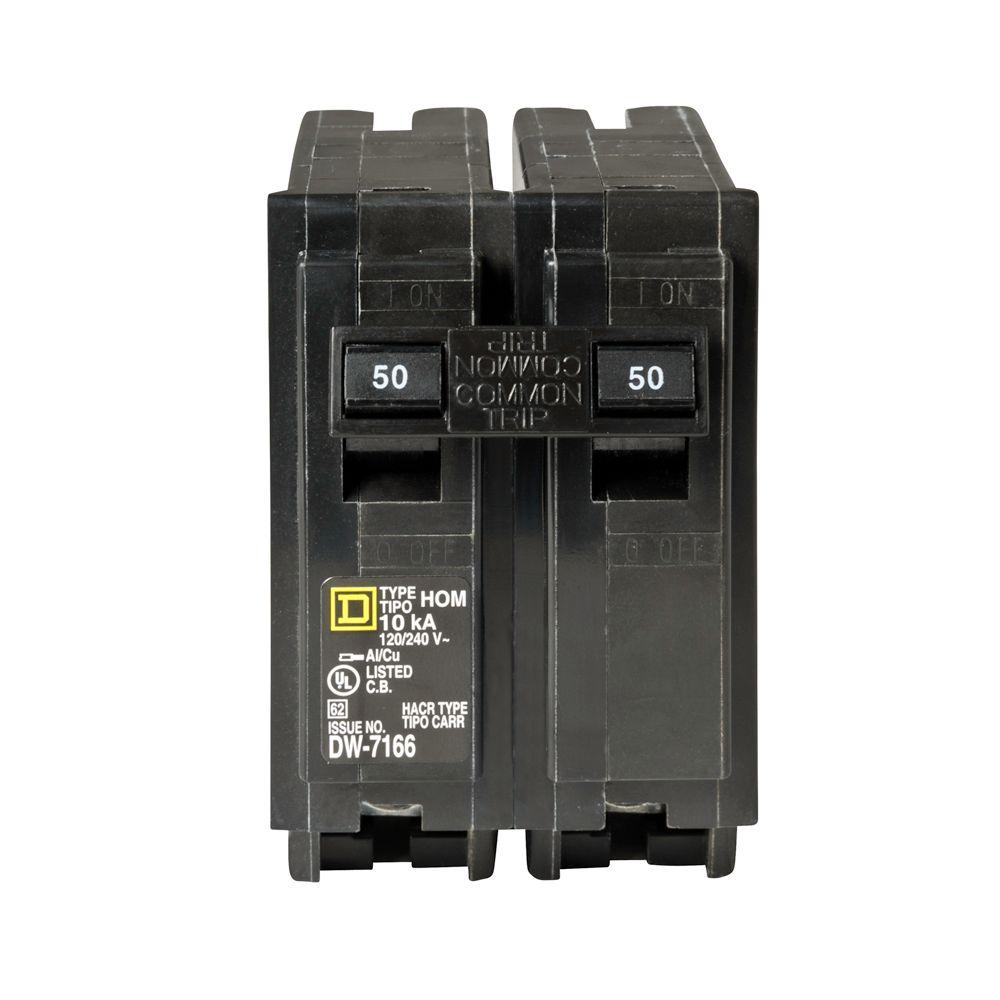
I'm actually curious about what size breaker to use now. I thought the 50A double pole I had was correct.

This is what I have (Square D Homeline panel):
square-d-double-pole-breakers-hom250cp-64_1000.jpg


Should I be using a different breaker? 90A double pole, 70A double pole...? I'm legitimately confused now.
 

alfredeneuman

Well-known member
Joined
Mar 3, 2011
Messages
4,596
Location
Fullerton, CA
If the OP used a 70 amp breaker, this would solve all problems, correct?
It depends which cable he uses.
2-2-4-6
I'd say a maximum 60 after the ground wire adjustment factor. It would normally have a #8 Al ground and the ground wire Table increases in size at 60
2-2-2-4
Can have 70-90 amp breaker
 
Last edited:

pattenp

Well-known member
Joined
Jun 4, 2008
Messages
10,175
Location
Virginia - USA
A 50A, 60A, 70A, 80A, 90A breaker is okay on the 2-2-4-6. A mountain is being made out of a mole hill over this.
 

Terry D

Well-known member
Joined
Mar 25, 2015
Messages
2,202
Location
St. Louis, MO.
Since he just has just one RV plugging into it and probably using the 50 amp, he will not have any problems. Sounds like this is just temporary anyway. But since the panel has space for more circuits to be added, that could put more load on the neutral down the road if turned out not to be temporary. 65 amps is alot on that neutral though, aint going to happen

Sent from my SM-G960U using The Garage Journal mobile app
 

MoonRise

Well-known member
Joined
Nov 5, 2010
Messages
4,045
Location
NJ
I bought a Siemens TL137US Temporary Power panel that has a 240v 4-prong 50A socket pre-wired, a 240v 3-prong 30A socket pre-wired, and a 120v GFI 20A outlet. 100A total in this box of pre-wired outlets. I will be using the 50A socket for the RV and probably also the full extent of the 20A plug for other things at the RV. I will probably not be using the 30A socket at all (and yes I realize I can't use it at all on the RV because it is 240v, not 120v like an RV 30A plug needs).

Umm, the Temporary Power Panel that you linked to and bought has:

- 50 amp two pole breaker feeding a NEMA 14-50R 4-blade 240/120 V receptacle built-in (across L1 and L2, hence 240V to the outlet)

- 30 amp single pole breaker feeding a TT-30R three blade 120 V receptacle built-in (across either L1 OR L2, hence 120V to the outlet)

- 20 amp single pole breaker feeding a NEMA 5-20R GFCI receptacle built-in (across either L2 OR L1, hence 120V to the outlet)

The Power Panel is a sub-panel.

With a max draw of 80 amps on whatever 240 V breaker is feeding the Power Panel (50 A 240 V breaker + 30 A 120 V breaker).

If he removes the TT-30R and 30 amp single pole breaker in the Power Panel and leaves the 50A 240V double pole breaker to the NEMA 14-50R and the 20 A 120 V single pole breaker to the NEMA 5-20R GFCI, he -could- have a 70 A worst-case imbalanced load through the neutral/ground (50 amp on L1 from the NEMA 14-50R line and another 20 amp on L1 from the NEMA 5-20R line, for instance). Not including worst-case dead-shorts type of failures for the breaker(s) upstream to try and clear.

Being fed from a sub-panel off of the Main panel.

With 125 ft of aluminum MHF cable.

100 amps running through 125 ft (one way) on #2 aluminum shows ~2.6% voltage drop. Which is within usual spec allowances.

Glad that you are asking questions, not so good that you aren't even clear on what you bought and how it and the built-in receptacles are wired.

A TT-30 RV plug/receptacle is 120V. It is NOT a 240V item.

Do NOT somehow wire it to 240V power, as someone/something plugging into a TT-30 is EXPECTING 120V.

I see conflicting ampacity rating on the aluminum 2-2-x-x MHF cable. Cable sellers are listing it as 100 amp ampacity @ 90C based on 2017 NEC.

https://www.prioritywire.com/specs/Mobile Home Feeder Cable (MHF).pdf

But that's based on it feeding a dwelling's 'main' panel.

But other places/sources are saying #2 aluminum is just rated for 75 amps (based on a 60C termination temp rating, probably because of the general listed panelboard temp rating/listing of 60C for #2 wire).

But #2 aluminum used to feed a subpanel is rated at 90 amps.

:willy_nil

:lol_hitti
 

alfredeneuman

Well-known member
Joined
Mar 3, 2011
Messages
4,596
Location
Fullerton, CA
I'd be surprised if I saw 65A neutral current on a 200A service. No way could someone overload this with a 90A or less feeder.

I'm talking about the feeder, not the whole service. I've already said that it would be next to impossible to do. But it could conceivably happen.
Article 220 ARTICLE 220 — BRANCH-CIRCUIT, FEEDER, AND SERVICE LOAD CALCULATIONS
220.61
A) Basic Calculation. The feeder or service neutral load shall be the maximum unbalance of the load determined by this article. The maximum unbalanced load shall be the maximum net calculated load between the neutral conductor and any one ungrounded conductor.

It doesn't qualify for any of the exceptions.
 

pattenp

Well-known member
Joined
Jun 4, 2008
Messages
10,175
Location
Virginia - USA
............
I see conflicting ampacity rating on the aluminum 2-2-x-x MHF cable. Cable sellers are listing it as 100 amp ampacity @ 90C based on 2017 NEC.

https://www.prioritywire.com/specs/Mobile Home Feeder Cable (MHF).pdf

But that's based on it feeding a dwelling's 'main' panel.

But other places/sources are saying #2 aluminum is just rated for 75 amps (based on a 60C termination temp rating, probably because of the general listed panelboard temp rating/listing of 60C for #2 wire).

But #2 aluminum used to feed a subpanel is rated at 90 amps.

:willy_nil

:lol_hitti

There is no conflicting information on the temp ratings and use of #2 Al if you fully understand all the applicable NEC and exceptions.
 

MoonRise

Well-known member
Joined
Nov 5, 2010
Messages
4,045
Location
NJ
There is no conflicting information on the temp ratings and use of #2 Al if you fully understand all the applicable NEC and exceptions.

But that was my point. Maybe not called out quite so clearly.

Without going through ALL of the conditions and exemptions and specific case limitations, I can easily see the OP or the supply house (not really their job) NOT getting the Code-specific cable ampacity correct.

Unless the OP's specific Power Panel has a "listed" temperature rating higher than 60C (I don't feel like looking that up. :lol: ), his #2 aluminum cable has an ampacity rating of 75 amps (based on the standard NEC panelboard 60C temp limit for #2 wire).

Even though the aluminum MHF itself has a temperature rating of 90C, and #2 aluminum MHF has an ampacity rating of 100 amps if fed to a dwelling (and meter, but not panel board).

It is ALL of the conditions and exemptions and limitations that have to be applied that change the ampacity rating. Even though the wire and cable is the same.

:beer:

OP, don't forget the NoAlox on the aluminum wire connections. And make sure that all the connections are properly torqued to spec.

Be safe. And let us know how the project comes out.
 
To avoid these ads, REGISTER NOW!
Top Bottom