To avoid these ads, REGISTER NOW!

Wiring Generator to House

Smiles79

Well-known member
Joined
Feb 15, 2018
Messages
290
Location
Northwest Missouri
Once I get moved into my new place I would like to wire it up for a generator. I haven't closed on it yet, so I'm not sure of all of the specifics. I'm mainly curious about wiring from the panel to the inlet. I currently have a 120V/30A inverter generator but will be setting it up such that the wiring from the inlet to the panel is sufficient for a 240V/50A generator. I plan on wiring the generator straight to the panel and using an interlock, not a transfer switch.

Is it acceptable to use 6 AWG aluminum thhn in conduit all the way from the panel to the generator inlet? The wiring will likely need to come out of the attic, down an exterior wall, and into the inlet.

How would you go about this?

Edit: Actually, I should be able to run it from the panel into the attached garage, and mount the inlet on the outside of the garage wall, so no outside runs. Could I use something like 2-2-2-4 SER, eliminating the need for conduit and allowing me to use a larger generator in the future?
 
Last edited:
To avoid these ads, REGISTER NOW!

John in OH

Well-known member
Joined
Jun 2, 2007
Messages
2,444
Location
SE Ohio & Eastern Virginia
I'm not an electrician, but I don't know of any simple, code-acceptable way to safely wire a 120v generator into a 240v main panel. Perhaps, you might be able to use a 120v sub-panel for your critical 120v circuits and a manual sub-panel transfer switch scheme for isolation .... but you should consult a "real" electrician.
 
OP
S

Smiles79

Well-known member
Joined
Feb 15, 2018
Messages
290
Location
Northwest Missouri
I'm not an electrician, but I don't know of any simple, code-acceptable way to safely wire a 120v generator into a 240v main panel. Perhaps, you might be able to use a 120v sub-panel for your critical 120v circuits and a manual sub-panel transfer switch scheme for isolation .... but you should consult a "real" electrician.
Thanks for the input but I believe I know how this can be done but will be sure before I do it. At any rate, I'm just looking for info on the size/type of wire to use.
 

FMB4

Well-known member
Joined
Jan 19, 2017
Messages
2,926
I'd pass on the aluminum wiring. Meanwhile, there many online videos on how to do exactly what you're looking into. Also be sure to follow code in your area.
.... but you should consult a "real" electrician.

^ This.
 

firebirdparts

Well-known member
Joined
Jun 8, 2016
Messages
10,609
Location
Kingsport, TN
There’s nothing special about it that I know of. If you want to back feed a 50 amp breaker, then wire size accordingly. I never use aluminum and I don’t have any comment about that. I have copper 6-3 to mine.

if your question is really about conduit and installation, you should probably move it to the electrical forum. They are pretty brilliant real electricians and you won’t get as many of these blather answers.
 

Leaflessshadetree

Well-known member
Joined
Aug 1, 2013
Messages
7,154
Location
Don't ask.
I believe you can use smaller wire for 50 amps. Check to see if an interlock is available for your panel. Make sure you have space for that breaker, I believe in most cases it needs to be in a position close to the main breaker.
A 120V generator may limit you to circuits on one side of the panel.
 

FredWanaker

Well-known member
Joined
Mar 27, 2021
Messages
1,470
Location
NorCal
There are all sorts of issues hooking a generator to the house panel. One is that the power cannot back feed into the lines coming to your house. Imagine a lineman working on power lines that are dead because of a fallen tree, gets zapped by your generator back feeding into what is supposed to be a grid that is de-energized. Your best bet is really to hire an electrician to do the work. Another option, and really the best one, is to install a permanent generator designed for that sort of thing, and let those folks do the permits and wiring etc.. We have friends up in the foothills here who lose their power sometimes during fires or heavy snows like now, and this is what they have done. If the power goes out the generator comes on automatically, powers the whole house, and the system automatically disconnects from the grid. If you are just trying to get thru a power outage right now, run a heavy extension cord to the refridge, heater etc.. and do the permanent install when you can. Be sure that the electronics in your heater etc., will handle the output from the generator you own. HVAC circuit boards can be rather expensive, and/or hard to find if they are obsolete. Small generators are gas hogs, compared to the permanent ones, so trying to power a house with one will require access to enough fuel daily to keep it going.
 

pattenp

Well-known member
Joined
Jun 4, 2008
Messages
10,175
Location
Virginia - USA
Aluminum SER cable is fine. #2 Al SER is 90A and may not fit in terminals of 50A inlet and breaker. #6 Al SER is good for 50A and is what I'd suggest if trying to save $$.
 

Steve in UT

Well-known member
Joined
Oct 30, 2018
Messages
205
Location
....
I believe you can use smaller wire for 50 amps. Check to see if an interlock is available for your panel. Make sure you have space for that breaker, I believe in most cases it needs to be in a position close to the main breaker.
A 120V generator may limit you to circuits on one side of the panel.
I installed an interlock on my panel. My generator is a 120v inverter. I simply jumped the backfeed breaker to catch both sides. I just shut off the 220 breakers (range and a/c) before I make the switch. My 3000 watt Honda runs the whole house just fine. (Led lights everywhere)
 

jack stand

Well-known member
Joined
Feb 29, 2012
Messages
3,335
Location
Lakes Region Maine
Steve's interlock ^^^^ is a wonderful thing. So simple and obvious it's amazing that it wasn't thought up years ago. All it is (available at HD) is a couple of metal stampings that physically prevents the main house breaker from being on (closed) WHILE your new 50 amp breaker is on (closed). This protects the line worker on the grid. The Kits are specific to your panel, ie; sq d, ge, etc. Along with this you'll need to add a 30a receptacle feeding this new breaker in your panel. The last thing is making up a cord from the generator to this new 30a receptacle.
HD had the lockout kit and the (outside) receptical (looks similar to a a/c or other disconnect sw) right by each other in the isle.
It's the simplest legal route.
Now if you have an oddball panel, that might be a problem. Do a little internet searching, you probably can order what you need tonight. 👍
If you are able to run the generator by your meter, your panel is generally just inside. A short 8'-10' run of wire is the extent of the "hard part".
 

HoosierMark

Well-known member
Joined
Jan 31, 2013
Messages
1,442
Location
Southeast IN
If you want a simple way, consider what my electrician did for my house when I built it. He set up as side panel with key breakers in it. Such as fridge, freezer, bathroom light, tv, etc. I simply roll my generator out of my basement garage, plug it into a nearby dedicated 220 plug and go over to side panel and flip the interlock breaker shutting the feed off to the main box and start the generator up. It works great and when the power comes on the other lights come on and I go down and shut the generator off, unplug and flip the breaker.
 

mike93lx

ALLIANCE MEMBER
Joined
Dec 9, 2013
Messages
37,515
Location
Richmond, VA
Up sizing all the way to a 50a input is a big jump. Unless you have a specific need for that much juice in an outage, I would stick with the all more common 30a hookup. Everything about it will be far easier and cheaper to deal with too.

Interlocks are fantastic. Safe, simple, cheap and easy. The only reason to not use one for a portable genertor is if one isn't available for your panel, IMO
 

thammel

Well-known member
Joined
Oct 3, 2005
Messages
2,243
Location
Maryland
I presume this is not an automatic standby generator. Then you need a manual transfer switch. Not had to do....check out your options on the web.
 

eagleknight

Active member
Joined
Aug 6, 2010
Messages
35
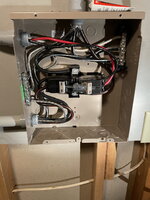
I just went through a similar situation. I needed a sub panel as well because I needed more room for circuits. I wanted to get a combo transfer switch and panel together, but those were back ordered and actually doing a separate switch and panel ended up being less expensive. Like patentp mentioned if you used #2 wire fitting in the terminals might be an issue. I used SER 6-6-6-6 that I had to hunt around for because only certain Lowes seemed to carry it, but that is good for up to 50A for the generator link. That saved me some money. The Interlink switch is a 100A from the main panel and then has a 60A for the generator side, but I am only running a 30A link with a NEMA L14-30P. So if I or future owner wants to upgrade to a 50A generator they would only need to switch gen link outside of the house to to a 50A. I did use #2 wire between main panel > Interlink switch > sub panel. Original panel was in between the studs so I also pulled it out and mounted everything on 3/4" plywood so running conduit between the boxes was easier.

All and all for sub panel, transfer switch, breakers, and wire it cost me $550 and just passed inspection last week. Inspector commented he wished all installs were this good so I was happy.
 

Attachments

  • IMG_0304.jpg
    IMG_0304.jpg
    407.5 KB · Views: 109
  • IMG_0306.jpg
    IMG_0306.jpg
    327.8 KB · Views: 104
  • IMG_0340.jpg
    IMG_0340.jpg
    320 KB · Views: 95
  • IMG_0526.jpg
    IMG_0526.jpg
    306.6 KB · Views: 108
To avoid these ads, REGISTER NOW!
OP
S

Smiles79

Well-known member
Joined
Feb 15, 2018
Messages
290
Location
Northwest Missouri
Aluminum SER cable is fine. #2 Al SER is 90A and may not fit in terminals of 50A inlet and breaker. #6 Al SER is good for 50A and is what I'd suggest if trying to save $$.
This is what I was looking for, thank you! And it does not need to be in conduit, does it?

I installed an interlock on my panel. My generator is a 120v inverter. I simply jumped the backfeed breaker to catch both sides. I just shut off the 220 breakers (range and a/c) before I make the switch. My 3000 watt Honda runs the whole house just fine. (Led lights everywhere)
Any issues doing this? I think I've read that under certain situations this can overload the neutral if you're not careful?
Up sizing all the way to a 50a input is a big jump. Unless you have a specific need for that much juice in an outage, I would stick with the all more common 30a hookup. Everything about it will be far easier and cheaper to deal with too.

Interlocks are fantastic. Safe, simple, cheap and easy. The only reason to not use one for a portable genertor is if one isn't available for your panel, IMO
Don't 240V generators output 50A? I thought this was the case, so I wanted to future proof for a larger generator in the future. If I'm wrong and a 240V generator will output 30A just like my 120V generator does, then I'll definitely just set it up for 30A.
I just went through a similar situation. I needed a sub panel as well because I needed more room for circuits. I wanted to get a combo transfer switch and panel together, but those were back ordered and actually doing a separate switch and panel ended up being less expensive. Like patentp mentioned if you used #2 wire fitting in the terminals might be an issue. I used SER 6-6-6-6 that I had to hunt around for because only certain Lowes seemed to carry it, but that is good for up to 50A for the generator link. That saved me some money. The Interlink switch is a 100A from the main panel and then has a 60A for the generator side, but I am only running a 30A link with a NEMA L14-30P. So if I or future owner wants to upgrade to a 50A generator they would only need to switch gen link outside of the house to to a 50A. I did use #2 wire between main panel > Interlink switch > sub panel. Original panel was in between the studs so I also pulled it out and mounted everything on 3/4" plywood so running conduit between the boxes was easier.

All and all for sub panel, transfer switch, breakers, and wire it cost me $550 and just passed inspection last week. Inspector commented he wished all installs were this good so I was happy.
Great info, thank you!
 

mike93lx

ALLIANCE MEMBER
Joined
Dec 9, 2013
Messages
37,515
Location
Richmond, VA
Don't 240V generators output 50A? I thought this was the case, so I wanted to future proof for a larger generator in the future. If I'm wrong and a 240V generator will output 30A just like my 120V generator does, then I'll definitely just set it up for 30A.
Sure, the big ones do, but 30a is way, way more common as it covers everything up to about 7500 watts. Portable generators with 50a plugs are huge, and heavy. Over 15hp engines, big fuel tanks, big gensets. 250+ lbs.

SER needs to be treated like romex/nmb when it comes to damage protection. If it is subject to damage, it needs conduit. And it cannot be underground, regardless of conduit.

So use it above ground and transition to something like xhhw or mhf if you need to go underground. If you can run conduit end to end, consider doing that and just running xhhw
 
Last edited:
OP
S

Smiles79

Well-known member
Joined
Feb 15, 2018
Messages
290
Location
Northwest Missouri
Sure, the big ones do, but 30a is way, way more common as it covers everything up to about 7500 watts. Portable generators with 50a plugs are huge, and heavy. Over 15hp engines, big fuel tanks, but gensets. 250+ lbs.

SER needs to be treated like romex/nmb when it comes to damage protection. If it is subject to damage, it needs conduit. And it cannot be underground, regardless of conduit.

So use it above ground and transition to something like xhhw or mhf if you need tobgo underground. If you can run conduit end to end, consider doing that and just running xhhw
Ah that makes sense. Thank you!
 

Steve in UT

Well-known member
Joined
Oct 30, 2018
Messages
205
Location
....
Any issues doing this? I think I've read that under certain situations this can overload the neutral if you're not careful?
The only problem I can find is if you have a Multi-Wire Branch Circuit. I have none in my panel. But if you do, simply shut one side off.
 

mike93lx

ALLIANCE MEMBER
Joined
Dec 9, 2013
Messages
37,515
Location
Richmond, VA
I just went through a similar situation. I needed a sub panel as well because I needed more room for circuits. I wanted to get a combo transfer switch and panel together, but those were back ordered and actually doing a separate switch and panel ended up being less expensive. Like patentp mentioned if you used #2 wire fitting in the terminals might be an issue. I used SER 6-6-6-6 that I had to hunt around for because only certain Lowes seemed to carry it, but that is good for up to 50A for the generator link. That saved me some money. The Interlink switch is a 100A from the main panel and then has a 60A for the generator side, but I am only running a 30A link with a NEMA L14-30P. So if I or future owner wants to upgrade to a 50A generator they would only need to switch gen link outside of the house to to a 50A. I did use #2 wire between main panel > Interlink switch > sub panel. Original panel was in between the studs so I also pulled it out and mounted everything on 3/4" plywood so running conduit between the boxes was easier.

All and all for sub panel, transfer switch, breakers, and wire it cost me $550 and just passed inspection last week. Inspector commented he wished all installs were this good so I was happy.
You have a bunch of double tapped neutrals that need to be fixed. And I thought even pvc fittings required bushings
 

mike93lx

ALLIANCE MEMBER
Joined
Dec 9, 2013
Messages
37,515
Location
Richmond, VA
Thanks for the help. So if I don't have any multi wire branch circuits, I turn off all 240v breakers, and I have an interlock, I should be safe?
If you are running a 120v generator, yes.

If it was my house, and all I had was a 120v generator, I would feed both sides of the buss bar and shut off all two pole breakers. Just be mindful of load with stuff like multiple fridges/freezers and a/c units
 
OP
S

Smiles79

Well-known member
Joined
Feb 15, 2018
Messages
290
Location
Northwest Missouri
If you are running a 120v generator, yes.

If it was my house, and all I had was a 120v generator, I would feed both sides of the buss bar and shut off all two pole breakers. Just be mindful of load with stuff like multiple fridges/freezers and a/c units
Thank you for all the info!
 

fitter30

Well-known member
Joined
Jun 23, 2019
Messages
2,973
Location
Peace Valley,mo
Run a 6500 watt lp portable generator. Can run a fridge, well pump, water heater some lights and a 5k window ac for a bedroom not at the same time. Heat is a cast iron stove with ventless lp logs. Have a outdoor 4 wire male plug made for a generator setup and a short cord and 1/2" quick connect gas hose. Only other lp is the cook stove. Have a
500 gallon tank last us over 5 years. With lp don't have to run to a gas station 15 miles away and the.gas.never goes bad.
 

Attachments

  • IMG_20220119_145750.jpg
    IMG_20220119_145750.jpg
    404.5 KB · Views: 42
To avoid these ads, REGISTER NOW!
Top Bottom