I am running conduit down the center of the barn to supply power to lights.
Next question.
I will be adding more runs out of my new breaker box to feed other circuits.
The above questions are for my 27x76 pole barn with an additional 12x60 foot room on the back.
Whoa, Nellie!
Three posts in less than 20 minutes, and you're all over the map.
The FIRST thing we need to address is some of your assumptions about those CFLs...
I am using 42 watt CFL 6500K bulbs from Feit electric. The are equivalent to 200 watt incandescent.
I presume you mean these:
http://www.homedepot.com/p/Feit-Ele...CFL-Light-Bulb-12-Pack-ESL40TN-D-12/100661903
I have tested 3 of them and they seem good for my barn needs.
Well, in the sense that they would likely be superior to conventional incandescent lamps of similar output, sure. But that's not really the yardstick you should be using. Look at the basic specs for these bulbs:
Code:
Light Output (lumens)   	2800
Wattage (watts)   		42
Average Life (hours)   		8000
Price:  			$98.96 / 12-pack
    				$ 8.25 each
Now compare that to, for example:
http://www.1000bulbs.com/product/90168/USH-3000102.html
Code:
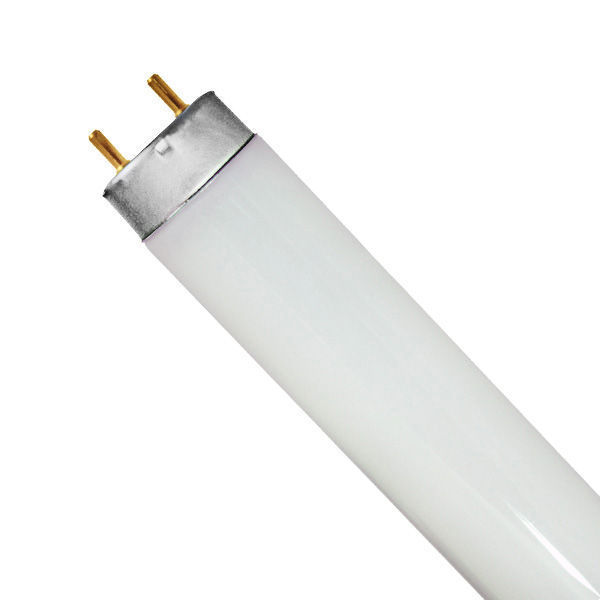
Lumens (Initial):  		3050
Wattage (watts)   		32
Life (hours)   			30,000
Price:  			$55.56 / 25-pack
    				$ 2.22 each
Obviously, the tubes produce more light, for MUCH less cost (particularly by the time you figure that you will be replacing dead CFLs nearly four times as often as the tubes will need replacement). But MUCH more importantly, at ~95 lumens/watt the tubes are FAR less expensive to operate than the CFLs (which produce less than 67 lumens/watt). So for equivalent brightness with the CFLs, your electric bill will be about 42% higher --
FOREVER.
You REALLY need to re-think this.
The barn is a storage building and is not going to be my main shop area. I think the 20 amp breakers should be good for 10 in each room. That puts me at 420 Watt.
Your math is off, at least if you mean that one breaker should supply power to both rooms. Two rooms, ten bulbs per room, each bulb consuming 42 watts, yields a total of 840 watts.
That said, a single 20A circuit would still be adequate, looking at it solely from a load standpoint. But again, that's not quite the way you ought to be looking at it. Regardless of the load calculations, you should split up your lighting (in each room) between at least two separate circuits/breakers. That way, if/when one trips (or must be shut down for maintenance), you won't be left completely in the dark.
Now, regarding some of your other points...
I am running all 12 awg THHN off of one breaker to feed these 10 lights. I am ending the run going down to a 4" square box on the wall that will have the light circuit. I am running a second circuit off of a second breaker that will feed power to a outlet in the last 4" box. So this 4" box will contain the switch (20amp HD) and a 20 amp outlet.
What size conduit are you planning to run? I'm not intimately familiar with the official limits of fill ratios, derating for multiple conductors, etc.; but as a very broad statement, "bigger is better" in terms of being able to EASILY make the pulls.
Do I need to run 2 grounds or can one 12 awg wire protect both circuits in this conduit run. It seems kind of silly to have to land 2 grounds in the last box.
If you are using properly fitted EMT, the conduit itself can serve as the ground. That's not to say you SHOULD do that, but it's acceptable. Given that, I can't imagine that a single ground wire within the EMT (which itself isn't "required" in the first place) could be ruled "inadequate".
HOWEVER... Just to be clear: When I say "ground" here, I am speaking ONLY of the "Equipment Grounding Conductor" (EGC). Each circuit still requires a dedicated and segregated Neutral (a.k.a. "Grounded Conductor").
The above questions are for my 27x76 pole barn with an additional 12x60 foot room on the back. main part of the barn is cut in half with a wall. So I am around 27x 38 in each room. The lighting circuit in post# 1 is for just one room. I will be running conduit into the other room to feed it with another 20 amp lighting circuit.
Keep the two breakers; but as noted above, arrange the loads differently. Put (about) half of each room's lighting load on "Breaker A", and the other half on "Breaker B".