To avoid these ads, REGISTER NOW!

Wiring switches and outlets

wrench409

Well-known member
Joined
Oct 14, 2006
Messages
2,559
Location
Over here....
I now have all my wire pulled through the conduit. I used 12 gauge stranded throughout all circuits except the 240 volt one which I used 10 gauge stranded.

I'm ready to finish up on the switches and outlets.

What's the NEC method to connect to the outlets and switches when using stranded wire?

Twist the wire and just loop it around the screw?
Solder the tip of the wire first then make the hook loop for the screw?
Crimp on fork type terminals?
Use a short section of scrap solid wire around the screw, then pigtail it with a wire nut?

Thanks,
wrench
 
To avoid these ads, REGISTER NOW!

Speedy Petey

Well-known member
Joined
Apr 22, 2012
Messages
1,430
Location
NY State
For a DIYer I would suggest crimp terminals. Especially for a motorhead who should nearly be a pro at using them. :thumbup: :3gears:
 

Tim The Tool Man

Well-known member
Joined
Mar 1, 2012
Messages
1,520
Location
Lehigh Valley, PA
Twist well and wrap around the screw. I wouldn't solder because it can deteriorate the insulation around the wire.

For a DIYer I would suggest crimp terminals. Especially for a motorhead who should nearly be a pro at using them. :thumbup: :3gears:

As Speedy Petey states, only if you are confident in your crimping abilities and own a decent crimping tool. I have seen my fair share of sloppy/loose crimps.
 

Higgins

Well-known member
Joined
Dec 25, 2009
Messages
1,934
Location
Shepheardsville, KY
This will take a little practice!

Using a GOOD pair of wire strippers, gently cut the insulation ~ 1 1/2" from the end, now slide the insulation ~ 1/2 off the wire AND LEAVE IT IN PLACE.

You can now wrap the wire around the screw, and the remaining insulation sleeve, will keep the individual strands in place!

Now go practice on some scrap wire!!!!
 

pattenp

Well-known member
Joined
Jun 4, 2008
Messages
10,175
Location
Virginia - USA
I suggest using the better grade outlets that have compression terminals, not the cheapo ones with the wrap around screw terminations.
 

tylernt

Well-known member
Joined
Jan 24, 2013
Messages
182
Location
Idaho, US
I suggest using the better grade outlets that have compression terminals, not the cheapo ones with the wrap around screw terminations.
I agree this is best.

Otherwise, I've found that twisting stranded counterclockwise and then wrapping it clockwise around a screw terminal, works pretty good. The counterclockwise twist somehow keeps the strands together better when they go around the screw.
 

theoldwizard1

Well-known member
Joined
Feb 22, 2011
Messages
43,153
Location
SE MI
X4 to use for stranded - will save you a ton of hassle.

I have to agree, but ouch on the price difference ! Leviton 5320 (screw and back stab) versus BR15 (commercial grade, screw and side clamp), from under $1 to typically around $5 !
 

rburke65

Well-known member
Joined
Nov 10, 2007
Messages
12,349
Location
Canfield, Ohio
Electrician here.....or was. Retired. When in this situation, I would strip the wire and the twist the strands in a counter clock wise rotation, form the loop, and then secure under the screw terminal. Being twisted in a CCW rotation, the wire is pulled back under the screw. Fruit.....you havenothingto loose.
 
To avoid these ads, REGISTER NOW!

Speedy Petey

Well-known member
Joined
Apr 22, 2012
Messages
1,430
Location
NY State
Okay, where ?

Best I could find was on eBay, 10 for $21.70. NOS, no packaging.

That is still about 4 times the cost of the cheap Leviton residential.
OK, $2.20 is WAY less than $5. So is the around $3 I pay. Especially considering we typically buy things like this in bulk.
 
OP
W

wrench409

Well-known member
Joined
Oct 14, 2006
Messages
2,559
Location
Over here....
Thanks for all the replies and links.

I'll make a few practice runs and decide. But it looks like:

CCW twist and CW hook with the stub of insulation at the end of the hook. No solder.

Great info.
 

GTO

Well-known member
Joined
May 8, 2009
Messages
3,927
Location
NJ,FL
For commercial installations you always pigtail off the outlets and then wire nut them together in the box. That way if you are using the last outlet on a string to power a tool the electricity is not going in and out of every other outlet (and through twice as many connections) in the string before getting to you. If you jump through the outlets instead and ever get a loose or corroded connection at either of the terminals on any of the outlets it will affect every outlet downstream from the problem, and that point of extra resistance can then become a fire hazard every time you use any of the outlets downstream of the poor connection.

Wire nuts done correctly rarely fail in any way if kept dry. If the outlets are all pigtailed and wire nutted the path of electricity only goes through a few wire nuts to get a hot, neutral, and a ground to any outlet in the string. That means that if any single outlet starts having a problem or a poor connection it only affects that particular outlet and that is it. It also prevents a problem that you find in older homes sometimes where almost all terminal connections on the outlets are either loose or corroded. If that home is wired through the back of every outlet with no pigtails you can have a slight resistance and voltage drop at each and every terminal which then adds up one by one to a large voltage drop, a very poor high resistance neutral, or major fire hazard problems by the time you reach the last outlet in the string.

Is there a diagram of this available anywhere.I would like to see it.
Thanks.
 

Charles (in GA)

Well-known member
Joined
Jan 11, 2006
Messages
12,489
Location
50 mi south of Atlanta
Cheap receptacles are just that, cheap. Dont waste your time with wrap around the screw receptacles. Use commerical backwire type.

attachment.php
 
Last edited:

theoldwizard1

Well-known member
Joined
Feb 22, 2011
Messages
43,153
Location
SE MI
Cheap receptacles are just that, cheap. Dont waste your time with wrap around the screw receptacles. Use commerical backwire type.

attachment.php

I have also used a type that has a "clamp bar" on the side. The wire goes straight in under the clamp bar and the screw secures the clamp bar down.

Charles, got a manufacturer and part number for the bottom one ?
 

Charles (in GA)

Well-known member
Joined
Jan 11, 2006
Messages
12,489
Location
50 mi south of Atlanta
I have also used a type that has a "clamp bar" on the side. The wire goes straight in under the clamp bar and the screw secures the clamp bar down.

Charles, got a manufacturer and part number for the bottom one ?

The pics are from THIS THREAD here is another pic that was posted in that thread. These have the clamp plates on the inside, like a Leviton. I think Cooper puts their clamp up plates on the outside, don't care for that as much.

attachment.php


Here is an older Leviton BR15. The design has since been changed I think. You can clearly see the V formed into the clamp plates inside the receptacle.

attachment.php
 
Last edited:
OP
W

wrench409

Well-known member
Joined
Oct 14, 2006
Messages
2,559
Location
Over here....
After I finished some modifications to my conduit and routing plans, I opened the boxes of the switches and outlets examined my stuff I previously purchased.

I have indeed the better commercial screw and side clamp type on every outlet (except one that someone obviously slipped a Chinese cheapy back into a Cooper box and returned to the store. I over bought so I still have everything needed to complete the switch/outlet with the above mentioned good stuff.

If I'd opened them earlier perhaps I'd have known but perhaps not.

It is still good discussion and very informative for all (especially me!).
 

egnorant

Well-known member
Joined
May 2, 2012
Messages
1,805
Location
East Texas
Had an old electrician drop by while I was wiring my shop and he showed me a trick or two.

Using #10 wire I was having a bear of a time getting the wire to crush well under the screws. He had me run the whole circuit, 5 boxes of quad outlets and at each box I would grab the wires in my fist and pull out enough to give it a half twist.

Then he had me measure 4 finger widths in the middle and strip 1 finger width on each side. This allowed me to pull the wire from both ends over the screw and make solid connections without the wire splaying everywhere. Middle piece bridged over to the next outlet and so on down the line. Once you got the hang of this it just rolls pretty quick with solid connections, just the right amount of slack to keep things neat and unstressed while keeping an uncut wire connection all the way to the last outlet.

cutting insulation out of the middle may have been a bit harder at first, but once you get your rhythm down it goes much faster than cut, strip, curl and try to keep it under the screw.

Bruce
 
Last edited:
OP
W

wrench409

Well-known member
Joined
Oct 14, 2006
Messages
2,559
Location
Over here....
Got most done yesterday.

One of my 'hand me down' flourescent light fixtures has a bad connector where the bulb twists in. It's a Kulka medium bi pin socket. I think Ace would be a better shot for this part.

Sure was nice having that much light!
 
OP
W

wrench409

Well-known member
Joined
Oct 14, 2006
Messages
2,559
Location
Over here....
Followup.

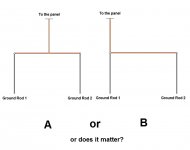
I have everything completed in the garage and now need to finish the ground rods. Code only mentions two 10' rods at 6 ft spacing.

Check the attached pic.

A or B or does it matter?
 

Attachments

  • dual ground rods.jpg
    dual ground rods.jpg
    37.7 KB · Views: 24

Speedy Petey

Well-known member
Joined
Apr 22, 2012
Messages
1,430
Location
NY State
Where are you seeing 10' rods being required??

This is typical:
1113920864_2.jpg


The wire from the panel can be passed through the acorn on the first rod and then on to the other rod.
 

darcyh

Well-known member
Joined
Aug 27, 2010
Messages
185
Location
London Canada
The pics are from THIS THREAD here is another pic that was posted in that thread. These have the clamp plates on the inside, like a Leviton. I think Cooper puts their clamp up plates on the outside, don't care for that as much.

attachment.php


Here is an older Leviton BR15. The design has since been changed I think. You can clearly see the V formed into the clamp plates inside the receptacle.

attachment.php

Using a MWBC, I need to join three wires; can I insert two wires into the holes and also wrap one around the screw?

Dave
 

Charles (in GA)

Well-known member
Joined
Jan 11, 2006
Messages
12,489
Location
50 mi south of Atlanta
Using a MWBC, I need to join three wires; can I insert two wires into the holes and also wrap one around the screw?

Dave

You have four holes, why would you need to wrap one around the side? Or are you splitting the receptacle top and bottom separate circuits? Most people put two receptacles side by side, and put one receptacle on one hot and the other receptacle on the other hot wire.

With three hot wires, you would do the same thing, wire nut the incoming and outgoing hot (or neutral) wires together along with a pigtail to the receptacle.

One thing to remember, the neutral on a MWBC MUST be pigtailed into the receptacles, so that you can remove the receptacle, temporarily or permanently, without interrupting the neutral circuit.

Charles
 
To avoid these ads, REGISTER NOW!
Top Bottom