I have an old Wolf Bench Grinder Model No. TG6D, serial No. 892343 and one of the tool rests has broken. I gave it to my cousin who can fix most things but he said he had no luck trying to fix it. I know I could go out and buy a new grinder but this one belonged to my father and they were far better made back then than the things you buy now. Does anyone know where I could find a replacement tool rest as I'm not having much luck so far? I have attached a photo of the one off the other side.

You are using an out of date browser. It may not display this or other websites correctly.
You should upgrade or use an alternative browser.
You should upgrade or use an alternative browser.
Wolf bench grinder
- Thread starter Gozoman
- Start date
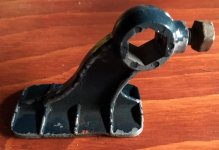
I have an old Wolf Bench Grinder Model No. TG6D, serial No. 892343 and one of the tool rests has broken. I gave it to my cousin who can fix most things but he said he had no luck trying to fix it. I know I could go out and buy a new grinder but this one belonged to my father and they were far better made back then than the things you buy now. Does anyone know where I could find a replacement tool rest as I'm not having much luck so far? I have attached a photo of the one off the other side.
Attaches to a hex rod? That's unusual. A pic of the grinder would be helpful.
someone on here could fab one up for you in steel . depends on how much you are willing to pay / maybe ask in the fab section if anyone can help you out
hex rod? probably a round shaft
hex rod? probably a round shaft
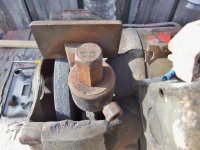
Here is another one that I have. Both rests have been repaired. It does not need a hex. hole to fit...a round one will do. This one belonged to a tool and die maker, just around the corner from me, I suspect it was his repair work, but he is no longer around to ask.
Where are you? There could be help close at hand, if we knew. ( N. Ireland, from later response.)
Where are you? There could be help close at hand, if we knew. ( N. Ireland, from later response.)
Attachments


Last edited:
Here is another one that I have. Both rests have been repaired. It does not need a hex. hole to fit...a round one will do. This one belonged to a tool and die maker, just around the corner from me, I suspect it was his repair work, but he is no longer around to ask.
Where are you? There could be help close at hand, if we knew.
Yep, mine is exactly the same as that. I'll post a photo tomorrow.
Roberts210
Well-known member
That one appears like it might be pot metal. I know of exactly ONE guy who can successfully weld pot metal. He's done it for me for my '53 Chevy 210. His name is Gonzalo Esparza, GE Antique Creations, 10721 Forest St., Santa Fe Springs, Cal. (562) 946-2664. He makes his own welding rods for pot metal from late 1950's Chevy car grills. He says he can't find any newer welding rods that have the correct metallurgy. He ain't cheap, but he's good.
I used him 5 years ago, and he was an old man then. Maybe he's still in business.
I used him 5 years ago, and he was an old man then. Maybe he's still in business.
That one appears like it might be pot metal. I know of exactly ONE guy who can successfully weld pot metal. He's done it for me for my '53 Chevy 210. His name is Gonzalo Esparza, GE Antique Creations, 10721 Forest St., Santa Fe Springs, Cal. (562) 946-2664. He makes his own welding rods for pot metal from late 1950's Chevy car grills. He says he can't find any newer welding rods that have the correct metallurgy. He ain't cheap, but he's good.
I used him 5 years ago, and he was an old man then. Maybe he's still in business.
Very interesting, unfortunately I'm in N. Ireland!
catalytic
Well-known member
I don't see anything broken except a 1/2" wide chip on the edge -- what am I missing? If it's just this unsightly chip 1/2" wide and only 1/8" or less deep into the part, then you could just file it flat or have someone with a milling machine mill it flat (mill the chip out). With a little file work, it will look good.
Otherwise, the first step is to determine whether it's cast aluminum or pot metal.
Then, NOTE: all of the following options (except glue) require that you leave the metal clean. This means keep your files/sandpaper/whatever away from the broken part. Using them will dig more junk into the pores of the casting and make welding even harder.
If it's cast aluminum, then it can be TiG welded by someone who is skilled at welding cast aluminum (many welders cannot do a good job on cast -- find someone who can). Because your part was very unlikely to be heat treated, a TiG weld on it will be as strong as the rest of the part. This is, in my view, the 'correct'/best way to fix it if it's cast aluminum.
There are 3 other options, which will work regardless of what metal it is:
1. use low temp brazing rod, which is sortof like soldering. Not very hard to do and this will work fine, just not be quite as strong as a true weld and once it's repaired you won't want to heat it to 250° or the brazing rod will melt. My guess is that the guy mentioned above who welds pot metal is actually using low temp brazing rod, but I could be wrong.
2. Have a new one cast from aluminum. Here, we'd send it off to Cattail foundry in pennsylvania or one of the aluminum foundries in California. The old one you have would be used as the pattern. You'd need to clean the casting up a little and drill the hole for the set screw once you get it back.
3. Use JB weld. Personally I would not do this, as it makes it much harder to properly TiG weld it at a later time (so I hate finding B welded parts after buying a machine). However, it's strong stuff.
Otherwise, the first step is to determine whether it's cast aluminum or pot metal.
Then, NOTE: all of the following options (except glue) require that you leave the metal clean. This means keep your files/sandpaper/whatever away from the broken part. Using them will dig more junk into the pores of the casting and make welding even harder.
If it's cast aluminum, then it can be TiG welded by someone who is skilled at welding cast aluminum (many welders cannot do a good job on cast -- find someone who can). Because your part was very unlikely to be heat treated, a TiG weld on it will be as strong as the rest of the part. This is, in my view, the 'correct'/best way to fix it if it's cast aluminum.
There are 3 other options, which will work regardless of what metal it is:
1. use low temp brazing rod, which is sortof like soldering. Not very hard to do and this will work fine, just not be quite as strong as a true weld and once it's repaired you won't want to heat it to 250° or the brazing rod will melt. My guess is that the guy mentioned above who welds pot metal is actually using low temp brazing rod, but I could be wrong.
2. Have a new one cast from aluminum. Here, we'd send it off to Cattail foundry in pennsylvania or one of the aluminum foundries in California. The old one you have would be used as the pattern. You'd need to clean the casting up a little and drill the hole for the set screw once you get it back.
3. Use JB weld. Personally I would not do this, as it makes it much harder to properly TiG weld it at a later time (so I hate finding B welded parts after buying a machine). However, it's strong stuff.
Last edited:
I don't see anything broken except a 1/2" wide chip on the edge -- what am I missing? If it's just this unsightly chip 1/2" wide and only 1/8" or less deep into the part, then you could just file it flat or have someone with a milling machine mill it flat (mill the chip out). With a little file work, it will look good.
Otherwise, the first step is to determine whether it's cast aluminum or pot metal.
Then, NOTE: all of the following options (except glue) require that you leave the metal clean. This means keep your files/sandpaper/whatever away from the broken part. Using them will dig more junk into the pores of the casting and make welding even harder.
If it's cast aluminum, then it can be TiG welded by someone who is skilled at welding cast aluminum (many welders cannot do a good job on cast -- find someone who can). Because your part was very unlikely to be heat treated, a TiG weld on it will be as strong as the rest of the part. This is, in my view, the 'correct'/best way to fix it if it's cast aluminum.
There are 3 other options, which will work regardless of what metal it is:
1. use low temp brazing rod, which is sortof like soldering. Not very hard to do and this will work fine, just not be quite as strong as a true weld and once it's repaired you won't want to heat it to 250° or the brazing rod will melt. My guess is that the guy mentioned above who welds pot metal is actually using low temp brazing rod, but I could be wrong.
2. Have a new one cast from aluminum. Here, we'd send it off to Cattail foundry in pennsylvania or one of the aluminum foundries in California. The old one you have would be used as the pattern. You'd need to clean the casting up a little and drill the hole for the set screw once you get it back.
3. Use JB weld. Personally I would not do this, as it makes it much harder to properly TiG weld it at a later time (so I hate finding B welded parts after buying a machine). However, it's strong stuff.
Yeah it's strange stuff whatever it is. My cousin can weld most things including cast aluminium but this is different. By the way the photo is of the good one that's on the other wheel. The broken one is broken at an angle half way along the leg.
rnscustom
Well-known member
Not sure I see the damage in that photo either . Make a mold out of it and cast another in sand . It's pretty simple . Or maybe a local foundry
rnscustom
Well-known member
Yeah we did tons of it in metal shop , 8th grade . My Upolsterer built a little foundry of sorts and used a hairdryer to blow into it . Cast all kinds of handles for old machinery . Not sure where he got the sand .
Yep, mine is exactly the same as that. I'll post a photo tomorrow.
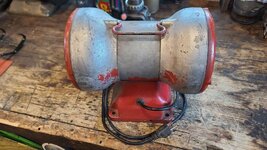
Here's a photo of the grinder itself.
Attachments

It does look like the original rests were cast aluminum...see attached picture. This is another one in our area, and the owner is also looking for spares.
There is no reason one couldn't be fabricated from steel if you just want something that works, like my guy did. No idea where he got the hex. collar though. As above, you could use a round hole (collar) to start.
There is no reason one couldn't be fabricated from steel if you just want something that works, like my guy did. No idea where he got the hex. collar though. As above, you could use a round hole (collar) to start.
Attachments

Roberts210
Well-known member
Yeah we did tons of it in metal shop , 8th grade . My Upolsterer built a little foundry of sorts and used a hairdryer to blow into it . Cast all kinds of handles for old machinery . Not sure where he got the sand .
I worked in an aluminum foundry after High School for a short time. We just used ordinary sand and added motor oil to it to make it stick in place in the mold. When we poured the molten alum. into the mold the smoke would roll out, and I'm sure the powers that be would want some kind of enviro-correct solution for that these days. But for just one piece.....
rnscustom
Well-known member
Never thought of that , ( adding sometiing to regular sand ) . You could weld something up too , nice thing about metal you can use different pieces and weld it all together . But if your keeping it correct then casting is the way to go . Cast metals are tricky to weld they get all kinds of dirt in the pores and just don't want to weld . Had a friend do a belt tensioner that couldn't be bought , he fought the dirt seeping out of those pores for hours till he finally got the weld to stick enough that he built a clean surface
rnscustom
Well-known member
Forgot to mention , those rests don't swivel , if it were mine I'd make two new ones that swiveled in the middle and put the originals away . I've taken the cheap steel ones , cut them in half at the neck and bolted them together so I could tilt the table for angles on chisels, blades and such
winchman
Well-known member
I too have one of the old Wolf grinders it is superb but missing an end guard should any one have a spare?
I too have one of the old Wolf grinders it is superb but missing an end guard should any one have a spare?
How could you lose an end guard??? If I'm forced to buy a new one I'll get in touch regarding the end guard.
winchman
Well-known member
I didn't loose it, I bought it with it missing, one tool rest is also missing.How could you lose an end guard??? If I'm forced to buy a new one I'll get in touch regarding the end guard.
If you ask on the Mig welding forum some one will be able to repair it.
http://www.mig-welding.co.uk/forum/
If you do decide to break it for parts I assure we could use it well but I feel you should be able to repair it, its much better than a new grinder.
I didn't loose it, I bought it with it missing, one tool rest is also missing.
If you ask on the Mig welding forum some one will be able to repair it.
http://www.mig-welding.co.uk/forum/
If you do decide to break it for parts I assure we could use it well but I feel you should be able to repair it, its much better than a new grinder.
Yeah I agree, much better made plus it was my late dad's so I'd prefer to keep it. Just been out looking at it and I think I could make a new rest from a 15mm hex ring spanner cut off at the right height with a small steel plate welded on. Just have to get a spanner as I have ever size except 15mm!
winchman
Well-known member
Just take your time and don't rush you can fix it and it will last for many more years.


Brazen Bull
Well-known member
- Joined
- Apr 3, 2024
- Messages
- 114
I have the same model. Would it be feasible to super glue the parts back together, than use it to make a duplicate by sandcasting with some aluminum? I've read of guys saving old aluminum pistons and melting those down for really tough replacement attachments.
Brazen Bull
Well-known member
- Joined
- Apr 3, 2024
- Messages
- 114
I can vouch for this kind of thing happening gents. I bought a vintage 1950s black and decker deluxe bench grinder, and the right hand side has a wire wheel (the left has a grinding wheel). Somebody had removed and lost the tool rest for the wire wheel side because i guess it got in the way, and that is how I got the old girl.I didn't loose it, I bought it with it missing, one tool rest is also missing.
If you ask on the Mig welding forum some one will be able to repair it.
http://www.mig-welding.co.uk/forum/
If you do decide to break it for parts I assure we could use it well but I feel you should be able to repair it, its much better than a new grinder.
So it's not his fault. This old stuff has a history before it gets to the current guy who owns it.
dutchgray
Well-known member
Don't see why that wouldn't work.I have the same model. Would it be feasible to super glue the parts back together, than use it to make a duplicate by sandcasting with some aluminum? I've read of guys saving old aluminum pistons and melting those down for really tough replacement attachments.
More often with these you are missing a tool rest because it was either removed and lost or got broken, they do seem to be often broken off on these Wolf grinders with just the stub of the arm remaining.
I have one of these 6" Wolf grinders for parts currently if anyone wants to come and pick it up (Dorset, UK) its only got one tool rest though.
Brazen Bull
Well-known member
- Joined
- Apr 3, 2024
- Messages
- 114
It seems the weak spot, well two weak spots of this cherry red gem, is the tool holders that fall apart (or gets lost) and the crappy switch.Don't see why that wouldn't work.
More often with these you are missing a tool rest because it was either removed and lost or got broken, they do seem to be often broken off on these Wolf grinders with just the stub of the arm remaining.
I have one of these 6" Wolf grinders for parts currently if anyone wants to come and pick it up (Dorset, UK) its only got one tool rest though.
I am exploring the possibility of replacing my switch with a typical wall style switch, grind down the mounting wings. And I mean a red industrial version of the wall style switch. Making a thicker plate for it. Maybe some brass plate.
And before my tool holders break, try to construct the steel tool holder I've seen on other examples that looks to bemade out of steel angle stock
dutchgray
Well-known member
I have a pair of the 8" 3 phase version of the Wolf grinders, one has an shop made rest system that comes up from a steel plate that the grinder sits on, with two cast steel arms and two adjustable tool rests, it's much better than the standard system.It seems the weak spot, well two weak spots of this cherry red gem, is the tool holders that fall apart (or gets lost) and the crappy switch.
I am exploring the possibility of replacing my switch with a typical wall style switch, grind down the mounting wings. And I mean a red industrial version of the wall style switch. Making a thicker plate for it. Maybe some brass plate.
And before my tool holders break, try to construct the steel tool holder I've seen on other examples that looks to bemade out of steel angle stock
One has the switch replaced by a DOL motor starter, the other has the original switch, which doesn't work that well, needs semi regular cleaning with contact cleaner.