To avoid these ads, REGISTER NOW!

Wood Flooring for Workbench Top

In The Doghouse

Well-known member
Joined
Dec 20, 2012
Messages
877
Location
South of Due West, West of NinetySix in SC
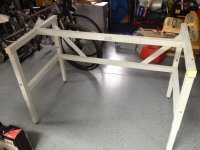
I recently picked up a surplus laboratory table frame on which I want to put a nice top for a workbench. I have been watching Craig's list but nothing has come to fruitation. This afternoon I stopped by Lowes and picked up 40 square ft of oak flooring that had been returned for credit. The price for the box of flooring was $166 but on clearance for $25.

I need a sturdy base for this 32" x 60" table top. I have 2 sheets of quality 1/2" plywood that I could glue together and then glue this flooring to it. That should be pretty sturdy at ~ 1.4" total thickness. Or should I buy a piece of hardboard to sandwich between a sheet of plywood and this flooring?

What says the GJ gang?
 
To avoid these ads, REGISTER NOW!

Squeeker

Well-known member
Joined
Feb 14, 2013
Messages
232
Location
Cincinnati, Ohio
I've made two desk tops using oak flooring over plywood and they have held up fine for several years now.
I wouldn't glue the flooring to the plywood though. Wood needs to expand and contract across the grain with changes in humidity. You could glue the two sheets together, but screws would be easier.
I face nailed the first row of strips, then nailed the rest of the rows the way flooring is normally installed. Install it just like you would on a floor.
 

groundcoat

Member
Joined
Jun 29, 2011
Messages
23
Location
Manchester, NH
I just built a very solid workbench that will be used away from a wall and accessed from all sides. The top is two sheets of 3/4" void free plywood glued together. The work surface is laminated wood flooring that I attached to the plywood with screws countersunk into the flooring. I oversized the laminated flooring work surface 1/4" on all sides then trimmed it flush to the plywood with a router. I then attached a 3/4' thick pine trim strip all around the top and stained it to match the flooring.

I chose laminated flooring as a work surface because it is very uniform, consistant, virtually indestructable and quite stabe to humidity changes. So far, it is working out quite well. I recommend its use to anyone.
 
OP
I

In The Doghouse

Well-known member
Joined
Dec 20, 2012
Messages
877
Location
South of Due West, West of NinetySix in SC
Have you thought of gluing 3/4 plywood between and at right angles to your 2 sheets of 1/2?
Over an inch and a half of plywood should provide a good base for your flooring....

Plywood by design has sheets of wood going in right angles. I thought about getting a 3/4" OSB board to sandwich between one 1/2" sheet of plywood, or both of them, and the flooring.

I've made two desk tops using oak flooring over plywood and they have held up fine for several years now.
I wouldn't glue the flooring to the plywood though. Wood needs to expand and contract across the grain with changes in humidity. You could glue the two sheets together, but screws would be easier.
I face nailed the first row of strips, then nailed the rest of the rows the way flooring is normally installed. Install it just like you would on a floor.

I don't have the gizmo thing to nail them down properly. Maybe I could rent one, but then my price would jump up. But glue costs money too..... As far as glueing, my thinking is that the entire wood top should expand and contract in unison. This bench will sit away from the wall for access on all 4 corners with no walls to constrain expansion. Expanding against a solid edge is what causes buckles in flooring.

I just built a very solid workbench that will be used away from a wall and accessed from all sides. The top is two sheets of 3/4" void free plywood glued together. The work surface is laminated wood flooring that I attached to the plywood with screws countersunk into the flooring. I oversized the laminated flooring work surface 1/4" on all sides then trimmed it flush to the plywood with a router. I then attached a 3/4' thick pine trim strip all around the top and stained it to match the flooring.

I chose laminated flooring as a work surface because it is very uniform, consistant, virtually indestructable and quite stabe to humidity changes. So far, it is working out quite well. I recommend its use to anyone.


This oak flooring I bought is pre-finished with very tight seams. I might put a coat or two of polyurathene over the finished top to seal up the seams. Could you provide photos of your finished top secured with screws?
 

shocksandstrutz

Well-known member
Joined
Jun 19, 2012
Messages
699
Location
Wentzville, MO
if you are going to build a workbench top with hardwood floor, using 1/2 sandwiched together and then the hardwood you should be fine. i have the same thing basically, i used 3/4 plywood and the 3/4 hardwood glued to it, solid as a rock, a few other member have built the same thing on here (thats where i got the idea) mine is on my roller cabinet, but it should work just as well on a benchtop. use some titebond wood glue when gluing it all down. dont worry about the hardwood expanding and contracting, you have a very small footprint, id bet it doesn't move at all. happy building and post some pics when your finished.
 

countrytech

Well-known member
Joined
Mar 9, 2011
Messages
467
Location
West Michigan
I just put a new top on my workbench this week. I laid 2x6's flat, then a layer of 1/2" plywood, then laminate flooring on top. It feels solid, and I think the flooring should hold up to some abuse, it is afterall made to be walked on, and chairs scrapped across it.
 

Attachments

  • bench1.jpg
    bench1.jpg
    94 KB · Views: 823
  • bench2.jpg
    bench2.jpg
    95.5 KB · Views: 665
To avoid these ads, REGISTER NOW!

countrytech

Well-known member
Joined
Mar 9, 2011
Messages
467
Location
West Michigan
how did you fasten it?

I didn't, it's just "floating" although I am going to fasten a piece of poplar to the front to keep it from sliding front over time, but so far the top hasn't moved at all unless I intentionally tried to pull it front. Natural forces tend to keep it pushed against the back.
 
OP
I

In The Doghouse

Well-known member
Joined
Dec 20, 2012
Messages
877
Location
South of Due West, West of NinetySix in SC
I just put a new top on my workbench this week. I laid 2x6's flat, then a layer of 1/2" plywood, then laminate flooring on top. It feels solid, and I think the flooring should hold up to some abuse, it is afterall made to be walked on, and chairs scrapped across it.

That looks really good. I like that hammer rack you have on the LH end.

It may be a few weeks before I get this together but I will post photos when completed. Here is the frame that I am starting with. Should I first paint it a more "shoppy" color?

What I am unsure of is how to finish the edges of this table top. I might just cut them flat and roll on some semi-flat paint or something. I would rather have the flooring wood trim, but I don't have the tools to do that correctly.
 

Attachments

  • Bench Frane.jpg
    Bench Frane.jpg
    140.2 KB · Views: 136
Last edited:

cgv69

Well-known member
Joined
Jan 11, 2012
Messages
1,033
Location
Boone Co., KY
Having been there, done that I can tell you it's not a good idea.

In my case I used 3 layers of 3/4 plywood topped with 3/4" thick Maple T&G flooring. The plywood was glued and screwed together and the Maple was glued down on top of that.

The problem is, wood expands and contracts, most notably across it's width due to moisture. When you glue the wood down, it does not allow the wood to move naturally. That is why hardwood floors are not glued down and why "butcher block" tops are glued up with the boards face to face and not side to side.

It does somewhat depend on your local? if you live in a low humidity area or if this bench will be in a climate controlled shop, it may not be that big of an issue? Around here though humidity shifts quite a bit from summer to winter. I built mine during the summer and when winter came around I ended up getting a big split down the middle of it when the top tried to contract. Come summer the crack almost disappears.

From a purely functional POV, I would stick with the doubled or triple up plywood and top it with Masonite. If you want pretty and functional, stick with a true butcher block type top. Just my $.02
 
OP
I

In The Doghouse

Well-known member
Joined
Dec 20, 2012
Messages
877
Location
South of Due West, West of NinetySix in SC
Rats! Now you're blowing a hole in my plans. This won't be in a climate controlled environment nor will it be outside. But our humidity swings in SC are probably similar to yours if not greater humidity in the summer.
Maybe I should nail down the flooring on top or wait to glue the top boards on when the humidity is low.
 

cgv69

Well-known member
Joined
Jan 11, 2012
Messages
1,033
Location
Boone Co., KY
I didn't catch that you lived in SC. My BIL lives down there so I know our humidity patterns are pretty similar, its just that your hot/humid season lasts longer and we get more cold/snow but most of our summer is 95+% humidity.

I don't think reversing the plan by itself will help (glue up in winter). Not sure if it will crack or swell or what but come summer and 90% humidity, something bad will happen. You can try to nail it which will keep it from cracking when it moves but it will still move and potentially cause other problems, especially if you edge it all the way around. If you still want to do it, this is how I would do it if I were to do it again...

I would start with the front edge of the bench. Take the first board and either face nail it or glue it down with the "tongue" facing the back of the bench. The rest of the boards would be nailed down (though the tongue only) and work your way to the back. I would do this during a low humidity period and only edge the front of the top (you can edge the sides too if you want?). The idea is, when the humidity kicks in and the boards start to expand, they can expand rearward towards the back of the bench and shouldn't crack or swell. As an added last step of insurance, cut the last board an 1" or so short/narrow and/or leave the bench 1" or so away from the wall to give the top some room to expand.
 

jake00

Well-known member
Joined
Aug 21, 2005
Messages
2,645
Location
illinois -- NW Burbs
Wow.....

I glued (subfloor adhesive) and used a brad nailer (in the nail channel) on my hardwood floor work benches. I've got 3, a red oak, a white oak, and a maple. The humidity in Chicago is 100 in the summer and 10 in the winter. Mine have never moved enough to gap


I suppose they could move, but I doubt a workbench is gonna be wide enough to see it. Several flooring mfgs recommend a full trowel adhesive on flooring wider than 5"

Lastly, use a stairnosing for a great looking finished edge. I sell this for less than 2 bucks a foot, a big box should have it for less than 4.
 

NorDel Garage

Well-known member
Joined
Oct 13, 2011
Messages
219
Location
Newark,Delaware
I have done two work benches topped with left over hardwood flooring. I used 2 x8 boards as a base then capped with 3/4 inch plywood. I screwed the plywood to the 2x8's . Since it was a small job ,I just drilled holes and a nail set on finishing nails for the flooring. I did NOT use any OSB but stuck with real plywood . I dont like / trust OSB. A light sanding, stain,and urethane finished the job .It is strong and tough as nails. If I have to I can re-sand and finish .
 
OP
I

In The Doghouse

Well-known member
Joined
Dec 20, 2012
Messages
877
Location
South of Due West, West of NinetySix in SC
It is interesting the contrasts of opinion of whether this will work out or not. I plan to build this top 3' x 5' and it will sit out in the floor with access to all 4 sides. No walls or shelving to restrict expansion. Hopefully the complete wood slab will expand and contract in unison.

This evening the humidity is 84% and I glued down the first strip. This Thursday through the weekend we should have humidity of < 50% during which time I plan to glue the remaining strips down.

I'll have to check out the stair nosing at Lowes, thanks for the tip.

This flooring oak is much harder than the pine plywood top I have worked off for the past 10 years. I remain optimistic.
 
Last edited:
To avoid these ads, REGISTER NOW!
Top Bottom