
You are using an out of date browser. It may not display this or other websites correctly.
You should upgrade or use an alternative browser.
You should upgrade or use an alternative browser.
Wood top bench build
- Thread starter bsaint
- Start date
kazlx
Well-known member
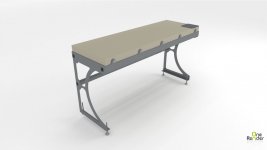
Looks rad, but it's going to flex quite a bit side to side, even with that stiffener across the back. Probably need to add some sort of 3rd dimension to the legs. Even if you double stacked them with maybe like 1" spacers, or a piece of angle up the back.
kazlx
Well-known member
It's still going to be flimsy side to side I think at that height. Especially if you think you're putting a vise on it.
kazlx
Well-known member
If you have 1/4, I think it would look rad if you double up those end plates with a gap in between and just space them apart 1-2". Don't really need to change anything except add some bolt holes.


kazlx
Well-known member
That's it. Looks good. Can stick the feet in between the two halves.
That revision looks a lot more stable, you would be surprised how thick metal plate/bar has to get to resist flexing like the previous model.
I like the look of the thick top, but it may be a headache if you plan on clamping to the table? Maybe set the block inside a bit more? You could open up the face to show off the wood more if needed?
I like the look of the thick top, but it may be a headache if you plan on clamping to the table? Maybe set the block inside a bit more? You could open up the face to show off the wood more if needed?
I like the look of the thick top, but it may be a headache if you plan on clamping to the table?
Good thinking but I don't do anything where I need to clamp work to the bench at my work shop. At home I could see this being an issue.
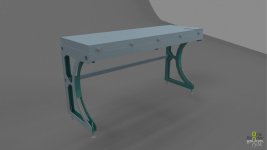
So here is what I came up with with as a final version of the legs. Maybe an additional few hundo to do it this way, but I think you guys are right about it being more stiff.
Total calculated weight with hardware is 398.6 lbs
Wood top is 162.5 lbs of that.
Attachments
Last edited:
kazlx
Well-known member
Awesome. I dig it.
This style is probably more rigid, and could be had for $50 or less, if you were closer.
https://www.kijiji.ca/v-view-details.html?adId=1395481898&requestSource=b
https://www.kijiji.ca/v-view-details.html?adId=1395481898&requestSource=b
Attachments
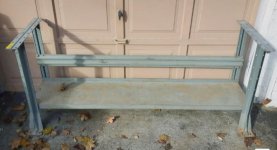
This style is probably more rigid...
Highly doubt it. 1/4" thick, doubled'up side plates with welded construction will be significantly more rigid than those bolt together, 16 gauge stamped steel precursor to ikea workbenches.
Even more so if the doubled up sides were even partially boxed.
cmandp
Well-known member
When in doubt, triangulate!
I really like that table!
Did you leave any room in the frame for your wood top to expand/contract with the seasons? I assume those tabs are for threaded rods to go through the wood top. Even with those in place, I think you might have issues.
If you wanted, you could keep the gap to the rear of the table by fastening the front 4x4 to the frame from the underside. That way, from the perspective of the person standing at the front of the bench, the top would always appear to be the same, while still allowing the wood to move around.
Did you leave any room in the frame for your wood top to expand/contract with the seasons? I assume those tabs are for threaded rods to go through the wood top. Even with those in place, I think you might have issues.
If you wanted, you could keep the gap to the rear of the table by fastening the front 4x4 to the frame from the underside. That way, from the perspective of the person standing at the front of the bench, the top would always appear to be the same, while still allowing the wood to move around.
I've had those benches. They **** for my line of work. The feet also rot out with moisture from the concrete.This style is probably more rigid, and could be had for $50 or less, if you were closer.
https://www.kijiji.ca/v-view-details.html?adId=1395481898&requestSource=b
Sent from my BBB100-1 using Tapatalk
gfd_703
Well-known member
Like the idea of a thick top but most 4 x 4 lumber around here is soft wood. Might look at using hardwood 2 x 4 on edge for the same look.
How much do you figure it'll expand? I can design to account for it.I really like that table!
Did you leave any room in the frame for your wood top to expand/contract with the seasons? I assume those tabs are for threaded rods to go through the wood top. Even with those in place, I think you might have issues.
If you wanted, you could keep the gap to the rear of the table by fastening the front 4x4 to the frame from the underside. That way, from the perspective of the person standing at the front of the bench, the top would always appear to be the same, while still allowing the wood to move around.
This is the bottom btw

Sent from my BBB100-1 using Tapatalk
Attachments

How much do you figure it'll expand? I can design to account for it...
Lots of good info on the woodworking websites, here's a pretty good one that tells you how to calculate it:
http://www.woodworkdetails.com/knowledge/wood/movement
EDIT:
The calculator appears to be missing from that first link, try this one instead...
https://www.popularwoodworking.com/tricks/how-to-calculate-wood-shrinkage-and-expansion/
Last edited:
I did the math. It would really expand almost a quarter of an inch? That's crazy. What kind of force are we talking about for expansion? I mean is it single digit PSI or what? 1 PSI would be 288 pounds of force x 6 boards is 1730 pounds pushing in each direction. Not enough to break welds.
I don't think it will expand with enough force to blow out a weld, but it will likely expand enough to cause a certain level of distortion. Lets assume you build this in the winter when there is low humidity. Lets also assume you leave no clearance between the wood top and frame, and tighten the through-bolts allowing no room between boards.
As the wood expands next spring/summer, any place where it is not constrained will expand freely. Since there is not a frame around the top perimeter, so it will expand into a slight wedge shape relative to the supported lower portion of the wood top. Wherever the bolts are present, you will see slight waves in the wood (and maybe the sheet steel) if you look down the front and rear faces wherever the bolts are present.
Just offering suggestions here, not dogging on your design or anything, so please don't take offense. If I were building this, I would leave a 1/4"+ gap (or whatever you calculated) for expansion. Don't forget to leave a little on the sides as well. It won't be as much, but you still might need a little. I'd attach only the front board to the front edge (as I mentioned earlier) using a couple of lag bolts - you don't want to go crazy, you just need them to keep the top from sliding around. I also would make the through bolts more decorative than anything else - oversize the holes in the boards a little so the bolt slides through the slab freely and only tighten the through bolts enough to be snug to the metal tabs. This will allow the boards to "slide" on them as they expand and contract.
Like I said, nothing personal, just offering my 2 cents. I really do like your design and can't wait to see how it turns out.
As the wood expands next spring/summer, any place where it is not constrained will expand freely. Since there is not a frame around the top perimeter, so it will expand into a slight wedge shape relative to the supported lower portion of the wood top. Wherever the bolts are present, you will see slight waves in the wood (and maybe the sheet steel) if you look down the front and rear faces wherever the bolts are present.
Just offering suggestions here, not dogging on your design or anything, so please don't take offense. If I were building this, I would leave a 1/4"+ gap (or whatever you calculated) for expansion. Don't forget to leave a little on the sides as well. It won't be as much, but you still might need a little. I'd attach only the front board to the front edge (as I mentioned earlier) using a couple of lag bolts - you don't want to go crazy, you just need them to keep the top from sliding around. I also would make the through bolts more decorative than anything else - oversize the holes in the boards a little so the bolt slides through the slab freely and only tighten the through bolts enough to be snug to the metal tabs. This will allow the boards to "slide" on them as they expand and contract.
Like I said, nothing personal, just offering my 2 cents. I really do like your design and can't wait to see how it turns out.
Trust me when I say I take no offense I just don't know how much time I should put into floating the top. I don't have any experience building anything with wood, my brother is doing the top plane work. I want to be able to pull those tie rods tight to a degree to hold the table tight together. I'm not using glue if I want to replace a section later on. So any ideas for a solution? I cant leave the tie rods loose a quarter inch! I can use heavy springs and float the rear plate or something.
Sent from my BBB100-1 using Tapatalk
Sent from my BBB100-1 using Tapatalk
I need to take a step back and remember that this is just a workbench. You may end up with gaps and uneven surfaces using only tie rods to hold the wood together, but if that doesn't matter for the type of work being done on the bench, then I would just proceed as planned.
If you had a thick, butcher block type surface (flat, smooth, no gaps) in mind, then you will need to glue it together - tie rods alone won't do the trick. One thing to remember is that a 4" thick oak top will be extremely durable, I can't imagine the type of work you would be doing on it to necessitate the replacement of an entire board. When it does get damaged to a point where you need to repair it, you could simply flip it over, or track down an industrial sized planer and resurface it. You could shave 1/4" off the slab 8 times before you'd get to 2" thick, which is still plenty of material to make a strong bench top.
The thing to remember about wood is that no matter what you do to constrain it, the wood always wins, or destroys itself in the process. The best plan is to accept that its going to move and accommodate for it. The Dude abides man, the Dude abides.
If you had a thick, butcher block type surface (flat, smooth, no gaps) in mind, then you will need to glue it together - tie rods alone won't do the trick. One thing to remember is that a 4" thick oak top will be extremely durable, I can't imagine the type of work you would be doing on it to necessitate the replacement of an entire board. When it does get damaged to a point where you need to repair it, you could simply flip it over, or track down an industrial sized planer and resurface it. You could shave 1/4" off the slab 8 times before you'd get to 2" thick, which is still plenty of material to make a strong bench top.
The thing to remember about wood is that no matter what you do to constrain it, the wood always wins, or destroys itself in the process. The best plan is to accept that its going to move and accommodate for it. The Dude abides man, the Dude abides.
Glue and bolt. Using only bolts will definitely shift with the wood.
A easy way to work around the movement of wood is doing a oversized hole for your connection point then use a smaller diameter screw+washer. Torque to allow for it to just barely move around.
I think bdbecker is steering you in the right direction.
A easy way to work around the movement of wood is doing a oversized hole for your connection point then use a smaller diameter screw+washer. Torque to allow for it to just barely move around.
I think bdbecker is steering you in the right direction.
Voi
Well-known member
I agree with using glue. Also, when you select your oak 4x4 stock look for pieces with the best quarter sawn grain on one edge. Orient those upwards and most of your expansion and contractions will occur over the thickness instead of the depth of the top.


So I ran a stress analysis to get an idea of deflection. I didnt include the top because it floats on the frame but I did make the top evenly distribute a load.
5,000 pounds evenly distributed along the top. Max deflection is about 1.1mm or 0.050". Max pressure is 185 Mpa, worse part of the design is a safety factor of 3 near the bottom but I can add some weldment to it to reinforce it.

This is a part thats 1 square foot and weights 416 pounds, which is 5000 pounds overall. The realm of this is possible with the size screw compressor pumps we handle. Deflection the same.
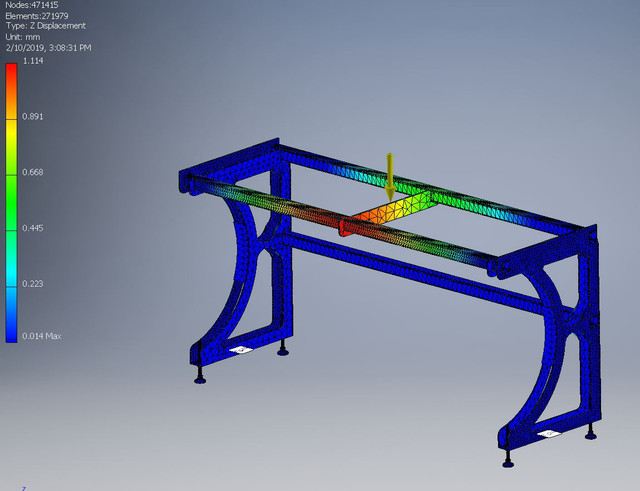
10,000 pounds evenly distributed along the top. This will most likely deform the bench. Even though the Z axis max MPa is below the modulus of the tubing, there is a stress level of 327MPa in the model that will deform the bench. There is a 0 safety factor as well.
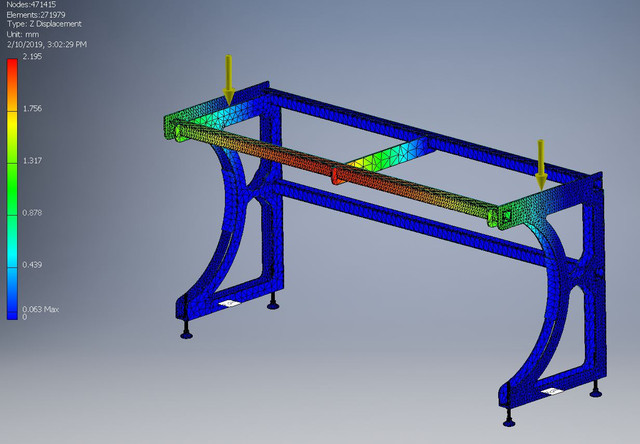
Here is a 800 pound force on the corner to estimate the maximum about of force while working the vice. 800 pounds of force is about a 1000 joules. I figured a big cheater bar removing the most stubborn fastener. My heaviest fastest hammer blow would be about 100 or so joules. Max deflection would be 0.020"

-----In conclusion I would say the bench is safely rated for 5000 pounds evenly distributed or 400 pounds per square foot ----
5,000 pounds evenly distributed along the top. Max deflection is about 1.1mm or 0.050". Max pressure is 185 Mpa, worse part of the design is a safety factor of 3 near the bottom but I can add some weldment to it to reinforce it.
This is a part thats 1 square foot and weights 416 pounds, which is 5000 pounds overall. The realm of this is possible with the size screw compressor pumps we handle. Deflection the same.
10,000 pounds evenly distributed along the top. This will most likely deform the bench. Even though the Z axis max MPa is below the modulus of the tubing, there is a stress level of 327MPa in the model that will deform the bench. There is a 0 safety factor as well.
Here is a 800 pound force on the corner to estimate the maximum about of force while working the vice. 800 pounds of force is about a 1000 joules. I figured a big cheater bar removing the most stubborn fastener. My heaviest fastest hammer blow would be about 100 or so joules. Max deflection would be 0.020"
-----In conclusion I would say the bench is safely rated for 5000 pounds evenly distributed or 400 pounds per square foot ----
Last edited:
Marctrees
Well-known member
bsaint - Unless those timbers are pretty close in moisture content to the ambient where it will sit, and I highly doubt they are.. you are gonna have some major problems with them moving in possibly ALL sorts of directions.
The ballpark 1/4" change in width is the least of your worries.
THAT can be planned for.. but the other forces in the wood that will come w drying cannot be predicted nor restrained.
Certainly not with the type of sawn timbers you have.
bdbecker is trying to explain this.
You will NOT end up with the flat top you are expecting.
Unless the above is done.. NO way will it stay close to flat.
The ONLY way to successfully make this top is with thoroughly acclimated wood... THEN machined flat and assembled.
If you want a massive wood top I would consider multilayer good quality ideally no void plywood.. w a replaceable facing on top.
bsaint - You sound like a detail oriented Engineer.
If so read R Bruce Hoadley https://www.amazon.com/dp/1561583588/?tag=atomicindus08-20
It is the #1 book on wood movement.
Marc
The ballpark 1/4" change in width is the least of your worries.
THAT can be planned for.. but the other forces in the wood that will come w drying cannot be predicted nor restrained.
Certainly not with the type of sawn timbers you have.
bdbecker is trying to explain this.
You will NOT end up with the flat top you are expecting.
Unless the above is done.. NO way will it stay close to flat.
The ONLY way to successfully make this top is with thoroughly acclimated wood... THEN machined flat and assembled.
If you want a massive wood top I would consider multilayer good quality ideally no void plywood.. w a replaceable facing on top.
bsaint - You sound like a detail oriented Engineer.
If so read R Bruce Hoadley https://www.amazon.com/dp/1561583588/?tag=atomicindus08-20
It is the #1 book on wood movement.
Marc
Last edited:
Marctrees
Well-known member
"The leg work is out for quote now."
You are farming it out ?
I would definitely be sitting down w a couple adult beverages in me when I open that envelope.
That base is designed unnecessarily expensive w no benefit other than aesthetic.
Marc
You are farming it out ?
I would definitely be sitting down w a couple adult beverages in me when I open that envelope.
That base is designed unnecessarily expensive w no benefit other than aesthetic.
Marc
Marctrees
Well-known member
Wood movement cannot be successfully restrained.
It can be reduced and dealt with w various design and other methods.
If those timbers have been cut in the last year they will be at around ? 50-100 ? MC.
Depending on your shop climate, over a few years they will end up roughly ballpark around 12%.
There will be a helluva number of differences between those two MC's in shape, size, etc.
Marc
https://www.google.com/search?q=res...rome..69i57.6624j1j1&sourceid=chrome&ie=UTF-8
https://www.fpl.fs.fed.us/documnts/fplgtr/fplgtr113/ch03.pdf
It can be reduced and dealt with w various design and other methods.
If those timbers have been cut in the last year they will be at around ? 50-100 ? MC.
Depending on your shop climate, over a few years they will end up roughly ballpark around 12%.
There will be a helluva number of differences between those two MC's in shape, size, etc.
Marc
https://www.google.com/search?q=res...rome..69i57.6624j1j1&sourceid=chrome&ie=UTF-8
https://www.fpl.fs.fed.us/documnts/fplgtr/fplgtr113/ch03.pdf