devvar
Active member
I am in the process of building a 20'x24' workshop (https://www.garagejournal.com/forum/threads/20x24-pole-barn-workshop.546488/). Current use is general storage, vehicle repair, woodworking, etc. This is currently the only covered storage on my property so it will be used for everything. Long term I plan to build a garage for parking the cars, and another equipment shed for storing tractors, implements, dump truck, etc. Eventually I plan for this current building to become a dedicated woodworking shop. I anticipate maybe 10 years before this building becomes dedicated woodworking space. My question is about the floor. I have very limited budget right now and want to get this building usable as quickly as possible. I am considering two options:
1) Pour a concrete slab. This would be insulated but not heated, probably 4-5" thick. I have never finished concrete before but would attempt to do it myself (with some help from family & friends). I understand the finish will not be as smooth as a professional crew but I think I can get it good enough. I estimate this to cost about $1000 more than the wooden floor below, performing all labor myself.
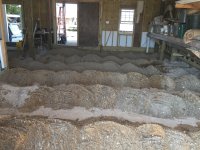
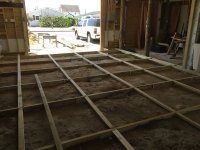
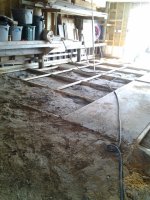
2) Build a wooden floor system. This is appealing to me for a variety of reasons, including that it will be less expensive, won't require any special skills or equipment I don't have, and could be built in phases if needed. I currently have 3-4 few inches of 3/4" clean stone down. I plan to compact the stone, put down a vapor barrier, and run 4x4 sleepers lengthwise about every 30". I will use double 4x6 where the tires of a vehicle would run to create a solid 12" wide area under each tire track. I would then fill the space between the sleepers with foam insulation board. Then install 2x6 lumber all the way across the top, creating my finished floor. There would be no airspace under any lumber. All lumber would be pressure treated. This floor could be repaired as needed, or even removed in the future for a proper concrete slab if I want
I have a couple concerns with the wooden floor:
- snow or water running off from my tractor or a vehicle parked in there for work getting trapped due to the vapor barrier on the bottom. Should I put the vapor barrier on top of the foam, under the 2x6 instead? Should I run all the 2x6 through my table saw to make tongue and groove boards to prevent bulk water intrusion? Should I use Rockwool ComfortBoard instead of rigid foam? I believe the comfortboard is vapor permeable and would allow drying upwards if the vapor barrier is on the bottom, but is much more expensive.
- structural integrity / stiffness when using a floor jack or bottle jack to raise a vehicle or tractor on the wood floor. I currently work on a dirt driveway so I'm used to the challenges of uneven, soft ground. I don't anticipate this being an issue here, especially using cribbing under the jacks/stands, but I definitely don't want a vehicle falling down when a stand punches through the top layer.
Is the wood floor a waste of time? Am I asking for trouble? I am interested to hear anyone's thoughts who has worked in an old barn or shed with a wood floor
1) Pour a concrete slab. This would be insulated but not heated, probably 4-5" thick. I have never finished concrete before but would attempt to do it myself (with some help from family & friends). I understand the finish will not be as smooth as a professional crew but I think I can get it good enough. I estimate this to cost about $1000 more than the wooden floor below, performing all labor myself.
2) Build a wooden floor system. This is appealing to me for a variety of reasons, including that it will be less expensive, won't require any special skills or equipment I don't have, and could be built in phases if needed. I currently have 3-4 few inches of 3/4" clean stone down. I plan to compact the stone, put down a vapor barrier, and run 4x4 sleepers lengthwise about every 30". I will use double 4x6 where the tires of a vehicle would run to create a solid 12" wide area under each tire track. I would then fill the space between the sleepers with foam insulation board. Then install 2x6 lumber all the way across the top, creating my finished floor. There would be no airspace under any lumber. All lumber would be pressure treated. This floor could be repaired as needed, or even removed in the future for a proper concrete slab if I want
I have a couple concerns with the wooden floor:
- snow or water running off from my tractor or a vehicle parked in there for work getting trapped due to the vapor barrier on the bottom. Should I put the vapor barrier on top of the foam, under the 2x6 instead? Should I run all the 2x6 through my table saw to make tongue and groove boards to prevent bulk water intrusion? Should I use Rockwool ComfortBoard instead of rigid foam? I believe the comfortboard is vapor permeable and would allow drying upwards if the vapor barrier is on the bottom, but is much more expensive.
- structural integrity / stiffness when using a floor jack or bottle jack to raise a vehicle or tractor on the wood floor. I currently work on a dirt driveway so I'm used to the challenges of uneven, soft ground. I don't anticipate this being an issue here, especially using cribbing under the jacks/stands, but I definitely don't want a vehicle falling down when a stand punches through the top layer.
Is the wood floor a waste of time? Am I asking for trouble? I am interested to hear anyone's thoughts who has worked in an old barn or shed with a wood floor