Woodworking Tip. Tricks, and Techniques.

Jgaz

Well-known member
Joined
Dec 16, 2016
Messages
1,637
Location
AZ
Now that there is a woodworking forum, I think we need a place to put tips etc. all in one place.
I‘ll start with with this one:

I’ve made a quite a few boxes as well several machinist chests that require thin stock to be used for dividers.
I also use thin stock for reinforcing the miter joint on picture frames.

Over the years I‘ve used several different methods of cutting this stock accurately and consistently but the following one is now my favorite.
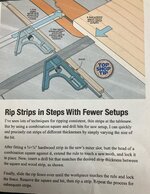
IMG_5756.jpeg

Obviously it’s not an original idea but here it is on my saw.
IMG_5753.jpeg

For the spline stock I just used on two large frame I measured the slot I cut using a #30 drill (.128”).
Cut a test spline and found it to be too snug with glue applied.
Substituted an 1/8” bit (.125”), recut a spline and it was perfect!

Way quicker, and easier than other ways I’ve tried.

Not shown but I remove the square and substitute a feather board before each cut.
 
To avoid these ads, REGISTER NOW!

dscheidt

Well-known member
Joined
Apr 26, 2017
Messages
2,885
Now that there is a woodworking forum, I think we need a place to put tips etc. all in one place.
I‘ll start with with this one:

I’ve made a quite a few boxes as well several machinist chests that require thin stock to be used for dividers.
I also use thin stock for reinforcing the miter joint on picture frames.

Over the years I‘ve used several different methods of cutting this stock accurately and consistently but the following one is now my favorite.
IMG_5756.jpeg

You don't even need the block, or two squares. You can use the right side of the miter slot, just tilt the square a bit. and the left side of the blade is a fixed distance from the miter slot, so once you know that, you can just subtract. Test the front and back of the blade -- make sure to use the same tooth -- to make sure the blade is square to the miter slot.
 
OP
J

Jgaz

Well-known member
Joined
Dec 16, 2016
Messages
1,637
Location
AZ
Not sure I follow two squares?
The block in my pic is about to be ripped and already has been moved to the square that is spaced away from the blade by the drill bit

Edit: You mean the bock or strip in the miter gage slot?
 

DGersic

Well-known member
Joined
Mar 12, 2017
Messages
6,276
Location
DeKalb, IL
Not sure I follow two squares?
The block in my pic is about to be ripped and already has been moved to the square that is spaced away from the blade by the drill bit

Edit: You mean the bock or strip in the miter gage slot?

Only one square. Your original image shows one square in two locations. Kinda looks like two squares the way it’s pictured. But what it shows is the square being zero’d to the saw blade, then moved over and used with a fixed spacer (drill bit) to set the piece to be ripped and the fence.

Yes, dscheidt is saying that you don’t have to measure off of the strip in the mitre slot. You could equally measure off of the slot itself. And checking to verify that the mitre slot and blade are truly parallel would be a good idea.
 
OP
J

Jgaz

Well-known member
Joined
Dec 16, 2016
Messages
1,637
Location
AZ
@DGersic I see now where the two square confusion came from. Thanks

In my experience, the strip in the miter slot makes the drill bit as shown much easier to use

My saw table miter slot has a ”tee” configuration. This design allows part of the smaller diameter drill bit to protrude into the larger width of the slot instead of it registering against smaller width (upper) part of the slot that the square registers against. I hope this makes sense.

Not that this method wouldn’t work without the strip.
I just prefer the easier (for me), direct, one to one measurement of drill bit diameter equals strip width.
 
Last edited:

jessesandy

Well-known member
Joined
Apr 8, 2016
Messages
3,543
Location
Upper California
Just trying to get a handle on this.
The off cut is the piece/strip you want ?
You set up a stopper the distance away from the outside of the blade to get the thickness you want.
Use the stopper the move the fence for each strip.
Drill bit is a spacer you pull out before cut so nothing binds up ?
 
To avoid these ads, REGISTER NOW!
OP
J

Jgaz

Well-known member
Joined
Dec 16, 2016
Messages
1,637
Location
AZ
Just trying to get a handle on this.
The off cut is the piece/strip you want ?
You set up a stopper the distance away from the outside of the blade to get the thickness you want.
Use the stopper the move the fence for each strip.
Drill bit is a spacer you pull out before cut so nothing binds up ?
Yes. I think you are understanding it correctly. Only thing I see is that I remove both the drill bit (spacer) and the combo square before the cut but I’ll bet you knew that.
 

sni-per

Well-known member
Joined
Dec 30, 2013
Messages
437
Location
Midwest
Now that there is a woodworking forum, I think we need a place to put tips etc. all in one place.
I‘ll start with with this one:

I’ve made a quite a few boxes as well several machinist chests that require thin stock to be used for dividers.
I also use thin stock for reinforcing the miter joint on picture frames.

Over the years I‘ve used several different methods of cutting this stock accurately and consistently but the following one is now my favorite.
IMG_5756.jpeg

Obviously it’s not an original idea but here it is on my saw.
IMG_5753.jpeg

For the spline stock I just used on two large frame I measured the slot I cut using a #30 drill (.128”).
Cut a test spline and found it to be too snug with glue applied.
Substituted an 1/8” bit (.125”), recut a spline and it was perfect!

Way quicker, and easier than other ways I’ve tried.

Not shown but I remove the square and substitute a feather board before each cut.
I like this!!! Question, is the drill bit representative of the thickness of the strip you're cutting?
I am just getting started in woodworking, and trying to absorb some knowledge.
 

niget2002

Well-known member
Joined
Oct 2, 2012
Messages
11,121
Location
Josephine, TX
I used one of these for cutting the thin strips for my kayak. The first time I used it on the table saw using feather boards to keep everything tight. The second time I used it on the bandsaw and it worked much much easier. Bandsaw ended up with a rougher cut, but it only took a bit of sanding to smooth everything back out. My bandsaw is older so the blade wanders and I was using a rather low TPI blade.

 
OP
J

Jgaz

Well-known member
Joined
Dec 16, 2016
Messages
1,637
Location
AZ
I like this!!! Question, is the drill bit representative of the thickness of the strip you're cutting?
I am just getting started in woodworking, and trying to absorb some knowledge.
Yes, the diameter of the drill bit will be equal to the thickness of the strip you cut.
 
Last edited:

Renegade1LI

Well-known member
Joined
Mar 11, 2018
Messages
4,937
Location
long island ny
Not sure I see how this is better than setting the fence to blade for the correct thickness & never move the fence. I'll set the thickness between blade & fence with a gauge block & then rip away, very consistent.
 
To avoid these ads, REGISTER NOW!
Top Bottom