To avoid these ads, REGISTER NOW!

Work Bench/Welding Table Overhang Questions

RedOak

Well-known member
Joined
Feb 6, 2010
Messages
97
I just went through a similar GJ thread, from way back in 2013, but I have more specific questions that I'd like to ask here...

I plan on fabricating a steel work bench/welding table for our [way too small] garage. As the price of 4' x 8' plates is psychotic right now, the top will be constructed of (4) 8-inch wide 1/2-inch thick flats cut to an 8-foot length. There will be no gaps in the top, so, instead, I plan to employ 3-inches of overhang on all four sides for clamping purposes.

We originally had a 3/4-inch 4 x 8 specified for this table, but the present prices forced us into a thinner top. As this project will also serve as a general work bench, I plan on installing a fairly hefty Wilton (8100M) 10" vise to the edge of the top, which is where certain questions come into this. Although 1/2-inch steel doesn't flex much, it certainly flexes more than 3/4...and the fact that we're going with flats instead of a plate makes the question of flex even more important.

As having to support a 115-pound vise for many years (plus any work that's placed in the vise) will put stress on the 1/2-inch flat the Wilton is mounted to, I'd like to ask the GJ fabrication board for some ways to brace the flat steel under the overhangs. My thoughts for the vise itself are to weld in a couple of triangular gussets to sort of "box in" the bottom of the vise mounting bolts, but I'm hoping for practical ideas for bracing the other overhang areas from those of you who have worked this issue before.

By the way, the frame supporting the top will be constructed of 3" x 4.1-pound structural "C" channel, with the flat side facing outward toward the edges of the table top.

Thank you kindly for your time ~ Red
 
To avoid these ads, REGISTER NOW!
OP
R

RedOak

Well-known member
Joined
Feb 6, 2010
Messages
97
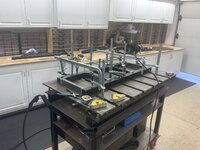
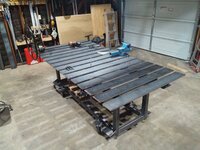
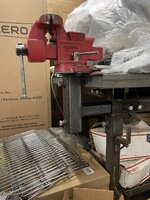
tarmy.... That is quite the welding table you have there. Did you fabricate it from bottom to top? if you intended on showing your "receiver mount vise," it didn't come through. Do you have a photo showing your vise mounting idea?

I'd also like to know more about, what appears to be, your "leveling rods." It may just be the engineer in me, but I suspect that you've employed either threaded rod or modified long bolts to mount/level your steel flats with. Perhaps anther photo would illustrate your design better, but I'm very interested in knowing what the "stock list" was for this project. Great work, regardless! :beer:
 

tarmy

Well-known member
Joined
May 28, 2014
Messages
4,670
Location
Nor Cal
tarmy.... That is quite the welding table you have there. Did you fabricate it from bottom to top? if you intended on showing your "receiver mount vise," it didn't come through. Do you have a photo showing your vise mounting idea?

I'd also like to know more about, what appears to be, your "leveling rods." It may just be the engineer in me, but I suspect that you've employed either threaded rod or modified long bolts to mount/level your steel flats with. Perhaps anther photo would illustrate your design better, but I'm very interested in knowing what the "stock list" was for this project. Great work, regardless! :beer:
Yep…stole most of the ideas from Welding forums…

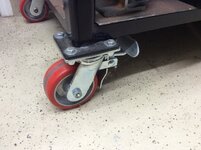
This was one of my first real welding projects…use it a lot. Just made the materials list as I went…found some I beams and went from there…make sure you get good casters.image.jpg6CD920C2-B82F-44F3-B47A-3B4822BE1852.jpeg85A7F34E-752E-4E20-B53B-75E35EBDE959.jpegAA6F57B7-FCE0-4412-9C29-DF078C8DE788.jpeg
 
OP
R

RedOak

Well-known member
Joined
Feb 6, 2010
Messages
97
tarmy.... Damn! I really like all of those great looking clamps, too! Man, what a welding outfit! Would you mind elaborating on the thread rods/bolts and the clamps? I'm not a professional welder, so please forgive the amateur welder questions. For example, where does one find clamping devices like that?
 

tarmy

Well-known member
Joined
May 28, 2014
Messages
4,670
Location
Nor Cal
Those are just bolts welded to tractor pin handles I cut the pin part off if. The clamps you can get at any good welding store…or Amazon. Cyberweld is a great place to buy welding tools and equipment too. Go on the site called Welding Web…great people and ideas there…some very knowledgeable folks that do it for a living.
 

BukitCase

Well-known member
Joined
Apr 11, 2017
Messages
1,075
Location
Oregon
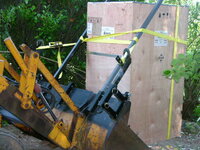
I tend to like the 2" receiver mounts for weld tables too, also have 7 of 'em welded on the loader bucket of my backhoe (and a LOT of "tinker toys" made up to do nearly any lift/push/pull I can think up :=)

These
have become one of my favorite weld clamps, I have just over 2 dozen in a couple different sizes - I like that they're usually a bit cheaper than some of the better-known name brands, plus the "4 in one" thing is handy, each clamp comes with an extension that can be used as a "step over" AND a pipe adapter, or the clamp can ALSO be reversed to act as a spreader.... Steve

BTW, that price drops to $35 if you were a customer of Enco before their parent company combined and you re-registered with MSC - all told, I'd have been at least $500 poorer just for the clamps if I'd NOT re-registered :rolleyes2
 

Attachments

  • ClampWall2415.JPG
    ClampWall2415.JPG
    406.7 KB · Views: 106
  • ClampWall2498.JPG
    ClampWall2498.JPG
    396.6 KB · Views: 103
  • DSCN2875.JPG
    DSCN2875.JPG
    392.1 KB · Views: 103
  • DSCN1354.JPG
    DSCN1354.JPG
    75.7 KB · Views: 102
  • DSCN3290.JPG
    DSCN3290.JPG
    516.6 KB · Views: 101
Last edited:

Jeepwheel

Member
Joined
Jan 14, 2022
Messages
22
Yep…stole most of the ideas from Welding forums…

This was one of my first real welding projects…use it a lot. Just made the materials list as I went…found some I beams and went from there…make sure you get good casters.image.jpg6CD920C2-B82F-44F3-B47A-3B4822BE1852.jpeg85A7F34E-752E-4E20-B53B-75E35EBDE959.jpegAA6F57B7-FCE0-4412-9C29-DF078C8DE788.jpeg


I can't express how much I love this table and all the extras! Well done... truly well done Sr.
 

tarbellb

Well-known member
Joined
Apr 17, 2011
Messages
5,747
Location
Oregon
Run a gap between the slates for clamping like Tarmy.

This style is excellent for clamping up fab work.

As far as flex, my 5/8" x 6" slates would deflect ~ 1/8" with 200lbs between the 36" spanIMG_20151120_161642.jpgIMG_20151113_172841.jpgIMG_20151113_173046.jpg
 
Last edited:

dirtyjerzy

Well-known member
Joined
Jul 8, 2012
Messages
87
Location
N.J.
We originally had a 3/4-inch 4 x 8 specified for this table, but the present prices forced us into a thinner top. As this project will also serve as a general work bench, I plan on installing a fairly hefty Wilton (8100M) 10" vise to the edge of the top, which is where certain questions come into this. Although 1/2-inch steel doesn't flex much, it certainly flexes more than 3/4...and the fact that we're going with flats instead of a plate makes the question of flex even more important.
I welded 8 reciever tubes, 2 on each corner to mount vices and other accessories. Drilled and welded a 5/8" nut to each to be able to crank down a bolt so there's no wobble and also drilled for a hitch pin. Turns out when the bolt is cranked down, the pin really isn't necessary. My top is 1/2", I left an overhang on all sides to be able to clamp to.
 

Attachments

  • IMG_20211212_201158370_HDR.jpg
    IMG_20211212_201158370_HDR.jpg
    373.4 KB · Views: 93
  • IMG_20211212_202057114.jpg
    IMG_20211212_202057114.jpg
    268.5 KB · Views: 109

larry4406

Well-known member
Joined
Jan 27, 2006
Messages
19,154
Location
Northern Virginia
I did the receiver tube vise mount as well. Did same for grinder.

My bench top is a commercial metal fire door. Made a tube steel sub frame. At the corners, the tubes over lap (one above, one below).

The vise mount is a tee shaped with slip in flange bolt plate. The tee's branch is horizontal to engage the receivers. The legs of the vertical tee section are unequal due to the different heights of the bench top tubes relative to the top work surface.

The actual mount piece that is bolted to the vise slips into the verticals. I can then position the vise at either the table end or along the side or not at all.
 

Attachments

  • Bench Tubes.JPG
    Bench Tubes.JPG
    382.5 KB · Views: 103
  • Vise Mount.jpg
    Vise Mount.jpg
    288.7 KB · Views: 91
  • IMG_2098.JPG
    IMG_2098.JPG
    439.1 KB · Views: 91
  • IMG_2100.JPG
    IMG_2100.JPG
    402.9 KB · Views: 89
  • IMG_2099.JPG
    IMG_2099.JPG
    380.7 KB · Views: 86
To avoid these ads, REGISTER NOW!

joe49

Well-known member
Joined
Sep 25, 2009
Messages
1,883
Location
Tonica, Il
The Swiss Army Knife bench recievers is a OK idea for attachments (benders, beverlys, metal shaping anvils,.....) it isn't a good choice for the vice which is all around better mounted solid. Not hanging out from the table on tubing. If not mounted on the top then on a shelf that keeps the top of the vice at the same height as the table top. As you are asking about a 115# vice with a pieced together table top a few gussets would not hurt.
 

dirtyjerzy

Well-known member
Joined
Jul 8, 2012
Messages
87
Location
N.J.
it isn't a good choice for the vice which is all around better mounted solid. Not hanging out from the table on tubing.
That tubing is 2" square tube, 1/4"wall, I could literally park a car on it! The vise would break before the square tube or the plate thats welded to it.
 

joe49

Well-known member
Joined
Sep 25, 2009
Messages
1,883
Location
Tonica, Il
Not about breaking, it's about being solid. If you have no room and do not have a 115 pound vice sure you can hang it on tubing. A lot of you home garage guy's do, but you try one mounted properly you will know better.
 

tarbellb

Well-known member
Joined
Apr 17, 2011
Messages
5,747
Location
Oregon
The Swiss Army Knife bench recievers is a OK idea for attachments (benders, beverlys, metal shaping anvils,.....) it isn't a good choice for the vice which is all around better mounted solid. Not hanging out from the table on tubing. If not mounted on the top then on a shelf that keeps the top of the vice at the same height as the table top. As you are asking about a 115# vice with a pieced together table top a few gussets would not hurt.

Good point, all depends on the table and shop space

My table was 1000+lbs, if you wanted you could still move the entire table around if you had enough leverage clamped in the vise.

I wouldnt be comfortable attaching a vise to a stud wall and doing the same, somethings gotta give, id rather it be my table.


Best option is bolting straight to a foundation if you got that luxury
 
Last edited:
OP
R

RedOak

Well-known member
Joined
Feb 6, 2010
Messages
97
To stiffen the plates, weld a piece of angle lengthwise to it.
Ricky Joe.... I honestly don't intend to muddy the water, but, after reading some of the responses I got on this nice thread, I'm seriously thinking about cutting our 8" wide 1/2" flats -- the basis of the table top -- into 30" pieces and putting a 1.5" gap in between each flat. This means that the orientation of the flats will be from front-to-rear instead of side-to-side, which will reduce the open spans (like the table top shown in Post No. 2, minus the leveling bolts).

Nevertheless, I want to ask you to please elaborate on your idea about using angle iron to "stiffen the plates." Are you saying that one can stiffen the flats by welding angle iron under the long dimension (long axis) of each flat and supporting the angle iron on each end?

Considering that I'm [presently] planning to lay the flats directly to the top of our 3" x 4.1 lb/ft structural "C" channel, I'm thinking that we would not only have to weld the angle iron you suggested to the bottom of each flat, but also weld both ends of the angle iron to the "C" channel frame members supporting the top. I'm very interested in any ideas I get in this thread, so please feel free to correct me if I'm misunderstanding anything. :)

EDIT: Employing (10) 8" wide 1/2" flats -- and (9) 1.5" gaps -- renders a 93.5" x 30" table top. As this table was always going to be somewhere in the neighborhood of 8' long, I was already intending on using (6) legs in this design.
 

Ricky Joe

Well-known member
Joined
Sep 15, 2013
Messages
2,452
Location
Roanoke, Va.
Ricky Joe.... I honestly don't intend to muddy the water, but, after reading some of the responses I got on this nice thread, I'm seriously thinking about cutting our 8" wide 1/2" flats -- the basis of the table top -- into 30" pieces and putting a 1.5" gap in between each flat. This means that the orientation of the flats will be from front-to-rear instead of side-to-side, which will reduce the open spans (like the table top shown in Post No. 2, minus the leveling bolts).

Nevertheless, I want to ask you to please elaborate on your idea about using angle iron to "stiffen the plates." Are you saying that one can stiffen the flats by welding angle iron under the long dimension (long axis) of each flat and supporting the angle iron on each end?

Considering that I'm [presently] planning to lay the flats directly to the top of our 3" x 4.1 lb/ft structural "C" channel, I'm thinking that we would not only have to weld the angle iron you suggested to the bottom of each flat, but also weld both ends of the angle iron to the "C" channel frame members supporting the top. I'm very interested in any ideas I get in this thread, so please feel free to correct me if I'm misunderstanding anything. :)

EDIT: Employing (10) 8" wide 1/2" flats -- and (9) 1.5" gaps -- renders a 93.5" x 30" table top. As this table was always going to be somewhere in the neighborhood of 8' long, I was already intending on using (6) legs in this design.
It wouldn’t have to be angle. Just a two or three inch wide piece welded to the bottom vertically to the horizontal plate would prevent the plate from flexing. Half inch plate would take a lot to make it flex, anyway. You wouldn’t have to weld the piece at the ends to anything. It wouldn’t even have to go all the way to the ends.
 
OP
R

RedOak

Well-known member
Joined
Feb 6, 2010
Messages
97
Good point, all depends on the table and shop space

My table was 1000+lbs, if you wanted you could still move the entire table around if you had enough leverage clamped in the vise.

I wouldnt be comfortable attaching a vise to a stud wall and doing the same, somethings gotta give, id rather it be my table.


Best option is bolting straight to a foundation if you got that luxury
tarbellb.... Are you saying that you've had work in a vise mounted to your 1,000 pound table that moved it around? If so, that would put my plan to add heavy casters to the table into serious question. Your words about mounting to a "foundation" seem to indicate that the answer to my question is a definite "Yes," but I started this thread to learn from those of us who've been here, so I'm very interested in anything folks have to say about the pros and cons of using their work/welding benches. :)
 

tarbellb

Well-known member
Joined
Apr 17, 2011
Messages
5,747
Location
Oregon
Yes

I was trying to cold bend some metal plate and rod, even with my floor stands extended (essentially a solid foot) and I could move the table on a smooth concrete floor.
Perhaps if the entire footprint of the table was contacting the floor it may keep it from moving, but thats not really feasible.

Granted this was lots of leverage on a clamped piece, it would likely rip a wall mounted vise off the wall.
 
OP
R

RedOak

Well-known member
Joined
Feb 6, 2010
Messages
97
It wouldn’t have to be angle. Just a two or three inch wide piece welded to the bottom vertically to the horizontal plate would prevent the plate from flexing. Half inch plate would take a lot to make it flex, anyway. You wouldn’t have to weld the piece at the ends to anything. It wouldn’t even have to go all the way to the ends.
Ricky Joe.... I was giving this some more thought to this...when you write "...welded to the bottom vertically...," are you saying that welding a flat to the bottom of the 1/2" table top flats -- in a perpendicular orientation -- would help reduce flex? In other words, are you thinking about forming a long "T" by employing a separate 2" or 3" flat? I'm not being critical with the question; I'm just looking for clarification.
 

cannuck

Well-known member
Joined
Nov 30, 2021
Messages
4,609
Location
Rural SK
Just a note of caution about all of this welding onto the back of what is supposed to be a flat working surface - it won't be. If anyone ever figures out how to weld on one side of a flat bar or plate and have it remain dead true, they will be a billionaire in a short while.
 

Ricky Joe

Well-known member
Joined
Sep 15, 2013
Messages
2,452
Location
Roanoke, Va.
Ricky Joe.... I was giving this some more thought to this...when you write "...welded to the bottom vertically...," are you saying that welding a flat to the bottom of the 1/2" table top flats -- in a perpendicular orientation -- would help reduce flex? In other words, are you thinking about forming a long "T" by employing a separate 2" or 3" flat? I'm not being critical with the question; I'm just looking for clarification.
That is what I was saying, exactly. Canuck is right regarding welding, or any heat, will warp the steel. I was addressing flex. The best way I can think of right off to avoid warping is to have a sink. Depends a lot on how true you actually need. If it is critical, don’t use steel. Maybe granite. I have welded to my tables with no practical adverse effect.
 
To avoid these ads, REGISTER NOW!
Top Bottom