To avoid these ads, REGISTER NOW!

Workbench worktop material

The_Inspector

Well-known member
Joined
Apr 18, 2022
Messages
103
Location
The Netherlands
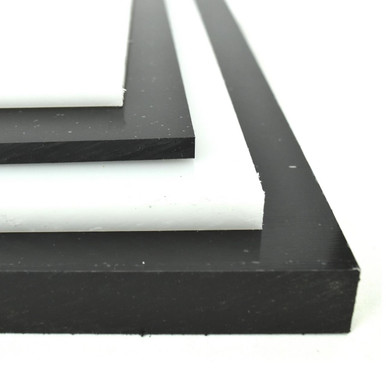
I want to make a workbench of 4040 extruded profile. On the top I want to make a plastic sheet (PVC, HPL, ABS?) I only don't know what material is best suited for this. I don't do a lot of welding or woodwork, it happens, but mostly it's electrical. Any recommendations?
 
To avoid these ads, REGISTER NOW!

carlaisle

Well-known member
Joined
May 14, 2022
Messages
372
Different plastics have different properties so your objective with the plastic top is important. What are you trying to accomplish with the plastic top that would not be viable with steel, wood, or another material? Solid surface countertop material is one option and has the added benefit of being easy to seam and shape. Formica or another brand of laminate over a wood substrate is nearly indestructible and very economical. Some plastics are more vulnerable than others to accumulating static charges which may be a concern depending on the sensitivity of your electrical projects.
 

4xdog

Well-known member
Joined
Aug 18, 2012
Messages
5,603
Location
Santa Fe, NM
Why a plastic sheet? Seems like an odd choice for a workbench top, and not a great choice for a number of reasons.

Maybe Masonite hardboard, MDF, Formica high-pressure laminates, IKEA butcher block wood, Corian solid surfaces (which are plastic, of a type, BTW)? Seems like just about anything would make a better work surface than PVC or ABS sheet.
 
OP
T

The_Inspector

Well-known member
Joined
Apr 18, 2022
Messages
103
Location
The Netherlands
Different plastics have different properties so your objective with the plastic top is important. What are you trying to accomplish with the plastic top that would not be viable with steel, wood, or another material? Solid surface countertop material is one option and has the added benefit of being easy to seam and shape. Formica or another brand of laminate over a wood substrate is nearly indestructible and very economical. Some plastics are more vulnerable than others to accumulating static charges which may be a concern depending on the sensitivity of your electrical pro
Why a plastic sheet? Seems like an odd choice for a workbench top, and not a great choice for a number of reasons.

Maybe Masonite hardboard, MDF, Formica high-pressure laminates, IKEA butcher block wood, Corian solid surfaces (which are plastic, of a type, BTW)? Seems like just about anything would make a better work surface than PVC or ABS sheet.
That's why I asked the question here. Plastic is not very expensive here, I willl pay approx 100 USD for a top that is 12mm thick. I will have a look at the Masonite board. I do not prefer MDF because it's a pain in the **** to impregnate it, but you mentioned a lot of options, thanks!
 

4xdog

Well-known member
Joined
Aug 18, 2012
Messages
5,603
Location
Santa Fe, NM
You can likely get phenolic- or melamine-faced birch plywood in NED. That's a terrific wear surface. I would *love* to have an easy source of phenolic-faced Baltic birch plywood for a number of projects...
 

rmmiller

Well-known member
Joined
Nov 24, 2012
Messages
2,410
Location
Kennewick, WA
My dad and I built new counters for the hose shop I worked for about ten years ago. We used 1/2" HDPE for the top and it worked very well and is still in good shape. We went with 1/2" because the thinner material would be more likely to move with temperature changes.

The reason we went that direction was it could take a beating from people slamming heavy fitting where the formica we had before was beat up pretty bad.
 

FredWanaker

Well-known member
Joined
Mar 27, 2021
Messages
1,470
Location
NorCal
any surface looks great when new. In 3 or 4 years after it is dinged, paint spilled on it, sharpie lines, knife cuts by accident - then one can assess what worked well and what did not. Personally, I use hardened Masonite and change it once every five to six years. It works really well for a general work bench top but you can't weld on it. I usually put on two layers and then just take one layer off when it is time to change.
 

carlaisle

Well-known member
Joined
May 14, 2022
Messages
372
My dad and I built new counters for the hose shop I worked for about ten years ago. We used 1/2" HDPE for the top and it worked very well and is still in good shape. We went with 1/2" because the thinner material would be more likely to move with temperature changes.
How did you hold that HDPE top in place? Screwed down from the top/up from the bottom or something else? I am aware of no adhesive that works on it.
 
To avoid these ads, REGISTER NOW!

no704

Well-known member
Joined
Apr 27, 2016
Messages
5,211
For electronic work i would want something with a high carbon/graphite content so you could ground it. There are plastics with this. If using a random plastic I would be concerned with static damage.
 

dfiler2

Well-known member
Joined
Dec 15, 2014
Messages
2,858
Location
NW Minnesota
I put 2 sheets of 3/4 plywood down then ran a trim board around it set up with a lip 3/16s proud. I then use a sheet of hardboard that lasts a couple of years and then flip it over. I think using a plastic sheet is a good idea and not very expensive, if you do it let us know how it works out. Here is a link to what I think you are talking about. (I would use some 3/4 ply under the plastic though)


MovingAlong

Well-known member
Joined
Aug 17, 2013
Messages
1,212
I want to make a workbench of 4040 extruded profile. On the top I want to make a plastic sheet (PVC, HPL, ABS?) I only don't know what material is best suited for this. I don't do a lot of welding or woodwork, it happens, but mostly it's electrical. Any recommendations?
My recommendations would be influenced by local material availability and just not aware of what might be practical for you.

When searching for "electronics bench" it seems a lot of wood tops come up.

In your context though, is Electrical different than Electronics?
 

nadogail

Well-known member
Joined
Jan 23, 2009
Messages
31,933
Location
Coronado, CA
The Electronics work bench on my first ship had a tempered hardboard top fastened to the aluminium frame with flat head nylon screws.
 

Jgaz

Well-known member
Joined
Dec 16, 2016
Messages
1,652
Location
AZ
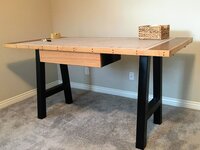
This is the 72x36” sewing/cutting table I made for my wife a long time ago.
Two layers of 3/4” Baltic Birch laminated together with a hardboard top secured with limited dabs of glue so it could be replaced.
IMG_1976_Original.jpeg
Originally it sat on two ”recycled” kitchen cabinets in our basement.
 

PoorUB

Well-known member
Joined
Mar 29, 2021
Messages
11,625
Location
Fargo, ND
My main bechtop is Formica laminate. I really like it. A few years back the bench top was in sorry shape, it was also laminate. I liked it so much I replaced it with laminate. I get about 20 years out of a bench top. Any paint or glue peels up with a sharp scrapper. Brake cleaner and gasoline doesn't affect it. It eventually gets beat up, scratches, gouges and burns.
 

Kaleb

Active member
Joined
Mar 28, 2011
Messages
25
any surface looks great when new. In 3 or 4 years after it is dinged, paint spilled on it, sharpie lines, knife cuts by accident - then one can assess what worked well and what did not. Personally, I use hardened Masonite and change it once every five to six years. It works really well for a general work bench top but you can't weld on it. I usually put on two layers and then just take one layer off when it is time to change.
I really enjoyed my Masonite / hardboard top which I coated with black polyurethane stain to provide waterproofing.
 
To avoid these ads, REGISTER NOW!
Top Bottom