To avoid these ads, REGISTER NOW!

Working on chuck concentricity

rslaback

Well-known member
Joined
Jul 24, 2010
Messages
4,064
Location
Westcentral Wisconsin
My new to me Sheldon lathe has a L00 spindle. The 5C collet closer chuck purchased for it is mounted to a backplate that was turned on the lathe and in my opinion it appears to have additive runout.
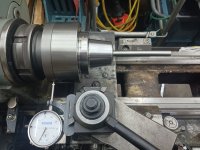
20260322_105918.jpg

The back plate has .0004" of runout, the outboard edge of the chuck mounting surface has .0011", the nose of the chuck has .003", the collet has .004" and the test rod (straightness spec of .0001 in 6") has .0095" at 5.5".

20260322_110306.jpg

If you were me and wanted to get this trued in a bit more where would you start? I have my thoughts but I do not want to share them yet. In case anyone is wondering I do have another lathe with a 5C setup that runs true so I do have the capability to turn the back of the chuck mounting surface if anyone thinks I should get wild with it.
 
To avoid these ads, REGISTER NOW!

Firebrick43

Well-known member
Joined
May 12, 2015
Messages
14,012
Location
West central Indiana
Have you mounted/dismounted multiple times and see if it repeats? Does the L00 taper have any dings/dents? Have you tried other collets?

The side runout of the back plate is completely immaterial. Only the spigot on the back plate and the mount face of the back plate has any bearing to the run out on the chuck. Is your cross slide cutting square to the face of the spindle or slightly concave?

Also note, a lot of the Chinese 5c chucks are trash for quality.
 
OP
R

rslaback

Well-known member
Joined
Jul 24, 2010
Messages
4,064
Location
Westcentral Wisconsin
Have you mounted/dismounted multiple times and see if it repeats? Does the L00 taper have any dings/dents? Have you tried other collets?

The side runout of the back plate is completely immaterial. Only the spigot on the back plate and the mount face of the back plate has any bearing to the run out on the chuck. Is your cross slide cutting square to the face of the spindle or slightly concave?

Also note, a lot of the Chinese 5c chucks are trash for quality.
The mount is repeatable. The collet used in another machine runs true. I also don't particularly like the .003 on the nose of the chuck.

I guess I never have checked the cross slide for perpendicularity. Not sure honestly how I would ever do that.
 

Firebrick43

Well-known member
Joined
May 12, 2015
Messages
14,012
Location
West central Indiana
The mount is repeatable. The collet used in another machine runs true.
✔️
I also don't particularly like the .003 on the nose of the chuck.
That could be caused by runout on the backing plate face or backing plate spigot. Have you done runout in these places with the chuck removed?
I guess I never have checked the cross slide for perpendicularity. Not sure honestly how I would ever do that.
The easiest for a functional check is to make a facing cut on a larger size round of material, clean up then a final cut at a high speed for a nice finish, aluminum is fine. Then blue a surface plate with a haze of prussian blue/oil mix lightly and see how it transfers to the part you cut. You dont want a convex face, Very slightly concave is ideal. Spot the center so there there is no place where the surface speed is effectively zero that will leave a nub that could affect your results
 
Last edited:

Cruzan80

Well-known member
Joined
Jul 22, 2015
Messages
4,190
Location
Denver, CO
The mount is repeatable. The collet used in another machine runs true. I also don't particularly like the .003 on the nose of the chuck.

I guess I never have checked the cross slide for perpendicularity. Not sure honestly how I would ever do that.
Does the nose of the chuck (where you are indicating) have anything to do with the mounting surface of the collet? If not, then why do you care? I could "theoretically" mount a square block with a collet sized hole in it, and as long as the seating area of the collet is concentric with the spindle, it wouldn't have any runout, but the OD of the block would be atrocious.

The .0011 area (and probably the .003 area) is the same as the people who measure and then complain about the outside of their drill chucks. What matters is the part doing the holding is concentric, not the outside shape.
 
OP
R

rslaback

Well-known member
Joined
Jul 24, 2010
Messages
4,064
Location
Westcentral Wisconsin
Does the nose of the chuck (where you are indicating) have anything to do with the mounting surface of the collet? If not, then why do you care? I could "theoretically" mount a square block with a collet sized hole in it, and as long as the seating area of the collet is concentric with the spindle, it wouldn't have any runout, but the OD of the block would be atrocious.

The .0011 area (and probably the .003 area) is the same as the people who measure and then complain about the outside of their drill chucks. What matters is the part doing the holding is concentric, not the outside shape.
I was asked for the runout of the snout so I provided it.

It looks to me like the chuck is a turned part. If that is indeed the case, one would assume that the holding part and the outside part are indeed concentric to one another, no?
 

Cruzan80

Well-known member
Joined
Jul 22, 2015
Messages
4,190
Location
Denver, CO
My point is simply that it doesn't matter. I was simply referencing your first post for nose runout, where you threw out numbers like .0011 on the body and .003 on the nose. Nothing about the L00 snout.

You are assuming that the holding part was done at the same time as the outside. Doesn't have to happen that way. As long as the spindle and collet are concentric, the outside doesn't matter as it has no effect on the concentricity of the collet (hence my square example).
 

Firebrick43

Well-known member
Joined
May 12, 2015
Messages
14,012
Location
West central Indiana
I was asked for the runout of the snout so I provided it.

It looks to me like the chuck is a turned part. If that is indeed the case, one would assume that the holding part and the outside part are indeed concentric to one another, no?
Only if its done all in the same machine. Its highly unlikely that it was.

The chuck was likely roughed out via turning on a lathe and then heat treated. Heat treating will warp the part and therefore the critical features, such as the mount face, spigot bore, and collet bore, will be finish ground to size. Only those critical features need to be concentric and perpendicular to each other.
 
OP
R

rslaback

Well-known member
Joined
Jul 24, 2010
Messages
4,064
Location
Westcentral Wisconsin
Only if its done all in the same machine. Its highly unlikely that it was.

The chuck was likely roughed out via turning on a lathe and then heat treated. Heat treating will warp the part and therefore the critical features, such as the mount face, spigot bore, and collet bore, will be finish ground to size. Only those critical features need to be concentric and perpendicular to each other.
Fair point
 
OP
R

rslaback

Well-known member
Joined
Jul 24, 2010
Messages
4,064
Location
Westcentral Wisconsin
On a scale of batshit to that might work, what do we think of this setup for truing the rear of the chuck?

It's a morse taper test bar with a tailstock center and the chuck locked onto the test bar.

20260407_141004.jpg


20260407_141017.jpg


I'm not necessarily opposed to adding a steady rest on the tailstock end of the chuck.
 

txvwnut

Well-known member
Joined
Jan 1, 2015
Messages
7,603
Location
Bedford, Texas
The proper way to true the back of the chuck is on a surface grinder. It looks like that chuck has "chatter" marks on the inside of the lip. If those are chatter marks I'd toss that chuck and get a new one. Also that setup looks like it would possibly introduce more error into the current equation.
 

cmandp

Well-known member
Joined
Dec 22, 2011
Messages
1,273
Location
New Jersey
I didn't see anywhere but maybe I missed it. What do the locating features on the backing plate measure for runout? Turning the chuck locating features would be my last resort...
 
To avoid these ads, REGISTER NOW!
OP
R

rslaback

Well-known member
Joined
Jul 24, 2010
Messages
4,064
Location
Westcentral Wisconsin
The proper way to true the back of the chuck is on a surface grinder. It looks like that chuck has "chatter" marks on the inside of the lip. If those are chatter marks I'd toss that chuck and get a new one. Also that setup looks like it would possibly introduce more error into the current equation.
How do you ensure the perpendicularity of the grinder and the axis of rotation?
 

bugnut

ALLIANCE MEMBER
Joined
Jul 14, 2012
Messages
3,863
Location
Central Ohio
just the thoughts of a *******, a 5c collet off the shelf does not offer a lot of concentricity. That is why they make collets to be mounted and collapsed that can be id ground or od machined. Even then the inaccuracy created by opening and closing the collet-because of the changing in clamping force and the collet stopping point on the seating taper do not offer great repeatability.

in my years around a shop no one I know has machined the back of a chuck, it is always reground if needed
 

Attachments

  • 5c collet.jpg
    5c collet.jpg
    59.2 KB · Views: 1
OP
R

rslaback

Well-known member
Joined
Jul 24, 2010
Messages
4,064
Location
Westcentral Wisconsin
just the thoughts of a *******, a 5c collet off the shelf does not offer a lot of concentricity. That is why they make collets to be mounted and collapsed that can be id ground or od machined. Even then the inaccuracy created by opening and closing the collet-because of the changing in clamping force and the collet stopping point on the seating taper do not offer great repeatability.

in my years around a shop no one I know has machined the back of a chuck, it is always reground if needed
I always learned that those were for emergency use if you need a non-standard size. I think they are actually referred to as an emergency collet by some manufacturers. They are pretty soft material from what I have seen and you wouldn't want to use them long term.

It's been a while but I had always learned that collets were the best method of holding a material true (outside of a 4 jaw with its extended setup time) as the slop in jaws of a scroll chuck pretty much always guaranteed a few thousands of runout.
 
OP
R

rslaback

Well-known member
Joined
Jul 24, 2010
Messages
4,064
Location
Westcentral Wisconsin
I didn't see anywhere but maybe I missed it. What do the locating features on the backing plate measure for runout? Turning the chuck locating features would be my last resort...
Is this what you are looking for?
The outside edge of the mount flange has .0006"
The inner edge of the mount flange has .0004"
The diameter of the mount flange has .0004"

20260408_153021.jpg


20260408_153122.jpg
 

bugnut

ALLIANCE MEMBER
Joined
Jul 14, 2012
Messages
3,863
Location
Central Ohio
I wish you good results

Real-world part-to-part repeatability​


In practice, repeatability is usually a bit looser than the raw TIR spec:


Typical ranges you’ll see:​


  • High-end Hardinge setup (clean, good spindle, good stock):
    👉 ~0.0001"–0.0003" repeatability (tenths)
  • Normal good shop conditions:
    👉 ~0.0002"–0.0005" repeatability
  • Average / worn / mixed components:
    👉 ~0.0005"–0.001" repeatability

Machinists commonly describe a good 5C setup as being “within tenths repeatably” when everything is right

If you’re trying to hold better than a couple tenths part-to-part, most shops:

  • use emergency (bored) collets, or
  • re-indicate / set-tru adjust between parts.
 

txvwnut

Well-known member
Joined
Jan 1, 2015
Messages
7,603
Location
Bedford, Texas
Is this what you are looking for?
The outside edge of the mount flange has .0006"
The inner edge of the mount flange has .0004"
The diameter of the mount flange has .0004"

20260408_153021.jpg


20260408_153122.jpg
How are you measuring tenth thousandths(0.0000) with thousandths(0.000) indicator?

You mentioned earlier that the back plate was turned on the lathe to get it true but has runout. Your error is in your spindle or the mounting taper not the chuck. I suggest getting some prussian blue and blue up the taper then mount the back plate then remove to verify that it is seating on the taper properly.
 
Last edited:

PCustoms

Well-known member
Joined
Jul 23, 2011
Messages
22,493
Location
VT
I wish you good results

Real-world part-to-part repeatability​


In practice, repeatability is usually a bit looser than the raw TIR spec:


Typical ranges you’ll see:​


  • High-end Hardinge setup (clean, good spindle, good stock):
    👉 ~0.0001"–0.0003" repeatability (tenths)
  • Normal good shop conditions:
    👉 ~0.0002"–0.0005" repeatability
  • Average / worn / mixed components:
    👉 ~0.0005"–0.001" repeatability

Machinists commonly describe a good 5C setup as being “within tenths repeatably” when everything is right

If you’re trying to hold better than a couple tenths part-to-part, most shops:

  • use emergency (bored) collets, or
  • re-indicate / set-tru adjust between parts.

Thanks AI
 
OP
R

rslaback

Well-known member
Joined
Jul 24, 2010
Messages
4,064
Location
Westcentral Wisconsin
How are you measuring tenth thousandths(0.0000) with thousandths(0.000) indicator?

You mentioned earlier that the back plate was turned on the lathe to get it true but has runout. Your error is in your spindle or the mounting taper not the chuck. I suggest getting some prussian blue and blue up the taper then mount the back plate then remove to verify that it is seating on the taper properly.
Needle sweep estimation. With an analog gage you get a pretty good idea of how far the needle goes between the indications.
 
OP
R

rslaback

Well-known member
Joined
Jul 24, 2010
Messages
4,064
Location
Westcentral Wisconsin
I wish you good results

Real-world part-to-part repeatability​


In practice, repeatability is usually a bit looser than the raw TIR spec:


Typical ranges you’ll see:​


  • High-end Hardinge setup (clean, good spindle, good stock):
    👉 ~0.0001"–0.0003" repeatability (tenths)
  • Normal good shop conditions:
    👉 ~0.0002"–0.0005" repeatability
  • Average / worn / mixed components:
    👉 ~0.0005"–0.001" repeatability

Machinists commonly describe a good 5C setup as being “within tenths repeatably” when everything is right

If you’re trying to hold better than a couple tenths part-to-part, most shops:

  • use emergency (bored) collets, or
  • re-indicate / set-tru adjust between parts.
This sounds like collet repeatability. My concern is total part runout. If the total runout that I was seeing was caused by only collet repeatability it should change as the test bar is taken out and rechucked. It does not.
 

Cruzan80

Well-known member
Joined
Jul 22, 2015
Messages
4,190
Location
Denver, CO
Needle sweep estimation. With an analog gage you get a pretty good idea of how far the needle goes between the indications.
So you can estimate less than 1/5 of a slot between graduations, but started out concerned about areas that don't affect TIR?
 
OP
R

rslaback

Well-known member
Joined
Jul 24, 2010
Messages
4,064
Location
Westcentral Wisconsin
So you can estimate less than 1/5 of a slot between graduations, but started out concerned about areas that don't affect TIR?
You can't see that? The needle is maybe .006" wide and the spacing of the marks is around .075". I can clearly see how close it is to one mark compared to another. My childhood years of analyzing which piece of pie was the largest prepared me for this in life.

I started out concerned that 5 inches from my collet a perfectly straight bar has .009"+ of runout. That remains my concern. I wasn't aware that lathe precision was mostly about eyeball concentricity.
 

Cruzan80

Well-known member
Joined
Jul 22, 2015
Messages
4,190
Location
Denver, CO
You can't see that? The needle is maybe .006" wide and the spacing of the marks is around .075". I can clearly see how close it is to one mark compared to another. My childhood years of analyzing which piece of pie was the largest prepared me for this in life.

I started out concerned that 5 inches from my collet a perfectly straight bar has .009"+ of runout. That remains my concern. I wasn't aware that lathe precision was mostly about eyeball concentricity.
Not good enough to determine 1/10 of a slot (or rather 4/10's vs 6/10's) by eye, just guesstimates. The starting concern was based on markings of "runout" including from the outside of the chuck/nose/etc, that don't impact the situation.

My main point is that the setup you have seems to induce runout at every step, with a large jump from the backplate to the chuck/collet, and you don't seem to be set-up to "true" it in correctly. if the backing plate is .0006 out max, but you are getting .004 at the front edge of the collet bar, then it is either the collet or the chuck causing the issue.

Did you measure the inside of the collect section (with no collet inserted) when the chuck is on the lathe?
 
Last edited:
To avoid these ads, REGISTER NOW!
Top Bottom