Happy New Year all!
As I mentioned in a previous post, I had been working on a Christmas gift for my wife over the last month or so leading up to Christmas. I hadn't posted any pictures of it just in case she happened to browse this thread.
My wife is a big fan of old, industrial furniture. She especially likes the look of raw steel and wood, such as an angle iron baker's rack or side table. Seeing as how I had a bunch of old bedrails in the corner, I figured I'd have a go at making her some kind of side table for the kitchen.

I selected some of the choicest, bend free material, and used the available length to determine the height of the unit. This ended up being 36" tall, 15" deep, and 43" long.


With the rivets ground out I made all the length cuts (with an angle grinder), and then clamped a scrap at the end so I could grind them all flush. This worked well but was pretty slow, and caused me to put 'metal chop saw' on my 'tools I need' list.

Moving on, I used the angle grinder once again to give the bottom of each leg a nice taper, 3/4" in, and 5" up the leg.

I then clamped everything together for a bit of a test fit, and mocked up some x-bracing with some flat bar scraps I had laying around. (Note, I did remove all the rust after).
Once I started welding however, My camera phone decided it would go on one of its frequent 'endless crash-reboot' cycles, so I wasn't able to take any pictures for a few days while it sorted itself out. By the time it came back, I had the frame all welded up.

I made a jig to make each end section, and tacked everything up. I did a few things different on this project that I hadn't before. a) I used a bunch of scraps to practice until i got the best settings (I used to just guess and go). b) I tacked everything, and if it wasn't within my tolerances, I took it apart and re-did it. I even figured out where to tack to make it pull in my favour (any seasoned welder reading this will be thinking 'well duh,' but I'm still a novice welder and learning it on my own, so I count this as progress). c) I made a jig, and I'm hooked. A simple jig saves all kinds of trouble. Jig it, clamp it, tack it, weld it.
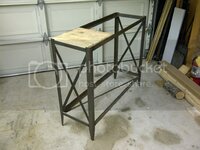
Anyways, I was able to get the frame pretty square, but it had about 1/8" 'drift' to it, so it looked a little like a parallelogram. To fix this, I strapped across the longest corner-to-corner, and pulled it into square. I then used another scrap length of smaller flat bar to brace it, and boom, it's square to within .030" or so. I also cut and welded in the x-bracing for the ends to make everything nice and rigid.
Then I popped out one night to an industrial area where I dumpster-dived some old pallets. I had been hoping to find some nice hardwood ones, but when it's well below 0, snowing, dark, and windy, you get a little less particular. I ended up with some nice long pieces for the top, and some thinner softwood for the bottom shelf.


I plotted out a stencil and cut out the letters, then hit one of the boards with black spray paint. Once it dried I sanded it back a bit to look like wear and tear. I just made up the 'Northern Steel Co.' label. As far as I know there is no such company, but it sounded Canadian and Industrial.
A custom shipping tag (FOB. WorkShop 88), and some boiled linseed oil, and there you have it.

I had wanted to add solid riveted corner gussets (just tack the rivets from behind for looks), but time was tight so I had to go without, I think it turned out though. I must say, I really enjoyed building this. It was my first piece of furniture and my biggest welding project (not counting the wagoneer). My workshop proved itself many times during this build, and I really wasn't wanting for more space.


