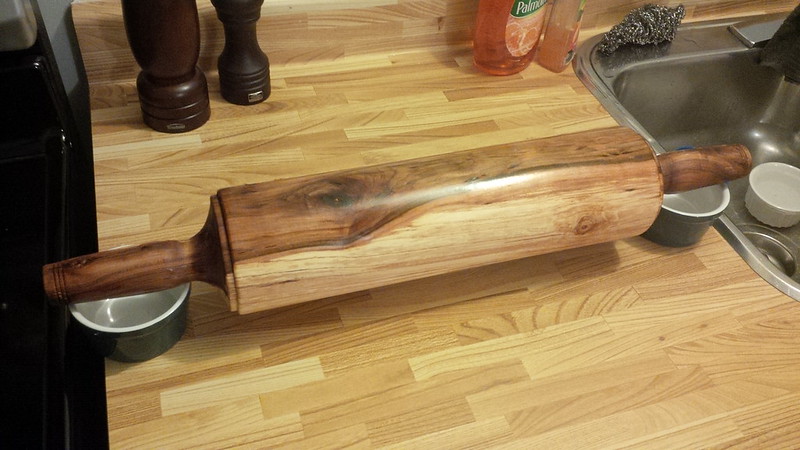
With it being Christmas and all, I had decided to try and tackle another custom gift for my wife. However, this year I haven't had quite the same amount of time to devote to it, so I had to scale back the options a little.
One of my wife's great passions is baking. Pastries, cakes, cookies, breads, fudges, you name it, she'll make it. I suppose, much like a guy has a thing for good shop tools, she has a thing for good kitchen tools. I figured I would set about making her a kitchen tool that would last her the rest of her baking 'career'.
Though she has just about everything a serious baker needs, I've always found her rolling pin to be a bit... under engineered (I think it was a gift). It's small and plastic-y, and I thought to myself "hey, I could do something way better!" And that's where things started to go a little sideways.
Anyways, on to the pics. I can only claim a partial success on this one, as you'll see.
I started with a big hunk of Sugar Maple from a 100+ year old tree that blew down a few years back on my parents farm. I actually sliced up a number of big chunks for projects like this. This chunk however, was the only one I had at home, and really not the best candidate for a heavy duty pin.
I sliced it into a more rolling pin size with the chainsaw and axe, trying to cut my workload down a bit. In hindsight I could have taken off a lot more than that. This is when I noticed that the wood, although it had been down for about 3 years, was soaking wet inside still (I bet some of you can see where this is going). The other issue was that this piece was going to end up mostly in the heartwood, where I should have been turning a chunk from the sapwood of a larger chunk of the tree (all I had on hand, remember?).


Anyways, I figured I'd see it through and at least get some practice out of it, I have maybe used a wood lathe a half dozen times in university, though never with wood. I pulled my $50 Hobby-Craft wood lathe out and bolted it to my old workbench top, then rigged a motor mount to hold my great grandfathers old 1/4HP motor (this is the setup from about a year ago that I never used). I rigged up a totally safe and CSA approved switch system by using a power bar to turn it on and off.
I was able to chuck the blank into the lathe and spin it in 1st gear, taking the high points off to try and balance it a bit. I should note that I only have a smattering of old lathe chisels from my great grandfather. I have about 6 sizes of square nose scrapers, and 2 bowl gouges. I look for more at antique stores but they either aren't very common, or wickedly overpriced.
Once I had turned the whole thing down into a drum about 5" in diameter, I started carving in the first handle. This posed a problem in that my tool rest was too long to fit into the gap. Luckily I had a 4' scrap of solid round stock that was the exact size of the receiver, so I made up a quick compact tool rest with scraps.
Once I was happy with the one handle I made a template of it with hardboard to use as a guide for the second, and turned that one down as well. The final turning step was to take the barrel down to it's final diameter. The pin has a 4" diameter barrel that is 14" long, with 5" handles. It may sound huge, and believe me, it is, but a hefty pin makes it easier for rolling out dough, as the tool does the bulk of the work.
After I parted off the ends I re-mounted it and worked it down with multiple grits of sandpaper so it was silky smooth. I then flipped it around and sanded in reverse rotation, then wet sanded it in both directions to raise the grain.
With the unit all sanded I brought it inside and gave it a nice coat of food-grade walnut oil. It actually looks good from afar, the trouble is I don't think she'll ever be able to use it.
Back when I realized the wood was wet, I knew that it had a huge likelihood of splitting, especially since the pith runs almost right down the axis. The barrel has 2 bad splits that run the full 14", and have opened up about 3/32". It's also full of knots, and the pith-wood took a hunk out of one of the handles.
In all, no, she can't use it, and the gift is a bit of a flop, but I learned a ton of stuff and am confident I can make one that actually stays in one piece and is useable. The splits should close up in time, and it may be a good display piece. The oiling certainly brought out a beautifully rich grain. On the plus side, my wife absolutely loves it, in all it's handmade split glory, so I guess it's still a win (I ended up showing it to her when I figured it wasn't going to work out, in case it went totally south).


 . Actually, shes really good about my picking up free stuff, since I usually sell it on kijiji and make a bit off it.