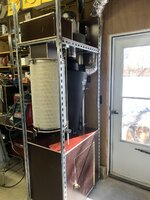
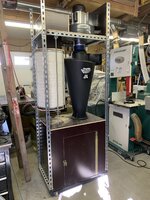
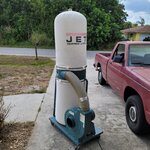
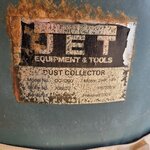
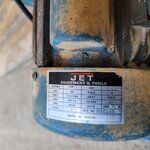
I just bought a used 1995 Jet DC-1200 dust collector. Even though it's 27 years old it looks to be in pretty good condition. It is prewired from the factory for 230v and is rated at 2hp. It draws 30 amps at 120v or 15 amps at 230v. It has a 6" input and about a 5" output. I'm ordering a flow tester to see what CFMs it actually flows. I'm assuming it should be 1200cfm because it's in the model number but I dont know. There is some intermittent problem with the switch and the wires in the cord look too thin for that big motor but it is the stock cord. I think I will put a thicker cord on it and replace the switch if needed.
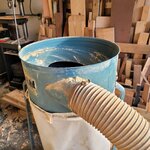
On the motor there is a big steel impeller looks to be about 12". The chips and dust and anything sucked up goes directly into the spinning impeller where it is directed with great force into the steel middle divider piece. In the middle piece there is a corkscrew spiral ramp that directs the heavier dust into the bottom bag. The light dust goes up into the top bag and is contained there, some of it being trapped in the fabric of the bag. The smallest dust particles smaller than 30 microns go right through the bag and into the human beings respiritory system where they do irreversible damage. When the DC is shut off the contained light dust falls onto the top of the ramp spiral thing and falls into the bottom bag. Some dust remains trapped in the bag and over time it restricts performance of the system although the bag is then able to filter much smaller particles. The bag then has to be removed and blown out with compressed air and then washed in a washing machine. Reinstall the bag and the cycle repeats. Clear plastic bags can be installed on the bottom and there are cannister filters that can be installed on top which filter down to 2 microns from what I understand. Some of them have a filter scraper built in.
So I was thinking. What if I take the middle piece with the spiral, ramp corkscrew thing, and attach it to a removable 55 gallon drum. Then put a cover on the top of it and attach the motor to it so that it draws the dust into the spiral and separates it into the drum. I wonder what percentage of the dust would collect in the drum? Any remaining light dust would be ejected from the motor into the outdoors through a vent in the wall. No filter bag so no backpressure to interfere with max flow. I have no chimneys or conditioned air in the shop.
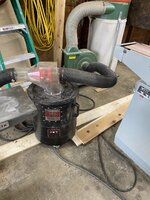
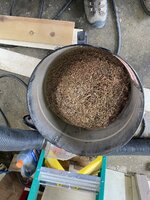
I saw a guy on youtube make this out of a home depot bucket with a vacuum cleaner attached to the top of the bucket and the input coming in from the side on an angle. He weighed the sawdust before and after sucking it up and said that 99.6% of the sawdust ended up in the bottom of the bucket.
This would be a low cost dust collector system as I paid $150 for the unit. Its 27 years old but I thought I would take a chance considering the price of new ones.
Should I go for it? My only question is would that middle piece create enough of a cyclone effect to separate 90% or more of the dust so that the ejected dust is so minimal it wont cause a mess outside. I also like the idea of the impeller not being exposed to hard objects accidently sucked up into the system. It would also take up much less space.
I have all my stationary tools on one wall and there would be a run of about 20 feet of 6" pvc. There will be five blast gates and a flexible hose coming off each.
Would this work how I imagine it?
Alternately I could just remove the top bag, replace the bottom bag with a clear plastic bag, park it outside the shop, hope nothing hard gets sucked into the impeller. From there just let the chips fall where they may. Literally.
On the motor there is a big steel impeller looks to be about 12". The chips and dust and anything sucked up goes directly into the spinning impeller where it is directed with great force into the steel middle divider piece. In the middle piece there is a corkscrew spiral ramp that directs the heavier dust into the bottom bag. The light dust goes up into the top bag and is contained there, some of it being trapped in the fabric of the bag. The smallest dust particles smaller than 30 microns go right through the bag and into the human beings respiritory system where they do irreversible damage. When the DC is shut off the contained light dust falls onto the top of the ramp spiral thing and falls into the bottom bag. Some dust remains trapped in the bag and over time it restricts performance of the system although the bag is then able to filter much smaller particles. The bag then has to be removed and blown out with compressed air and then washed in a washing machine. Reinstall the bag and the cycle repeats. Clear plastic bags can be installed on the bottom and there are cannister filters that can be installed on top which filter down to 2 microns from what I understand. Some of them have a filter scraper built in.
So I was thinking. What if I take the middle piece with the spiral, ramp corkscrew thing, and attach it to a removable 55 gallon drum. Then put a cover on the top of it and attach the motor to it so that it draws the dust into the spiral and separates it into the drum. I wonder what percentage of the dust would collect in the drum? Any remaining light dust would be ejected from the motor into the outdoors through a vent in the wall. No filter bag so no backpressure to interfere with max flow. I have no chimneys or conditioned air in the shop.
I saw a guy on youtube make this out of a home depot bucket with a vacuum cleaner attached to the top of the bucket and the input coming in from the side on an angle. He weighed the sawdust before and after sucking it up and said that 99.6% of the sawdust ended up in the bottom of the bucket.
This would be a low cost dust collector system as I paid $150 for the unit. Its 27 years old but I thought I would take a chance considering the price of new ones.
Should I go for it? My only question is would that middle piece create enough of a cyclone effect to separate 90% or more of the dust so that the ejected dust is so minimal it wont cause a mess outside. I also like the idea of the impeller not being exposed to hard objects accidently sucked up into the system. It would also take up much less space.
I have all my stationary tools on one wall and there would be a run of about 20 feet of 6" pvc. There will be five blast gates and a flexible hose coming off each.
Would this work how I imagine it?
Alternately I could just remove the top bag, replace the bottom bag with a clear plastic bag, park it outside the shop, hope nothing hard gets sucked into the impeller. From there just let the chips fall where they may. Literally.
Attachments


Last edited: