To avoid these ads, REGISTER NOW!

Would this remove welding fumes?

bullnerd

Well-known member
Joined
Sep 17, 2012
Messages
5,690
Location
Jersey
I've been thinking of adding some type of ventilation in my new shop before I add the ceiling panels. No idea how I want to do it! This seems like a pretty good deal if its large enough. I think I can get a nice hood from my work to go with it. It would only run during mig welding.

Also, what would be wrong with venting it into the "attic" of my pole building? I have full soffit and ridge vents.


http://southjersey.craigslist.org/grd/4743129321.html
 
Last edited:
To avoid these ads, REGISTER NOW!

onewheat

Well-known member
Joined
Feb 19, 2012
Messages
1,286
Location
Knoxville, TN
It's not big enough. If you made an enclosure to weld under (doesn't sound very practical) - it might help. At only 780 CFM, it would take over 15 minutes to do an air change in my garage and you would be continually adding more welding fumes. The vent over my cooktop is 1200 CFM. If you are really worried about exchanging air, get something that moves more of it.
 
OP
B

bullnerd

Well-known member
Joined
Sep 17, 2012
Messages
5,690
Location
Jersey
I have a gable fan in my 14'x24' garage that that pretty much takes care of my welding fumes.

My shop is 3040 and finished ceiling.

It's not big enough. If you made an enclosure to weld under (doesn't sound very practical) - it might help. At only 780 CFM, it would take over 15 minutes to do an air change in my garage and you would be continually adding more welding fumes. The vent over my cooktop is 1200 CFM. If you are really worried about exchanging air, get something that moves more of it.

Yeah, thats what I thought. I have looked at air exchange charts in the past. I don't really need to totally exchange the air, just take the smoke out. :bounce:
I guess theres no way to do it cheap and right. Welding area will mostly be contained to one bay, so was thinking of placing it over it.
 

Falcon67

Well-known member
Joined
Jun 11, 2009
Messages
18,371
Location
Merkel, TX
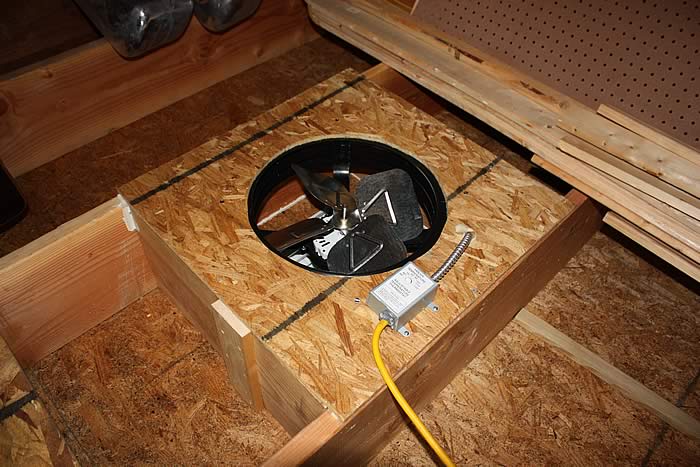
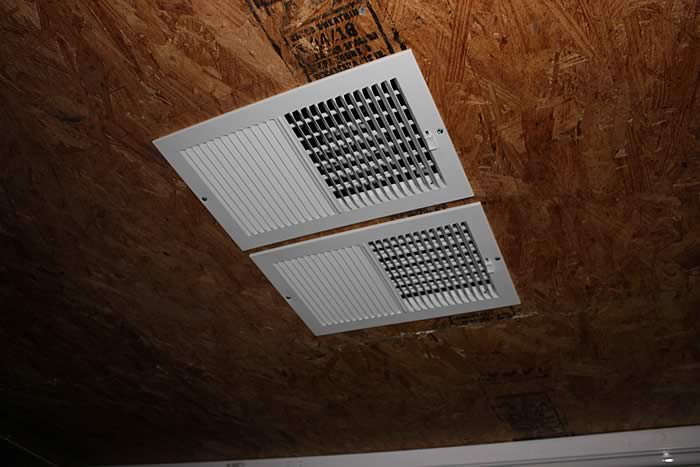
I use a gable vent ( about 1600 CFM) for some fume venting. I boxed it in over the car parking area with some louvers and it vents up into the attic space. Works "OK". If your ceiling is not sealed, a vent will push fumes back into the space.

Inside30.jpg


Inside31.jpg
 

Vegaman_Dan

Well-known member
Joined
Jun 1, 2012
Messages
2,453
Location
Pacific, WA
Couple of things to consider:

Too much airflow can affect your welds since you need the shielding gas to protect the weld as it forms. You can see this for yourself if you have a fan blowing on you while welding.

If you are going to be venting all the fumes, remember that you're also going to be exchanging all the heated air- you may find yourself in a cold garage if you don't have a heat source.

I haven't found the welding fumes to be excessive for my work, but I do very little jobs and nothing extensive. I usually just open the garage door and give up on heat until I'm done.
 
To avoid these ads, REGISTER NOW!

zkling

Well-known member
Joined
Jan 23, 2007
Messages
16,939
Properly ducted it will be fine. Most portable at source fume extractors are in the ~750cfm range.
 

DPelletier

Well-known member
Joined
Oct 23, 2012
Messages
170
Properly ducted it will be fine. Most portable at source fume extractors are in the ~750cfm range.

There is a big difference between a source capture and general ventilation fan/system....do not assume that they have similar airflow requirements.

Typically source capture systems use a relatively low volume and high capture velocity coupled with close proximity to the fume source to be effective whereas general ventilation uses high volume/low static fans to eliminate smoke buildup within the area/structure.

I own a commercial/institutional HVAC company and we are currenty installing 54 Nederman arms and a dedicated fume extraction system at our local college. Airflow for source capture is typically recommended by the arm manufacturer but in our case we are using two extractors capable of 16,000 CFM each for a per unit CFM of just over 500 CFM.

Now, obviously, few people are going to spend the money to have such a system (even on a smaller scale) in their residential shop but I wanted to point out the fan capacity issues. For general ventilation (which is less desireable than source capture for a number of reasons) you'd want to consider the air volume of the space, the number of air changes you want and size the fan from there. Most sources will advise on about 2-5 minutes per air change for a welding shop (at least)....for a typical 24' x 24' x 10' garage, that equates to approximately 1200 - 3000 CFM.

....there are also issues to consider around airflow and how it affects building pressure, any natural gas fired equipment, airflow and dust.

At the end of the day, most shop owners will pick a fan that is too small, but it's better than nothing. I would strongly advise against discharging into an attic space: duct it outside.

2 cents,
Dave
 

readhead

Well-known member
Joined
Dec 8, 2012
Messages
6,175
Location
Durango, Co.
A flexable rubber hose with a weight on the end hooked to an exhaust fan vented outside has worked for me for years. I think it is a five inch hose with a low speed fan. I place it on the table near where I'm working and it ***** out the smoke without pulling all the heat out of the building.
 

d3ad1ysp0rk

Well-known member
Joined
Apr 8, 2013
Messages
84
Location
Portland, ME
I'm a welding beginner, but just yesterday I was reading up on the Lincoln Electric site and came across this article: http://www.lincolnelectric.com/en-u...ry/Pages/controlling-welding-fume-detail.aspx

I was curious about the real risks (meaning, if I don't vent AT ALL, how much welding would I have to do before I actually start being at a real risk?), and found this: http://informahealthcare.com/doi/abs/10.1080/713611032

http://informahealthcare.com/doi/abs/10.1080/713611032 said:
Many of the epidemiology studies performed are difficult to compare because of differences in worker populations, industrial settings, welding techniques, duration of exposure, and other occupational exposures besides welding fumes. Some studies were conducted in carefully controlled work environments, others during actual workplace conditions, and some in laboratories. Epidemiology studies have shown that a large number of welders experience some type of respiratory illness. Respiratory effects seen in full-time welders have included bronchitis, airway irritation, lung function changes, and a possible increase in the incidence of lung cancer. Pulmonary infections are increased in terms of severity, duration, and frequency among welders. Although epidemiological studies have demonstrated an increase in pulmonary illness after exposure to welding fumes, little information of the causality, dose-response, and possible underlying mechanisms regarding the inhalation of welding fumes exists. Even less information is available about the neurological, reproductive, and dermal effects after welding fume exposure. Moreover, carcinogenicity and short-term and long-term toxicology studies of welding fumes in animals are lacking or incomplete.

So it looks like I won't be able to answer my question exactly yet due to a lack of studies, but I at least feel better having a cross breeze when doing more than a few minutes of welding.
 

LS6 Tommy

Well-known member
Joined
Dec 27, 2013
Messages
26,162
Location
Northern NJ
Just being the OCD Type A guy I am, ALL exhaust fans must vent to the outside of any building. It's code. You're filling your attic with garage fumes, occupied, vented or not...
 
To avoid these ads, REGISTER NOW!
Top Bottom