To avoid these ads, REGISTER NOW!

Would you replace this panel? With what?

cadunkle

Well-known member
Joined
Feb 13, 2011
Messages
474
Location
NJ
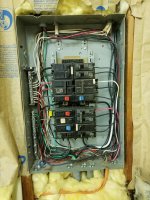
Would you replace this panel? What would you replace it with? It is a subpanel in a garage.

I dislike that it is divided into two halves with jumper wires. The panel is full and I'd like to run an additional 240v circuit and possible one 120v circuit. I could consolidate circuits and make it work if needed.

Also it is currently fed with 6ga copper through a 1" conduit, about 50' from main panel, 40a breaker in the house. Can I safely use a 60a breaker with that wire?
 

Attachments

  • 20181014_204238.jpg
    20181014_204238.jpg
    128.9 KB · Views: 374
  • 20181014_204301.jpg
    20181014_204301.jpg
    107.9 KB · Views: 151
To avoid these ads, REGISTER NOW!

wyliesdiesels

Well-known member
Joined
Aug 14, 2012
Messages
20,275
Location
Modesto, CA
Looks like a split buss main panel that someone repurposed into a subpanel and wired backwards...

What a cluster f*ck...

I would rip it out and get an Eaton CH...
 
Last edited:

TRWham

Well-known member
Joined
Aug 11, 2017
Messages
2,021
Location
East Cobb County, Georgia
I think I would replace it. That is a split bus panel that has been wired backward through a back-fed main breaker. I do not know if that use was supported by Murray (now part of Siemens). Split bus panels were briefly populaur in the 70s and 80s as a way to avoid a main breaker but still satisfy the 6 throws of the hand rule. Not necessarily dangerous, but, again, possibly not an approved use.
 

mm08822

Well-known member
Joined
Jan 13, 2012
Messages
6,316
Location
NJ
I too would get rid of that panel. It is a mix ‘n match of cb’s and maxed out.

Go with a 24 or 32 full space 100A panel for future expansion. I would get a 100A main cb vs. main lugs for localized convenience.

A new panel that size will be taller so you have some flexibility in mounting height/breaker positions to work with the existing branch circuit conductors.

The #6 Cu Thhn’s could be ocp’d @ 70A right now. Make sure it’s thhn/thhw and not TW insulation. If tw your stuck @60A.

The 1’’ conduit gives you some future flexibility depending upon how nicely it has been run.
If later demands required more than 60/70A, you could re-pull larger conductors in the 1”.
Assuming CU thhn:
2- #4, 1-#6, 1-#8. #4’s good for 85A, ocp'd @ 90A or
2- #3, 1-#4, 1-#8. #3’s good for 100A, ocp'd @ 100A
 

Norcal

Well-known member
Joined
Mar 16, 2008
Messages
13,796
While I am not saying keep it that is truly one of the few panels that allow other makes of breakers to be installed in them, ITE (Siemens), and Bryant (Eaton), are listed on the panel label as allowed in addition to the OEM Crouse-Hinds (Murray/Siemens) breakers. If it is replaced be generous in the size being cheap on panel size has a high likelihood of biting the user in the **** later when the inevitable changes occur.
 
OP
C

cadunkle

Well-known member
Joined
Feb 13, 2011
Messages
474
Location
NJ
Wire into the panel is 6ga THWN, rated at 65 amps? That's why I thought 60 amp breaker protecting it. If I ever needed more a 70 amp would not protect this wire, I would think?

I picked up a Square D Homeline 24 space panel today along with the various bits to install it. It pains my OCD but I think I'll install it "upside down" for cleaner wiring given the length through conduit from the house. Looks like the panel is intended to be installed in either orientation.

Regarding GFCI in a garage... Currently only the outside outlets are GFCI protected. Correct me if I'm wrong... All other outlets (except garage door opener) must be GFCI. Lighting circuits do not need GFCI. Ceiling outlets used for drop lights and/or extension cords must be GFCI. Hard wired 120 and 240 devices do not require GFCI (i.e. gas furnace, electric resistive heaters, compressor). No arc fault requirement in a garage.

As a curiosity, can I feed another subpanel from this subpanel? There is a shed on the property that currently has two circuits in it fed from this panel. One 120v circuit (12ga) powering outlets and lights. A 240v circuit (10ga) which will power my compressor (3hp). If I wanted more than these circuits or additional power in the shed could I pull appropriate size wire through the conduit, only bond neutral to ground in the house at the main panel, add a ground rod at the shed (14' from garage), and feed a subpanel from the garage subpanel?
 
To avoid these ads, REGISTER NOW!

wyliesdiesels

Well-known member
Joined
Aug 14, 2012
Messages
20,275
Location
Modesto, CA
Wire into the panel is 6ga THWN, rated at 65 amps? That's why I thought 60 amp breaker protecting it. If I ever needed more a 70 amp would not protect this wire, I would think?

I picked up a Square D Homeline 24 space panel today along with the various bits to install it. It pains my OCD but I think I'll install it "upside down" for cleaner wiring given the length through conduit from the house. Looks like the panel is intended to be installed in either orientation.

Regarding GFCI in a garage... Currently only the outside outlets are GFCI protected. Correct me if I'm wrong... All other outlets (except garage door opener) must be GFCI. Lighting circuits do not need GFCI. Ceiling outlets used for drop lights and/or extension cords must be GFCI. Hard wired 120 and 240 devices do not require GFCI (i.e. gas furnace, electric resistive heaters, compressor). No arc fault requirement in a garage.

all outlets need to be GFCI protected including GDOs and outlets for lighting.

As a curiosity, can I feed another subpanel from this subpanel? There is a shed on the property that currently has two circuits in it fed from this panel. One 120v circuit (12ga) powering outlets and lights. A 240v circuit (10ga) which will power my compressor (3hp). If I wanted more than these circuits or additional power in the shed could I pull appropriate size wire through the conduit, only bond neutral to ground in the house at the main panel, add a ground rod at the shed (14' from garage), and feed a subpanel from the garage subpanel?

yes you can go subpanel to subpanel

However, Only one feed is permitted to each structure. So that is a code violation as its wired currently.

You should remove both feeds and pull a new feeder to the shed.

yes you will need 2 ground rods and an isolated neutral bus bar.
 
OP
C

cadunkle

Well-known member
Joined
Feb 13, 2011
Messages
474
Location
NJ
No lighting is or will be on outlets. Lighting circuits are all hardwired lights, no outlets or other devices on lighting circuits. No GFCI required in this case?

I will put a GFCI on the garage door opener.

Regarding the shed, two circuits to another structure potentially being a problem was the source of my curiosity. The way this is done just seems kind of like a hack or a quick and dirty. Thanks for confirming. Is this an arbitrary section of code or is there an actual safety issue? What scenario could result in injury or fire? What does this requirement protect from? Either way I'll correct this before moving the compressor, at present there is just an unused 240v outlet in the shed, so only the single 120v circuit is in use.
 

dscheidt

Well-known member
Joined
Apr 26, 2017
Messages
2,978
No lighting is or will be on outlets. Lighting circuits are all hardwired lights, no outlets or other devices on lighting circuits. No GFCI required in this case?

I will put a GFCI on the garage door opener.

Regarding the shed, two circuits to another structure potentially being a problem was the source of my curiosity. The way this is done just seems kind of like a hack or a quick and dirty. Thanks for confirming. Is this an arbitrary section of code or is there an actual safety issue? What scenario could result in injury or fire? What does this requirement protect from? Either way I'll correct this before moving the compressor, at present there is just an unused 240v outlet in the shed, so only the single 120v circuit is in use.

Remember that GFCIs need to be 'readily accessible'. That means not on the ceiling. Use an outlet before the opener, a deadfront GFCI, or a GFCI breaker.

The two feeds thing is a safety issue. In addition to the obvious "Oh ****, it's not really off" issue, there are concerns about fault current paths.
 
OP
C

cadunkle

Well-known member
Joined
Feb 13, 2011
Messages
474
Location
NJ
New panel is installed. Just waiting on GFCI breakers ordered online to have GFCI for everything that needs it, should have them installed next weekend. I thought there were ground rods at the garage, however there are none.

There is a generator at the garage that is wired through conduit back to a transfer switch in the house at the main panel. This generator has a ground rod. Can I, and should I, use this ground rod for the garage and drive an additional ground rod 6' away to have two ground rods for the garage subpanel? Or should I drive two new ground rods for the garage subpanel (new ground rods would end up both within 6' of the existing rod for the generator)? 6 gauge solid copper from ground rods to panel?

In the 3/4" conduit to the shed are 3x 10ga copper stranded and 2x 12ga copper stranded. Looking at wire, at the end of the day cost is what it is but trying to optimize. I'm looking at a 60' run estimated through conduit and to where I'd place the panel in the shed, 65' to be safe if buying wire by the foot. With my 3/4 conduit I can put 4x 6 gauge conductors in it, so I may as well go with that if I'm spending the time to do it.

It would be nice to have different colors, but I can get a spool of 500' for less than it would cost for 195' by the foot (65' each to be safe), let alone 260' (4x 65' lengths). Is it still acceptable to tape the neutral to identify it? If so I'll just get a 500' spool of 6ga THHN and use that for the run from garage subpanel to shed subpanel.

Ground conductor sizing. As per table 250.122, 10 gauge copper is good for 60 amps. Am I looking at the right table for ground conductor sizing for a subpanel? Is the existing 10ga THHN ground from garage to shed acceptable as a ground conductor with 6 gauge feeding the panel? If not I will run a new 6ga THHN ground.

Load in the shed is a 3HP compressor, refrigerator, a couple lights, and outlets. Occasional tool use only one at a time (parts washer, sand blaster, saw, drill). Might eventually go to a 5 HP 2 stage compressor. I will likely run 4 circuits in the shed: 240v 20a 10/2 compressor, 120v 15a 14/2 lights, 120v 20a 12/2 refrigerator, 120v 20a 12/2 outlets. Is the existing 10ga THHN ground adequate for this (two new ground rods for shed subpanel, 6ga copper from rods to panel)? What size breaker should I use in the garage subpanel to feed the shed subpanel?
 

wyliesdiesels

Well-known member
Joined
Aug 14, 2012
Messages
20,275
Location
Modesto, CA
New panel is installed. Just waiting on GFCI breakers ordered online to have GFCI for everything that needs it, should have them installed next weekend. I thought there were ground rods at the garage, however there are none.

There is a generator at the garage that is wired through conduit back to a transfer switch in the house at the main panel. This generator has a ground rod. Can I, and should I, use this ground rod for the garage and drive an additional ground rod 6' away to have two ground rods for the garage subpanel? Or should I drive two new ground rods for the garage subpanel (new ground rods would end up both within 6' of the existing rod for the generator)? 6 gauge solid copper from ground rods to panel?

generators dont need grounding electrodes so that is odd.

I woul djust put 2 new ones in.

And yes #6 solid bare cu would work.

In the 3/4" conduit to the shed are 3x 10ga copper stranded and 2x 12ga copper stranded. Looking at wire, at the end of the day cost is what it is but trying to optimize. I'm looking at a 60' run estimated through conduit and to where I'd place the panel in the shed, 65' to be safe if buying wire by the foot. With my 3/4 conduit I can put 4x 6 gauge conductors in it, so I may as well go with that if I'm spending the time to do it.

You dont need #6 for the EGC/ground wire. You can use a #10. up to 60a.

It would be nice to have different colors, but I can get a spool of 500' for less than it would cost for 195' by the foot (65' each to be safe), let alone 260' (4x 65' lengths). Is it still acceptable to tape the neutral to identify it? If so I'll just get a 500' spool of 6ga THHN and use that for the run from garage subpanel to shed subpanel.

Code does not allow taping of wires sized #6 and smaller. This means you need a white conductor and a green conductor.

Ground conductor sizing. As per table 250.122, 10 gauge copper is good for 60 amps. Am I looking at the right table for ground conductor sizing for a subpanel? Is the existing 10ga THHN ground from garage to shed acceptable as a ground conductor with 6 gauge feeding the panel? If not I will run a new 6ga THHN ground.

yes. I actually gave you this information above before seeing this part of your comment.

Load in the shed is a 3HP compressor, refrigerator, a couple lights, and outlets. Occasional tool use only one at a time (parts washer, sand blaster, saw, drill). Might eventually go to a 5 HP 2 stage compressor. I will likely run 4 circuits in the shed: 240v 20a 10/2 compressor, 120v 15a 14/2 lights, 120v 20a 12/2 refrigerator, 120v 20a 12/2 outlets. Is the existing 10ga THHN ground adequate for this (two new ground rods for shed subpanel, 6ga copper from rods to panel)? What size breaker should I use in the garage subpanel to feed the shed subpanel?

If you upgrade the compressor to 5HP you will need 35a rated wire which is #8/2 NM-b or #10 THWN in pipe.

The compressor will also need to be hardwired since outlets are not rated for more than 3HP....
 
OP
C

cadunkle

Well-known member
Joined
Feb 13, 2011
Messages
474
Location
NJ
If you upgrade the compressor to 5HP you will need 35a rated wire which is #8/2 NM-b or #10 THWN in pipe.

The compressor will also need to be hardwired since outlets are not rated for more than 3HP....

I was not aware of that, most compressors advertised as 5HP I've seen are advertised as pulling low 20s for amps... Maybe marketing HP rather than actual HP. I have some 6/3 NM-B I'd imagine is okay to use? Just size breaker for the actual load. If I use this and have a neutral available could I run a 120v fan (under 1 amp I'd imagine) off one leg of the pressure switch (blowing over the aftercooler, gets heat soaked during continuous use), or is this prohibited? Just a thought since I have this wire handy and no other use for it. Another option I was originally planning to use some sort of 240v trigger relay if I could not source a reasonably prices and suitable dimensions 240v fan.

I have a 60 amp disconnect I intend to use at the compressor with a 10/3 flexible nonmetallic AC whip.Should be plenty good for my existing 3HP compressor, just change the wire in the whip should I ever upgrade (assuming within conduit fill).
 

wyliesdiesels

Well-known member
Joined
Aug 14, 2012
Messages
20,275
Location
Modesto, CA
I was not aware of that, most compressors advertised as 5HP I've seen are advertised as pulling low 20s for amps... Maybe marketing HP rather than actual HP. I have some 6/3 NM-B I'd imagine is okay to use? Just size breaker for the actual load. If I use this and have a neutral available could I run a 120v fan (under 1 amp I'd imagine) off one leg of the pressure switch (blowing over the aftercooler, gets heat soaked during continuous use), or is this prohibited? Just a thought since I have this wire handy and no other use for it. Another option I was originally planning to use some sort of 240v trigger relay if I could not source a reasonably prices and suitable dimensions 240v fan.

I have a 60 amp disconnect I intend to use at the compressor with a 10/3 flexible nonmetallic AC whip.Should be plenty good for my existing 3HP compressor, just change the wire in the whip should I ever upgrade (assuming within conduit fill).

low 20s is about 5HP. Ive seen 5HP motors with 23FLA rating.

As for the 120v wiring off the compressor circuit, you would need separate over-current protection.
 
To avoid these ads, REGISTER NOW!
Top Bottom