To avoid these ads, REGISTER NOW!

Wrench dimensions/specifications

KinzeMech

Well-known member
Joined
Jul 15, 2012
Messages
1,164
What should the open and box ends of a wrench measure at? What are typical tolerances for these measurements? For example, a 1/2" hex cannot be precisely 0.500" across the flats and a box end wrench also 0.500 across flats, and there be any expectation of usable fit. What are typical tolerances? Is the the tool slightly oversize, the fastener slightly undersize, or some of both?

What is a good source for these specifications?

My reason for asking is I noticed a loose fit on the open end of my 1-1/8" wrench the other day. According to my caliper, the open end was 0.015" wider at the tip than at the base, so that wrench has likely spread and needs replaced. Looking at it closely got me wondering what the dimension should properly be
 
To avoid these ads, REGISTER NOW!

CWP1616L

Banned
Joined
Aug 31, 2012
Messages
3,297
Location
USA
Whatever it is I use Snap-on as a standard to compare all wrenches to.

I definitely use them as a length standard.
 

Gmonkee

Well-known member
Joined
May 9, 2010
Messages
2,820
Actual dimentions of both the wrench and the fasteners will vary some from different makers and batches. The wrench should have a small margin of slack to fit the fastener.

If the wrench is at the bigger end of the range and the fastener at the smaller you may have a lot of slack.

My metric Powerbuilt offset DBE are in semi retirement for this very issue. Used with normal 'good' fasteners they are fine, when used on some Asain made fasteners they are too sloppy.
 

Rico.

Well-known member
Joined
May 28, 2009
Messages
1,330
Location
England
there is no industry standard as to how much oversize a socket or spanner should be.
But if I recall an ancient thread on here correctly all the high quality brands like Snap-On,
Facom, Hazet etc... were all around 0.1mm - 0.2mm larger than their given size and very
consistant with that oversize measurement over many sockets and spanners.

Some of the cheaper contenders were all over the shop with one spanner being 0.2mm
larger and another one of the same set being 0.45mm larger.

Obviously the socket or spanner does need to be a fraction bigger to account for ease
of fit on fasteners that are not exactly the right size either, and this sweet spot seems to
be about 0.2mm or a smidge less and whatever that translates to in Dinosaur... I think it's
about 0.008"

IMHO... anything over 0.3mm will probably feel a little sloppy... and if it helps all my Facom
sockets I tested were all 0.15mm to 0.17mm larger than the stated size, and the consistency
accross all the sockets was highly impressive.
 

superautobacs

Well-known member
Joined
Oct 31, 2008
Messages
3,997
Location
Vancouver, BC
I remember seeing the DIN or ISO standards listed on the back of a Gedore catalog, but I don't have it with me now. What I remember is that the larger the nominal size, the wider the margin was for min. and max. dimension across the flats.

My Ko-ken catalog shows this, for example:
14mm wrench size can have a min/max of: 14.05/14.27
32mm wrench size can have a min/max of: 32.08/32.48

With KTC's Nepros line they have their own standard which is quite amazing:
according to them 4mm-32mm sizes are all produced to a maximum of only 0.1mm.

I have a magazine that took single sample measurements of 14mm sockets from various brands:

Snap-on: 14.21
Facom: 14.20
Stahlwille:14.15
Ko-ken: 14.20
Nepros: 14.14
KTC: 14.14
Deen: 14.20
Hazet: 14.15
 

Dave455

Well-known member
Joined
Mar 19, 2013
Messages
5,821
Location
Sussex, England
there is no industry standard as to how much oversize a socket or spanner should be..

I regret that I must respectfully disagree!

Every standard, be it BS, ASA, DIN, JIS or whatever lists, for the 'nominal size' of every nut and bolt, not only the dimensions and tolerances for the fastener, but also for the wrench!

In theory, some of these standards can incorporate slight variations, but in practice they do not, as most countries (where they are not publishing an already agreed international standard, such as ISO Metric) derive their figures from the original source!

These standards are available from the standards authority in each counry, which in the U.K. means the British Standards Institute, but are reproduced in many places!

For example, the back of my Ko Ken catalogue states that the opening of an 8mm socket should measure between 8.03 and 8.15 mm, while a 16mm should be between 16.05 and 16.27mm. So, the amount of clearance increases with the size of the bolt as you would expect, as does the tolerance!

Of course, some manufacturers may elect to manufacture to a higher standard of tolerance, retaining of course, the required clearance! Snap On I suspect, with their cold forged sockets are capable of this, and KTC Nepros certainly do!
 
OP
K

KinzeMech

Well-known member
Joined
Jul 15, 2012
Messages
1,164
my ko-ken catalog shows this, for example:
14mm wrench size can have a min/max of: 14.05/14.27
32mm wrench size can have a min/max of: 32.08/32.48

for example, the back of my ko ken catalogue states that the opening of an 8mm socket should measure between 8.03 and 8.15 mm, while a 16mm should be between 16.05 and 16.27mm. So, the amount of clearance increases with the size of the bolt as you would expect, as does the tolerance!
If the min/max of those dimensions are considered in terms of the wrench size, the relative percentage of clearance is actually slightly tighter on the larger fastener:

For 14mm: .36%/1.9% (14.05/14.27)
For 32 mm: .25%/1.5% (32.08/32.48)

The listed specs for the sockets trend roughly the same:
For 8mm: .38%/1.9% (8.03/8.15)
For 16mm: .31%/1.7% (16.05/6.27)
 
To avoid these ads, REGISTER NOW!

Rico.

Well-known member
Joined
May 28, 2009
Messages
1,330
Location
England
^^^Dave^^^

No need to regret me being wrong... :thumbup:


I was always under the impression that the only industry standard measurement
of sockets and spanners was the torque spec... Once again this glorious forum
has taught me something I didn't know.


Cheers.
 

MotoDave

Well-known member
Joined
Jul 1, 2009
Messages
505
Location
Ventura, CA
My Machinery's Handbook has a table in it with wrench opening tolerances, which references ANSI/ASME B18.2.2. In general wrenches are sized slightly over the nominal, for example a 1/2" wrench should be .510/.504. Common mistake I see by other engineers is to leave hexes at nominal + sheet tolerance, i.e. .500±.010, which can result in a hex that won't accept a standard wrench. I typcially would go .500/.490.
 

diyer999

Banned
Joined
Jul 16, 2010
Messages
84
Whatever it is I use Snap-on as a standard to compare all wrenches to. I definitely use them as a length standard.

You failed to answer the question. There is an equation. Don't have it handy but everytime I used it, it was 0.200mm for the metric wrenches. The DIN standard may be closer.
 
Last edited:

BFBOB

Well-known member
Joined
Sep 20, 2011
Messages
5,073
If you do a little math and convert the units of measure to the same, you'll find that in a few cases the tolerance windows of metric and SAE wrenches overlap. A 19mm and a 3/4" wrench can be exactly the same size. Figuring out which pairs qualify is left as an exercise for the reader. I'm too lazy.
 

T45

Well-known member
Joined
Nov 20, 2014
Messages
3,253
snap on's as noted above tend to be built with good but not absolutely tight tolerance. That .20mm is about right, whereas a little more snug is .14-.15mm over nominal. They do this to keep the wrench easy to get on the fastener, which is a bit faster to use, which matters to people workin on the clock. Its also a bit less stressful to use because you don't focus as precisely one gettin the wrench on the work.

I have other units that fit more even-more-precise snugly, and each has a benefit depending on your work. Also have some snap ons which are broached ever so much more snugly than one another, but in general they are pretty consistent in their spec, and overal feel. In other words, each 0.05mm in variance in a spec or a production run is noticeble to the end user--but so is the shape of the chamfer and some other aspects of the design which are just as critical.
 
Last edited:

ssdave

Banned
Joined
Apr 11, 2015
Messages
2,913
Location
Eastern Oregon
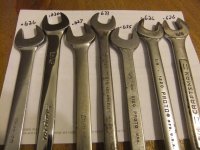
I was easily amused tonight, so took a small and admittedly unscientific sample from my toolbox. The steel is at about 25 degrees from being in an unheated space, but the Snap-on on the outside left was at 70 degrees.

The snap on on the left is from 1969, the second one is off the truck last week. The third one is not date coded, but from the late 60's or early 70's. The Proto range from the 1950's to 1990's. The craftsman is V^(2nd V inverted) = Danaher, ca. 1992 - 2008
 

Attachments

  • DSCF3471.jpg
    DSCF3471.jpg
    141.4 KB · Views: 351
Last edited:
To avoid these ads, REGISTER NOW!
Top Bottom