
You are using an out of date browser. It may not display this or other websites correctly.
You should upgrade or use an alternative browser.
You should upgrade or use an alternative browser.
WTF? My hot water heater
- Thread starter ratdoggy
- Start date

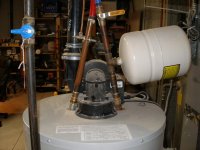
weird. the cold side looks rusty but...
Garagetime
Well-known member
Maybe this is what happened did search found this link below.
http://terrylove.com/forums/index.php?threads/imploding-water-heater.23656/
http://terrylove.com/forums/index.php?threads/imploding-water-heater.23656/
Last edited:
Maybe this is what happened link below.
http://terrylove.com/forums/index.php?threads/imploding-water-heater.23656/
That was first thing I saw when I googled it.
I shut it down so if it lets loose I won't have a huge mess
Shawn S
Well-known member
Why do you need a heater for your hot water?

coldh2o
Well-known member
Why do you need a heater for your hot water?
Because it's much more efficient to heat the 50 gallons of hot water in the tank than letting it get cold and reheating it. Unless it's the first fill, or you have a lot of showering teenagers, the unit is always bouncing a few degrees around the thermostat set point and heating hot (or warm) water.
Back on topic, I also have an 8 year old BW unit so am very interested in knowing the cause.
I'm also wondering what is written on the vent pipe...
pepi
Well-known member
I think the canister is not installed correctly, has nothing to do with the cockeyed water pipe on the water heater. But might consider plumbing that thing with the air valve up.
I don't care one way or the other just saying..
I don't care one way or the other just saying..
onewheat
Well-known member
Why do you need a heater for your hot water?
Because it's much more efficient to heat the 50 gallons of hot water in the tank than letting it get cold and reheating it.
I think the point is - that it is a "water heater", not a "hot water heater". Hot water heater is redundant.
toyotadriver
Well-known member
- Joined
- Dec 30, 2010
- Messages
- 1,586
I think the point is - that it is a "water heater", not a "hot water heater". Hot water heater is redundant.
But it is a hot water heater. The tank is full of hot water. You turn the hot water tap on, causing some hot water in the tank to be replaced with cold water causing the tank temperature to drop. When the tank cools to a preset temp (still hot though), the thermostat turns the heat source on and.......wait for it......wait for it.....heats the hot water even hotter.
It's some neat stuff.
Sawdustmaker
Well-known member
Eight year old Bradford White 50 gallon...
I just shut it down as I didn't like the look of this....
Why are the pipes bent inward like that???
Might have something to do with the fact you are running pex close to the fittings, also that water hammer arrestor looks heavy. Pex might not be giving enough support.
I think OP is running some sort of science experiment ..... something like the one that crush the 50 Gallon drums with a bucket of cold water....in physics class
were you trying to do this experiment?
I would check your cold water down mix tube makes sure it is still there.... and not disintegrate. It usually feeds the cold water to the bottom of the "Hot Water Heater". I think they are common to disintegrate over time, it's just some sort of PVC. Cheap part. Especially noticeable if your water is luke warm most of the time. If it have any chance of spraying cold water to the top of the tank like that 50 Gallon drum experiment, it could cause a mini rapid implosion from the rapid cooling of the top.... The inside of those tanks are at least 1/8 steel.... no rust would easily bend them.... I still have and old one in the back that I cut up.... Cheap American Water Heater brand, builder's quality one.
were you trying to do this experiment?
I would check your cold water down mix tube makes sure it is still there.... and not disintegrate. It usually feeds the cold water to the bottom of the "Hot Water Heater". I think they are common to disintegrate over time, it's just some sort of PVC. Cheap part. Especially noticeable if your water is luke warm most of the time. If it have any chance of spraying cold water to the top of the tank like that 50 Gallon drum experiment, it could cause a mini rapid implosion from the rapid cooling of the top.... The inside of those tanks are at least 1/8 steel.... no rust would easily bend them.... I still have and old one in the back that I cut up.... Cheap American Water Heater brand, builder's quality one.
Last edited:
onewheat
Well-known member
But it is a hot water heater. The tank is full of hot water. You turn the hot water tap on, causing some hot water in the tank to be replaced with cold water causing the tank temperature to drop. When the tank cools to a preset temp (still hot though), the thermostat turns the heat source on and.......wait for it......wait for it.....heats the hot water even hotter.
It's some neat stuff.
But it also heats cold water, luke-warm water, warm water, tepid water and almost-hot water, so it heats water and the temperature is irrelevant. It is a "water heater". Look on any box - they are labeled as "Water Heaters" on all of them - not "Hot Water Heaters".
James-W
Well-known member
Why do we continually argue about this? We all know what the opening poster is talking about so why can't we just move on?
dadsEH
Well-known member
Well there is 5 minutes i could have used more wisely.
Super Mech
Well-known member
Did this happen suddenly or did it happen over time? While that expansion tank looks heavy, I would tend to think that if it was lack of support on the pipes it would tend to lean towards the outside of the water heater. I've never seen anything like that.
A friend of mine has installed hundreds of water heaters, I'll see if I can get in touch with him.
A friend of mine has installed hundreds of water heaters, I'll see if I can get in touch with him.
I manage a scrap yard and see all kinds of water heaters come in and I have never seen one do this...
As far as the expansion tank it's been there for 8 years and why would the othre pipe bend inward?
Builder quality or not I've never ever seen this before and based on some of the answers that are reasonable not too many have either.
Of course I shut it down and will get it replaced but I want a real reason why it did that
As far as the expansion tank it's been there for 8 years and why would the othre pipe bend inward?
Builder quality or not I've never ever seen this before and based on some of the answers that are reasonable not too many have either.
Of course I shut it down and will get it replaced but I want a real reason why it did that
Did this happen suddenly or did it happen over time? While that expansion tank looks heavy, I would tend to think that if it was lack of support on the pipes it would tend to lean towards the outside of the water heater. I've never seen anything like that.
A friend of mine has installed hundreds of water heaters, I'll see if I can get in touch with him.
Basically over night it happened...I do have a water softener and wonder if it might have rusted internally
Why do we continually argue about this? We all know what the opening poster is talking about so why can't we just move on?
I have no idea why either... it's like just some stubborn old dog loves peeing on the hot water heaters.
rlitman
Well-known member
I think the canister is not installed correctly, has nothing to do with the cockeyed water pipe on the water heater. But might consider plumbing that thing with the air valve up.
I don't care one way or the other just saying..
Extrol tanks are designed to work in any orientation. But if you want to get all of the air out of the water side of the tank (more of a consideration for closed loop systems), then you should install it with the air valve DOWN, not up.
The OP's issue however is something else. From the way that both inlet pipes bent in the same way inwards, it is clear to me that a vacuum was drawn on the tank.
The Extrol tank is there to compensate for increases in pressure that can occur as water heats up and expands, and has nowhere to go when the path to the water system is blocked by a check valve.
The same water will contract as it cools. But the check valve will allow cold water to re-enter the tank before you get any vacuum.
I can think of two scenarios that could cause this.
1) The hot tank had the cold water supply shut off, and was then allowed to cool.
2) A firetruck on a nearby street pulled vacuum on the water main.
Vacuum arresters are required devices on things that can allow contaminants to enter a water system. In the case of vacuum being pulled from the system, they allow clean air in, rather than allowing contaminated water to enter. If the OP had a PVB, rather than a check valve on his water service, then scenario 2 would be impossible (if it worked as it should).
Gents, sorry to disagree, not a vacuum....excess pressure. A vacuum would draw the middle of the heater jacket inward forcing the ******* outward (think of squeezing a beer can). Thermal expansion or excess pressure forces the middle of the heater outward which forces the ******* inward.
Not really enough data given to give a absolute answer. If the outlet ******* are faced inward as depicted in the picture, it's likely that thermal expansion is to blame.
A few things to check:
Need to find out what the incoming water pressure is. If over 80psi, a pressure reducing valve is needed before going on to the following steps.
T & P Valve - Insure one is installed. I think I see it in the lower right-hand portion of the picture.
T & P Valve - Has it been seeping? IF not, check to insure that it is rated to NO MORE than 150 psi. Many people try to solve a seeping T & P issue by installing a T & P valve with a rating greater than 150 psi. If this has been done, shut down the water heater until you can get the proper T & P valve installed. This is a very dangerous situation.
If T & P has been seeping - Expansion tank has gone bad or is not properly charged. Expansion tank should be charged to incoming water pressure BEFORE it is installed (air can be compressed, water can't....at least not on earth).
Take the following steps:
1) Check T & P for proper rating (150 psi)
2) Check to see if you have a closed plumbing system. Check valve in the water meter, a pressure reducing valve, or a backflow preventer all close the system.
3) Check water pressure for 24 hours using a gauge with a lazy arm (cheap at Home Depot - link below).
4) If water pressure exceeds 80 psi you have found part of your problem.
5) Check expansion tank. Open the Schroeder valve (looks like the valve stem on a tire) for a second, if water comes out, expansion tank is bad.
6) If water does not come out, remove expansion tank and check air pressure. Expansion tank should be charged to incoming water pressure BEFORE installing it in the system. It is extremely common for tanks to be improperly charged as most do not know to charge before installation.
7) Reinstall properly charged expansion tank.
9) Use pressure gauge with lazy arm to check pressure for 24 hours. I think you'll find that unless you have a water hammer problem, the gauge will read within a pound or two of your original incoming water pressure (which should/must be under 80 psi).
A link to the gauge I use is below:
http://www.homedepot.com/p/3-4-in-Plastic-Water-Pressure-Test-Gauge-DP-IWTG/100175467?MERCH=REC-_-SearchPLPHorizontal1_rr-_-NA-_-100175467-_-N
There could be a bit more to what's going on, but the above is a good place to start.
Reflex
Not really enough data given to give a absolute answer. If the outlet ******* are faced inward as depicted in the picture, it's likely that thermal expansion is to blame.
A few things to check:
Need to find out what the incoming water pressure is. If over 80psi, a pressure reducing valve is needed before going on to the following steps.
T & P Valve - Insure one is installed. I think I see it in the lower right-hand portion of the picture.
T & P Valve - Has it been seeping? IF not, check to insure that it is rated to NO MORE than 150 psi. Many people try to solve a seeping T & P issue by installing a T & P valve with a rating greater than 150 psi. If this has been done, shut down the water heater until you can get the proper T & P valve installed. This is a very dangerous situation.
If T & P has been seeping - Expansion tank has gone bad or is not properly charged. Expansion tank should be charged to incoming water pressure BEFORE it is installed (air can be compressed, water can't....at least not on earth).
Take the following steps:
1) Check T & P for proper rating (150 psi)
2) Check to see if you have a closed plumbing system. Check valve in the water meter, a pressure reducing valve, or a backflow preventer all close the system.
3) Check water pressure for 24 hours using a gauge with a lazy arm (cheap at Home Depot - link below).
4) If water pressure exceeds 80 psi you have found part of your problem.
5) Check expansion tank. Open the Schroeder valve (looks like the valve stem on a tire) for a second, if water comes out, expansion tank is bad.
6) If water does not come out, remove expansion tank and check air pressure. Expansion tank should be charged to incoming water pressure BEFORE installing it in the system. It is extremely common for tanks to be improperly charged as most do not know to charge before installation.
7) Reinstall properly charged expansion tank.
9) Use pressure gauge with lazy arm to check pressure for 24 hours. I think you'll find that unless you have a water hammer problem, the gauge will read within a pound or two of your original incoming water pressure (which should/must be under 80 psi).
A link to the gauge I use is below:
http://www.homedepot.com/p/3-4-in-Plastic-Water-Pressure-Test-Gauge-DP-IWTG/100175467?MERCH=REC-_-SearchPLPHorizontal1_rr-_-NA-_-100175467-_-N
There could be a bit more to what's going on, but the above is a good place to start.
Reflex
Last edited:
James-W
Well-known member
I agree with you in principle, but for the pipes to bend that far inward it would mean the internal tank would have to bend outward pretty darn far. I doubt it would be possible for the internal tank to bend outward far enough to make the pipes bend inward that much without the internal tank bursting wide open. I mean, I am assuming the tank is glass lined steel and if that is indeed the case, just how far can it stretch without breaking and flooding the basement?Gents, sorry to disagree, not a vacuum....excess pressure. A vacuum would draw the middle of the heater jacket inward forcing the ******* outward (think of squeezing a beer can). Thermal expansion or excess pressure forces the middle of the heater outward which forces the ******* inward.
Not really enough data given to give a absolute answer. If the outlet ******* are faced inward as depicted in the picture, it's likely that thermal expansion is to blame.
A few things to check:
Need to find out what the incoming water pressure is. If over 80psi, a pressure reducing valve is needed before going on to the following steps.
T & P Valve - Insure one is installed. I think I see it in the lower right-hand portion of the picture.
T & P Valve - Has it been seeping? IF not, check to insure that it is rated to NO MORE than 150 psi. Many people try to solve a seeping T & P issue by installing a T & P valve with a rating greater than 150 psi. If this has been done, shut down the water heater until you can get the proper T & P valve installed. This is a very dangerous situation.
If T & P has been seeping - Expansion tank has gone bad or is not properly charged. Expansion tank should be charged to incoming water pressure BEFORE it is installed (air can be compressed, water can't....at least not on earth).
Take the following steps:
1) Check T & P for proper rating (150 psi)
2) Check to see if you have a closed plumbing system. Check valve in the water meter, a pressure reducing valve, or a backflow preventer all close the system.
3) Check water pressure for 24 hours using a gauge with a lazy arm (cheap at Home Depot - link below).
4) If water pressure exceeds 80 psi you have found part of your problem.
5) Check expansion tank. Open the Schroeder valve (looks like the valve stem on a tire) for a second, if water comes out, expansion tank is bad.
6) If water does not come out, remove expansion tank and check air pressure. Expansion tank should be charged to incoming water pressure BEFORE installing it in the system. It is extremely common for tanks to be improperly charged as most do not know to charge before installation.
7) Reinstall properly charged expansion tank.
9) Use pressure gauge with lazy arm to check pressure for 24 hours. I think you'll find that unless you have a water hammer problem, the gauge will read within a pound or two of your original incoming water pressure (which should/must be under 80 psi).
A link to the gauge I use is below:
http://www.homedepot.com/p/3-4-in-Plastic-Water-Pressure-Test-Gauge-DP-IWTG/100175467?MERCH=REC-_-SearchPLPHorizontal1_rr-_-NA-_-100175467-_-N
There could be a bit more to what's going on, but the above is a good place to start.
Reflex
EOC_Jason
Well-known member
I would like to see a disection of this after you get it swapped out...
Either the top collapsed in, or the sides expanded out... But like you said, "why" is the question here...
Either the top collapsed in, or the sides expanded out... But like you said, "why" is the question here...
Gents, sorry to disagree, not a vacuum....excess pressure. A vacuum would draw the middle of the heater jacket inward forcing the ******* outward (think of squeezing a beer can). Thermal expansion or excess pressure forces the middle of the heater outward which forces the ******
......
Reflex
The top and bottom of the inside tank normally is build with, the top is convex (domed) outwards and the bottom is concave inwards..... if it is excess pressure the top would have expand outward further. I would think..... only a vacuum implosion would have cause a convex surface dent inwards. . like that 50 gallon drum experiment.... the OP must have created certain unique conditions that cause this. .... such as some how rapid cooling the convex top.... Most of those heaters have a 10 year warranty especially on the tank why not claim the warranty
maybe the rapid cooling is caused by that draft inducing fan ?
Last edited:
Dogdog,
Excellent logic....and your are correct, the top and bottom portions of the tank are manufactured with the same basic shape (not exactly the same). The bottom of the tank is manufactured so that we get greater surface area for improved heat transfer. The top of the tank is shaped this way for strength. These parts are formed with a 60 ton press out of a flat sheet and are critical to the proper performance of the unit.
That being said, the weakest point of the tank is the middle of the vertical portion of the tank. In addition, the top and bottom of the tank are welded to the flue, this gives the top of the tank additional strength. What I didn't mention in my post (it was too long) was the fact that the original poster might also check for a collapsed flue. It is common for the flue to "give" in this situation. It's a little tough to check on a power vent.
Although in a vacuum or excessive pressure situation the pressure is equal on all sides, the long sides have the tank have a greater moment and therefore less rigidity. The top and bottom may collapse, but deformation of the sides occurs first. This causes the ******* to bow out when a vacuum occurs as the top of the heater is much stronger than the sides due to it's limited moment and it's curvature. We've all seen/done the paint can or gas can experiment in which the can is heated with the cap off and then taken off the burner and the cap put on. The can collapses as depicted in the picture below.

You point on vacuum is well taken, but I'll stick with high pressure. Enjoyed reading your post.
Thanks,
Reflex
Excellent logic....and your are correct, the top and bottom portions of the tank are manufactured with the same basic shape (not exactly the same). The bottom of the tank is manufactured so that we get greater surface area for improved heat transfer. The top of the tank is shaped this way for strength. These parts are formed with a 60 ton press out of a flat sheet and are critical to the proper performance of the unit.
That being said, the weakest point of the tank is the middle of the vertical portion of the tank. In addition, the top and bottom of the tank are welded to the flue, this gives the top of the tank additional strength. What I didn't mention in my post (it was too long) was the fact that the original poster might also check for a collapsed flue. It is common for the flue to "give" in this situation. It's a little tough to check on a power vent.
Although in a vacuum or excessive pressure situation the pressure is equal on all sides, the long sides have the tank have a greater moment and therefore less rigidity. The top and bottom may collapse, but deformation of the sides occurs first. This causes the ******* to bow out when a vacuum occurs as the top of the heater is much stronger than the sides due to it's limited moment and it's curvature. We've all seen/done the paint can or gas can experiment in which the can is heated with the cap off and then taken off the burner and the cap put on. The can collapses as depicted in the picture below.
You point on vacuum is well taken, but I'll stick with high pressure. Enjoyed reading your post.
Thanks,
Reflex
I would like to see a disection of this after you get it swapped out...
Either the top collapsed in, or the sides expanded out... But like you said, "why" is the question here...
I definitely want to see that too....
As I've mentioned; house was built in 2009 and we have never had any kind of problem with the unit before. I'll drain sediment out every now and then. No odd problems and I'm on city water
1953mercury
Well-known member
Couldn't have been the weight of the expansion tank or it would have bent the other way. I'm guessing Demons in the house. Mike
Mikemires
Well-known member
Definitely thermal expansion. If your expansion tank is like 80% of them I see in my area it was never charged with the correct pressure when it was installed rendering it useless. Definitely check your water pressure.
Lassen Forge
Well-known member
I would think the top of the water tank caved in. Subjected to a hard vacuum, add internal rust, and whang, just like the Pepsi cans above. If the warranty is still good on the tank, then you may be OK. but yeah, I'd replace that thing either way.
I'm wondering, tho, if it did rust internally why it rusted - there's supposed to be a sacrificial anode (or 3) in the tank to prevent that from happening... maybe it's shot, or worse, forgot to be installed when they built the thing...
It'll be interesting to see what that tank looks like once the sheet metal is removed, and what the tank looks like cut open.
I'm wondering, tho, if it did rust internally why it rusted - there's supposed to be a sacrificial anode (or 3) in the tank to prevent that from happening... maybe it's shot, or worse, forgot to be installed when they built the thing...
It'll be interesting to see what that tank looks like once the sheet metal is removed, and what the tank looks like cut open.
Sticks McGee
Well-known member
A little off topic but is that an ice maker tap on the "hot" pipe?
The bending is indeed a WTF I agree
The bending is indeed a WTF I agree
As for me, you'd better turn to professionals. I always use services of a water heater repair company in denver http://www.summitheatingco.com/water-heaters-denver/ It's really cool and very fast. Plus, its services aren't expensive. I hope I was useful. Take care
Dustball
Well-known member
It's probably for a whole house humidifier.A little off topic but is that an ice maker tap on the "hot" pipe?
The bending is indeed a WTF I agree
Dr Stan
Well-known member
This is probably an opportune time to replace it with an on demand AKA tank less water heater.
This is probably an opportune time to replace it with an on demand AKA tank less water heater.
I don't think it pays as I have Natural Gas I saw where yearly savings would be about $100...
Not worth it..
Cost to heat the house is one reason I wanted NG at the house..
You wouldn't believe how cheap my bill is for what I get..
Last edited:
manwithtools
ALLIANCE MEMBER
I'm curious to see what the failure mode is. In a gas water heater the flue is welded into the bottom and top tank ends, essentially forming a column within the tank. In theory, the area where the inlet and outlet bungs are welded to the top tank end (where yours appears to have buckled) should be one of the strongest parts of the tank. Failure from pressure or vacuum should effect the walls of the tank LONG before the ends.
This is truly an odd one.
This is truly an odd one.
Last edited:
Super Mech
Well-known member
I got in contact with a friend of mine who has installed literally hundreds of water heaters in his lifetime. He said that he has never seen anything like that. His theory is that if there is tension on the pex lines and the top of the tank weakend they could have pushed the pipes together. He doubts that's the problem. He had no other answer but would like me to tell him if an autopsy is done on the tank.
EOC_Jason
Well-known member
Time to call Mythbusters!!!!
Northislander
Well-known member
Link to a Railcar tanker implosion
https://www.google.ca/url?sa=t&rct=...VvTxZM&usg=AFQjCNF_T_V05gTiJn-BaTteOC__OkC53w
https://www.google.ca/url?sa=t&rct=...VvTxZM&usg=AFQjCNF_T_V05gTiJn-BaTteOC__OkC53w