To avoid these ads, REGISTER NOW!

WWII Drag Link Socket

Provincial

Well-known member
Joined
Sep 21, 2011
Messages
6,882
Location
Near Salem, OR
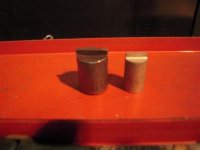
I recently purchased a Plomb WF 3/8" socket set. One of the items included was an unmarked drag link socket that is 11/16" in diameter and has a blade that is 7/64" thick. It should work on a 1/8" screw slot. The socket is cadmium plated and the finish matches the other parts of the set.

I am attaching photos of the set and two photos comparing this socket to a P&C 6076 1/2" drive drag link socket. There is a strong resemblance.

Does anyone have any information on this socket?

Thanks,
Jock
 

Attachments

  • WF Kit 1.comp.jpg
    WF Kit 1.comp.jpg
    31 KB · Views: 43
  • Drag Link Socket 1.comp.jpg
    Drag Link Socket 1.comp.jpg
    20.9 KB · Views: 61
  • Drag Link Socket 2.comp.jpg
    Drag Link Socket 2.comp.jpg
    22.8 KB · Views: 51
To avoid these ads, REGISTER NOW!

alwaysFlOoReD

Well-known member
Joined
Sep 24, 2013
Messages
2,434
Location
Airdrie, Alberta, Canada
No info, but I picked up a tool box that had something similar made from square stock. Can you show me how such a tool is used? I've never seen a drag link that needs such a tool, but I'm only familiar with 60's and up cars and light trucks.

Sent from my XT1032 using Tapatalk
 
OP
P

Provincial

Well-known member
Joined
Sep 21, 2011
Messages
6,882
Location
Near Salem, OR
No info, but I picked up a tool box that had something similar made from square stock. Can you show me how such a tool is used? I've never seen a drag link that needs such a tool, but I'm only familiar with 60's and up cars and light trucks.

Sent from my XT1032 using Tapatalk

Earlier cars and trucks (including WWII Jeeps) used a steering linkage that had ball ends on the steering arms and pittman arm. These were connected by a drag link that used spring-loaded ball seats that could be adjusted by turning a big slotted screw on the end of the link. Here is a picture of such a setup:

attachment.php


The adjusting screw is number 3328 in the diagram. The blade of the tool fits in the slot of the screw. The screw is locked by a cotter pin through the slot and holes in the rim of the rod end.

Other uses include adjusting steering gear sectors and any large slotted screw.
 

Ole Slewfoot

Well-known member
Joined
Feb 22, 2016
Messages
5,098
Location
Freedom, CA
Here is a chrome proto 5444 which is a little smaller than the cad plated War Finish (not WF)5446. I'd expect a Plomb WF drag link socket to have the same hollow grind, and maybe skip the 2 rings, but you never know.

Wondering about my 27 USA wrench....

20160802_030059_zps29bzukx0.jpg


20160802_030239_zpsrlcnds9e.jpg
 
Last edited:
To avoid these ads, REGISTER NOW!
OP
P

Provincial

Well-known member
Joined
Sep 21, 2011
Messages
6,882
Location
Near Salem, OR
Slewfoot, if you look at the photos in my original posting, the socket in question does not have the hollow ground design of the Plomb and Proto versions. It is made like the P&C design. It is very possible that Plomb supplied Wright Field with a product from their P&C subsidiary. Without markings, it is hard to tell.
 

Private Lugnutz

Well-known member
Joined
Mar 30, 2012
Messages
30,959
Location
The Authentic Jersey Shore
Hi Provincial,

Here is an excerpt from page 5 of the US Army Ordnance Supply Catalog, ORD 5, Standard Nomenclature List (SNL) J-4, dated March 1945. Your drag link bit is Federal Stock Number 41-B-644.

ORD20520drag20link20bits_zpssikqph9q.jpg


Background:

The ORD 5 lists every hand tool in the US Army Ordnance Dept inventory, individually. It also lists sets, including itemized contents. I am not going to provide all those scans, but the Ordnance Dept used many socket wrench sets during the war in a variety of square drives (1/4, 3/8, 1/2, and 3/4), sizes, and configurations. These socket sets were part of larger tool-sets (with other wrenches, machinists’ hammers, screwdrivers, pliers, etc). Many of the 3/8- and 1/2-inch square drive sets in the ORD 5 had at least one drag link bit in the set, some had a few. The General Mechanics Tool-Set (119 pieces), for example, had three (3) drag link bits – the 41-B-645 1/2-inch square drive set you see in my reference excerpt above. A few of the 3/8-inch drive socket sets in the Ordnance Supply catalog only had one drag link bit. In every case, that bit was the 41-B-644. From that I would gather it to be a very popular (diverse) size for several vehicles. The US Army Ordnance Dept was responsible for the maintenance of all tracked and wheeled vehicles in the fleet after August 1942, when the Quartermaster Corps was relieved of that responsibility.

With all the Plomb “WF” (Wright Field, HQ and location of the contracting agency for the US Army Air Forces) and Wright “AC” (Air Corps”, which was part of the USAAF) tools in your socket set, I think it’s safe to identify it as a USAAF/Air Corps tool-set. The US Army Air Forces, including the Air Corps, was a separate branch during WWII. It did not become the Air Force until 1946. And, it did not belong to the Ordnance Department.

Unfortunately, I don’t have anything similar to the ORD 5 for the USAAF in terms of period references. But, note that the USAAF had many of the same vehicles (including jeeps, 1.5 ton trucks, and bigger prime movers, etc). And, many of us collecting GMTK and upper echelon Ordnance tools also collect USAAF tools, and I can tell you that USAAF TM 1-425, which was used for training, and several Technical Orders that we do have, strongly suggests that many of the tool-sets and tools were similar. Since the government mainly followed industry standards, and most of the common hand tools were in the Federal Standard Stock Catalog (that’s where the Ordnance Dept got Federal Stock Numbers from), it stands to reason the USAAF had a 3/8-inch drive socket set, and, that it had a 41-B-644 drag link bit in it.

I have seen or owned wartime drag link bits from Snap-On, Blackhawk, Thorsen, Bonney, Duro, New Britain, and Walden. Those all have shoulders on either side of the blade. The only drag link bit I have ever seen forged like the P&C and your unmarked bit (without any shoulders or very minimal shoulders) was made by Truth. And I believe the Truth drag link bits have grooves on the base.

Since we know for a fact that Plomb was filling “WF” orders with P&C tools (I have had P&C DBEs with WF- markings), it stands to even more reason that could very well be an unmarked wartime P&C drag link bit in your set.
 
Last edited:
OP
P

Provincial

Well-known member
Joined
Sep 21, 2011
Messages
6,882
Location
Near Salem, OR
Lugnutz, thank you for the very informative post. I agree with your conclusions.

It is interesting that this size bit was so broadly issued. I suspect that one common use was adjusting steering sectors.

By the way, the Army Air Corps preceded (from July 2, 1926, until March 9, 1942) the Army Air Force, and many aviation standards were developed under the "AC" designation, including early hydraulic fittings. Most were converted over to the "AN" standards by WWII, but there were some hold-overs. I suspect that the AN code on the Wright tools was a legacy from providing tools to Army aviation in the 1930's.

It is fun to try to figure all this out from limited information.
 

Outlawmws

Well-known member
Joined
Aug 9, 2011
Messages
39,492
Location
The Badlands
And they are still handy to have if you work on swivel base vises and often it us a huge slotted screw as the center pivot.

I've actually used them for the drag links as well.
 
To avoid these ads, REGISTER NOW!
Top Bottom