To avoid these ads, REGISTER NOW!

Yet another insulation and BTU thread.

Eplebnista

Active member
Joined
Sep 25, 2010
Messages
40
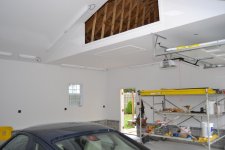
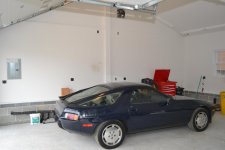
My garage is 24 x 26 with slab floor. Walls are 2x4 framing with fiberglass insulation. Storage trusses hold up one half of the roof and scissor trusses were used to make room for a lift over the over half. The ceilings are not insulated and the gable end on the lift side is just sheet rocked, leaving nothing but a 1.5 inch air space. Slope of the ceiling on the bottom of the scissor trusses is 4/12. Apex of the ceiling on the high side is 14' high.
Ceiling under the storage trusses is 10' high

I am located in the Baltimore area. I have been getting by in the winters by using a torpedo heater to quickly warm the interior and then using a 240 volt heater hung off one side of my lift. It's time to add AC and my plan is to use a mini-split - either 18K or 24K btu because the heat in the summer is just too punishing.

My plan is to blow in cellulose over the ceilings. I am limited to 6" depth where the storage trusses are. I could go deeper over the other half but wonder if that is worth it. My only idea for the sheet rocked high bay gable end is to put up foam panels over the sheet rock and those would have to have a fire resistant face to meet local code.

I also can't put the idea of a radiant barrier under the roof out of my head, although I am supposedly too far north for it to be worthwhile.

I appreciate any suggestions or comments from the group particularly on the sizing of the mini-split, depth of insulation over the high bay and radiant barrier.

Thanks
 
Last edited:
To avoid these ads, REGISTER NOW!

Toyomech

Well-known member
Joined
May 31, 2010
Messages
67
Location
Delaware
Pics would be helpful to see exact setup. I haven’t been impressed by those radiant barriers. I am in attics all the time in our area and they feel just as hot with or without. Foam board can be painted with intumescent coating. If you are going with cellulose I would definitely use more than 6 inches where possible. Although even 6 inches is going to be a 20 times better than no insulation at all.
 
OP
E

Eplebnista

Active member
Joined
Sep 25, 2010
Messages
40
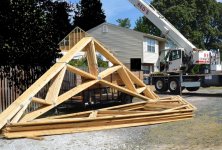
Here are some construction pictures and shots taken before my lift went in:
 

Attachments

  • DSC_0130.jpg
    DSC_0130.jpg
    74.9 KB · Views: 54
  • DSC_0132.jpg
    DSC_0132.jpg
    108.7 KB · Views: 57
  • DSC_0133.jpg
    DSC_0133.jpg
    94.9 KB · Views: 50
  • Picture 002.jpg
    Picture 002.jpg
    167.1 KB · Views: 51
  • Picture 008.jpg
    Picture 008.jpg
    159.6 KB · Views: 44

Toyomech

Well-known member
Joined
May 31, 2010
Messages
67
Location
Delaware
Im in the insulation biz and i think thats gonna be a tough one to do. Nothing is impossible but after everything is sheetrocked it is going to be difficult to insulate the scissor truss section, especially to get someone up there during the heat of summer. Regardless of insulation type you dont want to block the soffits unless you are insulating the roofline and creating a conditioned space. Sending a man to install baffles to prevent that is going to be quite the challenge from the way it looks...

Have you been up there yourself? Any room to slide a batt down? I say batt because shooting cellulose evenly is gonna be difficult if not impossible as is.
 
Last edited:
To avoid these ads, REGISTER NOW!
OP
E

Eplebnista

Active member
Joined
Sep 25, 2010
Messages
40
I have been up there to install a flood light on the front corner and it is tight. There is just enough room to put baffles in if I use an air or electric stapler. The good news is that there are upright at the ends of the scissor trusses where they sit on the plates.

I can get batts in there. It won't be fun, but I can do it. It's the price I have to pay for not insulating when it would have been relatively painless.

The bottom chords of the scissor trusses are 2 x 4's. I imagine the best approach is to put faced batts face down between the chords and then lay down unfaced perpendicular to the chords. I am going to be limited to 5.5 deep on the storage truss side. This would be around R-19. If I layer unfaced R-19 over R-15 on the scissor truss side, I guess this would be R-34. With both ceilings are over the same open space, is there a point in going with unfaced R-30 over the high ceiling?

The trusses are 16" on center. I was planning to use cardboard baffles or a product called Accuvent. Do you have a recommendation for baffles?

Thanks so much for your help.
 
Last edited:

mille755

Active member
Joined
Jun 14, 2018
Messages
39
Location
Northwest Indiana
You want the facing on the habitable side. You should used all unfaced at this point. It is a vapor barrier issue, but if you have to I wouldn't eoryy about it.
 

Toyomech

Well-known member
Joined
May 31, 2010
Messages
67
Location
Delaware
The facing is supposed to be a vapor barrier which should be on the warm side. In our area that will be reversed for half the year. With them generally not being stapled thoroughly I personally dont think it matters for this application. In a closed wall reducing vapor that could build up is one thing but with a large ventilated attic space above I don’t see you having an issue.

I would use as much insulation as will fit since its still below what is normally used R value wise (R49) for attics in zone 4. If half the attic gets a little more I think it should still help.

I don’t have a baffle brand preference but the cardboard or thicker material is far easier to work with. It is extremely rare that a building 16 on center actually measures that. So you get 15 3/4 , 16 1/4 etc. The cheapo thin foam baffles break easily if you bend them even a little.

Huge fan of the milwaukee battery powered stapler for stapling tight areas and not being able to swing a hammer stapler. No affiliation with milwaukee.

Also if you can manually put a batt in and secure it so it doesn’t block the soffit, you really don’t need the baffle at all. Could make your life alot easier that way.
 
Last edited:
To avoid these ads, REGISTER NOW!
Top Bottom