To avoid these ads, REGISTER NOW!

Your Assessment on Capacitor Replacement for Generator

apittmanii

Well-known member
Joined
Dec 28, 2015
Messages
110
Looking for advice on replacing capacitor on 8,000 / 10,000 watt generator. I recently acquired 8000 watt (10,000 surge watt) gasoline generator with brushless alternator. The model for the alternator is depicted in photo #1 (Model: GBVE8000-WK).

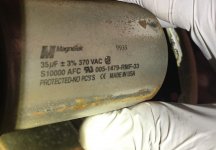
My problem with generator is low voltage. It consistently outputs 104 Volts instead of 120 (both hots on 240 volt are also 104 volts each). The original capacitor has the following markings (also depicted in photo #2): 35UF +/- 3% 370 Volts, S10,000 AFC. The alternator does not have an automatic voltage regulator.

My questions are:

1. Do you feel the problem could be the capacitor?
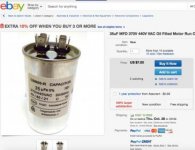
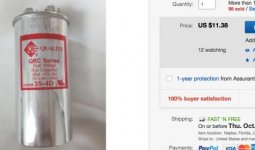
2. The cheapest OEM replacement capacitor is $40 from Zoro. There are examples such as those depicted in Photo #3 and #4 for under $10, but these are +/- 5%. Can this be used on an electric generator or should I spring for the full price OEM?

Thank you!
 

Attachments

  • Alternator_Model.jpg
    Alternator_Model.jpg
    148.6 KB · Views: 38
  • Old_Capacitor.jpg
    Old_Capacitor.jpg
    132.4 KB · Views: 38
  • Cheap_Capacitor_Example.jpg
    Cheap_Capacitor_Example.jpg
    17.1 KB · Views: 36
  • Cheap_Capacitor_Example_2.jpg
    Cheap_Capacitor_Example_2.jpg
    15.5 KB · Views: 28
To avoid these ads, REGISTER NOW!

Stuart in MN

Well-known member
Joined
Sep 8, 2005
Messages
23,114
Location
Minneapolis
What lead you to think it's the capacitor? Maybe it is, maybe it isn't. but you should let us know how you got to that conclusion.
 
OP
A

apittmanii

Well-known member
Joined
Dec 28, 2015
Messages
110
What lead you to think it's the capacitor? Maybe it is, maybe it isn't. but you should let us know how you got to that conclusion.

That's actually what I am wondering by question #1. I'm leaning towards that diagnosis because of google searching for similar problems. For additional context, the generator has been sitting for 15 years and upon removal of the capacitor, it was very rusty on the lower half. Would not surprise me if it leaked. Any thoughts on other possibilities for low voltage?
 
OP
A

apittmanii

Well-known member
Joined
Dec 28, 2015
Messages
110
For $7 or $12 it's worth a try. A quick google search indicates it can be a cause of low voltage.

That's the way I'm leaning. Also wondering if a capacitor rating of +/- 5% is typically used on generators. The original capacitor was +/- 3%, which increases the price four-fold.
 

engineer2

Well-known member
Joined
Dec 13, 2009
Messages
11,801
Location
Chicago burbs
Start with the ±5%. It'll be OK. That's only a 1.75uf variation. You're not out a lot of money and if that isn't it, you'll have an emergency spare.
 

blair683

Well-known member
Joined
Feb 21, 2017
Messages
460
Location
Ohio
You can test a capacitor with a multimeter that has a capacitor setting or with an actual capacitor tester.
 

laser3kw

Well-known member
Joined
Nov 17, 2012
Messages
7,276
Location
northen IL
For additional context, the generator has been sitting for 15 years and upon removal of the capacitor, it was very rusty on the lower half. Would not surprise me if it leaked. Any thoughts on other possibilities for low voltage?
good assessment, electrolytic caps dry out with time. I would swap them out just as a course of maintenance like replacing the spark plug periodically.
As far as the value of the cap, I would strive for the one the falls as close to the OEM value 35uf. The +/-5 value should be good enough for the voltage stability.
 
To avoid these ads, REGISTER NOW!
OP
A

apittmanii

Well-known member
Joined
Dec 28, 2015
Messages
110
I just replaced a couple on one, same problem. The oem were cheap, got some from the supply house.

Good deal, I went ahead and got 3 if them +\- 5% (Made in China) for $6 each. I’ll report back if this corrects the voltage.
 
OP
A

apittmanii

Well-known member
Joined
Dec 28, 2015
Messages
110
In case this helps someone in the future, the new capacitors fit and were functional, but they did not have any impact on the voltage. It remained low at 104 volts.

The issue was that the generator required adjustment to the Governor. I assumed it functioned properly because the Tachometer showed between 3590 to 3610 RPM on both spark plugs. Three turns on the governor bolt and my voltage got right but up to 120 volts. Runs like a champ now, and have a couple spare capacitors.

So even if RPM is at 3600, try adjustment to the governor if you are getting low voltage. Also, as noted by others in this thread, the generator runs fine using capacitors that are +/- 5%. You probably do not need to spring for the more expensive +/- 3% capacitors assuming you purchase ones with identical UF. Even at 25 Amps on 240 volts, the voltage rebounded quickly and remained consistent.
 
Last edited:

laser3kw

Well-known member
Joined
Nov 17, 2012
Messages
7,276
Location
northen IL
Good deal. I thpught about rpm but you sounded like you already looked at that. Glad it was a relative simple fix.
For my own knowledge, how did you test it under load? Did you plug in an electric heater or a bunch of incandescent light blubs ( resistive loads)?
 

sberry

Banned
Joined
Jun 18, 2005
Messages
35,747
Location
Brethren, Michigan
Yes, the low voltage on mine was really low, about 1/2 of what it should have been. It is a Briggs unit and as I mention the oem caps were really super chincy, the replacement seemed better built although that is certainly subjective.
I agree, at 104 would have been looking at the speed. I was hooking mine to the well, its 8 or 10K and it doesnt even blink with the 3 hp load, really have to listen to hear it come on.
It isn't like you replaced new caps with new ones, might not be a bad thing anyway.
I was surprised. it seems to start it better than the welding machines although they don't have as good of mufflers.
 
Last edited:
OP
A

apittmanii

Well-known member
Joined
Dec 28, 2015
Messages
110
I was pretty sure I had the RPM figured out myself. I agree no harm in replacing the capacitors. To measure the AMP draw, I plugged in a 240 volt / 25 amp Air compressor and it ran great. Attached is a photo of the generator referred to in this post.
 

Attachments

  • 285902D1-A25B-41AC-9081-0F28E5341A95.jpg
    285902D1-A25B-41AC-9081-0F28E5341A95.jpg
    24 KB · Views: 25

yyc_ranger_4x4

Well-known member
Joined
Jan 23, 2011
Messages
90
Location
Calgary, Ab
Be very careful changing the speed of the motor, while this will increase the voltage (as the windings are cutting the magnetic field at a faster rate), it will increase the frequency at which the power is being produced. This will cause all kids of problems for motors and inductive loads.

The proper way to adjust the voltage would be to increase the excitation voltage of the field through the voltage regulator. If its falling out of spec, you could have faulty/dirty connections or a problem in the regulator itself. I had a generator that was getting heat soaked and the regulator was pulling voltage to self protect.
 
OP
A

apittmanii

Well-known member
Joined
Dec 28, 2015
Messages
110
Be very careful changing the speed of the motor, while this will increase the voltage (as the windings are cutting the magnetic field at a faster rate), it will increase the frequency at which the power is being produced. This will cause all kids of problems for motors and inductive loads.

The proper way to adjust the voltage would be to increase the excitation voltage of the field through the voltage regulator. If its falling out of spec, you could have faulty/dirty connections or a problem in the regulator itself. I had a generator that was getting heat soaked and the regulator was pulling voltage to self protect.

Is it possible that some alternators do not have a voltage regulator? This alternator was 18 years old (not sure if that matters), and I did not see any adjustable voltage regulator such as an Automatic Voltage Regulator. Are these types of alternators “hard wired” for a specific voltage at 3600 RPM?
 
OP
A

apittmanii

Well-known member
Joined
Dec 28, 2015
Messages
110
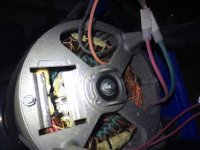
Here is an image of what I saw when I opened up the alternator.
 

Attachments

  • 840F0B63-5CCE-4DFD-8EAA-35DF851A90F2.jpg
    840F0B63-5CCE-4DFD-8EAA-35DF851A90F2.jpg
    16.9 KB · Views: 30
  • E4BA573F-2285-4B2E-9C84-489130B65CB1.jpg
    E4BA573F-2285-4B2E-9C84-489130B65CB1.jpg
    17.7 KB · Views: 29

C-Mac

Member
Joined
Dec 12, 2013
Messages
22
As others have said, increasing speed isn't a good idea as that directly affects frequency. Try a 40uF cap to boost voltage as the one that you replaced may have been undersized to begin with. As long as you test voltage before you plug something in you can't damage anything.
 
To avoid these ads, REGISTER NOW!
Top Bottom